




A student holds a phone in front of a campus poster and a 3D model of the laboratory rises from the paper. A shopper points the same camera at a living room wall and sees the sofa in place before paying for it. Both scenes run on one idea: digital content anchored to physical space.
Marketing teams call the first case augmented reality, and the second case explains why the label matters to revenue. One format keeps the real room and adds to it. The other removes the room and builds a new one, with a headset, a budget and a very different audience size.
Confusing the two costs money. A team that promises full immersion and delivers an overlay disappoints, and a team that buys headsets to solve a checkout problem spends on the wrong layer. The distinction matters in practice, and it ends in numbers rather than in adjectives.
What is augmented reality and how does the overlay work?
Augmented reality adds digital objects to a live view of the real world. A phone camera reads the scene, software finds surfaces and light, and a 3D model locks onto a surface so it stays in place when the person walks around it. Physical space remains the stage.
Two approaches dominate. Marker-based overlays trigger content when the camera recognizes a printed image, a package or a poster. Surface-based overlays map a floor or a table and place the object without any marker, which suits furniture, equipment and vehicles.
Google publishes augmented reality design guidelines that treat lighting, scale and user movement as core decisions instead of finishing touches. Scale matters most in practice: an object that floats or appears at the wrong size destroys trust in a second, and no copy recovers that.
Pokémon Go made the overlay familiar to a mass audience back in 2016, and that familiarity is the practical gain today. People already understand pointing a camera at the floor, so instructions can be short and the experience can begin in seconds.
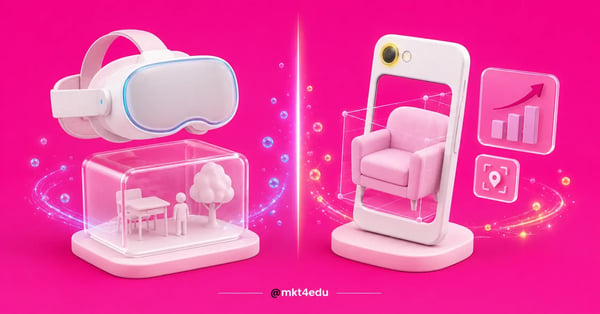 Caption: Side-by-side visual comparison between VR headset immersion and augmented reality product overlays on mobile screens.
What is virtual reality and where does it fit?
Virtual reality replaces the real scene with a generated one. A user wears a headset, the display fills the field of view, and head movement changes the image, which creates the sense of being elsewhere. Britannica describes a computer-generated environment with real-time feedback as the defining trait.
Virtual reality fits situations where the real thing is expensive, distant or risky. A nursing simulation, a factory line, a campus hundreds of kilometers away: each becomes a repeatable rehearsal, and rehearsal is exactly what a flat video cannot deliver.
Hardware volume stays small next to phones. IDC projects extended reality headsets rising from 6.7 million units in 2024 to 22.9 million in 2028, so XR headsets remain an event, laboratory and showroom format rather than a mass channel.
Persistent shared worlds, usually discussed under the label metaverse, sit on the same rendering stack. Shared worlds add hosting, moderation and identity work, which is why most institutions begin with one guided scene and a single objective.
Which differences separate the two technologies?
The real difference is what happens to the room around the user. Augmented reality keeps that room and adds a layer on top. Virtual reality removes the room and builds another one. That single choice drives hardware, production cost, distribution and the consumer experience each format can honestly promise.
Four decision points settle most of these projects: the device already in the user's hand, where the experience happens, what drives production cost, and how far distribution can reach.
| Decision point | Augmented reality | Virtual reality | Effort to a first public test |
|---|---|---|---|
| Device | Phone the audience already owns | Headset plus a supervised space | Days versus weeks |
| Where it happens | Anywhere the camera points | Event, laboratory or store | 1 link versus 1 venue |
| Cost driver | One clean 3D asset per product | A whole modeled environment | 1 asset versus 1 scene |
| Reach | Thousands through a shared link | Dozens per day, per device | Volume versus depth |
| Best fit | Trial before purchase or sign-up | Rehearsal of a place or procedure | Campaign versus program |
Table: Editorial reference for planning conversations, not a vendor quotation.
Reach explains the trade-off. The overlay wins volume because distribution is a link, and full immersion wins depth because attention is captive. Teams that need enrollment volume start with the overlay and keep the headset for events and laboratories.
Where does augmented reality in marketing drive sales?
Augmented reality in marketing drives sales when it removes one specific doubt before checkout. Trying a sofa in the living room, a frame on a face or a uniform on a body answers the question that stalls a purchase, and answering it inside the same session shortens the path to payment.
A study commissioned by Snap with Deloitte Digital reports product interactions in augmented reality associated with a 94% higher conversion rate than interactions without it. The sponsor is a platform vendor, so the figure indicates direction and should not become an internal promise.
AR in e-commerce is where the format matured first. Fashion and furniture retailers use a virtual showroom to place items in the customer's own space, and that same asset library later supports brand presence in social feeds, in-store screens and sales conversations.
Distribution decides the ceiling. DataReportal counted 150 million social media user identities in Brazil, 70.4% of the population, with October 2025 as the reference date, and identities are accounts rather than unique people.
Immersive marketing rides on that surface, which is why an overlay usually arrives through mobile marketing placements instead of a standalone download. The link sits where attention already is.
Personalization raises the bar for all of it. McKinsey found that 71% of consumers expect personalized interactions and that the fastest-growing companies take 40% more revenue from personalization, so serious work on virtual and augmented reality in marketing starts with segmentation.
How is virtual reality in education already useful?
Virtual reality in education is already useful in three places: laboratory practice that would be expensive to repeat, clinical rehearsal that cannot risk a patient, and campus visits for candidates who live far from the building. Each case replaces a cost that academic and admissions teams already carry today.
Scale explains the interest. The 2024 Higher Education Census from Inep recorded 10,226,873 enrollments in Brazil, with distance learning at 50.7% of the total and 66.8% of entering students, so most candidates now decide without ever walking through a campus gate.
Retention is the second reason. The 16th Higher Education Map from Semesp reports dropout at 26.6% in private on-campus courses and 41.9% in private distance courses, and a first week that feels concrete tends to help a new student stay.
Healthcare programs show the same mechanism outside marketing. Physiotherapy uses virtual reality to make repetitive exercise tolerable, and safety drills use it to rehearse an accident nobody wants to stage. Progress in artificial intelligence in education now speeds up the content behind those scenes.
What role does UX design play in immersion?
UX design decides whether an immersive experience gets used at all. Permission requests, loading time, a clear first instruction and an obvious way out determine whether a person ever reaches the moment that matters in the scene.
A beautiful 3D model sitting behind three confusing taps produces nothing. Most abandonment happens before the object appears, which means the fix belongs in the flow rather than in the model.
Search behavior rewards the same discipline. Attention to user experience affects how a page performs and how long people stay, so the page hosting an overlay still needs fast loading, readable text and a working layout on small screens.
Prototype before modeling anything. Testing the flow as a page layout in Figma costs hours instead of weeks, and UX writing carries most of the weight in that test, because the sentence asking someone to point the camera at the floor is the real interface.
How do you bring immersion into mobile apps?
Immersion reaches mobile apps in two ways: a web-based experience that opens from a link in the browser, or a feature inside an app the audience already installed. The web route wins reach because nothing is downloaded, and the native route wins performance and access to sensors.
Install friction kills most standalone projects. Asking someone to download an app to see one sofa fails almost every time, so the overlay usually belongs inside an existing app or on a campaign page.
Mobile marketing decides where that link lives. A social ad, a code printed on a package and a message in a chat thread each tolerate a different asset weight, and a heavy scene loses users on weak connections.
Camera permission is a legal question, not only a technical one. The LGPD requires a clear purpose and a lawful basis for data an experience collects, and the reason should be explained in plain words before the browser prompt appears.
How do you measure enrollment and revenue from immersion?
Measurement starts by naming the step that counts. An immersive experience should end in a tracked action: a form, a scheduled visit, a cart, a phone call. Views and dwell time describe attention, while only that tracked action connects the project to an enrollment number or to revenue.
A simple frame helps the conversation. The AARRR pirate metrics model splits acquisition, activation, retention, referral and revenue, and placing the immersive step inside that pirate funnel shows which stage actually moved.
Few teams complete the loop. EDUCAUSE found that 94% of higher education staff used artificial intelligence at work while only 13% measure return on investment, and immersive projects tend to repeat that same gap.
Attribution now includes assistants. SemRush reports visitors arriving from artificial intelligence tools converting 4.4 times more than visitors from other sources, which raises the value of the page that hosts the experience.
Organic search still carries the base. A 2019 study that became a reference put 53% of trackable traffic in organic search, so the text around a 3D scene deserves as much review as the scene itself.
When is immersion the wrong investment?
Immersion is the wrong investment when the problem sits somewhere else. A course with unclear pricing, a checkout that breaks on mobile or a form nobody answers will not be rescued by a 3D model. Repair the leak first, then consider adding a layer on top.
Platform risk is real and recent. Meta shut down its Spark tool for third-party creators in 2024, with the service switched off in January 2025, which stranded filters built only for that ecosystem.
Audience conditions matter more than ambition. Where connections are slow and phones are old, a heavy scene becomes a blank screen, and buying XR headsets for a campus without trained staff to run them produces expensive equipment in a locked closet.
Production capacity is the final filter. HubSpot reports 80% of marketers using artificial intelligence in content creation and 75% in media production, so a 3D pipeline competes for hours with work that already ships every week.
Frequently asked questions about augmented reality
Does augmented reality belong in your plan?
Augmented reality belongs in your plan when a real doubt blocks a decision and a layer on the phone can remove that doubt. Start with one product, one course or one space, publish it inside a channel the audience already uses, and attach a tracked step at the end.
Keep the first test small and honest. One overlay, one measured action and one month of data teach more than a showroom with no next step, and the same asset library serves the following campaign.
Immersion wowed them. Did a lead come in? See how a virtual reality experience turns into real prospecting.


.jpg)























 Portugal