




Word count is the oldest shortcut in content marketing. It survives because it is easy to brief, easy to check and easy to defend in a meeting, while search intent is none of those things.
Search engines never published the number anyway. Google documents crawling, indexing and its guidance on helpful content, and it says nothing at all about a required length, so ranking on Google depends on how completely a page resolves the search behind the query.
AI search then raised the stakes. Answers now get assembled from several sources at once, which rewards clear structure and honest topic coverage and exposes the padding that used to inflate a page.
How does Google search actually work today?
Google search runs in three stages: crawling to discover pages, indexing to store and understand them, and serving to choose results for a specific query. Length enters none of those stages as a rule. What enters is whether a page is reachable, indexable and unmistakably about the thing being searched.
Ranking systems then compare candidate pages on relevance, quality and usability. Google's guidance on creating helpful, reliable, people-first content frames the whole set as a coverage test, never as a volume test.
One more step now sits on top of those three. Google describes a query fan-out, in which a single search is expanded into related subqueries and the response is assembled from pages that handle those angles well.
That fan-out explains why cluster coverage beats page length. A topic answered across five focused pages gives a search engine five chances to match a subquery, while the same material stretched into one long page gives it one.
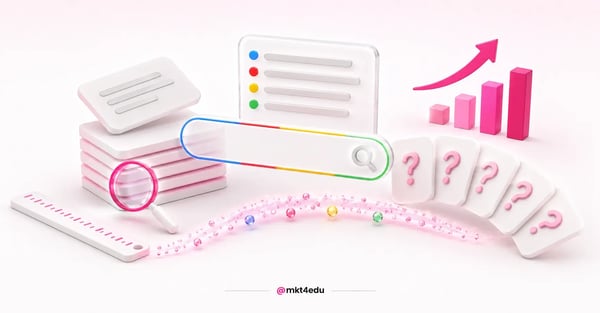 Caption: Visual illustration of key elements behind ranking on Google, from search intent to performance tracking.
What content length for blogs really performs?
Content length for blogs performs when it matches the depth of the question. A SemRush analysis of top-performing articles associates longer pieces with more traffic and more links, and that finding is correlation, not causation. No search engine publishes a required word count for any query.
The confound is easy to name. Longer articles usually cover more subtopics, include more examples and attract more citations, so depth of coverage travels with length in the data without length causing the result.
Blog content that wins on length alone is rare for a second reason. Volume became cheap: HubSpot's State of Marketing 2026 reports that 80% of marketers use AI in content creation, so a high word count no longer signals effort or expertise.
What still separates pages is resolution. A post that answers the question, shows the exception, gives the number and stops earns more repeat visits than a post that reaches 3,000 words by restating its own introduction.
Why does search intent decide before word count?
Search intent decides first because intent defines what a complete answer contains. A price comparison needs figures and options, a definition needs one precise paragraph, and a process needs ordered steps. Once those required elements are listed, page length becomes a result rather than a decision.
Three intents cover most queries. Informational searches want understanding, commercial searches want comparison, and transactional searches want a next step, and each one tolerates a very different amount of context before the reader gives up.
Every sector maps intent to the sales funnel. Someone comparing CRM pricing sits closer to a purchase than a reader looking up the definition of a pipeline, so marketing strategies work better when each page serves one of those moments completely.
Mismatched depth is the common failure. A long essay in front of someone ready to apply loses the application, and a two-line answer in front of someone weighing two programs loses the comparison.
Educational marketing strategies show the split cleanly. "Tuition for an online MBA" wants a figure on screen, while "is an online MBA worth it" wants criteria, comparison and proof. Same topic, opposite depth.
How do you rank on Google without padding text?
Ranking without padding means editing for coverage instead of volume. Answer the title question in the first two sentences, give every subhead a distinct job, delete sentences that restate the previous one, and add the angle that is missing rather than another paragraph about the angle already covered.
Teams asking how to rank on Google often add words when the page needs answers. A missing figure, a missing exception and a missing comparison each cost more visibility than five hundred absent words.
Structure carries much of the load. Short paragraphs, descriptive subheads, one idea per block and a self-contained answer under each question make a page easy to scan for a reader and easy to lift for a machine.
Pruning counts as optimization too. Removing three redundant sections can improve how clearly a page reads as being about one topic, which is exactly what the ranking stage is trying to determine.
What earns a spot in Google AI Overviews?
Nothing special earns a spot in Google AI Overviews. Google's documentation on AI features in Search states that "There are no additional requirements to appear in AI Overviews or AI Mode, nor other special optimizations necessary". The page needs to be indexed and eligible for snippets.
Clarity becomes the only lever that matters. Google also documents that there is no way to apply for a featured snippet, so the practical work is writing passages that stand alone and state the answer before the reasoning.
Coverage does the rest of the work. Because one search fans out into subqueries, a cluster that answers the neighboring questions gives the system more reasons to select your pages when it assembles a response.
How does SEO for AI use People Also Ask?
SEO for AI uses People Also Ask as a map of the subquestions a topic contains. Every related question in that panel is an angle real users pursue, and covering those angles with short, self-contained answers is what makes a page usable inside an AI generated answer.
Structured data no longer supports that pattern. Google's update log records that the FAQ rich result stopped appearing in Search on May 7, 2026, and that its documentation was removed on June 15, 2026, so question formatting is now an editorial choice.
Editorial still beats markup here. A question as a subhead, followed by one paragraph that answers it without pointing anywhere else, serves the reader scanning the page and the system quoting it.
How do SEO for blog and SEO for site work together?
SEO for blog and SEO for site solve two halves of one problem. Post-level work covers questions and earns entry points, while site-level work keeps those entries fast, crawlable and connected to the pages where a visit turns into a contact.
Internal linking is where the halves meet. Links between related posts and toward the relevant program or product page tell a search engine which pages belong to the same topic and which one deserves to rank for the commercial query.
Teams that start a blog around a cluster instead of a calendar tend to build that structure by default. Each new post fills a named gap, links to its neighbors and inherits the authority the cluster already earned.
Technical basics stay non-negotiable. Slow templates, orphaned posts and duplicate URLs waste good writing, because a page that is hard to crawl or slow to load rarely gets the chance to prove its coverage.
What do On Page and Off Page SEO change in ranking?
On Page and Off Page SEO change ranking through different, complementary routes. On Page makes the page readable and relevant to the query. Off Page proves the page deserves trust. One front without the other stalls the result, because strong content without authority does not climb, and authority without clear content does not hold the visit.
On Page SEO covers what lives inside the page itself. A Title and H1 that carry the keyword, organized headings, the meta description, scannability and load speed all belong here. It is the layer an institution controls in full and can adjust at any time.
Off Page SEO covers the signals that come from outside, and the main one is backlinks from other domains. Each relevant page that points to yours lends authority to your content. One citation from a respected site is worth more than dozens of low quality links.
E-E-A-T is what ties the two fronts together. The acronym, for experience, expertise, authoritativeness and trust, comes from Google's quality rater guidelines and is not a direct ranking factor: the documentation states that "E-E-A-T itself isn't a specific ranking factor", while adding that "trust is most important". A named author, first-hand experience and cited sources are what carry that signal.
The two fronts hold each other up. Without clean On Page, the engine cannot tell what the page is about. Without Off Page, the page rarely outranks established competitors, even with better writing. Fix On Page first, since it depends only on you, and build Off Page over time.
How do you measure organic traffic and SEO performance?
Measure coverage and outcomes, not length. Track organic traffic, impressions by query, share of the cluster questions covered and conversion by landing page: those four numbers show whether depth is working, while word count says nothing at all about SEO performance.
Baselines help more than benchmarks, because an absolute traffic target means little without a comparison. Search still carries a large share of trackable visits, AI summaries have already changed how often people click, and very few teams close the loop on return.
| Signal | What it answers | Reference point |
|---|---|---|
| Organic share of visits | Whether search still deserves the budget | 53% of trackable traffic (BrightEdge, 2019) |
| Clicks with an AI summary present | How much a summary compresses clicking | 8% of visits against 15% without (Pew Research, 900 US adults, March 2025) |
| Conversion from AI referrals | Whether AI visits deserve separate tracking | 4.4x higher conversion (SemRush) |
| Teams that measure return | Whether the numbers reach a decision | 13% measure ROI of AI use (EDUCAUSE, 2026) |
Table: Reference points come from different samples and years, so treat them as orientation rather than targets.
Two conclusions follow. Search remains the largest measurable channel for most sites, and the value of AI visibility currently shows up in conversion quality rather than in visit volume.
Reporting should follow that logic. A monthly view of questions covered, positions held and contacts generated per cluster survives an algorithm update far better than a chart of published words.
Where does paid traffic fit in this strategy?
Budget for paid traffic fits where organic coverage exists but authority does not yet. Ads buy immediate visibility for a term the blog already answers well, which converts a slow ranking climb into measurable demand while the cluster matures behind it.
Inbound marketing and paid media stop competing once each has a defined job. Organic earns the questions asked far from a decision, paid takes the queries with commercial urgency, and both send visitors to pages built for the same intent.
AI lead qualification then protects the budget. Scoring and routing contacts by declared intent keeps the sales team on the people ready to talk, whatever channel brought them in, which is what makes either investment defensible.
Sequencing matters more than splitting. Publishing the cluster first and advertising the pages that already convert costs less than paying to send traffic to a page that has not proven it can answer the question.
Frequently asked questions about ranking on Google
So what actually makes content rank on Google?
Complete answers rank, not long ones. A page earns position when it resolves the search behind the query, connects to the neighbors that resolve the adjacent searches, and gives an AI system a passage specific enough to quote when it assembles an answer.
Word count keeps one honest use, as a symptom. A 300-word page on a complex comparison is probably thin, and a 3,000-word page on a simple definition is probably padded, yet neither number was ever the goal.
The discipline is smaller than it sounds. Name the question, list what a complete answer requires, write exactly that, then measure whether the coverage produced contacts instead of counting the words it took.
Your post ranks. Did it pay for itself? Word count is not ROI. Good SEO strategies prove themselves in traffic, leads and revenue, so see what SEO returns.



.jpg)
























 Portugal