One of the most common questions for beginners is easy to ask and hard to answer: how to make a podcast script the listener actually finishes? The script is what separates an episode that flows from a conversation that loses itself halfway through.
Consumption is no longer niche. An Acast survey run in April 2026 with 400 people through the Attest platform points to 51.8 million podcast listeners in Brazil and 44% of adults listening weekly. The coverage of the study does not explain where those two figures come from, so read them as orders of magnitude. Ibope's Audio Pulse 2026 survey, released on 23 September 2026, measures that 44% of podcast listeners tune in at least once a week and that 75% research a product or service after hearing it mentioned in an episode.
That last figure is why podcasting entered inbound marketing strategies and digital marketing strategies instead of staying a weekend hobby. Below is the full path: the concept, the formats, what changed with video, the planning and the step by step of how to write a podcast script block by block.
What is a podcast and what is a podcast for?
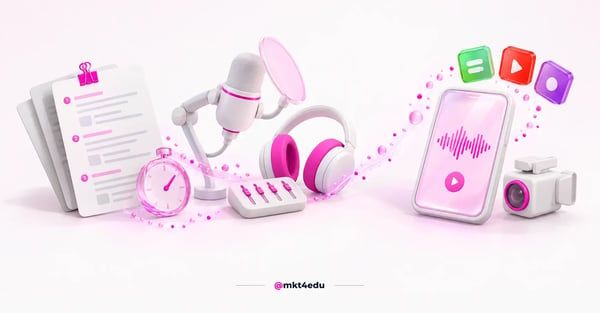 Caption: how to make a podcast script starts by splitting the episode into timed blocks, from the intro music to publication
If you listen to radio shows, you already have the starting point for understanding what a podcast is. The similarity is the spoken format; the difference is who controls it. The file is recorded and distributed over the internet, so the listener chooses when and where to listen, pauses, rewinds and speeds up.
The format has existed since 2004, but it only reached scale with streaming platforms. Today it lives alongside video, clips and transcripts, which is why the question of what is a podcast has a broader answer than it did five years ago: it is a serialized audio show that almost always also exists as image and as text.
And what is a podcast for inside a company or an educational institution? For three things a blog or a social feed does worse: building authority with depth, occupying attention nobody else occupies (commuting, the gym, household chores) and generating raw material for social media marketing, since a 40 minute episode yields dozens of clips.
In a well built marketing strategy, the podcast rarely works alone. It feeds the blog, the newsletter and audio marketing, and it becomes social proof inside inbound marketing strategies whenever the guest is a client or a recognized expert.
What are the types of podcast?
Before writing a single line, decide the format: it determines whether your script will be a list of questions, a continuous text or a map of topics. These are the types of podcast most used in the market:
- Informative: journalistic in nature, delivering reported news. The script is closed, almost read aloud, and the running time is short.
- Interview: the host receives one guest per episode. The script is a sequence of questions with room to stray, and preparation matters more than the text.
- Roundtable or chat: three or more voices discuss a theme. The script becomes a map of topics and of who leads each one, so nobody talks over anybody.
- Monologue: only the host speaks, to tell a story, answer questions or teach something. This is the format that most demands a written script, because there is no guest to rescue the pace.
Which types of podcast work best for an educational institution? In practice, interview and roundtable, because they turn professors, coordinators and alumni into living proof of the quality of the course, and because they supply material for viral content in clip format.
Why podcasts became video and what that changes in the script
This is the point that has changed most since most podcasting guides were written. The Acast survey in Brazil measured that 76% of listeners watch or interact with podcasts as video, that 28% stay only or mostly on video and that 54% balance both formats.
Discovery moved as well: 89% of respondents said they had already found a podcast on a social network and then watched a full episode, and 66% name TikTok and Instagram as the discovery channel. In other words, the vertical clip is not a byproduct of the episode. Most of the time, it is the front door.
That has three direct consequences for how to write a podcast script today:
- A hook in the first 30 seconds: the long intro music that opened shows in 2019 now loses the listener who arrived through a clip. Start with the question, then play the intro.
- Marked clippable moments: flag two or three 40 to 60 second stretches in the script that stand on their own out of context. Those become the clips.
- Framing notes: write down when the guest shows something, when a chart appears on screen and when the camera tightens. Without that, video editing becomes guesswork.
If your production is still audio only, start with our guide to audiovisual production for digital content, which covers equipment, lighting and capture without turning the project into a TV studio.
How to create a podcast from scratch: planning before the script
Good production starts long before recording. How to create a podcast from scratch without rework? By answering six questions on paper that hold for the whole season: the name of the show, the theme, the format, the average length, how many episodes and at what frequency.
With that settled, every episode gets a six field briefing: goal, primary audience, promise in one sentence, mandatory topics, estimated time per block and expected final action. That briefing is what makes the script fast to write, because it answers the decisions before you start.
The expected final action deserves attention: it connects the podcast to the rest of the operation. An episode can end by asking for a newsletter signup, a download or a booked conversation, and that is where the show touches inbound sales strategies instead of staying in the brand layer.
Anyone recording video should decide at this stage whether the show is born on YouTube or whether YouTube is a secondary destination. How to create a podcast on YouTube changes the planning: title, thumbnail and chapters become part of the script, not of post production. Our guide on how to create a YouTube channel covers the initial setup.
How to make a podcast script: the step by step of every block
With the planning in hand, it is time to write. This is the part that answers, in practice, how to write a podcast script. A complete one has six blocks, each with its own job. Note the expected time beside every heading: that is what stops the episode from stretching unnoticed.
1. Intro music
The intro opens the show and creates recognition. It has to be short, pleasant and easy to identify, without competing with the host's voice. Five to ten seconds is enough; beyond that you are spending the patience of someone who arrived through a clip.
2. Presentation
After the intro, the host introduces themselves and reveals the guests. Write it the way you speak: direct, but with your own personality. Put in the script who you are, who the participants are and what each one does. Years in the field and specialty are what give the episode authority.
3. Introduction
This is one of the most important parts, because it connects the presentation to the content and holds attention. Open with an overview of the theme, backed by a figure or a striking quote, and close with the question the episode will answer.
An example that works: “You have probably noticed, from the panel of experts here, that today we are talking about educational marketing. We are going to debate one of the biggest challenges in education, student dropout. The point is simple: why do so many students interrupt their course, and which practical actions help reduce that?”.
4. Content development
This is where the real interest of the audience sits and where most of the running time goes. If the episode is a monologue, split the agenda into topics in the order they will be covered. If it is an interview or roundtable, write the questions and the issues the group will discuss.
Because this is the longest part, include breathers: short breaks to refresh attention or change subject, marked with intro music, a song or an ad. This is also where the stretches flagged as clippable live.
5. Conclusion
Like any good piece of writing, the episode needs a beginning, a middle and an end. In the conclusion the host closes the subject by synthesizing what was discussed, not with a mechanical summary but by recovering the two or three ideas the listener should take away.
6. Closing
Use the ending to thank guests and audience, invite people to other content and ask for shares. A small spoiler of the next episode, or a request for topic suggestions in the comments, works well. After that, the closing intro music plays.
Platform to publish a podcast: Spotify, YouTube and Apple Podcasts
A good script without distribution is an episode nobody hears, and distribution here is also social media marketing, because the clip is what carries people to the full episode. The choice of platform to publish a podcast depends on where your audience already is, but the common practice is publishing a podcast on all platforms at once, with a single RSS feed powering the aggregators and a direct upload where the video format demands it.
|
Platform |
How the episode gets in |
What the script has to plan for |
|
Spotify |
RSS feed from the host or upload on Spotify for Creators |
Description with the topics and chapter markers |
|
YouTube |
Video upload or the show's RSS feed |
Searchable title, thumbnail and chapters by minute |
|
Apple Podcasts |
RSS feed validated in Apple Podcasts Connect |
Short summary and content rating |
Table: the same podcast script feeds all three platforms, but each one asks for a different piece of metadata
How to publish a podcast on Spotify, in practice: you host the file on a service that generates the RSS, register that address once and, from then on, every new episode shows up by itself. On 17 September 2026 Spotify announced the expansion of its Partner Program to more than 35 new markets, Brazil included, with the rollout planned for the following months. One caveat: the announcement does not detail eligibility criteria, so it is an announced expansion, not a door already open to everyone.
How to publish a podcast on YouTube differs in one point: there the episode is treated as video, so the algorithm reads title, description, thumbnail and retention. It is worth knowing the facts about the YouTube algorithm before deciding how to structure your titles, and worth deciding during planning whether the show is born there, because how to create a podcast on YouTube changes the script from the first line.
Inside mature digital marketing strategies, the published episode becomes a reusable asset: clips for social, a transcript for the blog and an excerpt for email. If you want that chain designed end to end, that is exactly what we do in content planning.
7 tips to make your podcast production easier
Producing a podcast is not simple, and until you reach a format that flows you will scratch your head a few times. These seven tips shorten the path:
- Know your audience: choose vocabulary and length from who listens, not from what you would like to say.
- Pick themes somebody searches for: an interesting theme is one that shows up in a student question, a client question or a search query.
- Use words that are easy to pronounce: what trips you up while reading trips you up on air.
- Write the way you speak: read the script out loud before recording and cut whatever sounds written.
- Stay flexible: not everything goes to plan, and a good script allows a detour without losing its way.
- Mark the time of each block: that is what stops the episode from doubling in length unnoticed.
- Record a pilot that never airs: it is cheaper to find out in a test that the format does not work than in episode three.
With that you have a complete answer to how to make a podcast script that works in practice, from planning to published episode.
Frequently asked questions about podcast scripts
Put your podcast script into practice
A well made podcast script solves three problems at once: it gives the episode rhythm, it cuts editing time and it guarantees the show ends where you want it to end. The rest is repetition, and repetition gets much simpler once the template exists. That is how the show stops being a loose piece and starts supporting the inbound sales strategies of the operation.
If you want help turning the episode into a content chain that feeds blog, email and social, talk to our team.














 Portugal