Developed with the aim of making companies' routines easier and improving customer service, chatbots are a technology that already offers a lot to digital marketing. For them to be built correctly, there is what we call a chatbot creation platform.
The question “which one is best” usually leads to the wrong answer, because the best-of list changes every year and your operation does not. What does not change are the selection criteria: channel, volume, integration and who operates it. That is where this article starts.
What is a chatbot creation platform?
A chatbot creation platform is the environment where you plan, build and deploy bots for channels such as websites, WhatsApp and social networks, without necessarily needing to know how to code. With it, companies organize support flows, capture leads, integrate journeys with CRM and run tests, surveys and complete processes, such as enrollment and document submission.
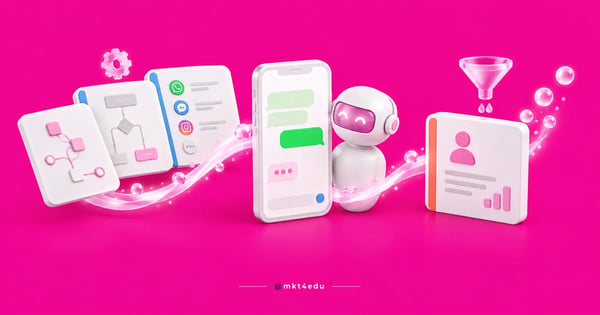 Caption: Choosing between chatbots platforms only matters for what comes out the other side: a resolved conversation and a qualified lead in the CRM
By choosing the right solution, the chatbot becomes a strategic ally to scale support, keep customer experiences consistent and follow the institution's growth.
- Automate support in digital channels and reduce repetitive tasks for the team
- Turn visitors into leads and route contacts to specific teams
- Integrate the bot with channels such as WhatsApp, social networks, apps and websites
- Run tests, exams, satisfaction surveys and receive documents in a structured way
- Use AI (Artificial Intelligence) and NLP to make the conversation more contextual
Chatbots were created to optimize processes and support tasks that previously required the effort of an entire team. As the technology advanced, bots became increasingly capable, with varied functions: customer service, turning visitors into leads, routing to specific teams, running tests and exams, and receiving documentation.
What are the types of chatbots?
The types of chatbots divide by how they decide what to answer, and that distinction is what weighs most on cost and result.
|
Type |
How it decides the answer |
When it makes sense |
|
Rule-based |
Follows a conversation flow you designed, with buttons and fixed options |
Predictable processes: duplicate documents, application status, opening hours |
|
With NLP |
Interprets intent from free text and maps it to an existing flow |
When the audience writes freely and questions vary a lot |
|
AI agents |
Decides the next step from context and executes actions in connected systems |
Lead qualification, scheduling and support that needs to query data |
Table: The three types of chatbots and the scenario where each one delivers more than the previous
Natural language processing NLP is what separates the first type from the second: without it, any answer outside the button becomes “I did not understand”. AI Agents go beyond comprehension and take on execution, which is the leap that changed the category over the past two years.
It is worth knowing that much of what the market calls the best value-for-money chatbot is, in practice, a well-designed rule-based bot. A simple flow solving 70% of cases usually pays off more than AI solving 90% at twice the implementation cost.
How do you choose the best chatbot creation platform?
Before deciding which tool to use, it is worth remembering that there is no single best solution for every case. The choice depends on support volume, priority channels, CRM integrations and the teams that will run it day to day.
- Priority channel: where support already happens today. A WhatsApp chatbot requires an official account and message template approval; on the website, none of that applies.
- CRM integration: if the conversation does not become a record, the bot resolves the ticket and loses the lead. That fit is what sustains lead qualification.
- Who operates it: if marketing adjusts the flow, the tool has to be no-code. If IT does, flexibility matters more than the interface.
- Reporting and data protection: AI features, reports, security and compliance with data protection law avoid rework during implementation.
- Cost by volume: almost every platform charges per active contact or per conversation. Simulate the peak of your admissions window, not the yearly average.
When comparing no-code chatbot platforms with more technical solutions, it pays to assess ease of use, local-language support, artificial intelligence features, reports and security. That avoids rework and helps the bot keep up with the institution's growth over the medium and long term.
Answering which AI is best for customer service without going through those five points is choosing by brand name. With them answered, the shortlist usually drops to two.
Which platforms should you consider today?
The options below cover different operation profiles. None of them is a closed recommendation: they are here to show how the criteria from the previous section apply in practice.
Landbot
Built for easy access, Landbot was developed so users can create bots without writing code. Interactive and well rated mainly for being intuitive, it lets you design conversation flows visually, and the bots can run on a website, WhatsApp or a landing page. It fits well when the marketing team itself operates the flow.
Google Conversational Agents, formerly Dialogflow
Dialogflow is Google's platform for bots that understand natural language. One warning for anyone starting now: in the official documentation, the Dialogflow CX console is marked Deprecated, replaced by the Conversational Agents console, and the page itself notes that some products and features are in the process of being renamed. Anyone deploying today should start from the new interface, not the one in older tutorials.
Manychat
Focused on digital businesses that serve customers through social networks and messaging, Manychat automates conversations on channels such as Instagram, WhatsApp, Facebook Messenger, TikTok, SMS and email. It works as a chat marketing hub, centralizing support flows, lead capture and transactional messages in one place. It has a free tier with a contact limit and paid plans whose price grows with the size of the base, so the cost simulation has to use your peak.
Chatflows and agents inside the CRM
When the CRM is already the center of the operation, building the bot inside it removes integration as a separate project: the conversation is born attached to the contact record. That is the route for teams using chatbots in HubSpot who want the history in the same place the sales team works.
If messaging is the main channel, it is also worth looking at AI SDR agents on WhatsApp, the application where the bot stops informing and starts qualifying.
A note on scope: building a WhatsApp chatbot is not the same task as building a website bot. Beyond the official account, every message template sent outside the 24-hour window needs prior approval, and that shapes the flow from the start.
What changes when a chatbot becomes an AI agent?
The practical difference is autonomy. A chatbot follows the conversation flow you designed; an agent queries data, decides the next step and executes an action in a connected system, such as creating a record or booking a meeting.
That changes what you ask of the tool. Instead of asking how many blocks the editor has, the question becomes which systems the agent can connect to and what it is allowed to do on its own.
In recruitment, the most direct effect shows up in lead qualification: the agent asks the profile questions mid-conversation, scores them and hands over to the human team only those above the threshold. That is AI for customer acquisition working before the first sales contact.
At the other end of the funnel, AI for customer retention is the same mechanism pointed at the existing base: spotting a churn signal and opening the conversation before the cancellation rather than after.
When the chatbot is built with natural language processing (NLP), it starts to better understand how people actually write and speak, with slang, abbreviations and context variations. That is why it matters to keep a training routine, reviewing intents and example questions and answers. This continuous process closes comprehension gaps and keeps the bot aligned with changes in audience behavior and in the institution's offer.
Another layer is connecting the chatbot to large language models (LLMs), able to generate natural-language answers with far more context and flexibility. When adopting LLMs, it is essential to define the scope of answers, the data sources and the business rules, and to respect data protection guidelines in any support channel.
Making the bot smarter is a big enough subject to have its own article: the training, survey and language-model tactics are gathered in intelligent chatbot.
AI SDR agents are the most mature case of this shift: they open the conversation, qualify and book the meeting on their own, which is why they show up first in AI for customer acquisition and shortly after in AI for customer retention.
How do you measure whether the chatbot works?
Conversation volume is not a result. The number that matters is how much of the conversation ends without a human and how much of it becomes a usable record in the CRM.
- Resolution rate: conversations closed without transfer to a human agent.
- Conversion rate: conversations that became a lead, an application or a booking.
- Drop-off by step: where the user leaves the flow, the bot's equivalent of the funnel.
- Time to first human reply: measures whether the handover works when the bot cannot solve it.
Tracking drop-off by step is what turns the bot into an asset for continuous improvement. Each drop is a badly phrased question, and fixing that usually yields more conversion rate than switching platforms.
Those numbers also say what the bot did for customer experiences: a shorter queue, an immediate answer outside business hours and less repeated information at every transfer.
They also say when to stop investing: if the resolution rate has plateaued and drop-off is concentrated in a single step, the problem is the flow, not the tool.
How do you fit the chatbot into your acquisition strategy?
The bot is not a channel, it is a layer. It serves on top of a channel that already exists, which is why it enters a digital marketing strategy as a stage accelerator rather than a new source of demand.
In an inbound marketing strategy, the chatbot covers the gap between interest and the form: it answers the doubt that would make the person leave the page and captures the contact inside the conversation itself. In an inbound sales strategy, it takes over the triage that today eats the rep's first half hour.
Knowing how to create a chatbot that serves the funnel is different from knowing how to build a flow: an inbound marketing strategy uses the bot to shorten the path to the form, and an inbound sales strategy uses the same bot to reach the rep with the context already collected.
- Map the five most repeated questions in your current support. They are the first flow.
- Define the handover criterion for the human team before publishing the bot, not after.
- Connect it to the CRM from day one, even if the flow is simple.
- Review the flow monthly based on drop-off by step.
Done this way, chatbot creation stops being a technology project and becomes an operating routine, which is where a consistent marketing strategy holds up. Knowing how to create a chatbot is the easy part; keeping the flow alive is what produces results.
In a digital marketing strategy that already runs media and content, the bot is the piece that keeps you from losing whoever arrived after hours. It is unglamorous and usually the single biggest gain.

Frequently asked questions about chatbots
Chatbots: what is the first step in your operation?
Start with the channel where support already hurts. Choosing a platform before knowing which conversation you want to automate is the fastest route to a pretty bot nobody uses.
With the five most repeated questions mapped and the handover criterion defined, comparing tools stops being subjective: what remains is the one that serves your channel, integrates with your CRM and fits your volume peak.
If the conclusion is that your case calls for an agent rather than a rule-based flow, the next question stops being which tool and becomes a budget one: what goes into the price, how it compares to the cost of a human SDR and how long the return takes. That is what the guide to AI SDR costs opens up in detail, with the ROI math alongside.












 Portugal