






An institution can have the strongest facilities in its region, an outstanding faculty and still watch its enrollment numbers slide term after term. The problem is rarely the academic product.
The gap sits in the path between a prospect's first click and a signed enrollment agreement, a path that has become shorter, noisier and far less predictable. Student recruitment strategies now describe a continuous operation, not a seasonal campaign.
Today's prospect researches in many places before speaking to anyone. They compare tuition on a phone, ask an AI assistant, scroll a program's social feed and only then fill out a form. By the time they do, they are already evaluating other options in parallel.
That shifts the problem: the work is not generating more inquiries, it is answering the inquiries you already receive faster.
What are student recruitment strategies and what changed in the funnel?
Student recruitment is the operation that carries an interested person from first contact with an institution to a confirmed enrollment. It brings paid media, organic content, admissions counseling, automation and data analysis under a single goal: agreements signed within the cycle.
What changed is the shape of the funnel. It stopped being a staircase and became a loop. The same prospect discovers a program through a video, checks accreditation, disappears for two weeks, returns through a retargeting ad, asks about tuition by text, and drops out because nobody replied on Saturday.
Consistent branding still matters inside that loop, because a prospect who meets the same institution across three channels needs to recognize it as one institution. What it cannot do is carry the cycle on its own.
Institutions that treat student recruitment and retention as one cycle tend to hold results better, because acquisition cost only pays back if the student stays.
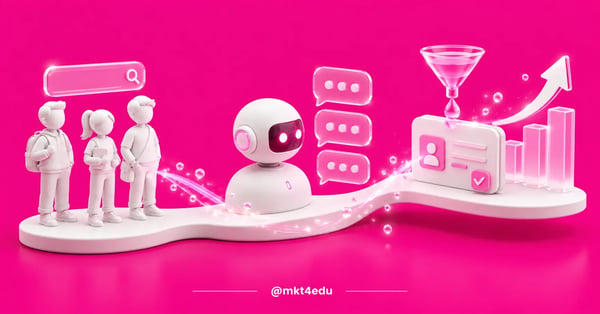 Caption: Student recruitment is now one continuous path: the prospect arrives, AI answers in real time and the funnel ends in enrollment.
Why has student recruitment become harder in higher education?
Because total enrollment is growing while the gains concentrate in lower-cost, highly competitive segments. The National Student Clearinghouse Research Center reported that fall 2025 postsecondary enrollment rose 1.0% overall, with private nonprofit institutions down 1.6% while community colleges grew 3.0% and public four-year institutions grew 1.4%.
That distribution matters more than the headline. A sector can grow while your segment shrinks, and aggregate optimism hides very different local realities.
Online delivery reshapes the competitive map on top of that. Federal data from NCES shows that in fall 2021, 61% of all undergraduate students were enrolled in at least one distance education course and 28% took distance education courses exclusively, well above the 36% and 15% recorded in 2019.
When a large share of study does not depend on physical proximity, the competitor is no longer the college one town over. It can be an institution three time zones away with a larger media budget.
How much does response time affect student recruitment results?
More than almost any other controllable variable. The study that became the reference on the subject is a 2011 study published in Harvard Business Review by James Oldroyd, Kristina McElheran and David Elkington, which examined how firms actually behaved when online leads arrived.
Among firms that responded within 30 days, average response time was 42 hours. Only 37% responded within the first hour, 24% took more than a day, and 23% never responded at all. Firms attempting contact within an hour were nearly seven times as likely to qualify the lead.
In higher education, the expectation shows up in sector research. RNL reports, drawing on the 2025 E-Expectations Report, that nearly half of students expect a response within 24 hours, that 90% of first contact is digital, and that 31% start with a website form while 28% start with email.
Two fixes solve most of the problem: a service level agreement measured in minutes rather than days, covering weekends and the application peak, and coverage outside business hours, because people research colleges at night.
A third fix costs nothing. Reply to the question asked before pivoting to a scheduling request, because a prospect who asks about tuition and receives only a calendar link learns that the institution is not listening.
Which messaging channels work best for student recruitment today?
The ones the prospect already opens, used as conversation rather than broadcast. In North America that usually means email plus SMS. In Latin America, parts of Europe, Africa and South Asia it usually means WhatsApp. The channel differs by market; the principle does not.
RNL's reading of prospective student behavior is useful here: 68% prefer follow-up by email and 40% accept text messages, while only 32% are willing to share a home address.
Two conclusions follow. Email remains the backbone of nurturing, so it deserves real content rather than reminder blasts. And text is permission-sensitive, so it works for time-critical, personally relevant messages and fails as a promotional channel.
Four rules hold across channels: identify the institution and the reason for contact in the first message, answer the question before advancing the process, offer an easy path to a human at any point, and respect local time zones, because a recruitment message at 11 p.m. costs trust.
What does an AI SDR change in a student recruitment operation?
It changes the first-contact and qualification layer, freeing human counselors for the conversations that decide enrollment. The agent responds within the first minute, asks the qualification questions, resolves factual doubts, books a call or visit, and hands the counselor a lead with context.
Three jobs suit AI automation well: immediate response at any hour, standardized qualification with the same questions for every inquiry, and reactivation of dormant lists that no counselor can work through manually.
Three jobs suit it poorly: scholarship and discount negotiation, reassuring an anxious or undecided applicant, and cases with document or academic holds.
Framing this as a choice between machine and person usually produces the wrong answer. In education operations, the design that tends to work is hybrid, with AI at the top and humans at the close. Cost expectations for that model appear in the breakdown of how much an AI SDR costs.
Before buying technology, measure the problem. If effective contact rate on your last campaign was under half, the bottleneck is speed and coverage, and an agent helps. If contact rate is high and enrollment conversion is low, the bottleneck is offer, price or argument.
How does predictive lead scoring qualify student recruitment leads?
It orders the outreach queue by probability of enrollment, using observed behavior instead of manually assigned point rules. Rather than adding ten points for an email open, the model learns which combinations of signals preceded real enrollments in your own historical data.
The signals that usually carry weight are familiar: recency of interaction, program and start term researched, tuition pages viewed, media source, distance to campus, and responsiveness to messages. The model does not invent those signals; it discovers which of them, together, separate people who enroll from people who only browse.
That depends on reasonably organized data. Without enrollment outcomes connected to inquiry history, there is nothing to learn from, and AI-powered lead qualification becomes a statistical placebo.
So the first step is less glamorous than vendor decks suggest: unify records, resolve duplicates, standardize program naming and log the outcome of every inquiry. Practical work with big data at an institution starts there, not with the dashboard.
One methodological caveat. A predictive model is a prioritization tool, not an individual forecast. It tells you who to call first; it does not promise that person will enroll.
Which student recruitment strategies work best for online programs?
The ones that assume national competition, lower tuition and faster decisions. With 61% of all undergraduate students enrolled in at least one distance education course in fall 2021, according to NCES, online recruitment is no longer a side vertical. It sets the media cost structure for many institutions.
Three characteristics change the playbook compared with campus programs. The competitor may be in another state. The decision cycle is shorter, because it does not require relocating a life. And attrition risk is higher, which forces better qualification at intake.
The media consequence is direct. An online program campaign without program-level intent segmentation burns budget quickly, because it competes for generic terms against advertisers with much deeper pockets.
Long-tail work pays better here. Questions about accreditation, exam format, transfer credit, student support and career outcomes carry their own search volume and bring a more decided prospect.
On the conversion side, long forms are the enemy. The prospect is on a phone, on unstable signal, comparing three institutions. Structures such as an interactive funnel tend to perform better because they return information at each step instead of only collecting it.
How is AI search changing student recruitment at the top of the funnel?
It inserts an intermediary between the prospect and your website. Instead of comparing ten links, the person asks an assistant which college fits and receives a synthesized answer citing a handful of sources. The consequence is blunt: an institution that is not cited does not enter the consideration set.
EAB surveyed more than 5,000 high school students in October and November 2025 and found that 46% already use AI tools in their college search, up from 26% in early 2025. The same study recorded that 18% removed a college from consideration based on AI-generated results.
The reassuring part is that there is no separate trick for this. Google's official documentation on AI features in Search states that there are no additional requirements and no special optimizations needed to appear in AI Overviews or AI Mode: the page must be indexed and eligible to show with a snippet.
What raises the odds of citation is content that answers real questions directly and verifiably. A program page that states length, entry requirements, cost, accreditation and curriculum in plain text is extractable. A page that hides all of it behind a form button is not.
The same reasoning applies to automated paid media layers, where understanding how Google AI Max works helps keep control over where recruitment budget actually goes.
Which student recruitment metrics should you track through enrollment?
The ones that cross the whole funnel, from click to paid enrollment. Tracking inquiry volume alone creates the illusion of a strong campaign with weak results, because form fills do not fund faculty salaries.
The useful reading separates each stage and looks for disproportionate drop-off. Here is how that organizes:
| Stage | Primary metric | What it reveals | Warning sign |
|---|---|---|---|
| Attraction | Cost per inquiry by program | Media and content efficiency | Cost falls but enrollment does not rise |
| Contact | First response time | Capacity at peak season | Average measured in hours, not minutes |
| Connection | Effective contact rate | Data quality and channel fit | Fewer than half of inquiries reached |
| Qualification | Qualified inquiry rate | Fit between prospect and program | Many inquiries without entry profile |
| Application | Applicant to deposit rate | Clarity of offer and process | High applications, low deposits |
| Enrollment | Enrollment conversion rate | Real result of the cycle | Drop concentrated in one program |
| Persistence | First-term attrition | Recruitment quality, not just teaching | Attrition above historical average |
Table: Metrics organized by recruitment funnel stage, with the signal that usually indicates a problem at each one.
Two rows deserve extra attention. Effective contact rate exposes data and channel problems that no ad optimization will fix. And first-term attrition exposes recruitment built on misaligned promises.
One note on tooling before you standardize internal reporting: Google's data visualization product became Looker Studio in 2022 and, in 2026, reverted to the Data Studio name. Confirm the current name before locking dashboard and documentation labels.
How do privacy rules limit student recruitment data use?
They do not prohibit recruitment, but they require a lawful basis, a declared purpose and transparency in how prospect data is handled. Whether the operation answers to GDPR in Europe, state privacy laws in the United States, FERPA once a person becomes a student, or Brazil's data protection law, the practical demands converge.
Purpose limitation comes first. Data collected to inform someone about one program does not automatically become fuel for campaigns about a different product unless that was made clear to the person.
Consent and withdrawal come second. A prospect must be able to ask not to be contacted again, and that request has to hold across every channel, not only email.
Third-party lists come third. A purchased list remains the most tempting and riskiest shortcut in education marketing, because the institution cannot demonstrate how the data was obtained.
There is also a specific sensitivity around minors and around health information collected in accessibility processes, which calls for extra care in storage and access control.
None of this blocks automation. Well-built automation, with opt-in records, conversation logs and an audit trail, usually leaves an operation more compliant than a spreadsheet on a counselor's laptop.
Frequently asked questions about student recruitment strategies
So, how should you rebuild student recruitment at your institution?
Start with what is already inside the building. Before increasing media budget, look at how many inquiries from the last cycle never received a reply, how long the first contact attempt took, and how many applicants went unpaid for lack of follow-up.
In most education operations, the largest available gain sits in that gap, not in a new campaign.
Then pick one lever at a time: response time, outreach order, program page clarity and continuity between application and enrollment. Technology comes after that, to scale what the process already proved, because automation without a defined process only accelerates the mistake.
If this description resembles your institution, a funnel diagnosis answers the question faster than another campaign test. That is the work the strategic educational marketing team at mkt4edu runs alongside marketing and admissions, mapping where prospects are being lost and what can still be recovered inside the current cycle.
To discuss your own numbers with people who run recruitment operations for institutions every day, talk to the mkt4edu team and bring the data from your last cycle.
Tactics change every year, but the goal behind recruiting new students stays the same.

























 Portugal