




There is a familiar moment in planning meetings at educational institutions. Someone asks how much still belongs in radio, college fairs or billboards, and the room goes quiet. Not because the answer is no, but because nobody has the number at hand.
Physical media budgets tend to survive out of habit or pressure from leadership. They show up on the spreadsheet as a cost and vanish from the report when results are due, which leaves offline marketing with a reputation as an act of faith.
The discomfort comes from the method, not from the channel. A college fair that produces 300 conversations and zero CRM records proves nothing. The same fair, with its own QR code and a source field on the form, becomes a line in the report.
What is offline marketing and how does it differ from online?
Offline marketing covers every promotional action that happens outside a connected environment: television, radio, newspapers, magazines, flyers, billboards, transit ads, physical banners, live events and street activations. The core difference from online is not the medium, it is the trail. A digital placement records who saw it and who clicked; a physical placement records nobody on its own.
That single distinction shapes everything that follows. Online media ships with identification built in, so measurement is a byproduct of delivery and the report writes itself without extra work from the team.
Offline, identification has to be built on purpose. Without a mechanism designed before the placement runs, the campaign goes out, genuinely influences the decision and leaves no usable evidence when it is time to report.
There is a second difference, in reach. A digital campaign can speak to a prospective student in any city, while a radio spot speaks to whoever is within its signal range.
For an institution recruiting within a defined territory, that narrower reach is an advantage rather than a limitation. Concentrating the budget on people who can realistically attend the campus cuts waste out of the plan.
The third difference is perception. A visible presence on radio, TV, outdoor or at a local event signals permanence in a way a feed ad does not, because it requires a public commitment to the place.
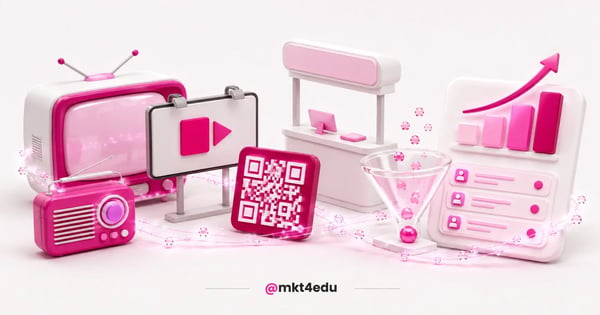 Caption: In offline marketing, every physical placement needs its own identification point to reach the CRM.
Does offline marketing still work for enrolling students?
It works, on one condition: the channel has to match the format being sold. In Nielsen's Q1 2026 Ad-Supported Gauge, streaming reached a record 46.6% of ad-supported TV viewing in the United States, while broadcast held 28.2% and cable 25.2%. Traditional channels still carry the majority of that audience.
Enrollment volume also stayed resilient. The National Student Clearinghouse Research Center reported 18.6 million postsecondary students in spring 2026, up 1.0% year over year, with undergraduate enrollment rising 1.3% to 15.5 million.
The caveat sits on the format side of the equation. Where online programs dominate the mix, territory channels lose efficiency fast, because the audience is scattered across the country instead of concentrated on any one avenue.
Brazil offers a sharp illustration of that shift. The 2024 Higher Education Census published by Inep showed distance learning reaching 50.7% of undergraduate enrollments, overtaking on-campus study for the first time.
A campus-based institution lives on the opposite logic. It needs to be recognized in the neighborhood, in the high school next door and in the conversation the family has around the kitchen table.
The pandemic left a lesson that still holds. When physical contact stopped, many institutions discovered that their standing in the local community sustained the brand better than advertising frequency did.
Which offline channels deliver results for a school?
Not every offline channel suits every institution. The choice depends on three variables: the size of the recruitment territory, the delivery format of the program and the moment in the academic calendar, because an application deadline campaign needs reach while year-round recruitment needs relationships.
Here is how the main channels sort out by use:
| Channel | Best use | Tracking mechanism |
|---|---|---|
| Regional broadcast TV | Application season and brand recall | On-air offer code |
| Local radio | Deadline reminders and enrollment nudges | Dedicated phone number |
| College fairs | Qualified leads from high school students | QR code per booth |
| Billboards and transit ads | Presence around the campus | Unique short URL |
| Community programs | Reputation and earned local press | Intake form at the service desk |
| Targeted print | Graduate programs and corporate audiences | Printed voucher |
Table: Offline channels most used by educational institutions and the tracking mechanism that fits each one.
The right-hand column is the one that usually goes missing. Picking the channel without picking the tracking mechanism is exactly what produces the campaign nobody can defend at the next meeting.
Execution differs channel by channel, in format and in offer. The offline marketing strategies to attract more students break down how to build each activation without inflating cost per lead.
How do live events generate qualified leads?
Live events convert better than any other offline channel because they gather people who already declared interest before walking into the room. College fairs, open houses, symposiums, exam prep nights and campus tours put the institution in front of someone who is deciding, rather than someone who might decide.
The competitive edge comes from what only a physical visit shows. A laboratory, a library, a teaching clinic and a two-minute conversation with a faculty member communicate quality in a way no placement reproduces.
One format widened the reach without diluting the effect. Streaming the lecture or the open house live serves people who could not attend, and creates a second contact base with an identified source.
The most expensive mistake at events is operational rather than creative. Collecting names on paper and typing them in later delays the first contact by days, and the prospective student has already spoken to three competitors inside that window.
The fix is cheap and takes an afternoon to set up. One QR code per booth, pointing to a short form with the source field prefilled, drops the lead into the CRM before the person leaves the venue.
Events pay off when they connect to the rest of the operation. The strategies for attracting students for higher education only compound when the collected base enters a nurture sequence the same day.
What role does networking play in education marketing?
Networking in education is a recurring recruitment channel, not institutional courtesy. A well-built relationship with high schools, local employers, unions, professional boards and public bodies opens access to entire audiences at once, at an acquisition cost well below paid media.
The logic is volume per relationship. A partnership with one high school can yield a career guidance talk each term for 200 students, plus direct access to the counselors who shape those families' decisions.
The same holds in the corporate world. An agreement with a local employer turns its workforce into an audience for graduate and continuing education programs, with a negotiated discount and a direct line of communication.
Business cards still change hands at industry events and roundtables, and the format has become more useful. A QR code on the badge or the card leads straight to the right form, and the contact lands in the database with the source already tagged.
What separates networking from conversation is the record. Without a CRM entry and a named owner for follow-up, the partnership lives in one person's memory and dies the day they change jobs.
How do community programs strengthen your brand?
Community work builds the kind of reputation paid media cannot buy: the sense that the institution belongs to the place. Social projects, free services, environmental campaigns and cultural programs put the brand into people's daily lives in a position of usefulness rather than of sales.
The most efficient format is also the most natural for a school. Opening the dental teaching clinic, the legal aid center or the physical therapy lab for free public service solves two problems at the same time.
On one side, students complete supervised practical hours on real cases. On the other, every person served leaves with a concrete experience of what the institution teaches, and usually tells the whole family about it.
That kind of program also earns editorial coverage. Local newsrooms cover a service story far more readily than an institutional announcement, and a mention in an independent outlet carries credibility an advertisement never will.
The brand effect is cumulative and deliberately slow. A one-off activation earns a photo, while a continuous program repeated over years earns the sentence a family says when a teenager asks where to study.
Reputation also protects revenue. In the Brazilian market, the 16th Higher Education Map from Semesp recorded 26.6% attrition in private on-campus programs and 41.9% in private distance programs, and attachment to the institution is one of the factors that keeps students enrolled.
That attachment is the same input that sustains persistence through the program. The best student retention strategies lean heavily on the sense of belonging that community work creates before enrollment even happens.
How do you measure the return of offline marketing?
Measuring offline means deliberately creating an identification point that a physical placement does not have by nature. There are four mechanisms, and none of them requires expensive technology: a unique code, a unique destination, a unique contact and a source question on the application form.
The unique code is the oldest of the four and still works perfectly well. A fee waiver voucher mentioned only in the radio spot identifies precisely who came from that placement and nowhere else.
The unique destination solves outdoor and print at once. A short URL per placement, or a QR code per location, separates traffic by origin without relying on anyone's memory at the moment of contact.
The unique contact works well during enrollment campaigns. A phone number used only in the television flight reveals volume, peak hours and the substance of the questions people ask.
The source question closes what the other three miss. A mandatory "how did you hear about us" field on the application form captures word of mouth and brand recall that no code will ever catch.
With all four running, offline enters the same dashboard as digital. That cross-reading is what the tools to monitor performance in educational marketing organize, and it is what makes cost per lead comparable between a fair and a paid search campaign.
As data volume grows, the reading gets sharper. Applications of big data in education help identify which channel combinations precede enrollment, instead of judging each channel in isolation.
How do you integrate offline and online recruitment?
Integration happens when the physical activation feeds the digital funnel instead of running beside it. The pattern is always the same: the offline contact hands over an identifier, that identifier enters the CRM with the source tagged, and from there the digital sequence carries the relationship through to enrollment.
One example makes the logic concrete. The college fair collects 400 contacts by QR code, each tagged with the event name and the program the person selected on the form.
The next day, those 400 receive an email and messaging sequence built around that specific program. People who open and click move up in scoring; people who stay silent drop into a lighter cadence.
The reverse direction pays off just as well. A digital base segmented by city shows where radio or outdoor is worth buying next cycle, which replaces decision by habit with decision by evidence.
Integration gets more consistent when a methodology sits underneath it. That is what inbound marketing in education structures, and what supports an integrated marketing plan across online and offline that stops treating the two environments as rival budgets.
One operational warning saves a lot of rework. If the source is not recorded at the moment of entry, it cannot be recovered later, and the institution loses its only chance to attribute the enrollment to the right channel.
Frequently asked questions about offline marketing in education
So, is offline marketing worth it for your institution?
It is, under two conditions that change the outcome entirely. The first is matching the channel to the format: a campus-based institution gains from territory channels, while a national online institution gains from segmented digital.
The second condition is the one almost nobody meets. No offline budget should leave the spreadsheet without an identification mechanism defined before the placement runs, because once the campaign is out there is no way to recover a source that was never captured.
The gap between a defensible investment and an act of faith fits into one planning decision. A unique voucher, a QR code per placement, a dedicated number and a source field on the form cost almost nothing and turn physical presence into a line in the report.
Once that is in place, the conversation in the meeting changes tone. Instead of debating whether radio still works, the team compares cost per lead across radio, fairs and paid search, and decides with numbers.
If your institution already spends offline and still cannot point to how many enrollments came from it, the next step is defining the metrics that tie each channel to a signed enrollment.
Offline still moves family decisions, which is why it stays in the budget of any outbound campaign.


.jpg)
























 Portugal