




An applicant decides where to study long before speaking to your team. They search the program on Google, compare tuition across three open tabs, read student reviews and ask an AI assistant whether the school is any good.
By the time they fill in a form, the opinion is already formed. Inbound marketing works in that gap, between the first question and the form, by putting the institution inside the research with content that answers the real doubt.
The competition for that space is heavy. Brazil's 2024 Higher Education Census, run by Inep, records 2,561 higher education institutions and more than 10 million undergraduate enrollments.
What is inbound marketing in education?
A visitor who finds your website or blog and sees their question answered starts building a relationship with the institution. At some point they are ready for a simple trade: contact details in exchange for a resource such as an e-book.
That trade is the moment a visitor becomes a lead. Understanding what leads are for educational institutions is what keeps the next steps from turning into guesswork.
With the advancement of digital technologies, inbound marketing has incorporated automation and artificial intelligence tools to further personalize communication with leads, increasing the efficiency of campaigns.
The visitor who is attracted by the content of your website and blog, when he sees his questions answered, starts to relate with his educational institution. Then, the moment comes when he is able to make a simple exchange: some contact information for exclusive content, an e-book, for example.
From the moment you obtain that visitor's contact information, you have a lead. This lead is then educated with personalized content so that, at the end of their sales funnel, they are ready to make the decision to enroll.
After enrollment, the same digital marketing strategies shift purpose: they now serve to delight and retain the new student, which is where inbound stops being an acquisition tool and starts protecting revenue.
Why should your institution invest in inbound marketing?
The way people choose a school has changed, and the scale of the competition explains why. With more than 2,500 institutions in the country, applicants compare before they talk and arrive at admissions already knowing what to ask.
An institution that never showed up in that research does not make the shortlist. It was not rejected: it was never considered.
Think like someone finishing high school and considering going to college: what's the first thing you would do to know your options? Search on Google.
The search runs on keywords, and results are ordered by how relevant the published content is. The first organic results tend to take most of the clicks, which turns search position into a direct contest for attention.
That said, the answer to our question is: you should do inbound marketing to increase the relevance of your educational institution and in search engines, achieving better online positioning.
But the benefits don't stop there: by sharing quality knowledge with thousands of people, you contribute to the institution's reputation, become a reference in the market, show what the educational institutions' differentials are and form a huge community of admirers.
The practical effect shows up on two fronts. The admissions conversation gets shorter, because the applicant already knows what they want, and the content keeps attracting people after publication, with no new cost per click.
Finally, you have a strategy that generates results for much longer, after all, a blog post, for example, can be read by thousands of students, each at their own pace.
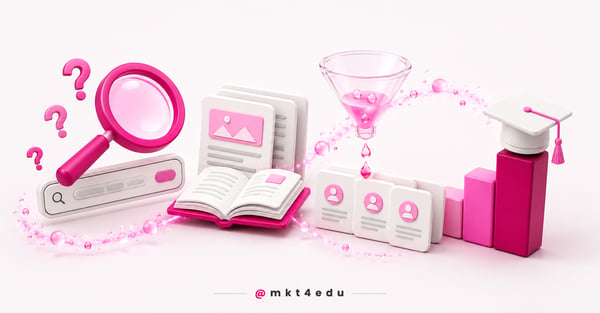 Subtitle: The distance between a search query and an enrollment is covered by content that answers before it sells.
How does AI search change inbound marketing in education?
AI search changes where the click lands, not the logic of inbound. Applicants still ask questions, but the answer now arrives summarised on screen, citing a handful of sources, instead of a list of ten blue links.
That shifts the goal of the content. Ranking is no longer enough: the page has to be the source the summary cites, and the pages that get cited tend to answer directly, with a verifiable figure and a named source.
The type of query works in favour of educational institutions. Research compiled by Semrush points to 88% of searches showing AI summaries carrying informational intent, which is exactly the ground a blog about programs, careers and admissions occupies.
Three adjustments matter: open each section with the answer in the first sentence, write subheadings as real questions, and back every claim with a linked source. These are the same practices behind SEO for LLM.
Qualifying who arrives is the next step. Traffic from AI search tends to be smaller and further along in the decision, which raises the weight of AI-powered lead qualification right at the top of the funnel.
How do you apply the inbound marketing cycle at your institution?
One of the great beauties of inbound marketing is that this strategy can be shaped, adapted and customized according to the needs of a company or a client. However, there is a cycle to be followed so that you can carry out conversions. This cycle is divided between ACTIONS and PEOPLE.
With that in mind, how can you apply the cycle at your institution? Let's go!
ATTRACT or turn strangers into visitors
The most important rule of inbound marketing is: you don't go to your customers, they come to you. And how does it work? Through presence, posture and, of course, strategy. Some of the most used techniques are content and SEO.
Content marketing is something that has changed a lot and very quickly in recent times. With changes in the audience of social networks, algorithms and the consumption of certain formats (videos, for example), making content that attracts is not easy. But you must invest in it.
The first step in doing good content marketing is defining your personas, or, in other words, your target audience.
Who are the people you want to reach? How old is it? What behavior? What kind of media do they consume?
Regardless of format or persona, content marketing is essential. And it is up to your Institution to find the best way to produce this content to attract your target audience.
The keyword here is "stability". And that's why in this "attraction" moment, you're turning acquaintances into visitors. The person who is interested in your content will always be "following" you, demonstrating that he is on the way to a possible decision-making process.
Being found also depends on SEO. Search Engine Optimization is the set of practices that improve where your institution's website or blog appears in search engines, and it is what makes the content you publish reachable at all.
What does that mean? That by applying SEO techniques to your content, you increase the chance that your personas will find your institution more easily and quickly.
SEO and Content Marketing are strategies that go together and can be your best way to win phase 01 of the cycle. Attracting correctly increases your chances of conversion and closing.
In short, your focus should be 1) producing cool, attractive and enjoyable content for your target audience and 2) finding the best way to make your persona find you.
CONVERT or turn your visitors into leads
Many companies believe that the conversion part is the most important part of inbound marketing. In fact, converting is essential for your business and the keyword of this stage is: induction. Don't take it the wrong way. Inducing someone to take action is something conducive to digital marketing.
But why "induction"? Well, consider your prospect's side for a moment: it's very comfortable to be in the "passive consumer" position.
Your visitors like your content, consume it because they believe in quality or identify with what is being passed, it's good to be there... Why then should they really connect with you? How to change their need for this conversion?
Some techniques can help: Call to Action, Forms and Landing Pages.
Call to Action (CTA)
This is a tactic to "pull" potential customers towards conversion. The words and ideas here need to be spot on.
A good method to get this click is to bring attention-grabbing concepts. For example, exclusivity. If your visitor is reading an article and you place a call that goes something like this: "did you like this content? Then download our exclusive e-book on the same subject".
This lead capture is done organically, because the person is not only attracted by your content, but also attracted by connecting in a unique way with your institution.
Forms
It's more "practical". It can be inserted in social networks as a link, with a call to "receive more information", for example. It can have a single field, with the call sign up for Newsletter. The focus of the form is to get basic data from your lead so that the cycle can continue.
Landing Pages
LPs or capture pages, these pages are intentionally created to convert visitors into leads. Unlike a form, the LP brings more content and information on a particular subject.
If you offer an ebook on a Landing Page, for example, you can put some "spoilers" of what the person will find in the content if they download it.
Options abound! The best prospecting strategy is the one that makes sense for your audience and your institution. Applying them in different mediums can increase your conversion rate even more.
CLOSE or turn your leads into customers
The 3rd stage of the cycle is everyone's dream, right? And it's almost impossible to talk about inbound marketing without mentioning email marketing practices. Ah, it's worth remembering that despite the name, this technique also consists of messages via WhatsApp or SMS.
The keyword in this cycle is "convincing", it is to strengthen the relationship by sending incentives for making a purchase decision. It's important to have good arguments to convince someone to buy your product/service.
In the case of your Institution, what are the points that make it different and the best choice for your leads? Is it the renown? Custom programs? The discount?
Regardless of what the argument is, use it to win over your lead. Just emphasizing that persuasion and insistence are different things. Don't be "the annoying relative" of your leads, but the mentor who will guide your leads to another level, to the future they want to achieve.
ENCHANT or turn your customers into promoters
Few institutions invest in the student who already enrolled. Post-enrollment work is what keeps the cycle turning, because a satisfied student brings the next applicant at no acquisition cost.
Enchantment is an incredible strategy to make the other 3 steps of your cycle more organic and fluid in the next capture. And how can you do this?
Create content aimed at those who are already your customers, promote actions within your Institution, events, lectures... Carry out social monitoring, with satisfaction surveys. Create actions for your students to bring in new leads, such as "refer a friend and get a discount".
The keyword here is "continuity". Once your lead becomes your customer, why lose them? Look for a lasting relationship and make it happen! Always stay connected, keep showing your students that they are as important as they were when they hadn't enrolled yet.
Frequently asked questions about inbound marketing in education
So, is it worth starting inbound at your institution?
It is worth it, as long as the institution accepts the timeline. Inbound does not deliver an enrollment in the first month: it builds a library of content that answers applicant questions and keeps attracting qualified people without cost per click.
The first cycle pays off more when it starts narrow. Pick one program, list the ten questions an applicant asks before deciding, and answer each one on its own page.
Inbound and paid media do not compete for the same slot. Running both is what sustains volume in the short term while organic matures, which is also why student recruitment and retention work better when planned together.
Measure three things in the first six months: organic visits to the new pages, leads generated by them, and how many of those leads reached admissions. That is enough to tell whether the library is working.
If you want to build that cycle inside the inbound marketing operation you already run, talk to the mkt4edu team. The conversation starts with a diagnosis of your funnel.


.jpg)























 Portugal