


The numbered-menu chatbot has lost its audience. People type a question the way they would say it out loud and expect the right answer on the first try, in the channel they already use.
Building a smart chatbot is now an architecture decision: which persona sets the tone, which knowledge base feeds the answer, which metric approves a change and how the record returns to the CRM (Customer Relationship Management) system.
The five tips below still hold, and they gained a new layer. AI agents raised the ceiling of what automated conversation delivers, and that jump shows up in the second half of this article.
Why does a smart chatbot need to sound human?
The closer the exchange gets to natural language, the better the channel is received. People want to be understood in the first sentence and to solve the problem without repeating information. A bot that reads intent removes friction, and friction is what kills automated customer service.
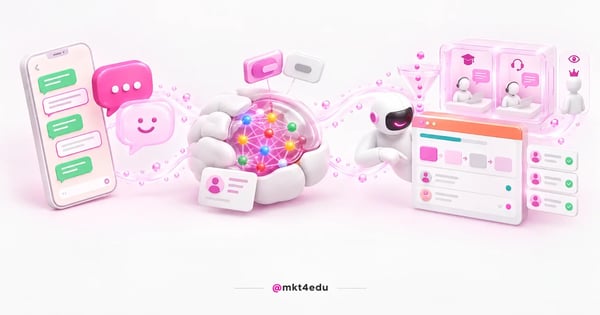 Caption: From scripted reply to agent that resolves: the smart chatbot reads intent, learns from testing and hands service back to the CRM flow.
What makes a bot smart is the ability to interpret the request and offer the right service. Answering fast while missing the subject feels like a wall, not like help.
Sounding human also means admitting a limit. When intent confidence drops, the bot transfers the conversation with history. That rule gets concrete when the channel is wired to the operation, as in customer service inside Service Hub, where the ticket is born from the conversation.
What is machine learning inside a chatbot?
Machine learning is the set of techniques that adjusts a model from examples. The bot does not get smarter on its own after a thousand conversations, it improves when someone turns those conversations into labeled data and ships a new version.
Answering what is machine learning in a service context means separating two distinct moments. There is model training, which happens offline, and there is retrieval from the knowledge base, which happens while the answer is being written.
Training uses reviewed dialogues, annotated examples and reinforcement learning from human feedback, a technique that brings model output closer to what a person would find useful.
Retrieval uses RAG (Retrieval-Augmented Generation), a design that pulls the right passage from an external source before the model writes the sentence. The content stops living in the model and starts living in your knowledge base.
Three gains follow from that arrangement: fewer hallucinations, because the answer starts from a real document; traceability, because you can show the source title and URL; and cheap updates, with no retraining of the main model.
Saying the bot "learns by itself" sells autonomy that does not exist and removes accountability from whoever runs it. Learning depends on labeled data and human review, and that dependency is exactly what lets you govern what the bot says.
What are the 5 tips for a smarter chatbot?
Five fronts solve most problems in a stalled bot: define the persona, model the language, connect the FAQ to a living base, test with real traffic and add the AI layer with clear limits. None of them requires switching platforms, and all of them require routine.
How do you create a persona to guide the chatbot?
People searching how to create a smart chatbot usually start with the tool, and the short path starts with the persona. Tone of voice, vocabulary and scope limits come from the profile on the other side, not from the taste of whoever builds the flow.
The route for how to create a persona starts with data you already hold: source channels, most frequent questions and the hours contact happens. A bot for a gaming portal does not speak like a bot for a law firm.
Document what the bot does and what it never does. That list stops the generative layer from inventing a discount policy or an enrollment deadline the institution cannot honor.
How does NLP create personalized interactions?
NLP (Natural Language Processing) is the layer that lets a machine interpret a sentence however it happens to be phrased. It combines Artificial Intelligence, linguistics and computing to extract intent and entities from a block of free text.
In practice, you model intents from real logs, extract entities such as course and date and tune the confidence threshold. The fallback has to offer a useful route, never a bare "I did not understand".
Teams on Google Cloud should watch the interface change. The Dialogflow CX console is marked as a deprecated user interface for building agents with flows, and Conversational Agents took its place, bringing generative playbooks and flows into a single console.
Inside HubSpot, the same logic shows up in chatbot configuration, where the conversation is born attached to the contact record.
How do you turn the FAQ into a living knowledge base?
Mapping frequent questions is the start, not the finish. The jump happens when the FAQ becomes an index the bot queries in real time to build the answer.
On Google Cloud that index is called a data store: a collection of websites, documents or data in third-party systems that the agent searches on every question. Question and answer pairs go in as CSV, with optional title and URL columns.
Unstructured material in HTML, PDF and TXT also fits in the index, along with pages crawled from verified domains. In that format the agent can reword the answer and show supporting links back to the full source.
Governance improves with it. You edit the re-enrollment policy in one document and service follows, without opening the flow builder. To feed that index with what people actually ask, it pays to map the answers coming out of conversations before writing new content.
How does A/B testing show bot performance?
Shipping and measuring is the only honest way to know whether a change helped. Test the greeting, the order of the questions, the error copy and the final call, always one variation at a time and with enough volume.
In Dialogflow CX, experiments compare a control version with one or more variants while the agent handles live traffic. The tool tracks live agent handoff, session end rate, turn counts and the total no-match count per variant.
Message volume is not a quality signal. Track CSAT (Customer Satisfaction Score) as well, which collects the service rating straight from the person who was served.
How does the AI layer widen what the bot resolves?
The generative layer comes after the knowledge base is in order, never before. It covers language variations the intent model did not anticipate, as long as the content comes from the base and not from the model's imagination.
Set the scope, the length limit and the blocked subjects. Log every answer, use human review on critical flows and release new capabilities as a canary version, with small traffic and a rollback plan before general rollout.
Video: Reasons to invest in an AI chatbot for student acquisition and retention, in Portuguese.
What is the difference between a smart chatbot and AI agents?
The chatbot answers inside the conversation. AI agents perform the task that comes next: they open the ticket, update the contact, trigger nurturing, chase the invoice. The border sits in the access the system has to act.
That layer now has its own address inside the CRM. Agent Hub is the central home for building and managing HubSpot's AI agents, and Breeze Assistant is the access point to them day to day.
Seven agents are named on the platform. Campaign turns a single goal into a multi-channel campaign, Content builds posts and landing pages in the brand voice, Nurture sends email based on where the lead actually is, and Prospecting monitors buying signals to launch outreach.
The other three close the post-sale loop. Customer resolves inquiries across service channels, Data answers questions about contacts and companies from the CRM, and Revenue automates invoice follow-up and reminders.
Anyone needing something outside that list turns to Agent Builder, which builds custom agents on one canvas with prompts, knowledge and CRM data, no coding required. The AEO (Answer Engine Optimization) offering is labeled beta.
Video: How usability, Artificial Intelligence and inbound meet inside the HubSpot CRM, in Portuguese.
What do AI SDR agents do in admissions?
AI SDR agents take the first layer of pre-sales: they qualify the lead, confirm interest, answer price and deadline questions and book the conversation with the human team. They work by voice and by message, at the lead's pace, not the call center's.
In student acquisition, the clearest gain is time to first response. Someone asking for information at eleven at night gets an answer right then, instead of the next day.
The design that works keeps the agent inside the process, never beside it. That is what separates a nice demo from an operation, as the SDR agent applied to admissions shows.
WhatsApp is where this is decided in Brazil. With the WhatsApp integration in HubSpot, the conversation the agent runs becomes a record on the contact, and sales joins with history in hand.
How do you increase the conversion rate with a chatbot?
The answer to how to increase the conversion rate with a bot is not "improve the experience", it is measuring what the bot resolves. Two numbers separate pitch from result: how much demand ends without a human and how much ends actually resolved.
Deflection counts any conversation not escalated to an agent, including the one that dies on the default reply. Automated resolution is stricter, because a model has to verify the request was resolved without human help.
Optimizing only the first number inflates the report. The user who gives up mid-flow shows as a contained conversation, and the demand returns later by phone, email or public complaint.
Tie every test to a real conversion: application started, document uploaded, enrollment completed. A living FAQ and A/B testing earn their keep when they move that number, not when they fill a volume dashboard.
The conversation is also a temperature signal, and reading it well shortens the cycle. These tips to make a lead hot for conversion help decide when the human team takes over.
Are user experience and customer experience the same?
No. User experience, or UX, is what happens at the interface: how many taps to the answer, whether the field accepts the format typed, whether the text fits a phone screen. Customer experience, or CX, is the whole relationship with the brand.
A bot can have excellent user experience and terrible customer experience. The conversation flows, and three days later the person finds the information was out of date. Separating the two changes which metric you pick: the first is measured by step abandonment; the second by satisfaction, repeat business and complaints avoided.
That reading gets clearer when you look at the relationship between customer experience and Artificial Intelligence across the whole operation, not only the chat window.
What does Brazilian privacy law require from a deciding bot?
Privacy and transparency are conversational design requirements, not a legal annex at the end of the project. If your bot shapes a decision that affects the user, article 20 of the LGPD (Lei Geral de Proteção de Dados, Brazil's general data protection law) gives that person a right to review.
The ANPD (Autoridade Nacional de Proteção de Dados, Brazil's data protection authority) gathered public contributions on the topic in Technical Note 12/2025, with 124 participants. The document consolidates the views received and does not state the authority's final position.
Two points of agreement run through the material: article 20 secures review of decisions taken solely by automated processing that affect the data subject's interests, and human review is expected when a decision carries legal or similarly significant effects.
Disagreement shows up in the detail, mainly over how broadly "interests" should be read and how much technical detail to disclose, since opening too much can weaken the security of the solution.
For your project the translation is direct: say the service is automated, explain how the data will be used, collect only what you need and keep a contestation channel with human review.
Frequently asked questions about the smart chatbot
How do you get the smart chatbot running?
The plan fits in one week. Pull the logs and list the main intents, build the living FAQ from official sources, design the fallback and the handoff with context, publish a canary version and run the first A/B test.
After that the routine is fortnightly: review what the bot got wrong, update the base and test one variation at a time. A smart chatbot is not a one-off delivery, it is a product with maintenance.
The agent layer comes in once the basics are stable. First the bot answers correctly, then it starts executing, and only then does it make sense to grant access so it can update contacts and open tickets on its own.
If the next step is building this inside your own admissions and customer service operation, talk to the Mkt4edu team and turn automated conversation into pipeline.












 Portugal