


Every recruitment manager knows the scene: the campaign delivers volume, the form fills up, and a meaningful share of those contacts never gets an answer while they were still interested.
The problem is rarely a shortage of staff, but a mismatch between the prospective student's hours and the operation's hours. That is where a chatbot in lead retention stops being a website ornament and becomes recruitment infrastructure.
The conversation has moved up a level in recent years. The bot that only returned a numbered menu now shares space with systems that interpret free text and carry AI-powered lead qualification all the way to a meeting with an advisor.
This article separates mature technology from promise, shows the adoption picture in Brazilian higher education and describes how to generate leads with automation without losing the human bond that closes enrollment.
Why does a chatbot in lead retention support student recruitment?
A chatbot in lead retention supports student recruitment because it attacks the variable that drags conversion down the most at educational institutions: the gap between the moment interest appears and the moment someone answers. While a human advisor handles one contact at a time, during office hours, the bot handles hundreds in parallel.
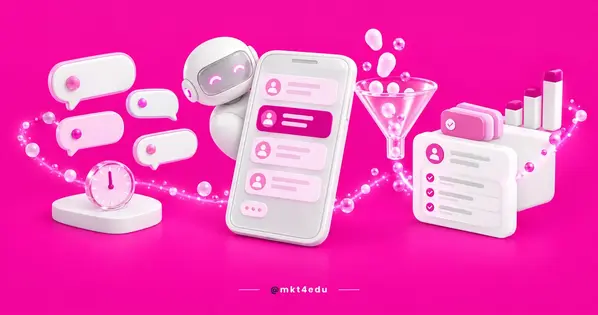 Caption: A chatbot in lead retention keeps the applicant inside the funnel by answering in seconds, and hands the complex case to a human.
The cost gain comes next, as a consequence of the time gain. When automation absorbs repetitive questions about tuition, curriculum, study centers and paperwork, the sales team stops spending selling hours on catalog questions.
Gartner projected, in a March 2025 press release, that agentic AI will autonomously resolve 80% of common customer service issues by 2029, with a 30% reduction in operational costs. The figure deserves to be read for what it is, an analyst projection rather than a result already observed in the market.
There is a third gain, less often mentioned and equally relevant to educational management: structured data capture. Every conversation records the course of interest, shift, format, location and stated objection, and those fields reach the CRM (Customer Relationship Management) ready for segmentation.
What separates a chatbot, an AI agent and an AI SDR agent?
Chatbot, AI agent and AI SDR agent describe three levels of autonomy, not three names for the same thing. A classic chatbot follows a fixed decision tree, an AI agent interprets free text and checks data, and an AI SDR agent does both and also qualifies the lead and books the meeting.
The practical difference shows up when someone writes outside the script. In a rule-based bot, a question that does not fit the menu produces a repeated list of options and an abandoned conversation. In an AI agent, it becomes a knowledge base lookup and a specific answer.
That distinction organizes the investment decision. An institution with a small catalog and predictable questions does well with a script-based chatbot in education; an institution with many courses, several formats and simultaneous campaigns hits the ceiling of the decision tree quickly.
Here is how the three layers differ inside a recruitment operation:
|
Criterion |
Rule-based chatbot |
AI chatbot |
AI SDR agent |
|
Accepted input |
Menus and buttons |
Free text |
Text, audio and CRM context |
|
Lead qualification |
None |
Partial capture |
Applies sales criteria |
|
Follow-up on silent leads |
None |
Depends on external flow |
Own cadence |
|
Handoff to a person |
By button |
By keyword |
By priority rule |
|
Maintenance effort |
Rewrite the tree |
Update the knowledge base |
Adjust criteria and script |
Table: Comparison of the three conversation automation layers applied to student recruitment.
The right-hand column explains why so many education operations have moved toward the AI SDR agent: the gain is not a prettier answer but the cadence that keeps chasing an undecided prospect without depending on one person's calendar.
AI SDR agent vs human SDR: which funnel stage belongs to each?
The AI SDR agent vs human SDR debate is settled by funnel stage, not by replacement. The agent covers first contact, triage and follow-up on people who went quiet. The human SDR takes over the moment the conversation requires negotiation, family context or trust building.
The detailed comparison between AI SDR agent vs human SDR shows where each model wins on cost, coverage and conversation quality. For most institutions, the stable design is hybrid.
It is worth noting the limits of the model. Poorly calibrated automation produces the opposite effect, with a generic reply at a delicate moment, so the escalation criteria must be defined before the first conversation.
How does an SDR agent on WhatsApp change qualified lead generation?
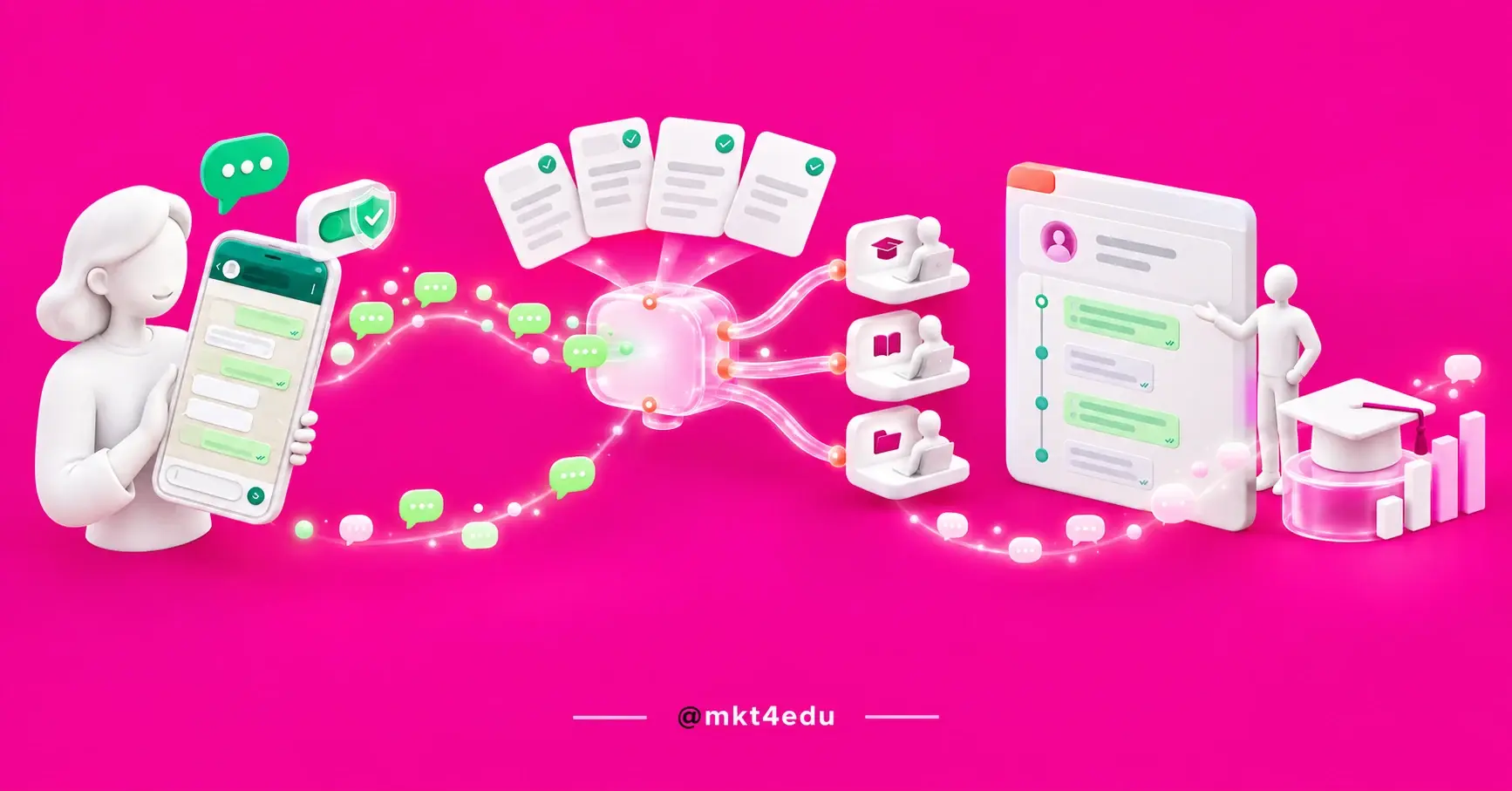
An SDR agent on WhatsApp changes qualified lead generation because it moves the conversation to the app where the prospective student already is, with a notification they actually open. A website form depends on the person coming back; a WhatsApp message reaches them, and read rates reflect that.
The channel also solves continuity. Someone starts the conversation on the site, leaves for work and picks it up on the phone, and the history stays in the same thread, with no need to repeat information.
That continuity matters for qualified lead generation for an operational reason: a qualified lead is one whose interest, timing and constraints are already recorded. An SDR agent on WhatsApp captures those fields inside the conversation, instead of in a parallel form nobody fills in.
AI-powered lead qualification adds a layer of judgment. Instead of tagging every contact as "interested", the system ranks by course fit, intake timing and intent signals, which lets the team prioritize the queue and makes digital marketing strategies measurable.
A well-built AI-powered lead qualification setup also feeds information back to media buying. Knowing that a given creative brings high volume and low fit changes budget allocation the following week.
For anyone asking how to increase conversion rate without raising media investment, the lever is usually here. Converting more of what already arrives costs less than buying more arrivals, and the question of how to increase conversion rate turns into a weekly routine of queue prioritization.
How do Brazilian institutions use chatbots in student recruitment and retention?
Chatbot adoption in student recruitment and retention in Brazil is still a minority practice, and that is precisely where the competitive advantage comes from. The proprietary mkt4edu survey “Use of chat for student recruitment across the 500 largest higher education institutions in Brazil”, from 2020, found about 34% of HEIs (Higher Education Institutions) running some kind of chat channel.
Within that group of institutions with chat, 42.4% ran actual chatbots, while the rest relied on human agents to carry the conversation. Against the full universe of 500, that works out to roughly 14% with an active bot.
The number is often quoted incorrectly, and the precision matters: the 42.4% is not the share of the 500 largest HEIs, but the share of those that already had a chat channel installed.
While adoption moves slowly, demand grows and changes shape. The 2024 Higher Education Census by Inep, released in September 2025, recorded that distance learning reached 50.7% of undergraduate enrollments, overtaking on-campus programs for the first time, in a total of more than 10 million enrollments.
Distance learning students talk to the institution through digital channels from the very first contact. When the only available channel is a phone line during office hours, the institution loses the prospect to the competitor that answers at 10 p.m.
The other side of the equation adds pressure. The 16th Map of Higher Education in Brazil, by Instituto Semesp, based on the 2024 Census, reported dropout rates of 41.6% in distance programs and 24.8% in on-campus programs, reaching 41.9% in the private distance learning network.
Those percentages explain why automated conversation cannot stop at enrollment. The same channel that captured the prospect serves the enrolled student afterwards, and fighting dropout in online learning starts with spotting who stopped interacting before re-enrollment season arrives.
How to improve user experience in a conversation with a bot?
Knowing how to improve user experience in a conversation with a bot depends on three decisions taken before launch: state that the counterpart is automated, define the exit path to a human and limit the scope to what the system actually knows. Transparency and scope matter more to perception than natural-sounding language.
Academic research supports those three decisions. A study of nearly 6,000 Swedish university students, published in 2024 in Computers and Education: Artificial Intelligence, found mostly positive attitudes toward AI chatbots alongside persistent concerns about privacy, accuracy of answers and loss of human contact.
The same tension appears in the higher education literature. A review published in 2025 in the journal Higher Education analyzed 23 empirical studies and recorded the coexistence of utopian and dystopian discourses about the role of AI chatbots in higher education, with little grounding in learning theory.
For anyone running recruitment, the lesson is direct. Prospective students accept automated service as long as it is fast, accurate and honest about what it is, and they reject automation that pretends to be a person and gets things wrong.
How to improve user experience in practice comes down to writing details. Short answers, no institutional jargon, the requested information in the first line, and an explicit invitation to talk to a person at any point.
How to build effective marketing strategies with a chatbot in lead retention?
Effective marketing strategies with a chatbot in lead retention start by mapping real questions, not by choosing a platform. As with any decision about digital marketing strategies, diagnosis comes before investment: the team lists the most frequent questions, the courses that raise the most objections and the busiest hours outside office time.
With that mapping in hand, the operational design becomes concrete. Here is the sequence that tends to work at educational institutions:
- Define the bot's scope by topic rather than by course, to avoid a giant tree.
- Write the critical answers with the academic team, not only with marketing.
- Integrate the conversation with the CRM from day one, to avoid a parallel database.
- Put the escalation criteria for the human advisor in writing.
- Measure response rate, qualification rate and booking rate every week.
Measurement is the part most often neglected. Without comparing the conversion of a bot-served lead with that of a human-served lead, the institution cannot defend the investment at the next budget meeting.
That same mapping answers anyone asking how to generate leads with automation without breaking what already works: the bot takes the highest-volume topic, and the rest of the flow stays as it is until the first numbers appear.
The question of how much does an AI SDR cost surfaces at this point, and it gets a better answer once the operation has baseline numbers. Cost per qualified lead and cost per enrollment make the comparison concrete, instead of a discussion about license fees.
Institutions that treat automation as an isolated technology project usually stall at integration. Those that treat it as part of educational management, with recruitment, registrar and course coordination involved, move faster.
When the internal team lacks the bandwidth to run this design, educational consulting with experience in recruitment funnels shortens the path, especially in setting qualification criteria and integrating with the existing database. The AI agents applied to recruitment and retention follow that project logic, with scope defined before technology.
One last point about expectations. Automation does not fix a weak offer, off-market pricing or a course without demand, and no serious educational consulting partner will promise otherwise.
Frequently asked questions about chatbot in lead retention
Where to start with a chatbot in lead retention?
Start with the point of greatest loss, not with the most complete tool. Map where in the funnel contacts stop replying, measure how long the team takes to respond and pick a single high-volume topic to automate first.
The second step is deciding the level of autonomy. If the bottleneck is repetitive questions, a well-written chatbot solves it; if the bottleneck is follow-up that never happens and qualified leads going cold, the case is an AI SDR agent, and the conversation turns into budget.
That is the moment when the practical question of how much does an AI SDR cost needs an answer with numbers, ranges and contract variables, so the comparison with the current human team cost rests on real figures.
Anyone who wants to discuss this design with a team that has already deployed AI agents in education recruitment funnels can bring the current scenario, lead volume and team size to a conversation with the mkt4edu team, and leave with a defined scope instead of a feature list.











 Portugal