


Keeping someone reading to the end is one of the goals of any content production strategy, and one of the hardest. Reading gets interrupted by messages, notifications and work, and the fight for attention is decided in seconds.
Audio marketing attacks that problem from the other side: instead of fighting to hold someone on screen, it offers the same content in a format they consume while driving, walking or training. What changed in the past two years was not the idea, it was the cost: producing audio no longer requires a studio.
In this post you will see what audio marketing is, how AI changed production, what can be measured today and how to fit the format into your content marketing strategy.
What is audio marketing?
As the name suggests, audio marketing is the strategy of turning your institution's material into sound. That includes texts, website pages, articles and even ebooks. The point is to give users more ways to choose how they consume a given piece of content.
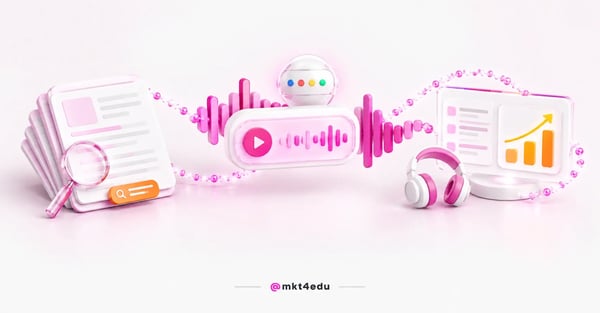 Caption: audio marketing does not replace text: it gives the same content a second way to be consumed, and a second chance to be measured
With a player at the top of the page, people can choose to listen to a post instead of reading the paragraphs. The format also covers longer material: an ebook already used to capture leads becomes an audiobook without a rewrite.
Audio marketing and voice marketing are not the same
It is worth separating the two terms, because they often show up together and solve different problems. Audio marketing is about delivery: the content your institution publishes, available as sound. Voice marketing is about entry: how people search by speaking, in assistants and in voice search, and how content answers that kind of question.
In practice the two meet. Content structured well for voice marketing is usually the same content that sounds natural when narrated, because both ask for short sentences, an explicit question and a direct answer right below it.
Why are audio posts interesting?
Since doing several things at once is now the norm, reading a full blog post or ebook has become hard. The process is constantly interrupted by messages, notifications and work.
By betting on an audio format, your institution creates more versatile content, consumed both by people who want to skim and by people who prefer to listen while doing something else. That is a gain in reach, not in ranking: the same piece starts reaching a moment of the day that text never did.
There is also the accessibility gain, which rarely makes it into the business case and should. Narrated content serves people with low vision, people with reading difficulties and people who simply read slowly on screen. For an educational institution, that is not a product detail: it is consistency with what it claims to be.
One honest caveat about numbers: percentages of engagement lift from audio players circulate widely without a source, a methodology or a sample size. Instead of repeating a figure nobody can audit, measure your own: publish the player on a set of pages, let it run for a cycle and compare against pages without one.
How did AI change audio production?
Until recently there were three options for recording, each bad in its own way: platforms that read the text in a robotic voice, dubbing companies working to order, or the team reading and recording it themselves. The first delivered a poor experience, the other two cost money or depended on someone having time.
Generative AI (Artificial Intelligence) knocked that trio down. Neural voice synthesis reached a point where narration sounds natural, with pauses and intonation, and the cost per piece became a fraction of what it was. Audio summary tools can turn a document into a two-host conversation: NotebookLM's Audio Overviews, for example, already run in Brazilian Portuguese and in more than 50 languages.
Settle the tone before you hit play
Once producing became cheap, the hard decision stopped being technical and became editorial. The marketing tone of voice types your institution can adopt completely change how the same sentence reads, and it is worth choosing before generating a hundred files in the wrong voice:
- Institutional: sober and measured, suited to announcements, regulations and authority content.
- Instructional: slower pace, emphasis on new terms, good for explaining a concept to beginners.
- Conversational: close to how people speak, works well for recruitment content and younger audiences.
- Narrative: used in case studies, student stories and podcasts, where emotion is part of the message.
Among the marketing tone of voice types, the most common mistake is mixing them: a conversational tone on an enrollment announcement, an institutional tone on a blog post. Pick one per content type and write it into your editorial guide.
And one guardrail worth writing down: synthetic voice does not remove the need for review. Proper nouns, acronyms and numbers are where it slips, and in an educational institution getting a course name wrong is worse than having no audio at all.
How do you measure audio marketing in Google Analytics?
Here lies the most important correction in this text. For years the advice was to track Time on Page and use it as proof that audio was working. That metric belonged to Universal Analytics, which has been discontinued.
In GA4, the Pages and screens report, the available metrics are average engagement time, key events, event count, total revenue, views, views per active user and active users. There is no "average time on page", and average engagement time measures how long the site was in focus in the browser, not how long someone spent on a specific page. Telling the team to watch a metric that does not exist is the fastest way to kill the measurement.
Add the second adjustment: Google states publicly that time on page is not a ranking factor. In December 2022, John Mueller answered a question on the subject by saying the number does not appear in Search Console precisely because it does not count. So the correct promise of audio marketing is not "it ranks higher", it is "it reaches people who were not going to read".
So what should you measure
- Play event: fire a GA4 event when someone hits play. That is the number that says whether anyone uses the player.
- Listening progress: milestones at 25%, 50% and 75% show whether the audio holds attention or is abandoned in the first minute.
- Average engagement time on the page with a player compared to the page without, over the same period.
- On-page conversion: what matters in the end is whether the resource was downloaded or the form was filled in.
With those four you can say whether audio marketing is worth it for your audience, with your own number, instead of repeating a percentage from a study nobody can open.
And a discipline reminder: your institution's digital marketing strategy measures by channel and by format. If audio enters without an event of its own, it disappears into the page's aggregate number and you will never know whether it paid off.
How do you build a complete audio marketing strategy?
Once you know what it is, the question is what to do first. Creating an audio version of everything your institution has ever produced generates cost without proportional return. A content marketing strategy means choosing.
1. Pick content by what it already delivers
Use an SEO tool such as SEMrush to identify which of your pages rank best. Those already get traffic, which is why they benefit most from a second format. Pay attention to keyword search volume too: content with little demand rarely pays back the time spent producing the audio.
That selection is part of content planning and runs alongside the SEO strategy: audio does not create demand on its own, it takes advantage of the demand text already captures.
In practice, that means the audio calendar is born from the same content planning that already exists, and the candidate list comes from the same report the SEO strategy uses to prioritize topics. Two separate lists become two routines, and the second one dies.
2. Look at what competitors do, and what they do not
A good signal of where to invest is the competition. See what the institutions competing for your students have been publishing, look for patterns and identify which formats perform better. The empty space informs too: a relevant topic nobody has narrated is cheap opportunity.
3. Produce, review and standardize
With the list in hand, generate the narration, review proper nouns and acronyms, and standardize the tone according to the previous section. A content production strategy that treats audio as the final step of the same editorial flow, rather than a side project, is the one that keeps the cadence.
4. Consider audiobooks
Those ebooks you use to capture leads tend to be more attractive as audio. The audiobook does not replace the PDF: it becomes a second option on the same landing page, and usually lifts the download rate without requiring new content.
Where does audio fit in the educational marketing strategy?
Audio marketing is not an isolated channel: it is a format that cuts across the whole educational marketing strategy. At the top, it widens the reach of content that already attracts. In the middle, it deepens the relationship with people who came back. At the bottom nothing replaces the conversation, but audio prepares the ground.
Inside an inbound marketing strategy, audio is one more door to the same content. Someone who would not read the article listens to the summary and moves a step down the journey. When they hand over an email to download the audiobook, the inbound sales strategy takes over: the team approaches whoever showed interest, with the context the record kept.
It is worth noting the fit: a mature inbound marketing strategy already has resources, landing pages and nurturing. Audio asks for nothing new, just one more track on each piece, and HubSpot CRM logs that interaction like any other.
That record is the CRM. In HubSpot CRM, every download and every visit sits in the same history, so the team knows whether the applicant listened to the audiobook before the call. That is what stops audio from becoming a loose vanity metric on one side and the conversation from starting at zero on the other.
At the top of the funnel, AI SDR agents (SDR stands for Sales Development Representative, the role of qualifying whoever arrives) answer the applicant in minutes and ask what is missing to qualify them. Audio and AI SDR agents solve opposite ends of the same problem: one widens who arrives, the other makes sure whoever arrived is not left unanswered. How that works is in SDR agent.
In the full picture of the institution's digital marketing strategy, audio is one of the formats; measurement and the record are what turn it into a marketing strategy rather than an experiment. To see how written content holds that base together, read how to create a successful blog.
Frequently asked questions about audio marketing
So, is audio marketing worth investing in?
It is, with the right promise. Audio marketing is not a shortcut to rank higher on Google: it is a way to reach people who were not going to read, to serve people who need accessibility and to extend the life of content you have already produced. With synthetic voice at its current level, the cost of testing is small enough that not testing is the more expensive decision.
The practical path: pick the pages that already perform, settle the tone, generate and review, instrument the play event in GA4 and compare against equivalent pages. In one cycle you will have your own number, which is worth more than any percentage from a study with no source.
If you want to build that design alongside your content production strategy, talk to our team.













 Portugal