


You sense your institution's recruitment process needs work, but you do not know where to begin. The report shows numbers, the meeting shows opinions, and the budget ends up with whoever argued best. A diagnostic assessment exists to replace that criterion.
It is a 360º analysis of the digital strategy you already run. It shows how the brand performs, which strengths are underused, where the improvement opportunities sit and which paths to take.
It sounds complex, but the principle is simple: before investing more, find out where the current money is leaking.
What is a diagnostic assessment and why should your school care?
A digital marketing diagnosis is the set of analyses that measures how a brand performs online and identifies what undermines the relationship with students and customers. It is needed even by those who already have a defined strategy, because a plan on paper does not guarantee execution in the real world.
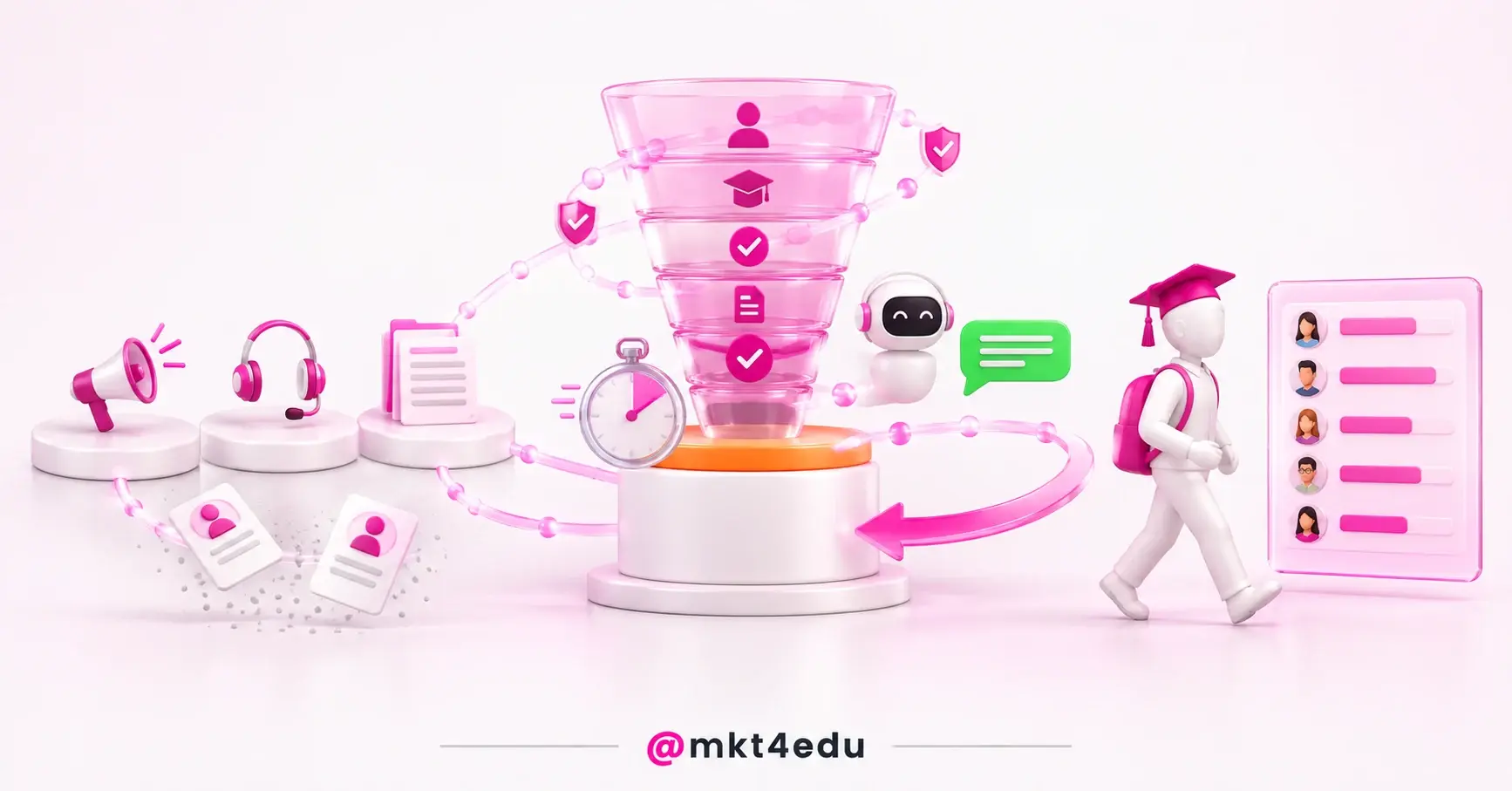
 Caption: A diagnostic assessment does not measure everything at once: it isolates the channel blocking enrollment and sets the order of attack.
Even well built inbound and outbound plans need constant review. The diagnosis reveals bottlenecks invisible to the naked eye and guides priorities on data rather than intuition.
Context explains the urgency. In Brazil, 993,000 children and teenagers aged 4 to 17 were out of school, according to the 2024 national household survey analysed by UNICEF and released in July 2025.
The figure is lower than in previous years, which is good news, and still high enough that no institution should treat retention as a settled matter. Dropout is not only a social problem: it is revenue that arrives and does not stay.
For a private institution, the effect lands in two places at once: fewer candidates at the top and more cancellations at the base. A marketing plan that only watches recruitment sees half the problem.
What can a diagnostic assessment evaluate?
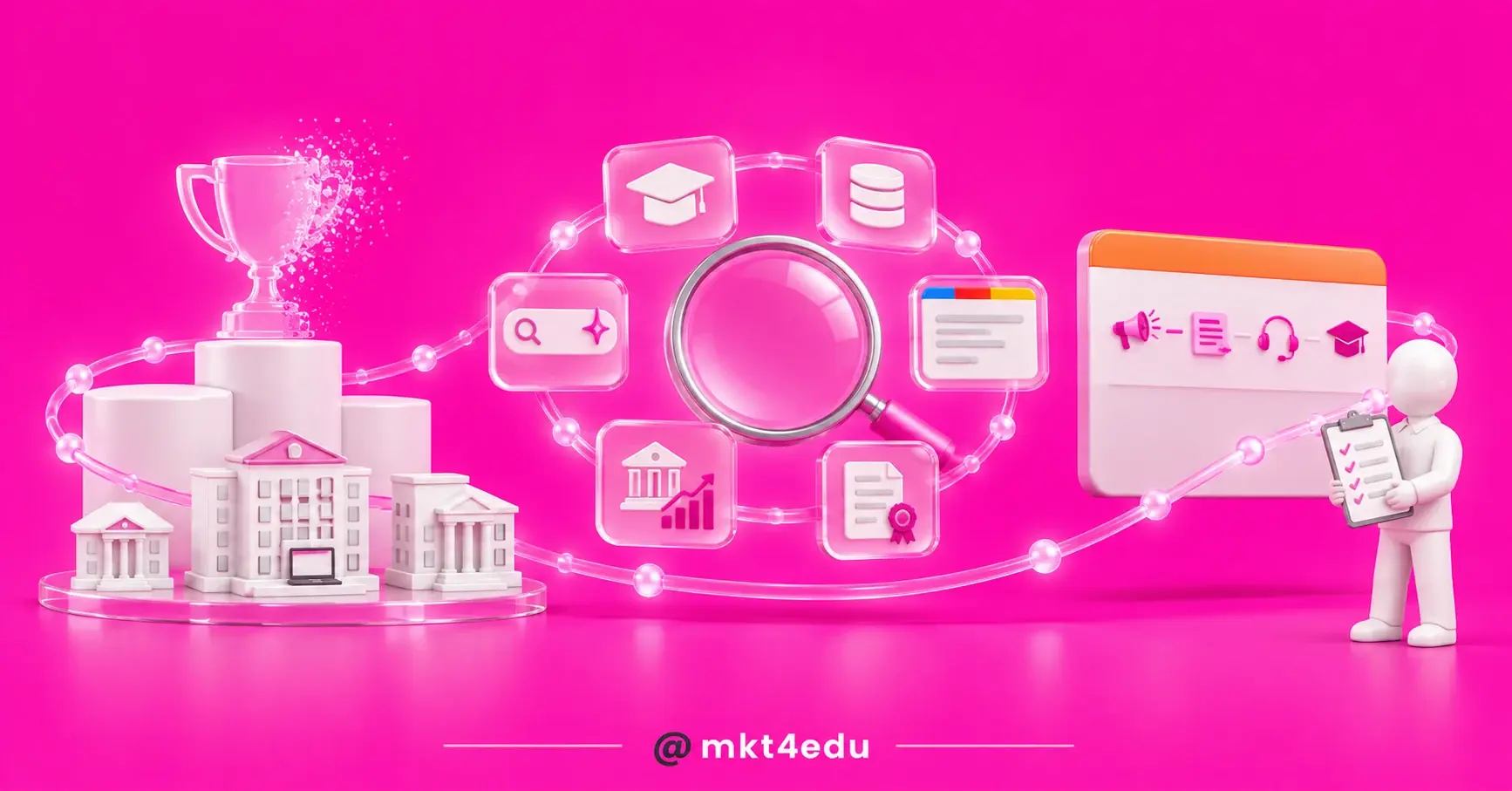
A diagnostic assessment examines four fronts: presence and performance across channels, the technical and content health of the website, the quality of the relationship recorded in the CRM (Customer Relationship Management) and the external market context. None of them explains the result on its own.
Start with the simple questions. Which channels is your institution on? Is publishing consistent? Is the content relevant to the people you want to attract? Social media metrics and website traffic analysis answer all three.
Organic performance and SEO
Watching how your blog posts rank shows whether the SEO strategy is working. A drop in position and a drop in clicks tell different stories, and only reading them together separates a content problem from a technical one.
Bear in mind that SEO strategies take months to show effect, while organic traffic can fall within weeks for technical reasons. Confusing the two rhythms leads teams to abandon what was just starting to work.
On the technical layer, include Core Web Vitals in the audit: LCP for loading, INP for responsiveness and CLS for visual stability. Google recommends achieving good Core Web Vitals for success in Search and describes page experience as aligned with what its core ranking systems reward, which is different from an isolated ranking factor.
That distinction matters when prioritizing. Fixing an INP above 200 milliseconds helps the experience and may help performance, but it does not replace content that answers the query. Anyone promising rankings in exchange for a technical score is selling what they do not control.
It is worth auditing a drop in organic traffic as an item of its own, because the cause is rarely the one that looks obvious at first.
And since part of search moved to generated answers, today's audit also looks at AI citation. SEO for LLM covers what changes when the first reader of your content is a model rather than a person.
Relationships and database
A thorough review has to assess the relationship through the analytical view of the CRM software. That is where you see how long a lead waits for an answer, how many contacts have no owner and at which stage the conversation dies.
The importance of CRM for companies becomes obvious precisely in the diagnosis: without centralized history, there is no way to reconstruct the journey that led to enrollment or to withdrawal.
Teams running on HubSpot CRM have an easier job here, because source, stage and history already live in the same record.
Even so, HubSpot CRM is not a prerequisite. A digital marketing diagnosis works in any CRM with reliable history; what blocks the analysis is a leaky database, not the brand of the tool.
Paid media, email and content
Paid media management enters the diagnosis through cost per result, not volume of impressions. A channel delivering cheap clicks and no enrollments is expensive waste, and that only shows once media data meets enrollment data.
A marketing plan that does not review paid media management every cycle pays dearly for inertia: tired creative and saturated audiences keep burning budget long after they stop converting.
Email marketing strategies are judged by the whole sequence, not by open rate alone. What matters is how many contacts move a stage after the flow.
And social media strategies enter through the qualified conversation they generate, not through follower count. A large audience that never asks about a programme is vanity, not recruitment.
In practice, email marketing strategies and social media strategies are assessed together, because they compete for the same contact at different moments of the decision.
Which methods support a diagnostic assessment?
Four methods give a diagnostic assessment its backbone: SWOT analysis, the CSD matrix, RFM analysis and consumer journey mapping. They do not compete with one another, each answers a different question about the same business.
SWOT analysis identifies internal strengths and weaknesses and points out external opportunities and threats. It is the oldest frame on the list and still useful for separating what you control from what you merely endure.
The CSD matrix organizes Certainties, Suppositions and Doubts by team, which lowers execution risk by making explicit what nobody has tested yet.
RFM analysis segments by Recency, Frequency and Monetary value, prioritizing offers and nurturing sequences for the people most likely to respond.
Consumer journey mapping closes the set, because it shows where in the decision the candidate stopped advancing. Without it, the diagnosis knows a loss happened but not where.
One obvious point tends to get forgotten: a method is not a deliverable. It organizes the reading, and deciding what to do with the result stays human work.
How does a diagnostic assessment help recruitment and retention?
A diagnostic assessment helps recruitment and retention because it changes the question. Instead of asking how to bring in more candidates, it asks why the candidates who already arrived did not advance, and that answer is usually cheaper to act on.
The most valuable material here is your students' opinion. Based on the view of people who already know the institution, you can build a recruitment diagnosis and a retention diagnosis grounded in real experience rather than assumption.
Student retention responds quickly once the diagnosis pinpoints the moment a student starts drifting away, because early intervention costs less than late recovery.
On the entry side, student recruitment improves when the diagnosis shows which channel brings candidates who actually enroll, not simply which channel brings volume.
Inbound marketing strategies benefit directly from that, because topics get chosen by the real doubt blocking the decision rather than by the writer's intuition.
The same holds for inbound sales strategies, which receive the contact with source and interest already attached, and for outbound marketing strategies, which stop approaching people who never had a chance to convert.
Taken together, marketing strategies stop competing with each other, and digital marketing strategies get cheaper without losing reach, because they stop paying for an audience the data already showed does not respond.
Where does AI fit into a diagnostic assessment?
AI (Artificial Intelligence) enters a diagnostic assessment at two points: processing a volume of open responses no team would read by hand, and estimating dropout risk before it becomes a cancellation. Both depend on an organized database to work.
There is practical evidence for the second use. Machine learning models raise the effectiveness of retention interventions when they combine prediction with targeted action, according to a peer reviewed study.
Transparent criteria and data governance remain essential. A model that flags a student at risk without explaining why guides no action, and it breeds internal distrust of the diagnosis itself.
Artificial intelligence in education shows where that layer has left the pilot stage and where it is still a promise, a distinction worth keeping before contracting any tool.
Once the parameters are set, the collected data turns into easy to read charts, which lets you analyse both the overall picture and each variable in isolation.
How do you know your institution needs a diagnostic assessment?
Four signals show a diagnostic assessment is no longer optional: the budget grew and enrollment did not, nobody explains the month's drop, each department reports a different number for the same question, and channel decisions turned into a contest of opinions.
None of those signals is solved by spending more. They are solved by visibility, which is exactly what a digital marketing diagnosis delivers before any purchase recommendation.
Numbers do not lie, but they change. A diagnostic assessment done once and filed away is worth little; the value lies in repeating the exam and comparing it with the previous reading.
In education specifically, the assessment has to read the recruitment calendar alongside the funnel, because the candidate's decision cycle is seasonal and a weak month may be perfectly normal.
The difference between a generic digital marketing assessment and an education marketing assessment lies in what each treats as normal: a January drop is seasonality in one and an alert in the other.
That calibration is what keeps digital marketing strategies aligned with what actually happens in the cycle, instead of aligned with another sector's calendar.
This is where an education marketing consultancy helps more than a new tool: someone who has seen the pattern across institutions recognizes seasonality and separates noise from problem.
Teams that prefer to start alone will find a first reading routine in campaign data analysis, and in dashboards the way to keep the tracking standing after the diagnosis.

Frequently asked questions about diagnostic assessment
Where to start your diagnostic assessment?
Start with what you already have. Before hiring a tool or a consultancy, gather the last twelve months of numbers for each channel, standardize what counts as a lead and what counts as an enrollment, and see how many questions the history already answers.
From that base, the order is predictable: identify the biggest bottleneck, estimate the gain from fixing it, act on one point and measure before moving to the next. A diagnosis that produces twenty simultaneous recommendations produces none.
An education marketing consultancy fits well from here, once the priority list exists and what is missing is the hands to execute without stopping the operation.
Record the baseline reading before changing anything. Without it, next quarter's improvement turns into an argument about what caused what.
If you want to run that exam with a team that knows the sector's recruitment cycle, talk to us. We start from what your data shows, and only then propose what to change.















 Portugal