






The sales funnel in education has stopped looking like a funnel: it moves back and forth, lasts years and does not end at enrollment. That pattern breaks most of the targets still designed as if candidates only moved forward.
The market explains the pressure: Brazil's 2024 Higher Education Census, released by Inep in September 2025, recorded 10,227,266 undergraduate enrollments, with distance learning at 50.7% of the total. It was the first time the online format overtook on-campus study in the country.
The detail that changes campaign design is the pace of that growth. Online enrollments grew 5.6% over 2023, far below the 20%-plus yearly rates of the expansion years, while on-campus enrollments fell 0.5%. New demand stopped showing up on its own.
When easy growth ends, every enrollment your institution wins comes from the preference of a candidate already in the market, and preference is built across the whole funnel, not in the month of the campaign.
Why is the sales funnel in education not linear?
The sales funnel in education is not linear because the decision to study is never settled in one sitting. Candidates compare institutions, disappear for weeks, come back with another doubt and slide from decision back to consideration as often as they need, and no fixed sequence of stages describes what actually happens.
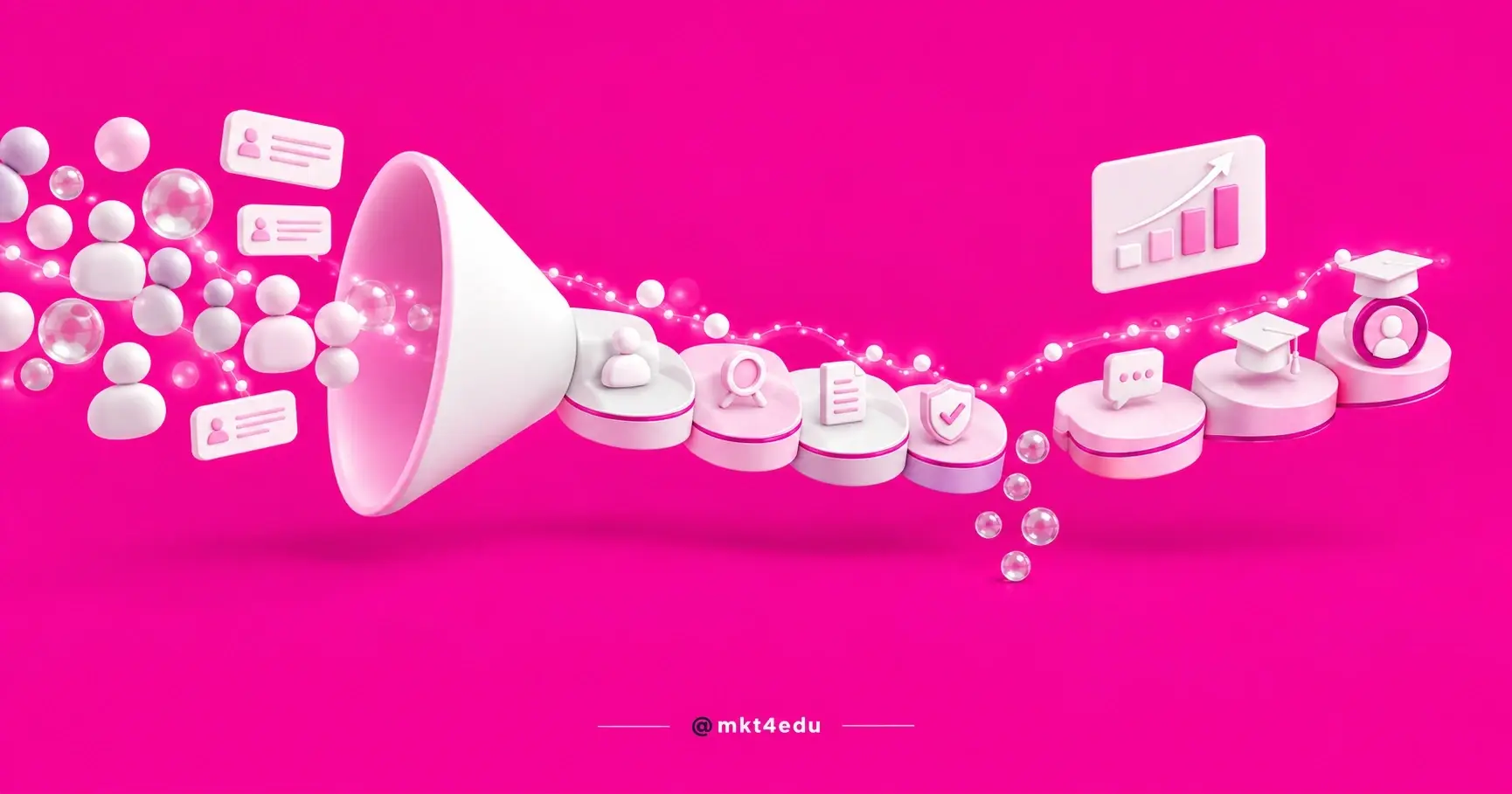 Caption: The education sales funnel loses width at every stage, and the biggest leak happens near the end, between approval and enrollment.
Drop the picture of the funnel as sequential steps: the same lead who asked about your program is asking about three others, and the stage showing in your report is only the latest record, not the real state of the decision.
Simultaneous access to information sped up that back and forth: search engines, social networks, messaging groups and, more recently, AI (Artificial Intelligence) assistants deliver instant comparison of institutions, price and reputation without the candidate talking to anyone.
That instant comparison forces institutions to be present at several touchpoints at once, carrying the same information. A single-channel strategy aged alongside the linear funnel, and anyone working a sales funnel with LLMs already sees the effect in lead origin.
There is also the costliest limit of all: recruitment does not end at the entrance exam. Open the report of accepted candidates against enrolled students and the gap between the two columns speaks for itself.
You only have a student once enrollment is completed. Any target hit at approval is celebrating an intermediate step, and that confusion is where most of the recruitment budget disappears.
What are the stages of the consumer journey in education?
The stages of the consumer journey in education add up to seven across the full funnel: prospect, interested, applicant, accepted, enrolled, active and loyal. The first five belong to recruitment and the last two to retention, a split that usually explains why they end up without an owner inside the institution.
Here is how each one is organized and what it asks you to measure:
|
Stage |
What defines it |
What to measure |
|
Prospect |
Knows the institution, has asked for nothing |
Reach and repeat visits |
|
Interested |
Left contact details or asked for information |
Cost per lead and response time |
|
Applicant |
Signed up for the selection process |
Application rate over leads |
|
Accepted |
Approved and has not completed enrollment |
Accepted over enrolled |
|
Enrolled |
Contract signed and place taken |
Acquisition cost per student |
|
Active |
Studying and renewing each term |
Dropout by entry cohort |
|
Loyal |
Returns for graduate study or refers others |
Alumni revenue and referrals |
Table: The seven stages of the education sales funnel and the indicator that supports each one.
Reading by cohort changes the diagnosis: following the group that entered in a specific term shows where it dissolved, while the aggregate enrollment number hides exactly that movement.
Every stage needs its own owner, target and deadline. Once the funnel talks to the buyer journey inside a revenue operation, those boundaries stop being an org chart debate.
How do you prospect for new students before the entrance exam?
To prospect for new students, an institution has to show up years before the application, with active presence in the school community around it. Anyone who only calls when the notice opens is competing for attention at the noisiest point of the calendar, against every competitor at once.
Recruitment starts in secondary school and, at basic education institutions, earlier still, with younger students. The horizon is three years, not three months.
Projects with other schools, events open to the community, talks for parents and guided campus visits build familiarity before the decision. These actions generate no immediate lead and are usually the first to be cut when budgets tighten.
Content sustains the gap between first contact and application. A blog with material segmented by school year, webinars for families, facility videos and alumni stories keep the institution present without demanding that the candidate be ready to buy.
This is inbound territory, and understanding what inbound marketing is and how to prospect avoids the most common mistake of the phase: treating someone still discovering as if they were already choosing.
Knowing how to prospect for new students is also a question of calendar. Spreading actions across the year avoids concentrating budget in the window where cost per lead is highest, as a student recruitment calendar organized month by month shows.
Why is mapping the consumer journey essential?
Mapping the consumer journey is essential because it shows the exact point where enrollment is lost. Without it, the institution knows how much came in and how much converted, but not which step the candidate abandoned, so it invests more at the top to compensate for a leak sitting in the middle.
The map pairs each stage with the marketing and sales action that supports it. When many accepted candidates fail to enroll, the problem is rarely the campaign: it sits in the follow-up, the deadline or the friction of the enrollment process.
There is a practical difference between tracking metrics and mapping the journey. The metric says conversion fell, and the map says where and why, and that second answer is what turns a number into a decision.
A future student is not just another customer. The institution delivers education, belonging and a credential that follows the person for life, and the journey has to match that.
That is why the work of mapping the customer journey starts by listening to people who went through the process, rather than by drawing the ideal flow in a meeting room. Understanding why mapping the consumer journey is essential means accepting that the real design is almost never the planned one.
How do you retain students after enrollment?
To retain students, an institution has to treat the active and loyal stages as part of the funnel, with their own targets and follow-up. Retention costs less than recruitment, and a retained student also opens new revenue in second degrees, graduate programs and extension courses.
The math favors retention, but only when the first experience supports staying. Alumni programs and special conditions for those who continue do not repair a degree in which the student felt like a number.
Follow-up has to work by cohort and by early signal: falling attendance, late payment and absence from the virtual learning environment appear weeks before a withdrawal request, and that window is when a conversation still works.
Knowing how to retain students is largely knowing when to speak. Once the student has decided to leave, the communication flow turns into chasing, and the return drops.
It is worth looking at the ROI of student retention before closing the next budget, because return per unit invested tends to beat recruitment in operations that already have a large base.
The meeting point between the two sides is organizational: when student recruitment and retention sit in teams that do not talk, the funnel breaks precisely at enrollment, where one team hands over and the other receives.
Knowing how to run student recruitment that holds up depends on this: the team that recruits needs to know what happens to the student afterwards, and the team that retains needs to know what promise was made before. Without that seam, student recruitment and retention become two operations competing for the same budget.
Frequently asked questions about the sales funnel
Where should you start rebuilding your institution's sales funnel?
Start with the step between accepted and enrolled, the point in the sales funnel where the candidate has already said yes and the institution still loses the enrollment. It is the cheapest and fastest repair in the whole path.
With that leak closed, the next step is giving owners to the active and loyal stages. They account for revenue that already exists and are almost always the only parts of the funnel without a formal target.
Only then does widening the top make sense: prospecting earlier pays off once the middle of the funnel stops leaking, and not before.
If your institution wants to structure that path with data instead of intuition, the Mkt4edu team can help design the funnel and the operation behind it. Talk to us through the contact page or see how content planning feeds the top of that funnel.
























 Portugal