






Higher education is not shrinking, but it is not growing fast either. Spring 2026 enrollment in the United States reached 18.6 million students, a 1.0% increase over the previous year, according to the National Student Clearinghouse.
Modest growth changes where the gains come from. When the pool stops expanding, the institution that wins is the one that loses fewer people along the way, which turns retention into a growth lever rather than a support function.
That is where automating marketing stops being an efficiency project and becomes an operating condition. Not because the technology is new, but because the math of manual follow-up no longer closes.
Adoption is already close to universal. In The Impact of AI on Work in Higher Education, EDUCAUSE found that 94% of the higher education professionals surveyed had used an AI tool for work in the previous six months.
The gap is in accountability. In that same study, only 13% said their institution measures the return on investment of those tools, which is how a technology budget quietly grows without anyone being able to defend a single line of it.
What does automating marketing actually solve for an educational institution?
Automating marketing solves three concrete bottlenecks: the candidate who gets no answer because the form arrived after business hours, the message that goes out identical to very different audiences, and the history that disappears when a contact moves from one department to another. It does not solve a weak program, misaligned pricing or an untrained front desk.
That distinction prevents the most common disappointment during rollout. Automation improves the execution of what is already decided; it will not repair an offer the candidate does not consider competitive.
The first bottleneck is time. A candidate who fills out a form at 10 p.m. and hears back two days later has already compared three other schools, so your message arrives as the fourth opinion instead of the first answer.
The second is relevance. Someone who asked about a graduate certificate and receives undergraduate admissions content concludes that nobody read what they wrote, and opens the next message with a good deal less patience.
The third is institutional memory. Without a shared record, the same candidate repeats the same details to the chat widget, the phone line and the registrar. Each repetition reads as disorganization to someone deciding where to spend four years.
High usage with low measurement tends to produce a predictable outcome: plenty of active licenses and very little clarity about what changed in the enrollment numbers. Naming one owner per tool fixes more of that than switching vendors.
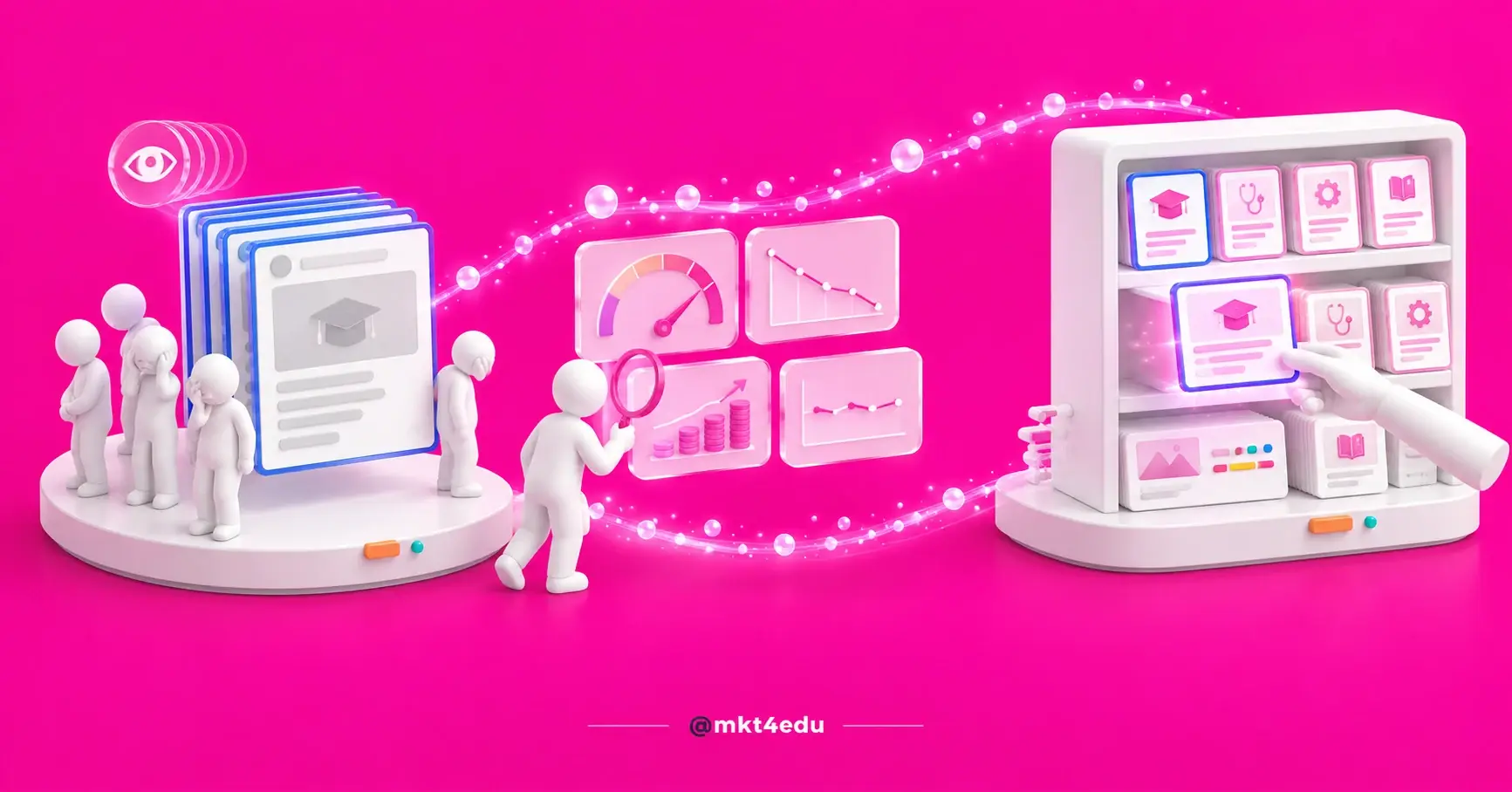
 Caption: Recruitment and retention are not two operations: they are the same student record, from the after-hours form to next term's re-enrollment.
How do you map the buyer journey before automating anything?
Mapping the buyer journey means naming the stages a candidate really moves through and defining what qualifies someone to enter each one. Without that map, an automated workflow becomes a fixed-interval email sequence that treats a person discovering the program the same as a person who already asked for a payment slip.
The journey of choosing where to study has a shape of its own. It starts early, months before the application window, and it involves more people than the candidate: parents, partners and employers all weigh in, especially in graduate programs.
It also has long pauses. A candidate may research in March, disappear, and return in November, so a workflow that drops people for inactivity discards exactly the person who was waiting for the cycle.
What defines the stage is behavior, not elapsed time. Downloading a career guide is discovery; checking the tuition page is decision, and those two actions call for opposite messages.
Naming the stages gives every workflow a job. Instead of a vague nurture track, each sequence gets a mission: get the contact to declare a program, book a campus visit, resume an abandoned application.
This is the same work as structuring a sales funnel in education, with one difference: here every stage has to become an entry condition the platform can actually read.
Why does Inbound Sales change the conversation your team has?
Inbound Sales changes where the conversation starts. Instead of dialing a list and explaining who the institution is, the advisor joins a conversation already in progress, with the candidate's history visible: what they read, which program they looked at, how many times they came back and what they answered on the form.
The difference shows up in the first thirty seconds of the call. A list-based approach opens by introducing itself; an informed approach opens with the subject the candidate already signaled interest in, and that changes how the other side listens.
It also changes the advisor's job. They stop having to build interest from zero and start removing one specific obstacle, which is almost always cost, schedule or the fear of balancing work and study.
Automation is what makes that possible at scale. It hands the enrollment team a queue ordered by behavior rather than a spreadsheet ordered by signup date, so the first call of the day goes to the warmest record instead of the oldest one.
For this to hold, the handoff rule has to be explicit. When a contact passes from marketing to enrollment, and what counts as a qualified lead, needs to be written down and agreed by both teams.
Without that agreement you get the classic standoff. Marketing says enrollment is not working the leads, enrollment says the leads have no quality, and both are looking at the same database.
How does CRM for education hold student retention together?
A CRM for education is what lets you treat recruitment and retention as one cycle. It keeps a single record from the first form through re-enrollment, so the candidate's history becomes the student's history without a break. Without that continuity, the institution wins a person and then restarts the relationship from scratch.
The practical value shows up in conversations about attrition. A student who stops logging into the virtual campus, falls two payments behind and ignores two messages is not a surprise: that is a pattern a system can recognize in advance.
What the CRM changes is reaction time. The conversation stops happening after the withdrawal request and starts happening in the week the signal appeared, which is the whole difference between retaining a student and processing a cancellation.
The same tracking organizes re-enrollment, which is the cheapest recruitment an institution has. A satisfied student in their next-to-last term is a far easier decision to sustain than a brand-new applicant.
All of it rests on organized data, and this is where data analysis tools for education stop being a talking point: the attrition signals already exist, usually in three systems that do not speak to each other.
Audience expectation pushes the same way. McKinsey reports that 71% of consumers expect personalized interactions, and that faster-growing companies derive 40% more revenue from personalization than slower-growing ones.
It is worth naming the limit. A CRM connected to marketing automation organizes and triggers, but it will not invent a relationship where the institution has no service process.
What role does AI play in spotting students at risk?
AI contributes on three fronts: reading signals, answering first-level questions and setting priority. It combines attendance, grades, payment status and interaction history to flag who is most likely to leave, replies to repetitive questions at any hour, and orders the queue the team should call first.
The real gain is arriving earlier. Retention depends on reaction time: a student wavering in week three of the term is recoverable, while the same student on cancellation day rarely is.
Automated first-line service handles volume. A large share of candidate and student questions repeat, and answering them immediately raises the odds the conversation continues. Deadlines, required documents and tuition ranges account for most of that traffic.
AI in content production is already the majority practice. HubSpot's State of Marketing report finds that 80% of marketers use AI for content creation and 75% use it for media production.
For an educational institution, that carries a hard editorial limit. Information about program accreditation, tuition amounts and financial aid rules cannot ship from generated text without human review, because an error there creates an enrollment problem and a trust problem at once.
The most mature setups combine both. Automated service handles triage and AI-supported enrollment shortens the path, while the sensitive decision stays with an advisor. The line between the two is drawn by what a wrong answer would cost.
Which educational marketing strategies should you automate first?
Rollout order matters more than the number of workflows. Starting with high volume and simple rules delivers a result in weeks and funds the next stage. Starting with the most sophisticated workflow usually burns three months of configuration and returns very little. Here is how the sequence organizes:
| Order | Workflow | Expected outcome | Complexity |
|---|---|---|---|
| 1 | Instant reply to form submission | Fewer contacts lost after hours | Low |
| 2 | Abandoned application recovery | Enrollments already started, finished | Low |
| 3 | Lead routing to the enrollment team | A queue ordered by behavior | Medium |
| 4 | Program-level segmented messaging | More candidates declaring a program | Medium |
| 5 | Attrition risk alert | A conversation before the withdrawal | High |
| 6 | Re-enrollment campaign | Persistence from term to term | High |
Table: Suggested rollout sequence, from the fastest-returning workflow to the one most dependent on consolidated data.
The first two items share a trait. Both act on people who already raised their hand, which is why they tend to show results before any new campaign does.
The last two require data most institutions have not consolidated yet. An attrition alert depends on access to the academic and finance systems, and that integration is a project in itself.
The full implementation path is the one described in the piece on marketing automation for educational institutions, which breaks down the benefit of each stage and the data each one assumes you already have.
How do you measure whether automating helped you attract more students?
Automation is judged by three numbers, and emails sent is none of them. What matters is how long a contact waits for the first reply, how many contacts advance a stage each week, and the cost per enrollment for that channel. Without those three, the review turns into a comparison of open rates.
The first indicator is the easiest to improve and the most ignored. Time to first contact measures precisely the bottleneck automation exists to fix, and if that number did not drop after rollout, something is switched off.
The second measures real movement. Stage-to-stage advance rate shows whether the messaging is making candidates act, or merely getting delivered. A stage that never advances is either asking for the wrong action or asking for it too early.
The third connects marketing to finance. Cost per enrollment by channel is the number that supports a budget request with leadership, and the only one that compares channels of different natures.
One retention indicator closes the loop. Term-over-term persistence, read by program and by cohort, shows whether the recruitment effort is producing students who stay. A channel that fills seats and loses them by the second term is not a cheap channel.
To reach those numbers honestly, contact source has to be captured at entry and preserved through enrollment, which is the starting point of any measurable student recruitment strategy.
Frequently asked questions about automating marketing
So what should you automate before hiring more people?
Automate what is repetitive, rule-based and high in volume: the first reply, the abandoned application reminder, the routing of contacts to the enrollment team. Keep your people for what decides enrollment, meaning the conversation about cost, financial aid and fitting study into an existing routine. That split is what separates an operation that scales from one that simply runs harder.
Order also matters for team morale. One simple workflow live in two weeks convinces leadership faster than a six-month integration project, and a visible win buys patience for the harder integrations that come after it.
One thing does not change. Automation, CRM and AI trigger the process you already have; none of them creates a process where none exists, so the first workflow usually doubles as a good excuse to write that process down.
Your flows are running. Are students enrolling?
We open your workflows and show you the exact stage where candidates stop replying. Talk to the mkt4edu team and get a read on your recruitment and retention operation.
Keeping students enrolled means constant contact without growing the team, which is where AI applied to retention earns its place.


























 Portugal