





Every year, hundreds of higher education institutions (HEI) repeat the same dispute, with the same exam candidates, the same registration window and the same space on the first page of Google.
Internet access is no longer the bottleneck in that dispute. In Brazil, the Continuous National Household Sample Survey run by IBGE, the national statistics office, recorded 95.0% of Brazilian households connected in 2025, the equivalent of 76.0 million homes.
The choice between SEO and SEM organizes what to do with that connected audience. One front builds visibility that accumulates through the year, and the other buys presence at the exact moment entrance exam searches spike.
What changed was the design of the search engine results page (SERP) itself. The AI generated answer took the top, the organic click became more contested, and the paid media auction now competes with that block.
The case for working both fronts still stands, but the reason changed, and that change decides where the budget goes first.
What is SEO and what does it deliver in an exam campaign?
SEO is the set of techniques that makes a page findable, indexable and visible in the unpaid results of Google. In a college entrance exam campaign, it accounts for everything the candidate finds without clicking an ad, from the article about cutoff scores to the course page itself.
When the candidate searches for "best colleges", "where to study business" or "how to pass the entrance exam", the institution that shows up is the one that worked on content beforehand. That gain in visibility without media cost is what the market calls organic positioning.
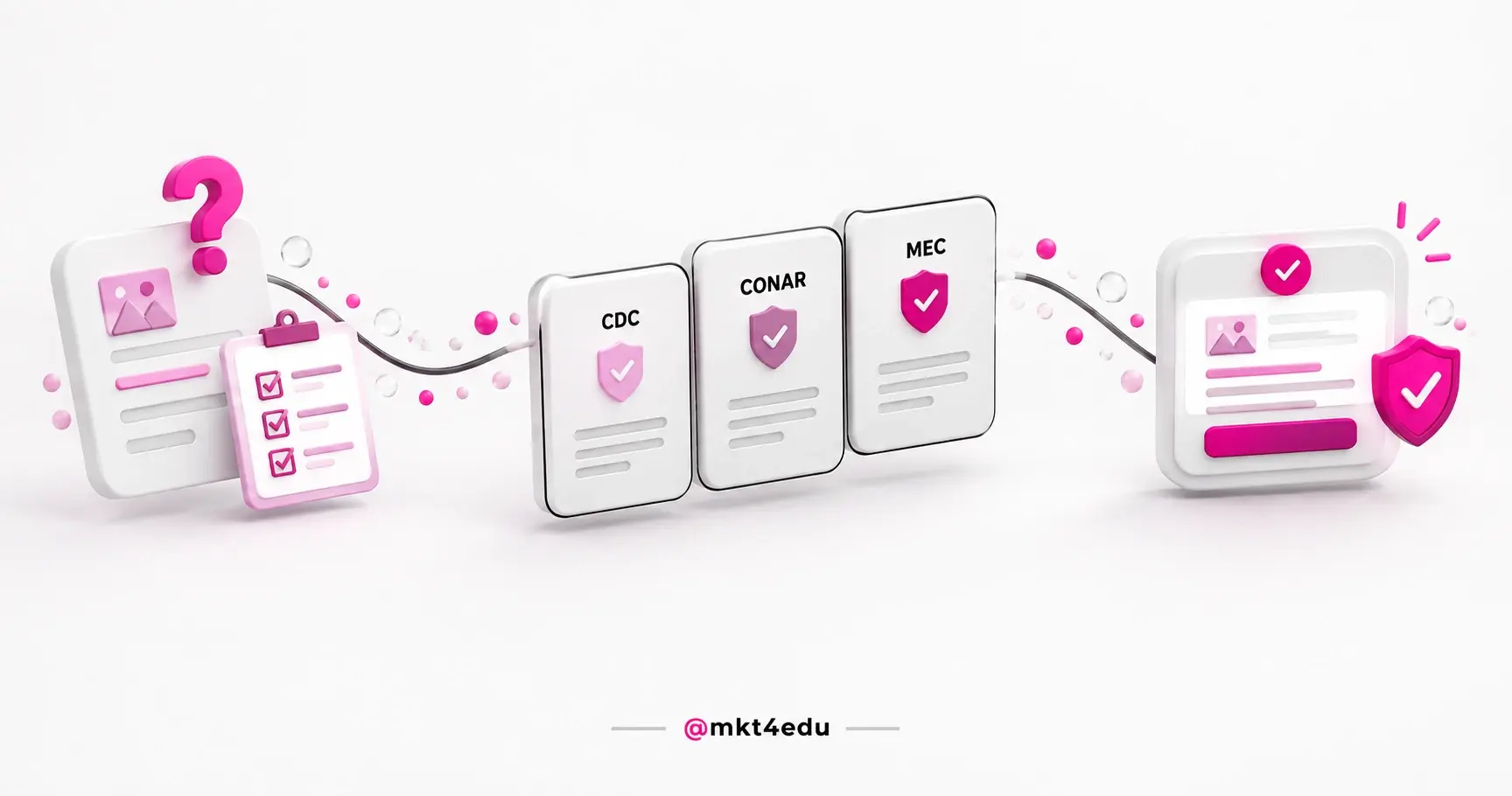
 Caption: SEO and SEM hold different places in the same entrance exam campaign: one compounds over the year, the other buys the moment.
The work has two layers. The first one is technical, with pages that load fast, a readable heading structure and careful user experience (UX) on mobile, which is where most of the searching happens while the candidate is still deciding where to apply.
The second layer is editorial. Blog posts that answer a real candidate question, complete course pages and rich materials build the library that sustains a Google ranking position outside registration season.
Having a good looking, well written blog does not multiply applications on its own. Blog posts have to be optimized for the search the candidate actually runs, with the words the candidate types into the box, and not with the vocabulary of the academic catalog.
The effect compounds. An optimized site and blog reach more people, more reach improves the ranking, and a better ranking returns more qualified visits to the entrance exam campaign.
That accumulation answers the question a finance director always raises: is SEO worth it at an institution with a tight budget? The organic traffic earned in this cycle keeps delivering candidates in the next one, with no new media spend.
What is SEM and how does Google Ads work for entrance exams?
SEM is the purchase of space on search engines, paid for on every click received. In an entrance exam campaign, it puts the institution at the top of the page on the day registrations open, without the maturation time that organic search demands.
The platform that runs that auction at Google is Google Ads, which was called Google AdWords until July 24, 2018. The rename also moved the account address, which went from adwords.google.com to ads.google.com and stayed there ever since.
The distinction matters when someone sits down to study the subject. Material that still teaches AdWords as the current name tends to be outdated in far more than the label, because the interface, the campaign types and the bidding logic changed along with it.
Today the platform concentrates automated formats, such as the Performance Max campaign, which distributes the same ad across Search, YouTube, Discover, Gmail and Maps.
The click value does not decide first place on its own. Google also weighs the quality of the landing page and the coherence between the ad and what the page delivers, which is how SEO work lowers the cost of paid media.
An institution that keeps a slow course page, with no information on scores, price and admission routes, tends to pay more for the same click as the competitor next door.
Execution carries its own seasonality rules, and paid advertising for colleges and schools pays off more when the offer is already clear on the page before the ad goes live.
What changes for SEO and SEM with AI generated search?
The results page stopped being a plain list of blue links. With the AI generated answer at the top and with queries running inside assistants, part of the research ends before the click, and that redistributes the value of every position in SEO and SEM.
Google states that there is no additional requirement to appear in AI features, and no special optimization is needed: the page has to be indexed and eligible to appear with a snippet in ordinary search.
In student recruitment, that pushes the effort back toward what already sustained organic search. Content with a named author, verifiable data and a clearly attributed source tends to be cited more often by answer systems, and to hold up better when a human checks it.
That is where E-E-A-T comes in, the acronym for experience, expertise, authoritativeness and trust. It names the bundle of quality signals used to judge the credibility of a page, of the institution behind it and of whoever puts a name on the byline.
At a higher education institution, E-E-A-T is built with a program coordinator signing the text, employability data backed by a public source and an institutional page that makes clear who answers for the information published there, including the date it was last reviewed.
The shift in behavior is detailed in the piece on SEO in the AI era, which shows how the query changed shape once the answer started arriving ready made.
The citation mechanics of large language models (LLM) follow another logic, and the answer to how to rank in AI starts with self-contained passages, each one carrying a named source, a verifiable number and enough context to be quoted on its own.
Knowing how to rank in AI became an editorial criterion, including for the text that explains cutoff scores and admission routes.
Every diagnosis of SEO in the AI era lands on the same point: the passage that answers on its own survives the cut the system makes of the page.
Voice search enters the same equation, because a spoken query is longer and closer to a whole question than to a string of keywords.
The numbers on the growth of Google voice search show how big that habit already is in search.
In an entrance exam campaign, whoever already writes in question and answer format starts ahead, because the same text feeds the AI block and serves the voice search the candidate runs.
Google voice search usually carries local intent attached, of the "nursing school near me" kind, which ties that habit directly to the local SEO of the institution.
On the paid side, the change is about competition. With fewer clicks left below the answer block, the entrance exam auction tends to get more expensive exactly in the peak weeks, which turns user experience on the landing page into a cost factor.
SEO or SEM: which costs less and which responds faster?
Neither one is cheaper in absolute terms, because they charge in different ways. SEM charges per click and delivers the same day, and SEO charges in production and in time, and delivers a library that keeps working after the campaign ends.
The comparison gets clearer with the decision criteria side by side, and this is how they break down:
The time frame row is the one that usually settles the split. An institution that starts planning recruitment two months before the entrance exam has no room to build organic positioning, and SEM becomes the only lever available in that cycle.
Customer acquisition cost (CAC) tells the same story from another angle. A campaign sustained only by paid media tends to hold CAC steady or rising, and a campaign with a mature organic base usually sees average CAC fall as the content library grows.
Return on investment (ROI) from organic search shows up late and is harder to attribute, which explains why many teams abandon the front far too early.
The question of whether SEO is worth it rarely settles in the first quarter, and that is why it has to enter the budget as a fixed line, and not as whatever is left over from media.
A Google ranking position earned through content does not vanish when the monthly budget runs out, unlike the ad, which disappears the same day.
How to split SEO and SEM across the entrance exam calendar?
The calendar resolves the false choice between SEO and SEM. Organic search takes the low months, when the candidate is still researching courses and careers, and paid search concentrates the budget in the registration weeks, when the decision happens and competition gets expensive.
The preparation window, between the end of one cycle and the start of the next, is when an SEO checklist pays off most. That is where technical review, course page rewriting and cleanup of outdated content fit.
An SEO checklist for an education institution usually covers four fronts, and none of them depends on media budget:
- Technical performance, with loading speed and stable navigation on mobile.
- Content architecture, with complete course pages and blog posts linked to them.
- Local SEO, with an updated campus listing and one page per unit when there is more than one address.
- Trust signals, with identified authorship and data backed by a public source.
Local SEO deserves attention of its own in on-campus admissions, because the course search usually comes attached to the city name, and an outdated campus listing kills conversion.
The course page is where the two fronts meet. Treating it as a product that ranks on its own is what Product-led SEO proposes, instead of leaving the blog to carry the weight of acquisition alone.
Product-led SEO works well in education because the catalog already exists and is large. Each course, shift and delivery format is a real query, with intent closer to enrollment than any top-of-funnel article.
As the season turns, paid budget takes the lead. The combination of paid and organic traffic pays off more when the ad sends the visitor to a page that already had authority, and not to a landing page built the night before.
How to measure SEO and SEM and react to an organic traffic drop?
Measuring SEO and SEM starts by separating what each front delivered. Paid search has cost per click and conversions tracked inside the platform, and organic search requires crossing Google Analytics 4 (GA4) with Search Console to know which query brought which candidate.
A useful SEO report answers three questions: which queries bring people, which pages convert and what changed since the previous cycle.
The walkthrough for building that SEO report in GA4 starts by isolating the organic channel from the others, before comparing any number between periods.
SEO analysis does not end at the report. A sound reading compares average position, click-through rate and conversion for the same page over time, to separate lost position from lost clicks with the position held.
That distinction became central with the AI generated answer block at the top, because a page often holds its position and loses clicks anyway, something an SEO analysis based only on session volume never sees and a team then misreads as a content problem.
Facing an organic traffic drop, the first step is to date the event and cross that date with algorithm updates, site changes and recruitment seasonality.
Not every organic traffic drop is a technical problem. At an education institution, the end of registration season pulls volume down predictably every year, and confusing seasonality with a penalty leads to rewriting content that was working.
On the SEM side, the equivalent read is quality score and cost per click by term, which show where the budget leaks on queries that never turn into applications.
Frequently asked questions about SEO and SEM
Where to start with SEO and SEM in the next campaign?
Start with the calendar, not with the tool. Look at the registration opening date of the next entrance exam and count backwards: what depends on time, such as content and technical fixes, has to start now, and what depends on budget can wait for the peak window.
If the campaign opens in less than eight weeks, SEM carries the cycle, and SEO enters as preparation for the following one. If there is more room, the order flips, and paid media becomes a complement instead of the foundation.
Treating both fronts as a single budget decision, revisited every cycle, is what separates the institution that recruits with predictability from the one that rebuilds the campaign from scratch every year.
The mkt4edu team follows both fronts inside the student recruitment calendar of education institutions, from the SEO diagnosis to the budget split between organic and paid.



























 Portugal