


A relationship ruler is the design of the conversation between an institution and its students. It defines who gets what, in which channel and at which moment, and it replaces the generic blast with a sequence that responds to each person's behavior.
The payoff shows up on both ends. In student recruitment and retention, the ruler shortens the distance between interest and enrollment, and it removes the silence that usually comes right before a student drops out.
This article does not rehash the definition. It deals with execution: how to gather data, build the workflows, choose the channels, run everything inside the CRM and measure what came out of it.
What is a relationship ruler and what does it solve in practice?
A relationship ruler is the planned sequence of contacts between an institution and each person in its database, with message, channel and interval defined by behavior. The concept comes from inbound marketing and applies both to the candidate still comparing programs and to the student already in the fourth semester.
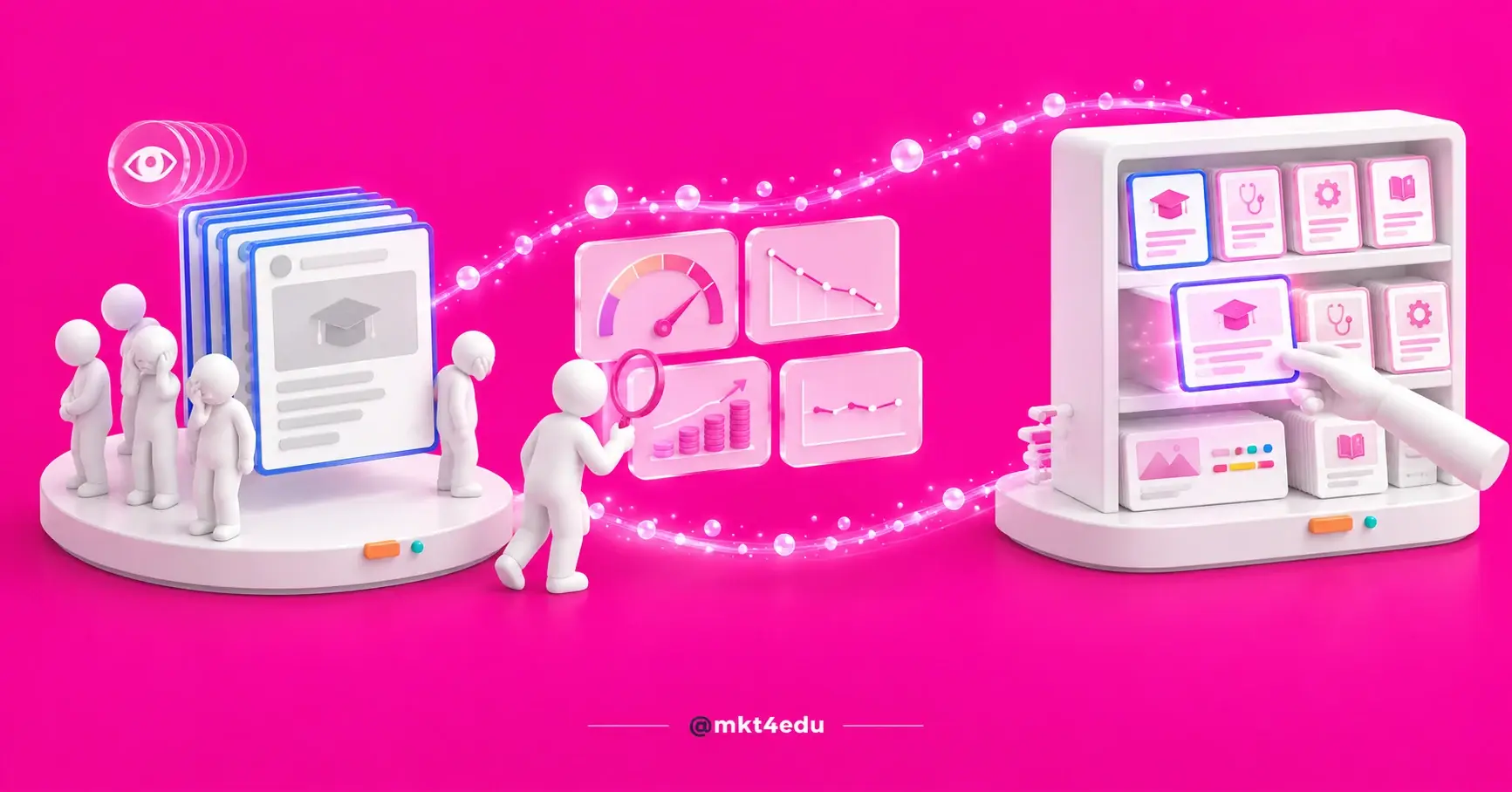
 Caption: A relationship ruler organizes contacts over time, from the first notice to loyalty.
The problem it addresses has a known size in Brazil. The 16th Mapa do Ensino Superior no Brasil, published by Instituto Semesp, reports an annual dropout rate of 24.8% in on-campus programs and 41.6% in distance learning, based on 2024 figures.
Private institutions carry the heavier load: 26.6% on campus and 41.9% in distance learning, the highest value in the 2014 to 2024 series. Public institutions report 21.4% and 32.2% for the same indicators.
That volume of departures is rarely about price alone. A large share of it is a relationship that cooled down, a question nobody answered and a student who stopped feeling seen by the institution they chose.
That gap is where the ruler belongs. It turns communication into a process with an owner, a cadence and a trigger, instead of depending on whoever remembers the student base in a given week.
The concept has its own boundary, and it pays to know where programmed communication ends and where the relationship begins before designing any workflow. The distinction carries weight when you decide who owns each message inside the operation.
The customer relationship ruler was born in sales operations from other industries, and education adapted it. The difference is the cycle: an undergraduate program runs for years, so customer loyalty here is measured in semesters, not in repeat purchases.
Video: The five best practices of the student relationship ruler. Video in Brazilian Portuguese.
How do you map the consumer profile and the personas before building the ruler?
Mapping the consumer profile always comes before the first workflow. Without knowing who sits on the other side, personalization shrinks to swapping a name in the greeting field, and the relationship ruler returns the same result as the mass blast it was supposed to replace.
The groundwork uses data the institution already holds. Application forms, service history, lead source, program of interest, declared income bracket and the hours when people reply say a great deal before any new survey is commissioned.
Turning enrollment data into personas that actually steer the offer is what separates real segmentation from segmentation for show. Each persona fits on a single page, with a goal, a main objection and a preferred channel.
What are the five best practices of a relationship ruler?
The five best practices of a relationship ruler are welcome messages, segmented offers, content production, contact on meaningful dates and after-sales follow-up. They cover the full cycle, from the first conversion to persistence, and they work as a skeleton for institutions of any size.
1. Welcome messages
The welcome message is the first contact after a conversion, and it sets the tone for everything that follows. When someone downloads material or fills in a form, an immediate reply confirms there is an institution on the other side.
2. Segmented offers
An offer works when it reaches the person it solves something for. Enrollment discounts, fee waivers and special tuition terms weigh on the decision, but they lose force when the same email goes to the entire database with no cut by program or stage.
Email marketing strategies remain the best place to run this, because the channel allows cut-off rules, subject line testing and a history you can audit message by message. Offers tied to the program someone searched for convert better than any blanket discount.
3. Content production
Content is what keeps the ruler alive between one offer and the next. Material about choosing a program, the job market in the field and study routines sustains the relationship during the stretches when there is nothing to sell.
Each piece needs to close with one clear and specific CTA inviting the next step. The invitation can be reading another article, joining an open class or talking to the admissions team, and there should be exactly one per message.
Inbound marketing supports this stage, because it treats attraction and nurturing as part of the same commercial process, not as a side task for the communications team. Content with no commercial destination is just production cost.
4. Contact on meaningful dates
Birthdays, student day and enrollment anniversaries are chances to make contact with nothing attached. A message that asks for nothing builds the credit the asking messages spend later. Generic greetings in volume turn into noise, while one tied to a real date is remembered.
5. After-sales and follow-up
After-sales is the part of the ruler with the strongest effect on persistence. Once enrolled, students face paperwork, adaptation and academic doubts, and every one of those frictions is a possible reason to quit.
A solid after-sales ruler watches for signals: attendance dropping, grades below expectation, late payments and prolonged silence across channels. Those signals should trigger human contact, not only another automated message.
Student retention campaigns are built on exactly these triggers, which is why they outperform a blanket retention push fired at the end of the term. A trigger reaches the student while the problem is still small.
How does the relationship ruler follow the student buyer journey?
The ruler follows the buyer journey by matching each message to the person's decision stage. Someone who just discovered the institution gets orientation content, someone comparing options gets comparisons and terms, and someone already decided gets whatever is missing to finish the application.
This buyer journey has a trait specific to education: it is rarely an individual decision. Parents, partners and employers weigh in, so the ruler needs material the candidate can forward to whoever decides alongside them.
At the top of the funnel, the goal is simply presence. Content about career paths, employability and the weekly routine of the program answers questions before the sales conversation, and it keeps candidates from arriving with no context at all.
In the middle, comparison takes over. Curriculum, class format, scholarship policy and commuting time are the real criteria, and each one deserves its own message inside the sequence. A single page comparing all four answers more than three separate emails.
At the bottom, the ruler exists to remove friction. Application deadlines, missing documents and payment questions are where enrollment stalls, and a reminder at the right moment clears most of them.
That is where inbound sales picks up. The admissions team receives an informed lead with the whole customer journey visible inside the CRM, so the conversation starts where the ruler stopped instead of repeating questions.
The customer relationship ruler does not end when the contract is signed. Student Recruitment and Retention are the same process seen from two angles, and treating them as separate projects is what causes the drop in rhythm right after enrollment.
Which channels belong in a relationship ruler beyond email?
Beyond email, a current relationship ruler runs on WhatsApp, website chat and AI SDR agents. The choice is not about preference, it is about timing: each channel carries an expected response time, and using the wrong one at the wrong moment costs conversion.
Email marketing strategies remain the base of the ruler, because the channel carries long sequences, dense content and an auditable history. It also survives decision cycles that run for weeks, which is exactly the case when someone picks a degree.
WhatsApp covers the opposite end: urgency, a single question, a quick confirmation. Opening that channel with recorded consent and restrained frequency is what keeps the number from getting blocked.
AI SDR agents entered the ruler through the gap no team covers: the question that arrives at eleven on a Sunday night. They answer on the spot, qualify the contact and hand over an organized record to whoever takes the conversation next.
It is worth understanding how an AI SDR agent handles a first conversation before putting one on the front line, because the script design decides whether it helps or pushes people away.
Video: How the relationship ruler lifts conversion. Video in Brazilian Portuguese.
How do you build the relationship ruler CRM with marketing automation?
The relationship ruler CRM is the operational version of the design: every contact becomes a record, every interaction becomes data and every trigger lives inside the platform. Without that, the ruler exists on a slide and dies in execution, because nobody runs manual sequences at scale.
The build has four layers. The first is a clean database, with standardized fields for program of interest, stage and source, because a good workflow on dirty data delivers the wrong message very efficiently.
The second layer is marketing automation. It fires the messages on behavioral triggers such as a visit to the application page, an abandoned form or no reply after a defined number of days.
The third layer is the handoff between marketing and admissions. When a lead meets the agreed criteria, ownership changes inside the CRM itself, and inbound sales takes over with the full history in view.
The fourth layer is governance. Someone has to own workflow reviews, retire messages that underperform and confirm that suppression rules still hold after each new campaign goes live. Without an owner, the ruler drifts within two terms.
Running marketing automation and CRM as a single system is what prevents the most common scenario in education: two databases, two histories and no single view of the student. One record per person is the condition for everything else.
How do you measure a relationship ruler: CTA, click-through rate and retention
Measuring a relationship ruler happens on three levels: the message, the conversion and the persistence. The first shows whether the communication was read, the second shows whether it moved anyone, and the third shows whether that movement survived into the following term.
At the message level, click-through rate is the most honest indicator. Open rate became unstable once email providers rolled out privacy protections, while a click remains a deliberate action from someone who actually read.
Click-through rate is calculated by dividing unique clicks by total delivered messages. The number alone says little, and the useful reading comes from comparing workflows inside the same ruler, with the same audience.
Every CTA needs its own measurement. When a message carries three different invitations, none of them produces clean data, and the fix is one CTA per message, with a tracked destination and a target declared before the send.
What to write so a student opens and replies has its own craft, and subject line, length and send time weigh more than layout in whether the message gets a reply at all.
At the persistence level, watch which indicator you picked. Annual dropout and cumulative cohort dropout are different indicators, and mixing them produces a report nobody can defend in a board meeting.
Annual dropout measures who left in a specific year. Cumulative cohort dropout tracks one intake across the whole cycle: in the 2020 to 2024 cycle it reached 64.7% at private institutions and 68.1% in private distance learning.
That distinction matters more now that distance learning accounts for 50.7% of undergraduate enrollments in Brazil, according to the 2024 higher education census. Half the base sits in the format with the higher dropout rate.
Student retention strategies have to be measured on the right indicator, by cohort and by program. An institution-wide average hides both the program losing an entire intake and the one holding on well.
Video: Seven tips for a student retention email. Video in Brazilian Portuguese.
Frequently asked questions about the relationship ruler
Where do you start the relationship ruler at your institution?
Start with the stage that loses the most people today. If the problem sits at enrollment, the ruler starts in the buyer journey; if it sits in the first semester, it starts in after-sales, with attendance and payment triggers.
The second step is to inventory what already exists. Mapping every message the institution sends today usually reveals repetition, contradiction and entire stretches of silence nobody had noticed.
The third step is to pick one workflow and do it properly. A complete ruler on paper with nothing running is worth less than a welcome sequence that works and gets measured every week.
Student retention strategies and student retention campaigns work better when they start from that same inventory, because they reuse the channel and the history the ruler has already built.
Customer loyalty in education is a consequence of consistency. An institution that talks to students in neutral moments has someone to turn to when it needs to talk in a critical one.
Anyone looking to speed up that build can design the workflows with a team that runs email marketing for educational institutions every day, starting from a tested ruler instead of a blank page.














 Portugal