






Both Inbound Marketing and CRM are essential strategies for the success of any business in today's market. Since both have common goals, such as attracting and keeping customers, the integration of these two strategies is capable of optimizing (much) the company's sales process.
In this way, learn about 5 reasons to unite Inbound Marketing and CRM and grasp how this integration is capable of positively reflecting on the success of sales and the financial results of the business.
Synchrony and unity of marketing and sales teams
One of the advantages of integrating the CRM with the Inbound Marketing strategy is to ensure collaborative work between the company's marketing and sales teams.
In this way, it is possible to count on a spirit of collaboration between the employees and optimize the performance of the two sectors.
With the common goal of attracting and retaining customers, sellers can use the leads and lead information generated through the digital marketing to approach and serve customers more effectively.
Likewise, the marketing team benefits from the data generated by the CRM tool, improving lead nurturing, sales funnel segmentation, email marketing strategies Outbound Marketing, among others.
Therefore, by synchronizing and uniting the marketing and sales teams, it is possible to achieve better and faster results, ensuring a greater number of closed deals and good financial performance.
That is, this is a great reason to combine Inbound Marketing and CRM with your strategy.
To sustain this collaboration on a daily basis, it's worth formalizing smarketing routines with shared goals and KPIs, joint playbooks, and clear data governance.
Articles from the Harvard Business Review show that when you wire marketing to sales for good, same steps, same tools, same dashboards, both sides do more and redo less. They are all reading the same customer.
When goals, pipeline, and messaging are aligned, the sales cycle shortens and the handoff between teams becomes predictable, which tends to increase the win rate without inflating sales costs.
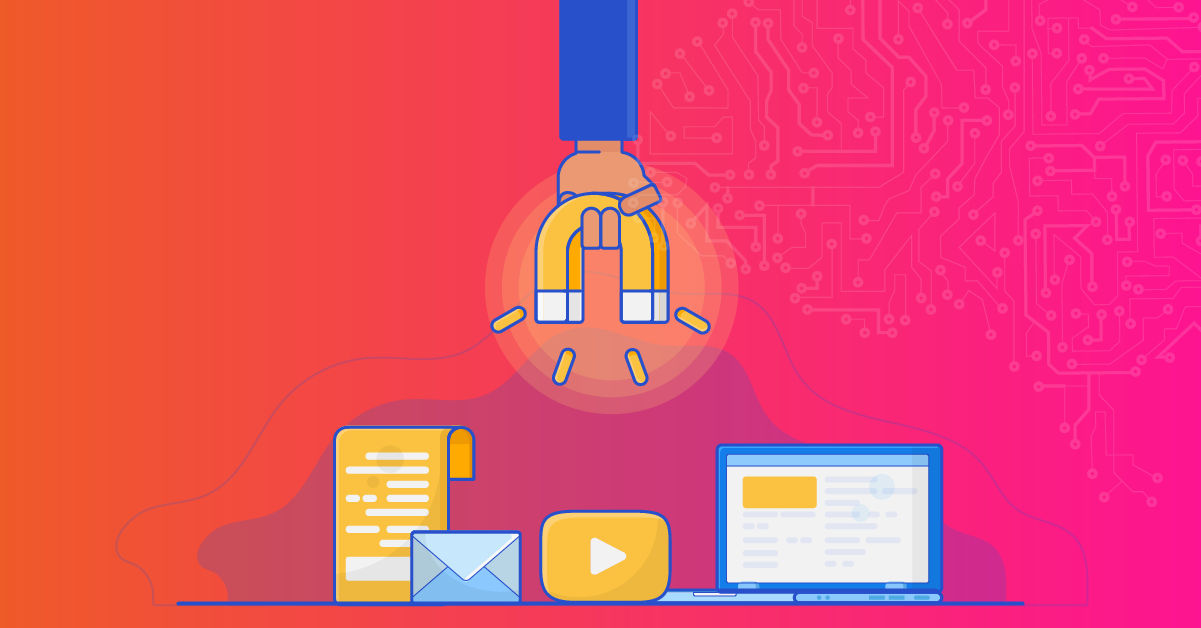
Image: Inbound Marketing and CRM Integration: Strategy to Attract and Nurture Leads Efficiently
Information always up to date and in one place
When the CRM software is not integrated with the tools used by the marketing team, some problems can happen. An example is the duplicity of registrations and outdated information.
Imagine the following situation: a potential customer was attracted to the sales funnel through digital marketing campaigns and the marketing team segmented this lead as “top of the funnel”, that is, a customer who is still at the beginning of the process of sales.
However, this lead goes to the physical location of the company and makes the purchase. Without the information being in a single place, the marketing team continues to treat the lead as someone who has not yet completed the purchase journey, and the work should already be related to after-sales and loyalty.
Therefore, avoiding outdated information is very important to guarantee the performance of both the Inbound Marketing strategy and the CRM strategy. Therefore, it is essential to update information in a single place, through the integration of strategies.
A practical way to avoid duplication and inconsistencies is to adopt a single customer view (SCV). The model pulls every touch into one profile, the site, email, paid media, the CRM, the service desk. Duplicates get merged, status updates run on their own, and marketing and sales read the same segments.
With SCV, the funnel no longer "breaks" between platforms, and teams work from the same history, which reduces friction, improves message personalization, and avoids mistakes like treating a recent buyer as if they were still at the top of the funnel.
Greater customer satisfaction
CRM and Inbound Marketing have customer satisfaction as a common goal. Therefore, these tools, when worked together, reach their goals optimally. After all, with the information obtained through content marketing, the seller is able to approach the customer by delivering exactly what he wants. And which customer is not satisfied with a personalized service?
Consistent personalization depends on well-integrated data. McKinsey research indicates that companies that master personalization capture more revenue and loyalty because they deliver relevant offers and content at the right time.
By combining CRM signals (stage, history, ticket) with digital behavior (pages, terms, emails), marketing creates tailored journeys and sales approaches with context, cutting friction and increasing satisfaction.
In practice, data-driven personalization boosts the experience and sustains repurchase, rather than relying solely on mass blasts or generic approaches that tire the lead.
In addition, with the data brought by the CRM tool, the marketing team is able to improve its strategy. In this way, it is possible to deliver quality content to the customer, as the greater amount of information allows boosting content production, lead nurturing, e-mail marketing work, among others.
Therefore, if the customer is satisfied, he will buy from the company again and even recommend it to friends and family. thus ensuring that the common goals of the Inbound Marketing and CRM strategies are reached, once the attraction and loyalty of customers has taken place.
Better management through the union of Inbound Marketing and CRM
One of the great advantages of the CRM tools used by 4revops is the possibility of having access to the behavior and buying habits of the lead. In this way, the Inbound Marketing strategy can be much more effective. After all, with this information, it is possible to have better management and strategic planning of base segmentation for inbound actions.
That is, knowing the lead's interest in research, navigation or clicks helps to grasp what type of content he is looking for. This contributes both when approaching and selling and nurturing leads, producing content, etc. In this way, decision-making through management is much more accurate due to a good analytical view based on data.
In addition to descriptive analytics, it's worth incorporating data-driven experiments and AI models to quickly adjust messages, offers, and timing.
Harvard Business Review highlights that teams that continually test hypotheses (creatives, channels, cadences) and use propensity predictions allocate budgets better and rank accounts with a higher likelihood of closing.
By integrating these learnings with CRM and inbound automation, planning is no longer static: segments are continually refined, and playbooks evolve with evidence, avoiding decisions based on gut feeling and cutting media waste.
Increased ROI (Return Over Investment)
ROI is the calculation of the relationship between profit and the amount invested to obtain such profit. In other words, it is the return on investment. Therefore, every company aims to reach a big number of ROI. After all, it means that the company is making big profits with little investment.
First of all, align the ROI definition and calculation method across departments. ROI is the ratio of the gain obtained to the cost of the investment, a simple metric that needs standardized attribution and analysis windows to avoid biased readings.
Meanwhile, McKinsey articles show that data-driven personalization tends to make marketing money go further, because the effort lands on the people most likely to buy. With the CRM and Inbound joined up, measuring, comparing, and tuning a campaign becomes a loop that never stops. ROI grows, and it keeps growing.
By joining Inbound Marketing and CRM to your business strategy, it is possible to increase ROI. This means reaching excellent financial results, as integrating the two strategies into a single platform allows for a smaller investment to reach greater profit.
The pairing also cleans up how work flows. Marketing and sales move faster and do more. People pull in the same direction. Content marketing gets sharper. What comes out of it: more leads, more sales, and customers who stay. Revenue climbs. In plain terms, ROI climbs with it.
So these are 5 great reasons to combine Inbound Marketing and CRM with your strategy. Furthermore, it is clear how these two tools together are essential for the success of the business, increasing the number of sales and giving excellent financial results.
Are you interested and want to know more about how to reach excellent results in your company? So learn about CRM strategy: an essential application for the success of any business!
Uniting the two starts with clean segmentation: how you group leads inside HubSpot's CRM decides what inbound can actually automate.

Reasons to Integrate Inbound Marketing and CRM to Boost Results
Why integrate Inbound Marketing and CRM?
The tie-up lines marketing up with sales. Data sits in one place, each contact gets a personal turn, and leads move to deals with less drag. It shows up in the money.
How do Inbound Marketing and CRM help synchronize marketing and sales?
When integrated, both teams share data and work toward unified goals and KPIs. This shortens the sales cycle, boosts lead handoff, and increases close rates.
Why is centralized information important?
Centralizing information in a single system prevents duplicate records and outdated data. It ensures that marketing and sales operate with the same customer view, enabling more precise and consistent approaches.
How does integration improve customer satisfaction?
With integrated data, companies can deliver personalized and relevant experiences at every stage of the journey, increasing satisfaction and loyalty. Satisfied customers are more likely to return and refer the company to others.
How does Inbound Marketing benefit from CRM?
CRM gives insights into lead behavior, interests, and purchase history, enabling more precise segmentation, targeted campaigns, and more effective lead nurturing.
How does CRM improve lead management?
The CRM joins every touch and updates itself. So each lead gets a call at the right hour, no message reads like a form letter, and more of them convert.
How does integration impact ROI?
Combining Inbound Marketing and CRM allows resources to be directed toward leads with a higher probability of converting, optimizes campaigns based on data, and cuts waste. That leads to higher return on investment.
What other benefits does this integration offer?
Beyond boosting ROI and productivity, integration streamlines internal processes, enhances collaboration between teams, and makes managing marketing and sales strategies more practical and efficient.

























 Portugal