


Have you ever stopped to measure how much student recruitment weighs on your institution? The quality of the contacts arriving today shows up directly in next term's enrollment numbers.
The strategic, operational and financial effort spent attracting students has to come back as real enrollments and students who stay. Lead generation is what connects those two ends, because it organizes the journey between the first click and the signed contract.
The question a manager actually cares about is blunt: how do you generate qualified leads for a university without inflating cost per student? The answer runs through knowing the audience, publishing useful content and measuring every step.
How does talking to your academic community improve lead generation?
Talking to your academic community improves lead generation because it hands you, for free, the raw material every campaign needs: real language, real doubts and real reasons for choosing. Everyone currently enrolled was once the lead you are chasing, and they remember what tipped the decision.
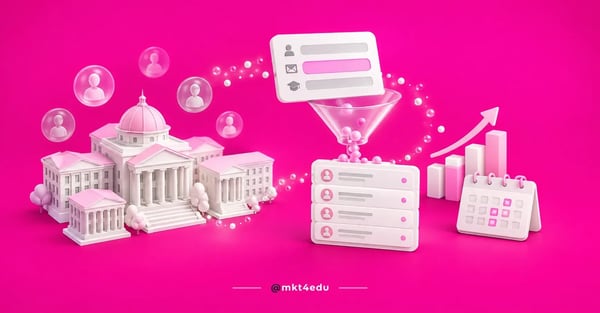 Caption: Lead generation organizes the path between an anonymous visit and an identified contact your team follows all the way to enrollment.
Short surveys, one-to-one interviews and empathy maps built course by course do most of that work. The material feeds the personas that guide every one of your Educational marketing strategies.
The common mistake is running the research once and freezing the result, because the profile of an incoming class shifts every cycle. On-campus degrees, distance learning and graduate programs carry different decision triggers, and treating them as a single audience flattens your segmentation.
No other kind of organization has such easy access to the people it wants to reach. A university can walk down a corridor and ask.
Why does an intuitive website hold up lead generation?
An intuitive website holds up lead generation because it is where intent becomes a contact. It concentrates the search for course, price, scholarship and admission process, and any friction in that passage kills conversion before the form. Speed, clarity and predictable navigation matter more than visual effect.
According to Think with Google, 53% of visits are abandoned when a mobile site takes longer than three seconds to load. That weight grows on the phone, which is the dominant device for prospective students.
The first requirement is responsive design, which adapts the layout to any screen without breaking menus and buttons. The second is information architecture: how many clicks does it take to find course details, and does the tuition figure ever appear?
Without a visible CTA (Call to Action), a visit ends without leaving a trace. Downloading a guide, simulating tuition or signing up for the entrance exam are the actions that deserve prominence.
Avoid loading pages with information that does not help the student decide. Objectivity converts better than volume of institutional copy.
How do you become a source of information with content marketing?
Becoming a source of information means answering a student's questions before selling any course. Content marketing does that with a blog, downloadable material and video that help an applicant choose a career, understand financing and prepare for the exam. Authority comes before conversion.
Education starts outside the classroom, and helping a candidate pass the admissions exam is already part of the relationship. The institutional blog is the center of that operation, because it pulls visitors from organic search, feeds the social channels and holds your position on education topics.
A single blog can serve applicants, undergraduates, graduate students and continuing education audiences at the same time. Each modality carries its own search volume and its own set of doubts.
Learning how to do content marketing that performs both in Google and in language models has changed the discipline in recent years. Publishing is no longer enough, the text has to answer precisely.
Take what the student research revealed and turn every recurring question into an article. Course choice, career paths, salary expectations and payment options alone fill months of editorial calendar.
Video content for student recruitment covers the stage where the candidate wants proof rather than promises. Campus tours, alumni interviews and a day in the life of a course do more than a brochure.
How do you optimize content for search and for AI?
Optimizing content means structuring each page so it can be found and quoted. SEO (Search Engine Optimization) handles the technical and semantic side, and the AI (Artificial Intelligence) layer on top of search retrieves self-contained passages. Pages written as direct answers get cited more often.
Algorithms change frequently, always in the direction of a better answer for the user. That forces an institution to revise old content, not only to publish new content.
Course searches carry a strong geographic component, because a candidate looks for the campus near home. Working on local SEO for colleges resolves a large share of neighborhood and city level recruitment.
Relying on experienced professionals to optimize the site changes recruitment directly. A solid SEO structure applied to the institution keeps strong courses from staying invisible in search.
How do you distribute content and widen your reach?
Distributing content means carrying what you produced to where the student already is. The most common model puts the blog at the center and has social media, email, organic search and paid media drive traffic into it. Without distribution, the best article sits still.
The main traffic drivers for an education blog are social media and organic search. The institution needs an active presence where its audience circulates: Instagram, TikTok, YouTube, LinkedIn, Facebook and X, the platform renamed from Twitter in July 2023.
According to the Digital 2026 Brazil report, from DataReportal, Brazil has around 150 million active social media identities, the equivalent of 70.4% of the population. The same study counts 185 million internet users, or 86.9% of Brazilians.
Teams starting from scratch get there faster by studying how to use social media to attract new students before spreading effort across every platform at once.
Paid advertising amplifies what already works organically. Google Ads, which was called Google AdWords until the rename announced in July 2018, remains the main channel for declared intent.
Meta Ads, TikTok Ads and LinkedIn Ads complete the set, each one with a distinct role in the funnel. The discipline is keeping spend under control, and using paid traffic without blowing up your acquisition cost is a management habit rather than a creative one.
All of these fronts need to speak the same language and share complementary KPIs (Key Performance Indicators). A channel that reports an isolated metric hides waste.
How to run a lead generation campaign without waste?
Knowing how to run a lead generation campaign starts with defining the offer and the goal, never with picking the creative. A well built campaign has a defined audience, a clear promise, a dedicated landing page and a success metric agreed before the first dollar goes out.
The first step is choosing what the campaign sells: exam registration, a scholarship, free material or a campus visit. The second is sizing the goal in enrollments and working backwards to the number of contacts required and the budget that matches.
The third step is the landing page. The best practices to capture leads in a school campaign show that the most expensive mistake is launching media without a dedicated page, because the traffic lands on the homepage and dissolves into the menu.
Admission campaigns also carry a regulatory layer covering course recognition, workload and accreditation claims. Admissions campaigns require a review of what can and cannot be promised.
Measuring a campaign by contact volume alone leads to the wrong decision. The number that matters is cost per enrollment, and it only appears when the CRM (Customer Relationship Management) system records the origin of every contact.
Good marketing strategies for recruitment keep three offers live at once: one for the top of the funnel, one for the middle and one for direct conversion. Teams that learn how to run a lead generation campaign end to end stop treating those three as the same job.
How do you build a student recruitment calendar?
A student recruitment calendar is the document that spreads offers, content and budget across the months of the year, anchored in the real cycles of higher education. It prevents the familiar pattern of chasing enrollments only in the week before classes start, when media costs peak.
The starting point is the set of fixed dates in the sector: national exam windows, results and appeals, the application deadlines for public financial aid programs, and your own intake dates. In Brazil, that means mapping the ENEM, SISU, FIES and PROUNI calendars, which move the whole market at once.
Between the peaks sit the audience building windows, when career content works to fill the base that will be converted later.
A good student recruitment calendar also reserves room for reactivating the old database, which usually costs less than a brand new lead.
Without that calendar, the operation lives in reactive mode and pays a premium for the rush. Annual planning lets you negotiate media, produce content ahead of time and test formats outside the critical window.
How to do remarketing and recover lost leads?
Learning how to do remarketing starts with accepting that most visits never convert on the first pass. Remarketing shows a specific ad to someone who already signaled interest, picking the conversation up where it stopped, at a lower cost than cold prospecting.
Audience lists built from behavior are the foundation. Someone who viewed a course page, someone who started a form and someone who downloaded material should each receive a different message.
The ad has to move the conversation forward instead of repeating what the person already saw. Understanding what remarketing is and how to use it to recover leads separates the tactic from a plain increase in frequency.
On the operational side, how to do remarketing in Google Ads step by step settles list configuration, membership windows and frequency caps.
Remarketing also works outside paid media. Email sequences and messaging through WhatsApp for student recruitment play the same role at a low marginal cost.
What role does relationship building play in lead generation?
Relationship building is what turns a contact into an enrollment when price and curriculum look similar across competitors. In lead generation, the focus sits on informing and helping the student decide, because pushing a course has lost its effect in a market with abundant supply.
Competition in the education sector has grown, and candidates compare options easily. An institution that listens, answers quickly and helps solve problems builds a bond before the sale, and the enrollment becomes a consequence of that bond.
Candidates read opinions before deciding, and understanding how social media contributes to brand reputation keeps a small complaint from costing you enrollments.
The differentiator a family remembers is rarely the building. It is the answer that arrived on a Saturday afternoon when nobody expected one.
Which benefits make a student hand over their data?
A student hands over their data when the return feels immediate and concrete. A career choice guide, a commented practice test, a preparation webinar and a tuition simulator all work because each one resolves a specific doubt at the moment of decision.
The offer has to match the stage of the doubt. An applicant stuck on mathematics wants a revision webinar, while someone hesitating between business and law wants a side by side career comparison.
When promoting the offer, lead with the benefit rather than the format of the material. Each offer deserves its own landing page, with a form proportional to the value delivered.
Email remains the cheapest channel for nurturing someone who already converted. A well structured email operation keeps the contact warm until the application opens.
How do you scale lead generation with technology?
Scaling lead generation means serving thousands of contacts with the care you would give to ten. Technology handles that through publishing automation, landing page creation, contact capture and qualification, list segmentation and nurturing flows triggered by behavior rather than by a fixed weekly schedule.
The CRM sits at the center of that operation, because it holds the history of each contact and shows where they came in. Without that record, the institution cannot say which channel produced the enrollment.
Automation makes it possible to react to what a visitor does. A course page visited three times is a signal of intent and deserves a sales approach, not another top of funnel email.
AI agents have entered this flow to answer repetitive questions and qualify contacts outside business hours, and the gain shows up in the speed of the first reply.
Integrating HubSpot and social media marketing reduces the manual work of publishing and measuring. Scale without measurement, though, is just volume without direction.
How does lead generation connect to student recruitment and retention?
Lead generation connects to retention because the promise made during recruitment sets the expectation the student carries into the classroom. A contact attracted by an inflated promise enrolls and drops out in the first term, and the acquisition cost turns into a loss instead of an investment.
Treating student recruitment and retention as separate departments opens a gap between marketing and academic experience, and students notice the distance between what was advertised and what they found.
Integration starts with sharing the same data record. When the contact origin and the stated reason for choosing reach the academic team, the institution can act before the student disappears.
Institutions that already integrated student recruitment and retention usually discover that the channels with the best cost per lead are not the ones with the best persistence. That finding changes budget allocation in the following cycle.
How do you choose a lead generation agency?
Choosing a lead generation agency starts with the operation, not with the visual portfolio. The criterion that separates suppliers fastest is the ability to connect media, content and CRM into a single enrollment report, with accountability for the final result.
The first criterion is experience in the education sector, because the decision cycle and the regulation are specific. An agency that has never run an admissions calendar will learn on your budget.
The second is data transparency, since a report of impressions and clicks without cost per enrollment hides the number that matters. The third is technical command of the platform, because a poor integration between form and CRM breaks attribution.
The criteria for choosing an educational marketing agency help you run a more honest selection process. A mature lead generation agency refuses to promise volume without context and asks about the enrollment target before talking about budget.
The educational marketing strategies that sustain real recruitment are few and repeated with discipline. Anyone offering an endless list of tactics is usually selling activity instead of results.
It is worth comparing proposals by the marketing strategies for capturing leads each one puts on the table. The most efficient plans fit on a single page.
Frequently asked questions about lead generation
Where should you start with lead generation at your university?
Start with what already exists. Before opening a new campaign, look at the current site, the dormant database and the articles that already bring traffic, because there is almost always conversion being lost there.
The second step is fixing measurement, because without the origin recorded in the CRM every budget decision is guesswork. The third is picking one offer and making it work end to end, from the ad to the enrollment.
After that, growth becomes repetition with adjustment: widening channels, building the annual calendar and connecting recruitment to the experience of the enrolled student.
If your institution wants to move faster with a team that already runs recruitment in higher education, talk to the mkt4edu team and bring the target for your next cycle.












 Portugal