




A signed enrollment is not the finish line; it is where the risk starts. Every student who leaves mid-program takes away the revenue that had not arrived yet and the acquisition cost that was already paid.
The numbers say how wide that gap runs. The National Student Clearinghouse Research Center reports 77.1% first-year persistence and 69.1% first-year retention for the fall 2024 cohort in the United States.
That eight-point difference is where student retention becomes a marketing problem: those students stayed in higher education, just not at the institution that recruited them. The structure that attracted them can also keep them.
The second half of that operation gets discussed far less and decides far more: the data that flags dropout early, the content that supports an enrolled student, and the tools that make follow-up fit a small team's week.
Where does student retention sit inside educational marketing?
Student retention sits in the second half of educational marketing, the part that runs after enrollment. Educational marketing covers attracting, converting and keeping students, and most definitions stop at the first two, which is exactly where the result leaks: keeping is the part that protects revenue the institution already won.
Enrollment volume sets the scale of the problem. The National Student Clearinghouse Research Center counted 18.6 million postsecondary students in spring 2026 in the United States, up 1.0% year over year, a gain of roughly 192,000 students.
With growth that modest, churn matters more than acquisition. When the pool expands by one percent, every student who leaves has to be replaced from a market that is barely moving.
Online programs sharpen the challenge. A student who never walks a hallway has no casual run-in with a coordinator and no classmate nearby to point to the right form, so every contact has to be designed rather than left to proximity.
So the scope of educational marketing has two fronts. One works before enrollment, through strategies for attracting students, and the other works after it, following the people who already joined.
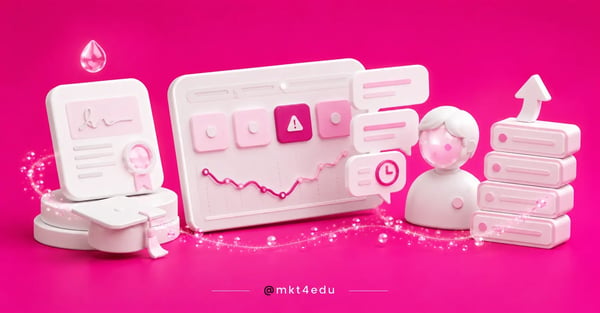 Caption: From the signed enrollment to the next term: the student retention dashboard that shows who is leaving before any withdrawal request arrives.
Why is retaining students cheaper than recruiting?
Retaining a student costs less than recruiting one because the person is already identified, already opted in to contact, and does not have to be won again in a paid auction. Student retention and recruitment also run on the same infrastructure, so splitting them across two departments costs more than integrating them.
An enrolled student costs nothing to reach again, while new leads have to be generated, qualified and worked before anyone signs anything.
The waste shows up as duplicated work. The database, the contact cadence, the channels and the team that reads behavior are the same on both sides of enrollment, so two departments end up building the same thing twice.
Personalization has a documented effect in this kind of relationship. A 2021 McKinsey study found that faster-growing companies draw 40% more of their revenue from personalization than slower-growing peers, and that 71% of consumers expect personalized interactions.
Five years is a long time in personalization, so read the figure as direction rather than promise. What holds is the logic: generic contact with an at-risk student rarely changes behavior.
The specific retention tactics, with the design and timing of each action, are detailed in the best student retention strategies, which covers how to sequence them across a full academic term.
What does dropout actually cost an institution?
Dropout costs the tuition from every remaining term plus the acquisition spend that never returns. In an eight-term program, losing a student in the second term means forgoing six terms of tuition, on top of the recruitment cost already booked.
The first year carries most of that risk, and two figures separate the problem cleanly. The two rates come from the same cohort and diverge by eight points:
| Indicator, fall to fall | Fall 2024 cohort | What it tells marketing |
|---|---|---|
| Persistence, any institution | 77.1% | Share who continued in higher education anywhere |
| Retention, same institution | 69.1% | Share who stayed with the institution that enrolled them |
Table: First-year persistence and retention for the fall 2024 cohort, per the National Student Clearinghouse Research Center report published in June 2026.
The eight-point gap between the two lines is the actionable part. Those students did not give up on studying; they gave up on one institution, which makes the loss a relationship problem rather than a demand problem.
Online programs tend to run wider gaps. In the Brazilian private sector, the Semesp higher education report records a 41.9% dropout rate in distance learning against 26.6% on campus for 2024. That market-specific contrast points the same way: less physical presence demands more designed contact.
How do the first weeks shape whether a student stays?
The opening weeks decide persistence because they concentrate the questions that cause early departure. A new student has to find where class meets, whom to ask when something breaks, how assessment works and when the first payment falls due.
Every unanswered question becomes friction, and accumulated friction becomes withdrawal. People rarely quit because the program is bad. They quit because they stopped being able to use it and nobody noticed in time.
Build a short, dated sequence. A welcome on enrollment day, first-access guidance before the opening class, a check-in during week two and a conversation at the end of month one cover most of the risk.
Trigger on behavior rather than on the calendar alone. A student who has not logged in by day three needs a different message from one who logged in but skipped the first assignment.
Name a single owner for that flow and put the name in writing. Without one, the onboarding cadence is the first thing that stops the moment the team enters recruitment season, and every hand goes to the funnel.
What signals does the CRM need to surface before dropout?
The CRM has to surface behavior, not just records. Date of last platform login, assignments submitted, attendance, payment status, open support tickets and preferred contact channel form the minimum dashboard for spotting risk before a formal withdrawal.
Name, program and phone number predict nothing on their own. Those are identification fields, useful for addressing someone correctly. Departure shows up in movement rather than in a static profile.
Combined signals beat isolated ones. A drop in logins plus a late payment plus an unanswered support ticket describes far greater risk than any of the three on its own.
Reading that requires the systems to talk to each other. How that integration works, and what belongs in each database, is covered in marketing automation and CRM.
There is a known measurement gap in how institutions adopt technology. EDUCAUSE research published in 2026 found that 94% of higher education professionals used AI tools at work while only 13% of institutions measure the return on those tools.
How does content marketing support enrolled students?
Content marketing supports enrolled students by answering the questions they never bring to a coordinator. How to make the internship count, what the hard course demands, how employers read the credential: each answer lowers the odds that a doubt turns into a silent departure.
Material written for enrolled students runs on a different brief from material written for applicants. An applicant wants to know whether joining is worth it, and an enrolled student wants to know how to get value from what they already paid for.
Reuse the same piece across both when it fits. An article on career outcomes in a field convinces someone who is hesitating and reinforces the decision of someone already inside.
Production does not have to double to cover the second front. The method for building the editorial plan and distributing it is set out in how to do content marketing.
Using AI in production is now standard rather than experimental. HubSpot's State of Marketing 2026 reports that 80% of marketers use AI in content creation, which lowers the cost of keeping both fronts active.
Does an AI SDR agent help students who already enrolled?
An AI SDR agent helps, within a tightly defined scope. The agent handles volume and first response: it confirms details, answers repeated operational questions, reminds students of deadlines and identifies who needs a human, at hours no team covers on its own.
The gain lives almost entirely in response speed. A student stuck on platform access at ten at night will not wait until the next business day before giving up, and that silent surrender never reaches a report.
The limit is equally clear. Conversations about money trouble, doubt over the program choice or conflict with an instructor need a person, because the decision in play is emotional before it is operational.
Design the handoff before switching the automation on. The agent has to recognize the topic that is not its own and pass the conversation along with full history, without making the student repeat the story.
How that kind of agent works, where it stops and what to check before deploying it are covered in the SDR agent material.
Which educational marketing strategies come first?
With a small team, sequence by risk: onboarding for the opening weeks, a signal dashboard in the CRM, behavior-triggered contact and content for enrolled students. That order handles most early dropout before requiring any new media spend.
Onboarding goes first because the risk window is short and it never reopens. One well-executed action in the first four weeks returns more than three campaigns launched in the middle of the term, when the decision is largely made.
The signal dashboard comes second because everything downstream depends on it. Without knowing who is at risk, any contact cadence goes out to the whole cohort, loses its effect and trains students to ignore the channel.
Leave fine-grained personalization for a later phase. The tactic does improve results, but it depends on an organized database, and cleaning up student data usually takes longer than building the first contact cadence.
Budget reality supports that sequencing. Gartner's 2026 CMO Spend Survey puts marketing budgets at 7.8% of company revenue, with only 30% of organizations ready to scale AI capabilities, which argues for fixing the basics before buying capability.
The sector-specific version of this priority list, with the trade-offs that change by institution size and delivery format, appears in the educational marketing strategies.
How do you measure whether student retention improved?
Measure student retention by cohort rather than by overall average. Track each entering class across terms and record how many remain enrolled, because a blended average hides the exact group that is leaving. The number that matters is how many of a given intake are still there one year later.
Four indicators give the core picture, and each answers a different question. Cohort persistence rate, re-enrollment rate per term, time to first risk signal and recovery rate after contact cover the full arc from entry to intervention.
The last one is what shows whether the marketing work paid off. If contacting at-risk students does not change the departure rate for that group, the cadence is wrong, even when the headline number looks stable.
Split results by delivery format and by program. An institution can post excellent on-campus persistence while bleeding students online, and the average blends both into a figure that guides no decision.
The full indicator list, with formulas, reading frequency and the reporting cadence that keeps leadership informed without weekly noise, is in the educational marketing metrics.
Frequently asked questions about student retention
Is student retention worth the investment now?
Student retention is worth the investment, and the arithmetic favors it over recruitment. With enrollment growing 1.0% year over year and first-year retention at 69.1%, each student kept moves the result more than each new student won.
The encouraging part is that the initial investment is organizational rather than financial. A signal dashboard, an onboarding cadence and content for enrolled students all run on tools most institutions already pay for and use only partially.
The cost of doing nothing is well documented. The institution keeps buying students at auction to replace the ones leaving through the back door, and cost per enrollment climbs every year while the base stays flat.
You filled the class. Who is there in year two?
We map where students let go of your institution, and what brings them back. Talk to the mkt4edu team and find out which stage of your operation is losing students.


.jpg)
























 Portugal