




Universities rarely lose candidates for lack of initiative. They lose them to a pile of disconnected initiatives, each with a different audience in mind and none with an agreed indicator.
Marketing for universities solves that the moment it stops being a list of channels and becomes an ordered repertoire of actions. Eight of them cover almost everything a higher education institution needs to run in order to attract students and keep them enrolled.
The order matters more than the volume. Starting with the ad and ending with the persona is the most expensive way to discover that the message was wrong from the beginning.
What is marketing for universities and what does it solve?
Marketing for universities is the set of actions that puts the institution into the candidate's conversation before, during and after enrollment. It gathers audience research, content production, media, service and data into a single plan, with recruitment and retention goals declared from the start of the cycle.
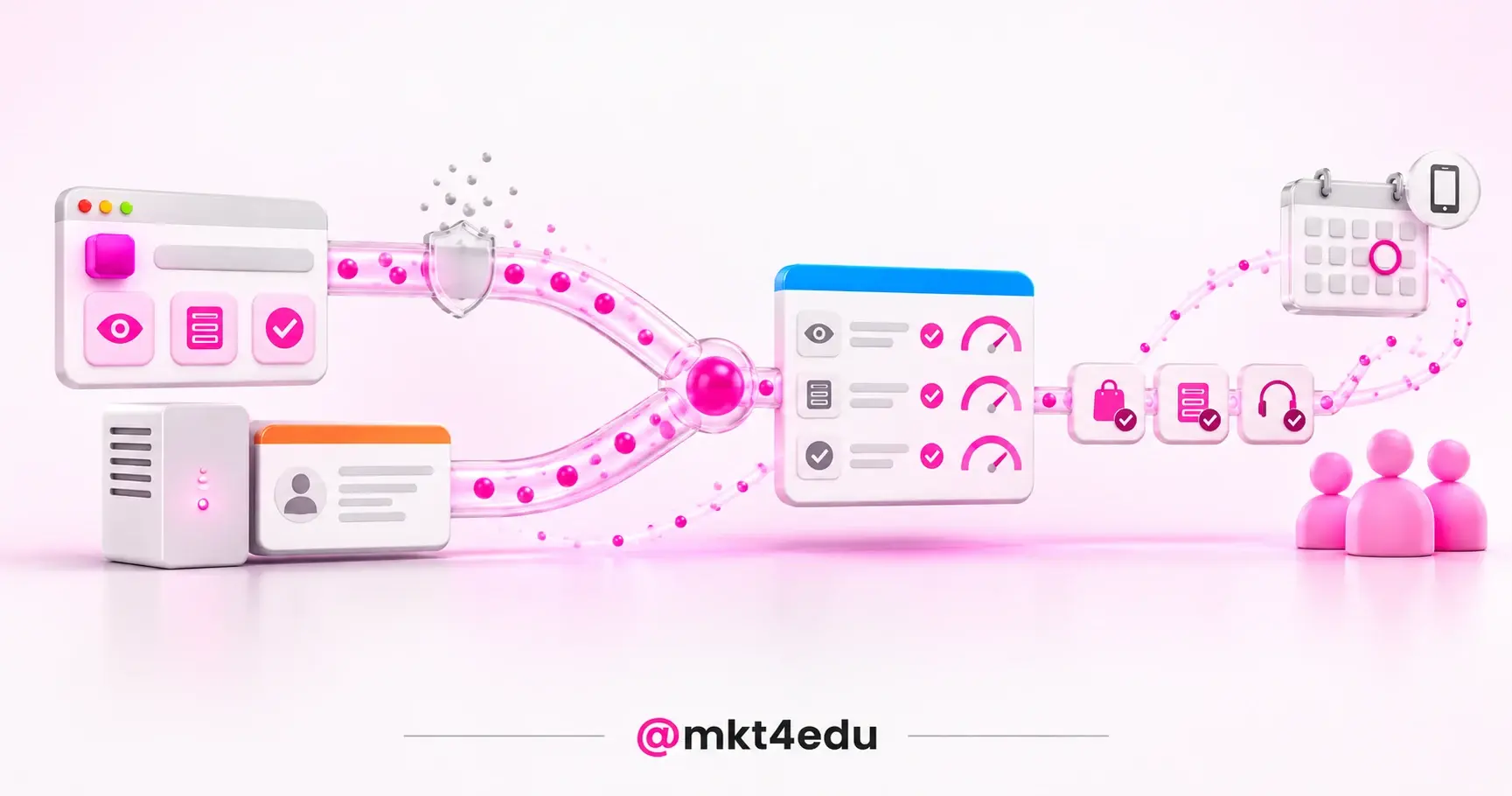
 Caption: Marketing for universities starts with knowing who you are talking to: a defined persona, a measured number and an open channel turn anonymous interest into enrollment.
The difference between an isolated action and a plan is the sequence. An Educational marketing strategy defines first who the university wants to serve, then what it will say, and only then where it will pay to appear.
That order answers the most frequent question in admissions teams, which is how to create educational marketing strategies once the calendar has already started. The way out is to make the eight actions converge on the same audience and the same indicator.
Institutions that treat digital marketing strategies as a list of channels tend to repeat the same mistake, which is buying an audience before having anything to say to it.
Student recruitment and retention strategies come from that same repertoire. What changes is the point in the funnel where each action enters and the metric it has to move.
A mature educational marketing strategy also accepts that not every action pays off on the same horizon. Content and SEO build the base, while media and service move the number of the current month.
How to create personas before any marketing campaign?
How to create personas is the first action because every other one depends on it. A persona is the semi-fictional portrait of the student the university wants to serve, built from interviews, CRM (Customer Relationship Management) records and service history, never from the team's assumptions.
A useful persona answers four questions: what this student wants to solve with a degree, what stops the decision, who influences the choice and how much the family can pay without a scholarship.
Universities mostly talk to young people, and that audience is already used to personalization. Generic institutional brochure language loses ground to a message that recognizes the specific doubt of whoever is reading, as the work on personas that help increase sales shows.
It is worth separating recruitment personas from retention personas. The first-year student who needs reassurance about internships is not the same person as the senior at risk of dropping out because of work hours.
The practice of how to create personas also improves retention. When the institution knows what brought each profile in, it can anticipate the reason that would make that student leave.
How to measure data, conversion rate and CRO marketing at a university?
Measurement is the second action because it is the one that tells whether the others work. The data plan defines which events the university records, from visit to application, and which conversion rate each step has to deliver for the enrollment goal to close at the end of the cycle.
Four numbers are enough to start: website visitors, applications started, applications completed and paid enrollments. The ratio between each pair shows where the loss happens.
The conversion rate from applicant to enrolled student is usually the most neglected point. It concentrates the largest volume of revenue already won and not yet confirmed, which is why reducing the rejection rate to increase conversion pays off so quickly.
CRO (Conversion Rate Optimization) comes after measurement, not before. Testing a page headline without knowing which step is stuck is guessing, and guessing does not scale.
In CRO marketing practice, the university changes one variable at a time on the course page, the form or the application flow, and compares the result with the equivalent previous period.
A consistent CRO marketing program also protects the media investment. Improving the conversion of the same traffic lowers the pressure on the cost of next term's educational marketing campaigns.
Which content marketing strategies sustain student recruitment?
Content is the third action and the base of every inbound marketing strategy the institution runs. Content marketing strategies deliver, in text, video and rich material, the answers a candidate looks for before even considering an application, from job market doubts to the comparison between course formats.
Market appetite for that investment remains high. In HubSpot's 2026 survey of more than 1,500 professionals, 79.2% expect at least a slight budget increase, and content marketing appears in 36.9% of the stated increase intentions.
The 2024 figure that circulated about half of professionals planning to raise content investment has no direct equivalent in the most recent edition of the study. For that reason it leaves the text instead of being updated by estimate.
For a university, three formats usually carry the weight: the course page, career guidance content and the alumni testimonial with a verifiable result.
Content marketing strategies pay off more when each piece has a clear destination in the funnel. Top-of-funnel material feeds the list and bottom-of-funnel material shortens the decision of someone who has already compared institutions. Content also lowers the cost of marketing campaigns over time, because an owned audience reduces dependence on rented audience.
How do SEO strategies and AI SEO put the university in the answer?
SEO is the fourth action and it turns content into recurring traffic. SEO (Search Engine Optimization) strategies organize title, structure and links so the course page appears when the candidate searches, and AI SEO extends that work to automatically generated answers.
Search has changed visibly. Today half of all Google searches include an AI overview, and 40.6% of professionals name updating SEO for those changes as one of the main fronts of the year.
AI SEO does not replace the classic work. To enter the generated answers, there is no technical requirement beyond the page being indexed and eligible to appear in Search. What helps is writing blocks able to answer on their own, because answer systems retrieve passages and not whole pages. In practice, that means opening each section with the direct answer, naming the entity instead of using a pronoun and backing every claim with verifiable data.
It is also worth auditing what assistants already say about the institution. That audit reveals information gaps no keyword tool points to, and it usually starts with the same on-page optimization checklist the team already uses.
In the same survey, website, blog and SEO appear in 35.4% of the investment increase intentions, behind content and paid social.
What does social media marketing demand from a university?
Social media is the fifth action and the most visible one to a young audience. Social media marketing demands a platform choice, a publishing rhythm and, above all, replies: a profile that posts and does not talk works as a notice board, not as a recruitment channel.
The first decision is where not to be. Among digital marketing strategies, social media punishes dispersion the most: a university with a small team gets more from two well-served networks than from five updated out of obligation.
Video concentrates a relevant share of attention and budget, appearing in 37.1% of the investment increase intentions in the HubSpot study.
Behind-the-scenes content, course routine and faculty voices usually perform better than institutional artwork. The candidate wants to see what studying there is like, not the logo in motion.
Social media marketing also weighs on retention. An enrolled student who recognizes their own routine in the institution's profile tends to defend it when someone asks for a recommendation.
When do paid traffic strategies enter marketing for universities?
Media is the sixth action and it enters once there is a message and a page to receive the click. Paid traffic strategies buy immediate reach in search, social and display, which is why they answer fast, and also why they stop producing the day the investment stops.
Paid social leads the investment increase intentions with 37.4% in the HubSpot survey, just above video and content marketing. For a university, the most profitable use of paid traffic strategies is covering declared intent: institution name, course name and open application terms.
The question of how to define a marketing budget resolves better by funnel stage than by channel. First cover the people already looking for the institution, then compete for the ones still comparing options.
Institutions that need to recruit while paying less find the most direct path in that cut, because removing waste on brand terms usually frees budget for the genuinely competitive auctions.
Treat paid educational marketing campaigns as a complement, not as a foundation. They amplify what already converts and expose, very quickly, whatever is not ready yet.
How to open channels and apply inbound sales strategies in the funnel?
Open channels are the seventh action and the point where interest turns into progress. Whoever contacts the university will not wait days for an answer, so email, WhatsApp, site chat and phone need to feed the same contact record, with a history visible to the whole team.
Inbound sales strategies organize that service. Instead of approaching every contact the same way, the team prioritizes whoever showed real interest and adapts the conversation to the stage the person is in.
That depends on well-defined sales funnel strategies, with clear handover criteria between marketing and admissions. Without that agreement, a qualified lead goes back to the list and cools down.
Inbound marketing strategies feed the top of that funnel with material that educates before selling, and inbound sales strategies take over the conversation once the person signals intent.
Sales funnel strategies also serve retention. Welcome flows, first-semester follow-up and contact ahead of re-enrollment are student retention strategies that run on the same infrastructure, as the material on how the CRM helps retain customers details.
Video: How lead generation, recruitment and retention connect inside an education institution. Narration in Portuguese.
What changes with the use of artificial intelligence in education?
Artificial intelligence is the eighth action and it has stopped being an experiment. The use of artificial intelligence in education now shows up in content production, data analysis, message personalization and first-line service, with a clearer gain in volume than in creativity.
Adoption is broad. In HubSpot's 2026 survey, 86.4% of marketing teams say they use AI (Artificial Intelligence) in at least a few areas, and 68.2% say they understand how to apply it, against 47% the year before.
The declared return is still uneven. McKinsey's survey of 1,719 respondents across 97 countries records that 80% report improved individual productivity, while 37% attribute some EBIT impact, essentially unchanged from 2025.
Chatbots are the most scaled application, at 47% in the same survey. For a university, that means service available outside business hours without growing the team.
AI SDR Agents are the next step. They qualify contacts by voice and message, log the conversation in the CRM and hand the human only what moved forward, which is what AI agents built for admissions are designed to do.
The use of artificial intelligence in education also appears inside the platforms themselves. HubSpot's Agent Hub gathers named agents for content, prospecting and customer service, included in the Starter, Professional and Enterprise editions.
AI SDR Agents do not replace the enrollment advisor. They remove the wait between interest and the first answer, which is where most contacts are lost.
How to build the student recruitment calendar with the eight actions?
The student recruitment calendar spreads the eight actions across the academic cycle, respecting how long each one takes to mature. Personas, data, content and SEO enter in the off-season, while social media, paid media, service and automation ramp up as the application window approaches.
Split the year into three blocks: preparation, recruitment peak and retention. Each block has its own goal and a different set of active actions.
In preparation, student recruitment strategies are invisible to the public. This is the moment to revise personas, clean the database, fix the course page and produce the content that will circulate later.
At the peak, everything prepared gets amplified. Student recruitment strategies then depend on response speed and on media coverage over declared intent terms.
After enrollment, student retention strategies begin, with first-semester follow-up, experience surveys and early re-enrollment contact.
A student recruitment calendar only works with an owner per action and an indicator per block. Without that, student recruitment and retention strategies go back to competing for the same team hours.
Prioritising those actions is, in the end, a budget decision. Deciding how much goes to each front before the cycle starts is what keeps the money from piling up on a last minute campaign.

Frequently asked questions about marketing for universities
Where to start marketing for universities in the next cycle?
Start with whatever blocks the other seven actions. If the institution cannot describe the student it wants to serve, no campaign fixes that, and if it does not measure the step from applicant to enrolled student, no budget increase can be justified.
Pick one action per calendar block and give it an owner and a number. Marketing for universities does not fail for lack of ideas, it fails from too many open fronts without anyone responsible.











 Portugal