






The internet and Marketing on digital channels handed companies a real chance. They can talk to their public better, and sell more for it. All of it rests on how much they can now learn about the people they serve.
If previously executive decisions and marketing strategies were based on intuition and unfounded opinions, guesswork has no place and it is possible to analyze the behavior of customers and potential customers to plan and execute actions more assertively.
Consuming resources from your budget with Marketing and not knowing exactly what return this investment brought to your educational institution is a reality of the past.
Today you can follow the money you put in. From what you learn about the people your work reached, and how they behaved, your team can keep sharpening how it talks and how it performs. More money comes in, whether that is through fresh leads, more enrollments, or students who stay.
As digital marketing evolves, the strategic priorities of marketing teams are also adapting. The top priorities for marketers in 2024 include demonstrating return on investment (ROI), bringing revenue, and boosting digital marketing strategies.
These calls show a growing need: tie the marketing work to what the school earns. That is what keeps a campaign lean and makes it land.
Using data is nothing new for those who work in Marketing. Good professionals have been working based on market research for a long time. However, in many cases, carrying out this research needed a high investment. They did not always give such specific data for decision-making.
Currently, with Marketing Digital, data can be accessed without the institution having to spend a lot of financial resources. Additionally, there is the advantage that they are much more accurate.
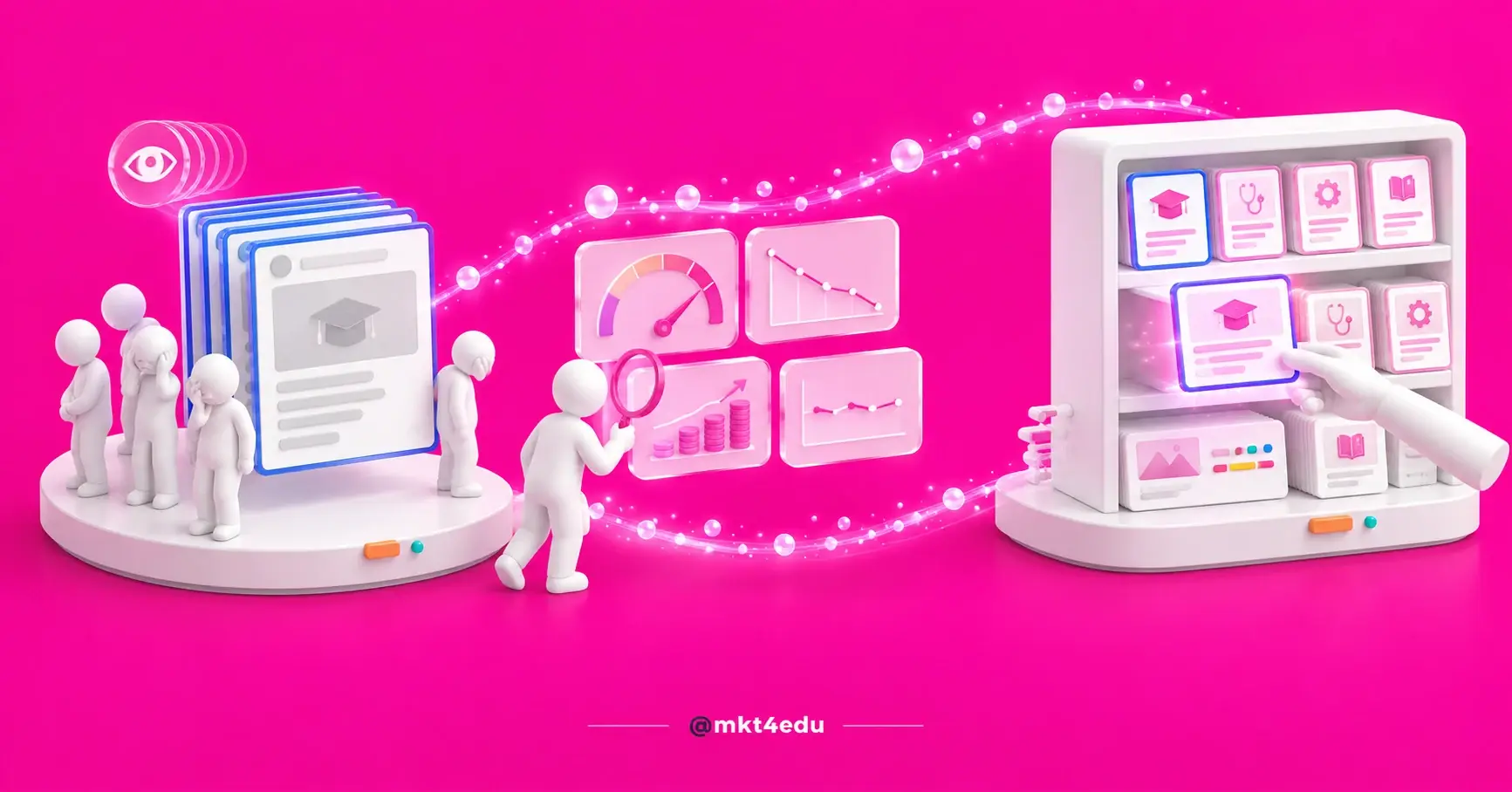
If you have a website, for example, you can install the Google Analytics, track visits and get a read on who is out there. You learn the shape of your public: rough age, gender, where they are. You learn how they browse: on a computer or a phone, which browser, what hours, one visit or many, and which pages they read most. You also learn where they came from, whether that is organic, paid media, or a social network. And more besides.
For educational marketing strategies, Gathering this data and reading it, along with the rest of what students and future students do, is what gets any manager to the goal they all share: doing more with less. Or doing more without asking for a bigger budget.
This way of planning, executing and tracking actions based on data is also called data driven marketing. And if your educational institution still doesn't do data-driven Marketing, it's time to rethink your investments in the area, you could be losing customers and spending wasted time.
Furthermore, the integration of artificial intelligence (AI) into marketing strategies has proven to be a big trend. By 2025, 70% of chief marketing officers (CMOs) are expected to consider ethical responsibility in the use of AI as one of their top concerns.
This highlights the importance of using AI tools ethically and transparently, especially when personalizing campaigns and analyzing student data.
Marketing for educational institutions: how data can help
With a data-driven Marketing strategy, your institution will gain agility and efficiency in decision-making, cut costs and be able to better adapt to student demands and market changes. It is also possible to predict trends. In the education segment, a change that we can already mention is the growth of Distance Learning (Online).
Hold your data in good order and your managers can read how leads and students behave. That is an edge. In Marketing, here is what that reading is good for:
(1) sharpen how you slice your paid campaigns on Facebook and Google, and your posts on social networks. Aim at the people most likely to enroll, drawn from the profile of the students you already have. Look for a crowd that looks like them, and stop spending time and money on ads for people who are not your target;
(2) create personalized messages based on the profile and behavior information of your visitors and leads, and thus increase your conversion into registrations;
(3) create more relevant content based on the interest shown by your audience based on the interactions of users on your website, considering the most accessed pages and the most searched terms on Google about your business, for example.
According to Gartner, a leading market research and consultancy company, data analysis is at the forefront of the priority list of top Marketing leaders. And the big issue for these professionals is to combine the interpretation of quantitative and qualitative metrics to better grasp customers.
After all, it's not enough to have access to a huge amount of data without knowing what to do with it. You need to have a strategic look to assess which information really matters and has a positive impact on your sales. This brings more enrollments to the institution.
To maximize the impact of data-driven marketing strategies, it is key to set up an outcomes-based measurement framework.
This model allows you to align marketing goals with business results. This makes it easier to show the value of marketing actions to stakeholders.
Using frameworks that tie the key numbers, the KPIs, straight to the goals of the company, so a campaign can be read with more care and more use.

How to do marketing with little money?
In addition to greater access to data, Digital Marketing has brought small and medium-sized companies the possibility of carrying out actions without having a very large budget. There are tools free (like Google Analytics) and other paid, but low-cost. Investments in advertising (Facebook, Instagram, Google, Bing) are smaller compared to traditional media such as television.
To start Digital Marketing actions, it is interesting to use marketing automation software, such as HubSpot (which has a free version and paid options). This type of program records the interaction history of your institution's leads and students with your website (pages the lead accessed, materials they downloaded, emails they opened and clicked on, etc.).
This way, the work of data analysis is made easier, since much of the information you will judge and interpret will be gathered in a single place.
It is also key to have a specialized team that knows best market practices and knows how to bring results to your institution. 4RevOps is focused on education and HubSpot's only Diamond partner in Brazil. We exceed expectations in bringing results with inbound marketing, capturing more leads and cutting costs in the Educational Marketing we carry out for our clients.
Last, it is worth saying this. Data-driven marketing does more than make a campaign run leaner. It also lifts where the school stands in the education market.
By using data to better grasp student behavior and needs, institutions can offer more personalized and relevant experiences. This raises student satisfaction and loyalty.
This student-centric approach is key to stand out in an increasingly competitive environment.
Do you want to increase the number of enrollments at your institution at an affordable cost? Schedule a conversation with us.

How does data drive educational marketing?
What is data-driven marketing?
It’s an approach based on collecting and analyzing audience behavior data. It enables more strategic, personalized, and efficient decisions, boosting student acquisition and retention.
Why should educational institutions adopt data-driven marketing?
Because it ensures precise decision-making, cost reduction, better audience communication, and measurable results, such as increased enrollments at a lower cost.
How do data improve educational campaigns?
They help accurately segment audiences, personalize messages, create more relevant content, and optimize investments based on proven results.
What tools support data-driven marketing?
Google Analytics, HubSpot, SEMrush, and automation platforms are key. They centralize data and offer valuable insights for more effective marketing actions.
Can efficient marketing be done on a low budget?
Yes. Digital marketing allows cost-effective campaigns. Free tools like Google Analytics and affordable paid solutions make this strategy accessible even to small institutions.
How does artificial intelligence support educational marketing?
AI enables scalable personalization, predictive analysis, and task automation. AI-based tools like HubSpot Breeze AI Suite help increase conversion rates and campaign efficiency.
What is the ethical role in using data and AI?
A school must use data with care and in the open. Respect the privacy of each person. And keep bias and misuse out of anything a machine decides, above all in education.
How to measure the success of data-driven campaigns?
Use goal-aligned KPI frameworks to prove results, enhance decision-making, and show the true impact of marketing efforts.
























 Portugal