





Attracting students has become a challenge for educational institutions, as there are countless of them spread across the country trying to create some type of connection with their target audience.
It is in this scenario that educational institutions have been investing in digital marketing strategies. The 16th Map of Higher Education, published by Instituto Semesp in March 2026, describes a higher education market in Brazil that already exceeds 10 million enrollments, with distance learning redrawing the competitive map.
However, putting together an ideal digital marketing plan for an educational institution is not an easy task. Therefore, 4RevOps prepared tips for your educational institution to stand out in the education market. Check it out!
What is digital marketing and what is marketing planning?
“Satisfying customers is no longer enough: we need to delight them”, Philip Kotler.
Based on this phrase from one of the greatest references in Marketing, we describe Digital Marketing as a set of strategies, developed in the online environment, which aims to promote and contribute to building the brand and its products before the target audience.
However, it is no longer enough to satisfy customers or students. In the case of educational institutions, it is necessary to delight them with something that adds value.
And how can Digital Marketing help? With personalized campaigns, released at the right time and focused on the interests of the target audience.
Marketing planning is the step that comes before all of that. It decides which objectives the institution pursues, for which personas, on which channels and in which order, and it is what separates a personalized campaign from a shot in the dark.
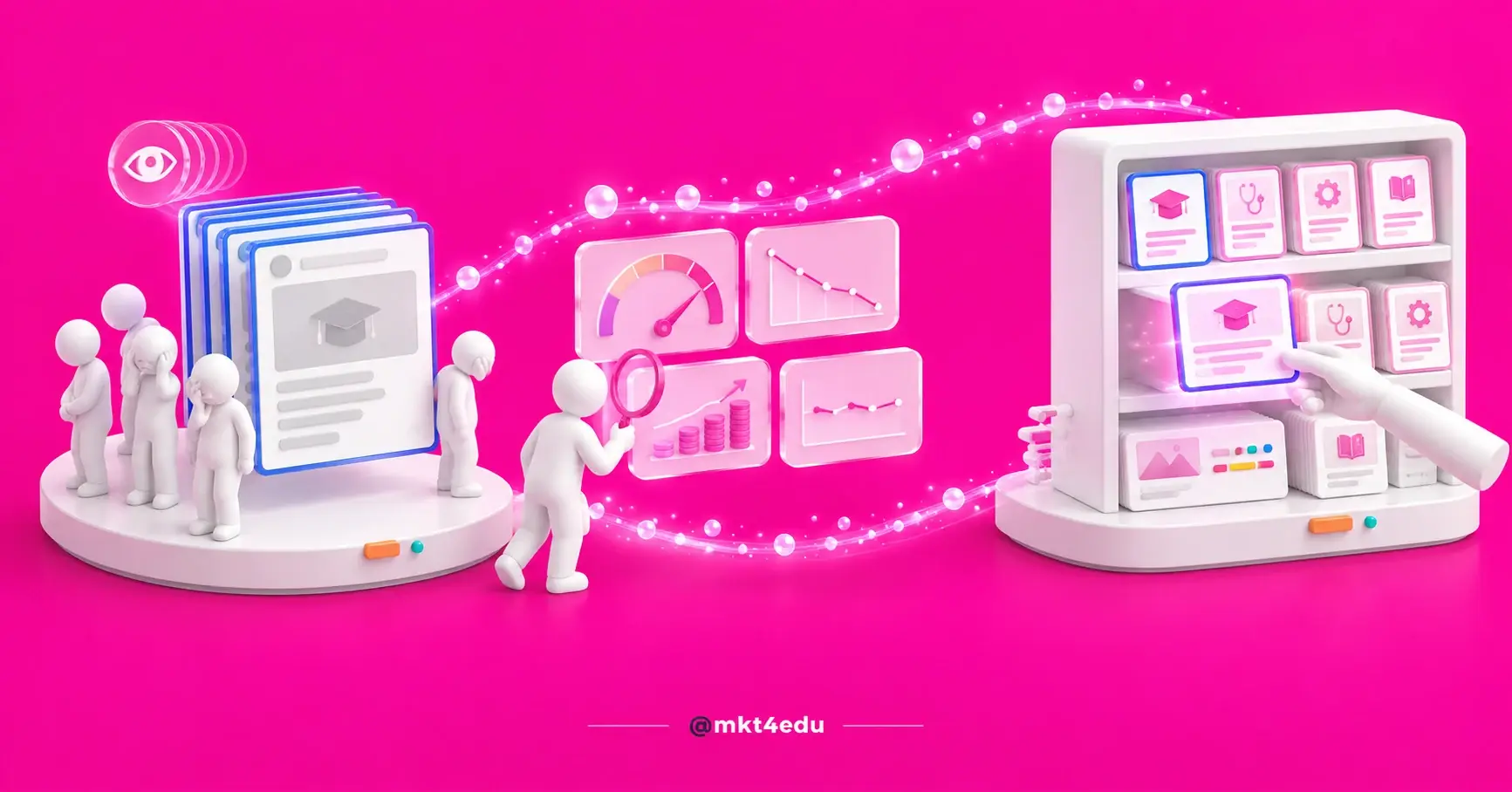
 Caption: Data analysis is essential to design efficient digital marketing strategies in the education sector.
How to do digital marketing planning?
Digital marketing planning at an educational institution is a guide for executing strategic campaigns. An effective digital marketing plan depends on actions that can be decisive in results. Here are some tips.
Plan and define objectives
Digital marketing revolves around actions and also a constant analysis of results. Therefore, it is essential that the educational institution chooses priorities and evaluates throughout the campaigns whether they are delivering results.
At this initial moment, it is possible to build personas, define the best communication channels (social media, SMS, messaging apps, website and email, for example) and apply targeted content marketing.
According to Sebrae, 25% of companies close due to lack of planning, which demonstrates the negative impacts of those who do not plan.
It is worth stating the objective as a number, not as an adjective. “Increase visibility” guides no decision at all, while “generate 1,200 qualified leads for the January admissions cycle” already defines channel, topic volume and budget.
Record the target cost per channel too. Because acquisition cost rises with every cycle, the plan needs to state how much each front may spend per lead before it gets cut, as the most relevant metrics for universities make clear.
Build the persona
Segmenting your institution's audience correctly is decisive in digital marketing planning. It is impossible for any marketing action to work if you don't know exactly who to direct it to.
For this it is necessary to build a persona based on the student's habits, interests, lifestyle and demographic and psychographic data.
One persona source almost nobody uses is the institution's own CRM. Questions repeated in support, in forms and in chats show the doubt that blocks enrollment, already validated by people who raised their hands.
Define the best advertising channels
Before investing the educational institution's money in a single strategy, it is necessary to know where your audience is and the best way to reach them. Below we have selected some advertising channels:
- Social Media Marketing. Brazil has 150 million social media identities, according to Digital 2026: Brazil, from DataReportal, and reach is very uneven across platforms.
- Email Marketing. Segmented content still performs better, and it is the only channel where the institution talks to a list it owns, without depending on anyone's algorithm.
- Video Marketing. YouTube reaches 150 million people in the country, the widest reach among platforms, and it answers questions with a face and a voice.
- Content marketing on blogs. It is the library that sustains every other channel and what Google and AI systems read when deciding whom to cite.
That unevenness in reach is what old plans usually miss. A channel that was once mandatory may have become a niche, and stayed in the plan out of habit alone. Here is how reach breaks down:
|
Platform |
Reach in Brazil |
Role in the marketing plan |
|
YouTube |
150 million |
Video marketing and course research |
|
|
147 million |
Social media and social proof |
|
TikTok |
131 million |
Course discovery among younger audiences |
|
|
109 million |
Adult applicants and their families |
|
|
90 million |
Graduate programs, MBA and corporate education |
|
X |
17.1 million |
Niche, no priority in recruitment |
Table: Advertising reach reported by the platforms in Brazil, according to Digital 2026: Brazil, with data from October 2025.
How to distribute a topic across the channels?
The same topic pays off in more than one format, and the plan decides the order. Social media marketing cuts the argument into a short piece, video marketing gives the explanation a face and a voice, and email marketing carries the depth to people who already showed interest.
The order that works starts with text. The blog article is the piece that sustains the others, because it is where the video script, the social carousel and the email body come from.
Video marketing earned its place in education because it answers questions with proof. Alumni testimonials, lab tours and curriculum explanations convince more in short video than in text.
Produce targeted content
Strategies based on content marketing capture demand that already exists. That's why designing a strategy based on relevant and attractive content for your target audience makes all the difference in the effectiveness of digital marketing.
All content must be based on what your audience wants, thus increasing the possibility of engaging students and gaining more enrollments. Content is also what gives the other channels something to distribute, as social media and inbound marketing strategies show.
Content planning is the editorial layer inside marketing planning. It decides the topics, the formats and the publishing order, while the larger plan decides the objectives, the budget and the channels that will carry those pieces.
Create an action schedule
The educational institution's action schedule, in digital marketing planning, is essential for teams not to get lost in campaigns.
Through it, it is possible to create a process flow that allows measuring results and making corrections within campaigns. In other words, all digital marketing actions and investments will be measurable, whether they are paid media, SEO, social media or inbound marketing campaigns.
Anchoring the schedule to the academic calendar changes the outcome. Top-of-funnel content has to be published and indexed months before applications open, because ranking takes time, and a bottom-of-funnel article published during admissions week only serves the next cycle.
Measurement needs three levels to be useful: organic traffic per piece, leads generated per piece and enrollment attributed to the channel. Without the third, the report shows audience and hides revenue.
Which educational marketing strategies should come first?
The educational marketing strategies that enter the plan first are the ones that address the tightest stage of the institution's funnel. If lead volume is missing, the plan prioritizes discovery and top-of-funnel content. If leads arrive and do not convert, it prioritizes bottom of funnel and response speed.
That choice avoids the most expensive mistake in the sector, which is copying another institution's plan. A college with a strong local brand has a different bottleneck from one that just launched an online program.
Three fronts usually carry the result of a cycle: student recruitment through organic search, nurturing by email and reactivation of the list that already showed interest in previous admissions rounds.
The plan also has to say what goes out. Keeping five fronts with half the attention pays less than sustaining two with consistency, and that is what separates educational marketing strategies from a list of tasks.
How do SEO strategies fit into marketing planning?
SEO strategies belong in topic selection, not in the final review. Keyword research is what reveals which question has search volume, which one the site already covers and which competitor owns the space. Without it, the plan produces beautiful pieces for questions nobody asks.
The gain lies in capturing demand that already exists. Someone typing “is an online graduate degree worth it” is closer to a decision than any audience reached by an awareness ad.
Three SEO decisions have to sit in the plan. The main keyword of each piece, the cluster it belongs to and the internal link that will point to it on publication day.
The third one is the most forgotten. Content published without an inbound link is born orphaned, and organic traffic takes longer to reach a page no other page recommends.
How to show up on Google with your institution's content?
To show up on Google, the institution needs a page that answers the query better than the ones already in the top positions. That means covering the whole topic instead of repeating the keyword, because the search engine breaks the question into subquestions before deciding whom to show.
For a site that has published for years, the shortest path is not a new topic. It is updating the content that already has history and inbound links, because it starts the race with accumulated authority.
Social platforms became part of the same job. Profiles, captions and video descriptions are indexable too, and they increasingly show up in branded queries.
To know whether the strategy works, the plan closes the loop by tracking ranking position per keyword, not just total sessions.
How to show up in AI search with marketing planning?
To show up in AI search, content has to be extractable in self-contained passages, backed by named sources and supported by verifiable data. AI systems retrieve passages, not whole pages, so each answer must make sense in isolation from the paragraph above it.
The landscape shifted fast. Google launched AI Mode in the United States in May 2025 after bringing AI Overviews to its biggest markets the year before.
The effect on the results page is measurable. The SparkToro study built on Similarweb data reports 68.01% of searches ending without a click between January and April 2026, against 60.45% in 2024.
The same study shows AI Overviews appearing in more than 20% of searches, with click-through rates falling by almost 60% when they are present. Part of the audience reads the answer and visits no website at all.
The shift does not end SEO, but it changes the goal stated in the plan. The objective now includes being the source cited inside the answer, which requires original and verifiable content, as Google's documentation on AI features in Search explains.
SEO for AI asks for no special file and no secret markup. It asks for what SEO always asked, now with less tolerance for generic content, and the answer engine optimization discussion made that plain.
Frequently asked questions about marketing planning
Where should your institution start with marketing planning?
Start with an inventory of what already exists. Before opening a new campaign, list the published URLs, flag which ones carry expired data and which ones compete for the same keyword. That audit alone usually reveals more organic traffic opportunity than any new calendar.
Did you like the tips? If you need help, 4RevOps has a team ready to serve you and with expertise in the educational market.

























 Portugal