





Your customer talks to Artificial Intelligence every day and almost never notices. The recommendation on the streaming platform, the answer from the assistant on the phone and the bank chat all come from the same family of models.
Inside companies, the use of AI left the technology department and became a subject for service, marketing and sales. Knowing how to use AI to improve customer experience stopped being an innovation project and turned into operating routine.
The recent shift is in the type of AI that reached the front line. The assistant layer became a generative model layer, and software that used to answer now executes.
How did AI move from the lab into customer experience?
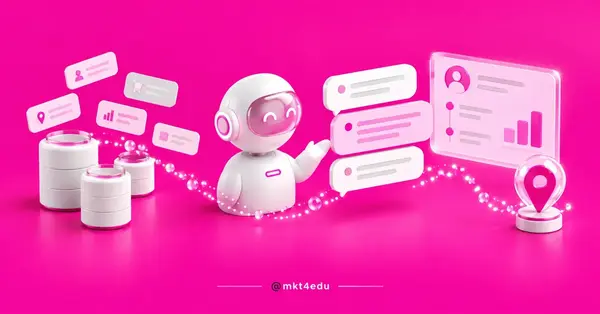 Caption: Using AI to improve customer experience starts with data gathered in one place, before any agent goes live
AI reached customer experience by accumulation, not in a single leap. Research started around 1950 with the Turing Test and gained a name of its own in 1956 at the Dartmouth Conference. It became a public subject in 1997, when Deep Blue beat Garry Kasparov at chess.
In February 2011, IBM introduced Watson to the public, a cognitive services platform built for business. It was the first time a system of that size arrived on the market as a corporate product rather than as a laboratory experiment.
From then on, investment changed both its scale and its destination. AI stopped being a research project and became a software layer inside the tools your team already opens every day.
The goal of the science has not moved since the Turing Test: simulate human behavior and intelligence without depending on a human. What changed is the volume of available data and the cost of processing all of it.
Algorithms read that data, find patterns and turn the pattern into action. That path, from raw data to decision, is what holds up any promise of personalization in customer service.
Which AI assistants does your customer use every day?
Your customer lives with AI through assistants already built into the phone, the home and the office. Siri, Alexa, Gemini and Copilot are the names left after a decade of consolidation, and each one trains an expectation about how a company should answer.
The list shrank in concrete ways. Microsoft retired Cortana in stages, ending the standalone Windows app in the first half of 2023, dropping support in Teams and in Outlook mobile in the second half of the same year, and switching off voice search in Outlook mobile in June 2024.
Microsoft points to Copilot and to Voice Access as the replacements, which already signals the change of layer in the assistant market. The fixed command list gave way to a model that reads intention.
Google followed a similar path. The removal of access to Google Assistant started on September 4, 2026, on Android phones and tablets, Wear OS watches, compatible earbuds and Android Auto projected from the device, with Gemini taking over as the default assistant.
Cars with Google built-in keep working with Assistant, according to the same announcement. The split matters for anyone building a service channel, because the same brand now answers in two different ways depending on the device.
That detail matters more than it seems for anyone running customer service. The assistant layer, which used to execute fixed commands, became a generative model layer able to interpret a request written in free language.
The direct consequence is expectation, and it arrives ready-made at your channel. Someone who asks the phone assistant for a duplicate bill and gets a one-sentence answer no longer accepts a numbered menu with nine options.
How do you use AI to improve customer experience with real-time data?
Using AI to improve customer experience starts with the response time of the data, not with the channel. The technology shortens the gap between what the customer does and what the company sees, and that short gap is what makes it possible to act while the opportunity is still open.
The clearest gain shows up in analysis. Pulling and cross-referencing databases, which used to consume hours of the team's time, now run in the background and arrive ready to read.
The move from in-person processes to digital ones sped up that demand. Consumers compare your response time with any application they use, not with the institution down the road.
Marketing 5.0, by Philip Kotler, published in 2021, sums up the posture in one expression: being ready to change. Day to day, that willingness means spotting the opportunity and adjusting the route before the context shifts again.
None of it works without an indicator. There is little point in investing in lead generation without tracking KPIs, the key performance indicators that show whether customer experience improved or merely got cheaper.
Real-time tracking also protects the user experience. UX, short for user experience, describes how a person feels while moving through your website, your application form and your service channel.
What are AI agents and what do they change in customer service?
AI agents are systems that receive a goal and work until they complete it, querying tools, deciding the next step and executing actions inside real systems. The difference from traditional automation lies not in the quality of the answer, but in who decides the path.
Three layers live side by side in customer service today, and confusing one with another gets expensive at the design stage. Here is how they separate:
|
Layer |
What it does |
Where it usually stalls |
|
Rule-based automation |
Fires the same action whenever the condition repeats |
Any request outside the expected rule |
|
Scripted chatbot |
Answers expected questions inside a designed flow |
A question written in free language |
|
AI agent |
Receives the goal, queries systems and finishes the task |
Incomplete data and missing permission |
Table: Comparison of the three Artificial Intelligence layers that coexist in a customer service operation.
One concrete example of the third layer is an AI agent that holds the first conversation over voice and messaging, qualifying the contact and booking the meeting without following a fixed script.
The market already projects volume for that layer. Gartner estimates that by 2029, agentic AI will autonomously resolve 80% of common customer service issues, with a 30% reduction in operating cost.
Today's picture is more modest than the projection. In the seventh State of Service report from Salesforce, which surveyed 6,500 professionals, teams estimated 30% of cases resolved with AI in 2025 and projected 50% by 2027.
Among the service leaders in the same survey, 79% consider the investment in AI agents essential for current demand. The number describes a stated priority, not a budget already approved.
The distance between the projection and today's number is the useful part of the data. What blocks adoption is rarely the model, but data scattered across systems that do not talk to each other.
How do AI SDR agents work in lead generation and customer experience?
AI SDR agents act at the first commercial step. SDR stands for Sales Development Representative, the professional who makes the first contact and qualifies interest before passing the lead along. The agent takes that shift over voice and over text.
The difference from an automated blast is the conversation. The agent asks, listens to the answer, checks the history and decides whether to book a meeting, to qualify the contact or to close it.
In a higher education institution, the gain appears at the hour when nobody is online. A candidate who fills in the form late at night gets an answer the same night instead of waiting in the queue the next morning.
Customer experience improves for a reason that is simple to measure: the time to first contact falls, and the response rate follows. Both numbers already sit in the CRM report, so the comparison needs no new tool.
Building this takes more design than technology. Implementing an AI SDR agent depends on escalation rules, a clean database and an exit script for the moments when the agent does not know the answer.
Instead of replacing the sales team, AI SDR agents hand time back to it. A comparison between an AI SDR and a human SDR usually lands on division of labor, with the person entering a conversation that already carries context.
Chatbot or enterprise virtual assistant: what changes in customer service?
Chatbots and enterprise virtual assistants solve different problems. The chatbot covers first-line service, with fast answers and high volume. The enterprise assistant integrates internal systems and handles requests that cross departments such as enrollment, finance and academic records.
Choosing between the types of chatbot depends on what is stuck in your operation today, and not on what a vendor calls innovation.
The enterprise assistant market has changed shape and name more than once. IBM itself, which introduced Watson in 2011, reorganized its current offer around an agent orchestration platform.
Treat the category, not the brand, as the buying criterion. Vendors rename products often, and a project tied to one name ages faster than the operation it serves.
The classic chatbot gains still hold: service at any hour, instant answers, several conversations in parallel and standardized data collection. None of those four depends on a generative model to work.
What generative AI added was the understanding of context. The bot stopped depending on an exact keyword and started interpreting the request as it was written, typing mistakes included.
Retention service follows the same logic with one important detail. There, the history weighs more than the question, because the dropout signal shows up in attendance before it shows up in the conversation.
How do CRM and AI unify the data of the customer journey?
The CRM is where AI finds context. CRM stands for Customer Relationship Management, the system that stores the relationship history of each contact. Without that consolidated history, the model may get the tone right and still miss the moment.
The tool collects data from wherever it is connected: email, social networks, website, blog and landing pages. The useful work starts when those numbers become a single record per person.
Service connected to the history of the customer changes what the team sees during the conversation. Ticket, purchase history and previous interaction appear on the same screen, and the team no longer starts the answer from zero.
Without that unification, AI only reproduces at scale the silo that already existed. An agent that reads only the channel where the conversation happened repeats a question the customer answered somewhere else.
The quality of the data also defines what can be predicted safely. A predictive model trained on an incomplete base makes confident mistakes rather than small ones, which is far worse for customer experience.
Which customer experience metrics show that AI is working?
Customer experience is the term the market uses for the sum of a person's perceptions across every contact with a brand. Measuring the effect of AI on it means looking at resolution, time and satisfaction together, never at one isolated number.
Three indicators carry the reading: the first contact resolution rate, the average handling time and the satisfaction declared at the end of the conversation. Taken on its own, each of the three can be improved by the wrong move.
The resolution rate answers whether the agent solved the case or merely postponed it. A conversation closed without a solution disappears from the time report and comes back the following week, with a more impatient customer.
Customer experience analytics connects those numbers to earlier behavior. That is where you find out whether a drop in satisfaction came from the bot or from the cancellation policy.
It is worth tracking the escalation rate to a human as well. It is not a failure signal, but the thermometer of where the agent still lacks data or permission to finish on its own.
CX, the everyday abbreviation for customer experience, becomes a shared responsibility when the data is common to marketing, sales and service. That is the ground RevOps covers when it aligns the three areas around the same revenue number.
How do you connect marketing strategies and AI across the journey?
Marketing strategies with AI work when they start from the journey instead of from the tool. The starting point is mapping where the customer gets stuck, picking one stretch of the journey at a time and deciding which decision the machine makes and which one stays with a person.
Personalization is the most visible example. Content, offer and channel change according to the moment of the contact, and the model picks the combination based on what worked for similar profiles.
The next step is predictive action. Instead of reacting to a question, the operation anticipates the likely question and resolves it before it becomes an open ticket.
Marketing strategies designed this way change the routine of the team. Less time on repetitive tasks, more time on the complex case, which is exactly where the experience is won or lost.
Mkt4edu documents lead generation and retention projects supported by AI institution by institution, with the context, the scope and the result of each operation. Reading a case close to your own size says more than a generic benchmark.
It is worth naming what is still unknown. Nobody can predict which vendor will dominate this layer or how much of customer service will be autonomous three years from now.
That uncertainty argues for documented process and clean data, because both survive a change of platform and neither depends on a single supplier staying in business.
Frequently asked questions about how to use AI to improve customer experience
What should you prioritize first when using AI in customer experience?
Prioritizing, in AI for customer experience, means choosing one stretch of the journey at a time. The first cut is not between channels, but between what is stuck for lack of data and what is stuck for lack of people, because only the second group improves quickly with automation.
The order that tends to work has three steps: fix the data in the CRM, automate the predictable part of customer service, and only then put an agent in charge of executing a task from end to end.
Reversing that sequence is the most expensive mistake. An agent running on a dirty base scales the error just as efficiently as it would have scaled the win, and the customer feels the difference on the first contact.
The next decision is scope. One whole process handed to the agent yields more learning than ten processes with partial automation, because only the first one shows where the operation actually gets stuck.
If the question is where to begin, a conversation about AI agents applied to customer service separates what the technology solves now from what depends on fixing the process first. The meeting ends with a list of journey stretches that pay back within the current cycle.

























 Portugal