




It is no longer a secret that the CRM cycle, when well managed, can bring countless benefits to any business strategy. Each step of this cycle is a fundamental part of every company's objective: to improve the customer service.
Bringing to light the usefulness of CRM as a marketing and customer relationship management tool, what is the relationship between it and the use of artificial intelligence in this process? How do these two linked technologies help us to obtain better results and offer more assertive solutions to our customers?
That's exactly what we're going to discuss in this post!
CRM and Artificial Intelligence in practice
CRM is software that centralizes all customer contacts and interactions, allowing marketing, sales and support teams to stay aligned around the customer journey. Artificial Intelligence uses algorithms, machine learning, Big Data and deep learning to identify patterns and provide fast, in-depth analysis. When CRM and AI are combined, companies gain automation, predictability and personalization, optimizing time, reducing errors, increasing productivity and delivering faster, more accurate and relevant experiences throughout the entire customer relationship.
-
-
Centralize customer contacts and interactions in a single platform.
-
Align marketing, sales and service teams around the same customer view.
-
Use AI to analyze large data volumes and predict behaviors.
-
Automate repetitive tasks across the customer journey.
-
Increase productivity, support agility and customer loyalty.
-
What you will see in today’s content
-
CRM concept and how it structures customer relationships.
-
Main features and benefits of using CRM in a company.
-
What Artificial Intelligence is and how it connects to CRM.
-
How CRM and AI optimize time and reduce operational errors.
-
Productivity gains with automation, machine learning and chatbots.
-
How AI improves support, satisfaction and customer loyalty.
-
How Mkt4Edu applies CRM, AI and HubSpot to generate results.
What is CRM?
Customer Relationship Management (CRM) is nothing more than a software developed with the objective of facilitating the management of customer relationships.
The idea is that your entire customer contact structure is within a CRM tool: contact list, interactions via email, WhatsApp messages, calls… .
The purpose of this tool is for all teams in your company to be on the same page when we talk about the consumer journey, since all these interactions can be accessed by any area of your team. In this regard, it is possible to follow up on previous contacts before making a new call, for example.
When we talk about the CRM cycle, as the expression suggests, it refers to a cyclical movement, that is, a constant looping between all the stages of managing your relationship (company) with your customer (or potential customer). The image below exemplifies this well:
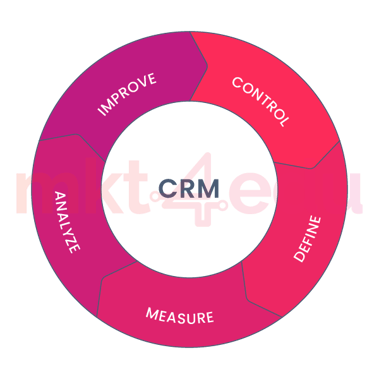
Image 01: Visual representation of the CRM cycle, highlighting the continuous stages of defining, measuring, analyzing, improving and controlling customer relationships.
What can a CRM do in your company?
- Personalization and automation of emails and messages;
- Integrate in a practical and simplified way different areas of your company (sales and marketing team, for example);
- Storage of high amounts of data;
- Creation of automatic activities for each area according to the stage of the consumer journey;
- Predictive data analysis;
- Development of automatic reports;
- Management of team activities, etc.
We could write a few pages about the various advantages of having a CRM in your company, a living example of this is the fact that we invest so much time studying and exploring Hubspot (CRM we use here), that we not only base our entire structure on it, but also we managed to bring excellent results to our clients through it, which for the second consecutive year gave us the title of Latin America Partner of the Year.
But that's not what we're going to talk about now. Today, we're going to understand a little more about the relationship between CRM and Artificial Intelligence.
The fact is that these two tools together help you better understand the consumer journey and, consequently, deliver better solutions to your customer.
What is Artificial Intelligence?
Cutting to the chase, Artificial Intelligence (AI) is the intelligence that simulates human behavior without needing a human.
Through the use of algorithms, machine learning, Big Data and deep learning, systems identify patterns of behavior and present responses and solutions similar to human behavior.
The great advantage of using AI in everyday life is the very high analytical capacity that this science offers. This analytical capacity, when coupled with CRM, offers optimized and agile results.
In recent years, the use of AI in CRM has moved from “future trend” to large-scale reality. According to a global market report on AI in CRM, investments in these solutions are expected to grow from just over $8 billion in 2024 to around $11 billion in 2025, with an annual growth rate above 30%.
Beyond traditional machine learning, generative AI and CRM copilots are gaining traction. These tools summarize interactions, suggest next best actions, and automate service and sales tasks in a more contextual way, enabling faster responses and more personalized customer journeys.
Speaking of AI and CRM, here are some curiosities and advantages of this successful relationship.
Read too:
- How does CRM connects with the sales funnel steps
- What is the importance of CRM for companies? 6 benefits
- What is the connection between CRM and the purchase funnel stages
- Marketing Automation and CRM: why is it important to put them together
1. Time optimization
We know that with all the processes that exist within an organization, it has become increasingly difficult to perform some activities quickly and objectively. In this regard, CRM can help you (and a lot).
Using the automation services that CRM can offer, workflow for demands such as recording contact and sales activities, managing pipelines (such as the sales funnel), creating reports, and sending emails and messages can be done in an automated way, freeing up your team's time with repetitive activities.
This time saving for your team can be directed towards more complex tasks where you really need a human.
2. Error reduction
The use of intelligent data resulting from the use of Artificial Intelligence drastically reduces the errors and deviations made by the absence of material or even by human error, because the data are automatically recorded, and from this record, the extraction of reports becomes faster and more complete.
Imagine all the times you've made/tried to make a report that needed to unite information from different areas (such as commercial, marketing and call center). How much time was needed? How many times a single number or comma out of place, changed all formulas and consequently exposed results?
Well, with the union between CRM and AI, manual data recording is in the past and, consequently, errors too!
3. Increase in productivity
As we have already mentioned, one of the advantages of artificial intelligence is to use machine learning to learn from the workflow already carried out by service professionals and then optimize itself automatically. The more your team uses the chosen tool, the more optimized it will be for your company's and your customers' solutions.
Another point is that this optimization is customized for each user (it would be quite difficult to do it manually), so the solutions are different for each person.
Still in the area of productivity, one of the most used tools within AI is the chatbot, often used in customer service. These tools are designed to work 24/7, 365 days a year - without getting tired. It can help both to unburden your service team and to offer faster and more personalized service to your customer.
This behavior increases the productivity of both your team, which will leave the massive and repetitive jobs with robots, and for your result, since the agility of robots is infinitely greater than that of human beings.
4. More efficient support = higher loyalty rate
The consumer is increasingly demanding and has no time to wait for an answer, the world is working from "now to now", when contacting the call center, he has no more time and no patience to wait for an appointment for 30 minutes.
As we said before, the use of AI integrated with CRM can help you with this! The use of chatbots makes service faster, more efficient and more accurate.
Another advantage of using this service is the elimination of queues for service, after all, the chatbot can simultaneously handle numerous requests while an attendant serves one customer at a time.
Recent research shows that well-designed AI chatbots can improve both efficiency and customer satisfaction. However, the best results come from hybrid customer service models with chatbots and humans, where bots handle simple or repetitive requests while human agents take over complex, sensitive, or high-value interactions.
Studies on customer experience also highlight that people appreciate the convenience of self-service but still expect empathy, personalization, and a clear path to a human when issues become serious. Combining AI with human support helps reduce wait times without sacrificing service quality.
Service without waiting time, with quick response and problem solved? It is the revenue from the increase in the customer satisfaction index.
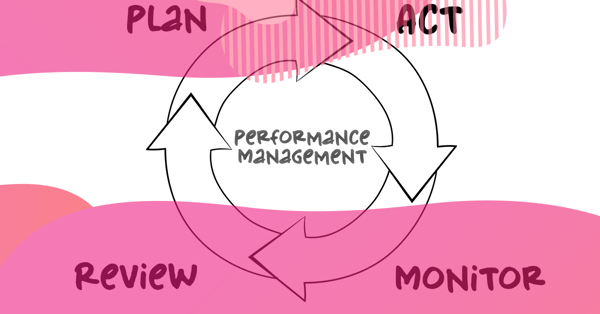
Image 02: Illustration of the continuous cycle of planning, monitoring, reviewing and acting that can be applied to CRM with the support of artificial intelligence.
How to have this optimization of results in your company?
We can help you with that! Our expertise here at Mkt4Edu is to promote strategies to optimize your acquisition and retention process at a lower investment cost. There are already more than 3,000 campaigns during our activity period!
We use technologies that allow us to collect, analyze and monitor data, such as Hubspot, to promote the success of your marketing actions and monitor your company's performance in online and offline channels. In this way, we can work in a predictive way in data analysis and, consequently, offer customized solutions for each situation.
The use of Artificial Intelligence provides the flexibility we need to work according to the needs of each business. If you want to know more about our solutions, visit our website! There you will find more information about our solutions and you can contact our team and discover the best solution to help you leverage your business.

Frequently asked questions about CRM and Artificial Intelligence
What is CRM and what is its main goal in a company?
CRM (Customer Relationship Management) is software designed to facilitate customer relationship management. It centralizes information such as contact lists, e-mail history, messages, calls and other interactions. The main goal is to ensure all teams are on the same page regarding the customer journey, with access to past records before starting a new contact. In this way, CRM helps organize service, sales and marketing processes, integrates different departments and creates a solid data base for more accurate decisions across the entire business strategy.
How does the CRM cycle work in the customer journey?
The CRM cycle is described as a cyclic movement, a constant looping between all stages of managing the relationship between the company and its customers or prospects. Each interaction recorded feeds the system and allows the company to track the history, understand the customer’s moment in the journey and plan next actions. By seeing the relationship as continuous — instead of isolated contacts — the company can adjust campaigns, sales approaches and service activities using updated data, keeping the customer at the center of its decisions.
What are the main practical features of a CRM?
A CRM can personalize and automate e-mails and messages, integrate areas such as sales and marketing, store large amounts of data and create automatic activities according to each stage of the customer journey. It also supports predictive analysis, automatic report creation and task management for different teams. With this structure, repetitive tasks are automated, teams gain agility and the company starts working with more complete and accessible information, which improves customer service, strategic decisions and the results achieved in campaigns and commercial actions.
What is Artificial Intelligence and how does it relate to CRM?
Artificial Intelligence is intelligence that simulates human behavior without needing a human, using algorithms, machine learning, Big Data and deep learning to identify patterns and provide responses and solutions. Its great advantage is a very high analytical capacity. When integrated with CRM, this capability enhances the use of the data stored in the system, enabling faster analysis, more accurate predictions and smarter automations. As a result, CRM and AI together help companies better understand the customer journey and deliver more suitable solutions at each stage of the relationship.
How do CRM and AI help teams save time?
CRM, with its automation resources, allows tasks such as logging contact and sales activities, managing pipelines, generating reports and sending e-mails and messages to be done automatically. AI contributes with fast, accurate data analysis, reducing manual effort when interpreting information. This combination frees teams from repetitive, operational work and lets people focus on more complex or strategic tasks that require human judgment. Overall, the use of time inside the organization becomes more efficient and aligned with higher-value activities.
How does artificial intelligence reduce errors in data and report management?
Using smart, AI-driven data significantly reduces errors caused by human failures or lack of information. Instead of relying on manual records and spreadsheets prone to typing mistakes or incorrect formulas, data is recorded automatically in the CRM. From these records, report extraction becomes quicker, more consistent and complete. This reduces rework, avoids distortions in key analyses and provides more reliable support for marketing, sales and service decisions, which are then based on more accurate and structured information.
How do CRM and AI contribute to higher productivity?
CRM and AI increase productivity by automating processes, learning from workflows and optimizing themselves continuously. AI uses machine learning to identify patterns in how service professionals work, adjusting recommendations and automations as the tool is used. The more the team uses the system, the more adapted it becomes to the company’s needs. User-level personalization also makes suggestions more relevant. With chatbots and automations handling repetitive demands, professionals can focus on higher-impact activities, raising overall productivity and improving business outcomes.
How does using AI chatbots impact customer support and loyalty?
AI chatbots can operate 24 hours a day, 7 days a week, 365 days a year without getting tired and can handle many requests simultaneously. This reduces waiting lines and ensures fast, personalized responses based on data stored in the CRM. When properly configured, chatbots make support more efficient and accurate, solving simple and recurring issues quickly. Support with no waiting time and problems solved promptly directly contributes to higher customer satisfaction and, as a consequence, to stronger customer loyalty.
Why is combining human support and AI important for the customer experience?
Recent research indicates that the best results come from hybrid models that combine chatbots and human support. In these models, AI solves simple, repetitive issues, while the team handles complex, sensitive or high-impact cases. Customer experience studies show that people value the convenience of self-service, but still expect empathy, personalization and the option to talk to someone when the issue is more serious. Integrating AI and humans makes it possible to reduce queues without sacrificing quality, balancing efficiency with genuine care.
How does Mkt4Edu use CRM, AI and HubSpot to optimize marketing and sales results?
Mkt4Edu uses technologies such as HubSpot to collect, analyze and monitor data, supporting strategies to acquire and retain customers with lower investment costs. With more than 3,000 campaigns carried out, the company works in a predictive way in data analysis, using CRM and Artificial Intelligence resources to offer tailored solutions for each situation. This makes it possible to track performance across online and offline channels, adjust marketing actions based on concrete information and find the best combination of tactics to boost business results.


























 Portugal