





Conversion rate is a basic metric in digital marketing, and almost every educational institution tracks its own. The result depends on what the team does with that number once it has been measured.
Many teams respond to a low number by buying more traffic. It is the most expensive route and the least durable one, because the bottleneck stays on the page.
Conversion Rate Optimization exists precisely to attack that point. It improves the yield of the people who already arrived, instead of widening the top of the funnel, and it does that from observed behavior.
Anyone asking how to improve conversion rate without raising the budget is asking for CRO, even without using the acronym. A new factor also joined the equation, because AI (Artificial Intelligence) search changed the composition of the traffic that reaches you.
What is Conversion Rate Optimization?
Conversion Rate Optimization, or CRO, is the set of techniques applied to a website or a landing page to turn a visitor into a lead and a lead into a student. When the person takes the expected action on the page, whether a download or a registration, a conversion happened.
The name describes the method well, because it consists of improving what already exists before buying more audience. Nothing about it depends on a bigger campaign to start producing results.
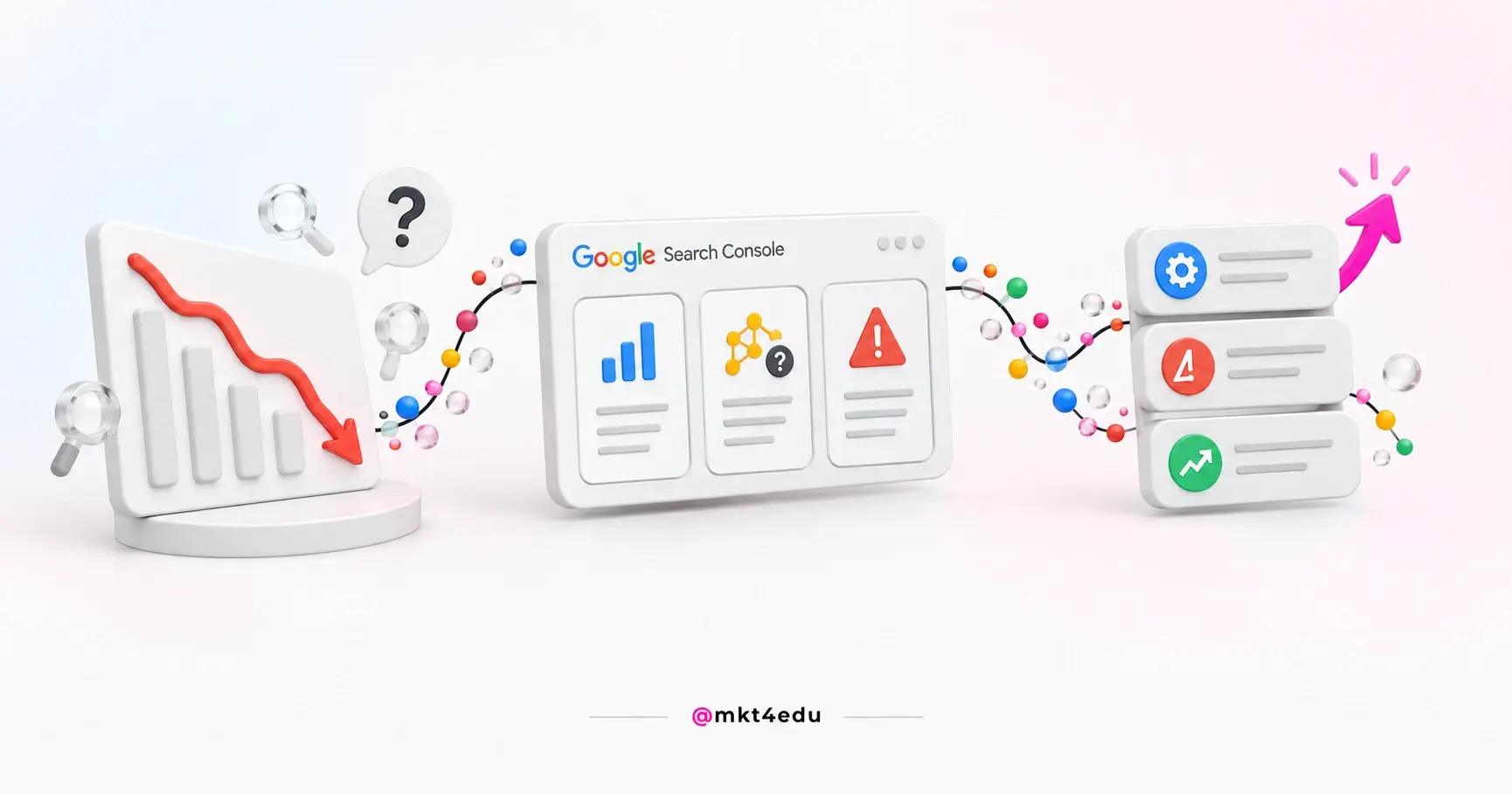
 Caption: Conversion Rate Optimization starts by reading real behaviour and ends with the test that confirms the hypothesis.
No page converts by accident. The user experience along the buyer's journey has to be supported by digital marketing strategies that point to the same final goal, which is enrollment.
That is why CRO became a central piece of digital marketing strategies at educational institutions. It makes the rate of leads turning into new students grow without depending on a larger investment.
Why is Conversion Rate Optimization important for UX?
The importance of Conversion Rate Optimization shows up at the point where a beautiful layout and a real result stop being the same thing. A site can be visually attractive and still block the enrollment, because the UX (user experience) decides whether the visitor moves forward or gives up.
Imagine that your institution has a website where the prospective student looks for information before enrolling. The first question is not whether the page pleases the eye, but what interaction it provides.
Does your website carry the visitor to the enrollment? What are your results, for real? Those questions cannot be answered by guessing, and that is exactly where data comes in.
UX improvements at critical stages, such as checkout, have a direct impact on conversion. Research from the Baymard Institute points to an average potential increase of up to 35% in conversion rates when recurring usability problems are corrected.
It is a solid argument for prioritizing CRO without expanding the paid media budget. The connection between CRO, SEO and UX becomes evident here, since the three disciplines fight over the same bottleneck.
If optimization raises enrollments, it also improves the return on investment (ROI) of every campaign. The money placed in media stops leaking through pages that do not sustain the decision of the people who arrive.
CRO can also raise the average ticket. Selling to someone who already studied with you is simpler than winning over a stranger, so it is worth offering a second purchase to the former student, such as a graduate program or a second degree.
How CRO works and how to do CRO at your institution?
Here is how CRO works: the strategy goes through three linked stages, which are collecting behavior data, interpreting what that data reveals and testing changes on competing versions of the same page. Anyone who knows how to do CRO treats each round as a controlled experiment, and not as a site redesign.
How to gather information about user behavior?
Collection tends to be the longest phase of the process, because it supports everything that comes next. Web analytics tools help you watch what the visitor does, instead of what the team imagines they do.
This is the stage where you learn how to track the customer journey with evidence: which pages come before the form, where the flow breaks and which content sustains the enrollment decision.
Google Analytics 4
Google Analytics 4 is now the measurement standard of the Google ecosystem. Standard Universal Analytics properties stopped processing data on July 1, 2023, and access to historical data, to the interface and to the API ended the week of July 1, 2024.
GA4 adopts an event-based model, rather than one based only on sessions, which improves the reading of actions such as CTA clicks, downloads and form submissions.
Review goals, audiences and reports against that standard to align conversion measurement and avoid inconsistency across channels and pages. The tool delivers behavior, profile, acquisition and conversion data in real time or over a custom period.
Lucky Orange
Why does your website fail to convert? Lucky Orange attacks that question with a real time dashboard, heatmaps, session recordings, conversion funnels, feedback surveys and form analysis.
The company states that this set of features helps you discover why 99% of a website's visitors never become customers. Treat the number as a vendor claim and validate the real proportion in your own reports.
Hotjar
Hotjar suits teams that do not master analytics metrics yet, because it translates behavior into images. Heatmaps, recordings and surveys show where attention concentrates and where it gets lost.
Use both tools together: let GA4 show what happens, such as a drop in engagement, and let Hotjar reveal why. The integration between them speeds up the diagnosis by connecting events and sessions.
That division of roles avoids a common mistake, which is measuring bounce rate with Hotjar. The number comes from GA4, and the explanation comes from the recorded behavior.
How to interpret the data you collected?
Interpreting means separating pattern from noise. Look for repeated behaviors and their probable causes, and remember that every line in the spreadsheet corresponds to a real candidate deciding where to study.
This is where the question about how to improve lead conversion gets a specific answer. The bottleneck may sit in a long form, in the promise made by the page or in an offer that does not match the ad that brought the visit.
How to run A/B tests without skewing the result?
Anyone who wants to know how to run A/B tests has to start with the experiment design. Create distinct versions of the same landing page, run both at the same time and define sample size and duration before switching the test on.
Testing in sequence contaminates the result with seasonality, a new campaign or a holiday. Running in parallel isolates the variable that matters.
Avoid peeking at the result in the middle of the experiment, a practice that skews the conclusion. This guide from the Harvard Business Review gathers the most common traps and explains how to escape them.
On platforms, Google Optimize was discontinued in September 2023 and GA4 received no native replacement. Anyone studying how to run A/B tests today has to choose a market tool integrated with GA4 and Google Ads to preserve data and reports.
That is the operational answer for anyone asking how to improve conversion rate without raising the budget: test, measure and keep the winner, round after round.
What does AI search change in conversion rate and click-through rate?
AI search changed the composition of the traffic that reaches your site. The results page now solves part of the question before the click, with AI Overviews and generated answers, so fewer visits tend to arrive, and they usually arrive more decided.
That shift affects two indicators at the same time. Click-through rate tends to fall on informational queries, while the site's conversion rate tends to rise, because the visitor already did part of the research.
Reading the two numbers in isolation leads to the wrong conclusion. A drop in sessions with stable conversion usually indicates filtering on the results page, and not a loss of demand for your courses.
Google states that there is no additional technical requirement to show up in the AI features of search, and that helpful content practices still apply. Anyone asking how to improve click-through rate in this scenario has to work on title clarity, a specific promise and depth that a generated answer does not deliver on its own.
Three adjustments help keep the reports honest:
- Compare conversion per session, and not only raw session volume.
- Separate brand queries from informational ones before concluding anything about how to improve click-through rate.
- Watch assisted traffic, because the visit that converts may have been born in a generated answer.
AI search also forces you to revisit how to track the customer journey, since the path to enrollment now includes steps that no session report registers.
What are the practical actions of Conversion Rate Optimization?
Three actions concentrate much of the gain of a Conversion Rate Optimization strategy at an educational institution: qualifying leads, placing automated service at the right point and reactivating the people who left without converting. None of them requires a bigger media budget to start.
1. How to qualify leads to convert more?
Lead qualification consists of selecting the people with the highest chance of closing an enrollment and giving priority to them. The goal is to concentrate service on real decision potential, without overloading the sales team with cold contact.
It is the most direct lever for how to improve lead conversion, because it changes the ratio between effort and result without touching a single line of the website.
2. How do chatbots help UX and conversion?
Chatbots with AI answer questions about schedule, price and admission the moment they appear. The visitor does not stall in the middle of the decision, and the page's UX improves without depending on staff availability at midnight.
Perception matters as much as the feature itself. When the bot reads as a cost cut, satisfaction drops and the effect on conversion weakens.
The Harvard Business Review recommends transparency about being a bot, empathetic language and an easy exit to human service, simple adjustments that raise trust and sales results.
3. How to do remarketing without wasting audience?
Anyone looking for how to do remarketing has to start with the list, and not with the creative. The visitor who left without converting remains reachable on another page or on a social network, as long as the audience is segmented by behavior.
On tracking, Chrome kept third-party cookies in 2025, which preserves cookie-based tactics. Even so, prioritize first-party data, which survives any browser change.
For users in the European Economic Area, Consent Mode v2 is a requirement for personalization and conversion modeling in the Google ecosystem. Make sure the consent platform and the consent signals are correct so you do not lose measurement or campaign performance.
Knowing how to do remarketing with lists built from behavior avoids burning budget on people who never showed any intention of studying at your institution.
It is worth looking at what happens after the conversion with the same lens, because a good share of paid traffic leads never becomes a sale due to failures in qualification and response time, and not for lack of volume.
Frequently asked questions about Conversion Rate Optimization
Where to start with Conversion Rate Optimization?
Start with the pages that already receive traffic and still do not convert. A page with steady visits and a weak result delivers enough evidence for a first round of testing, and the gain shows up without depending on a new campaign or extra budget.
The sequence that works is short. Measure what happens in GA4, understand why with recordings and heatmaps, formulate a hypothesis and run the test against the current version of the page.
After that, repeat the cycle with the next page on the list. CRO pays off through accumulated rounds, and not through a single site overhaul.
If your team already has data and lacks a method to turn it into experiments, conversion optimization is where mkt4edu comes in: page diagnosis, a prioritized hypothesis and a test designed to answer one question at a time.



.jpg)























 Portugal