





The question that opens a recruitment plan has moved. Teams no longer argue content versus direct approach, they argue about which of the two turns into an enrollment inside the same term.
Marketing strategies for colleges spent years migrating toward inbound marketing, and with good reason. What never got a clear answer was the trigger criterion for outbound marketing, the channel that speaks to a candidate without waiting for that candidate to come looking.
That criterion is what separates a welcome campaign from an approach that burns the database. It rests on three variables: the volume of qualified contacts, the deadline on the academic calendar and the quality of the data available about each person.
A recent shift in search behavior made the arithmetic easier to see. When the organic channel returns fewer visits for the same effort, direct contact gains relative weight in the recruitment mix.
What is outbound marketing for educational institutions?
Outbound marketing for educational institutions is any action in which the school starts the conversation, instead of waiting for a candidate to arrive through search or content. That includes the flyer at the school gate, the phone call, the text message and the conversation at a careers fair.
 Caption: Outbound marketing regains weight in the mix when search returns fewer clicks, and the direct channel gets triggered by a signal rather than by instinct.
Confusion starts when someone treats the direct channel as a synonym for offline. Display ads, campaigns sent to an owned list, WhatsApp messages and dialer calls are digital, and all of them remain an active approach.
What separates the two methodologies is who opens the conversation, not the medium used. The differences between inbound and outbound marketing show up in cost, in response time and in the kind of contact each channel delivers.
Inbound marketing builds demand: it attracts people who are still researching, educates them over weeks and hands over a warm contact at the end of the process.
Outbound marketing harvests demand that already exists. It finds the people who have decided to study and shortens the gap between intention and enrollment, which matters a great deal when the academic calendar tightens.
Neither side handles student recruitment and retention on its own. A school that masters only one of them stays hostage to the other one's cycle, and usually discovers that at the worst moment of the term.
Teams asking how to do inbound marketing normally start with content production. The step that gets postponed is deciding what to do with the contact who is already ready and cannot wait for three more emails.
Why does the drop in organic clicks favor outbound marketing?
Organic search returns fewer visits for the same content effort than it used to. When the click becomes scarcer, the direct channel recovers relative weight in the recruitment mix, because it does not depend on a candidate finding the school on their own.
The SparkToro study on searches that end without a click recorded that 68.01% of Google searches in the United States ended with no click at all between January and April 2026. In 2024 the same indicator stood at 60.45%.
The same study found AI Overviews, the AI (Artificial Intelligence) summaries at the top of the page, in more than 20% of searches. The reading published by Search Engine Land points to a fall of almost 60% in click through rate when they appear.
The figures come from the United States market, and other countries were not part of that sample. Even so, the direction tends to repeat itself wherever the search interface is the same.
The practical reading is straightforward. If the same investment in content returns fewer visits, the cost of each enrollment from the organic channel rises, and direct contact looks comparatively better.
None of this argues against inbound marketing, which keeps feeding the database with owned, consented contacts. What changes is the proportion, and in many cases it is worth reserving part of the budget for actions that do not depend on ranking.
When should you trigger outbound marketing in student recruitment?
Outbound marketing should be triggered when there is formed demand, a short deadline and enough data to personalize the approach. With any one of the three missing, the action tends to produce noise instead of enrollments, because it speaks to people who have not decided anything yet.
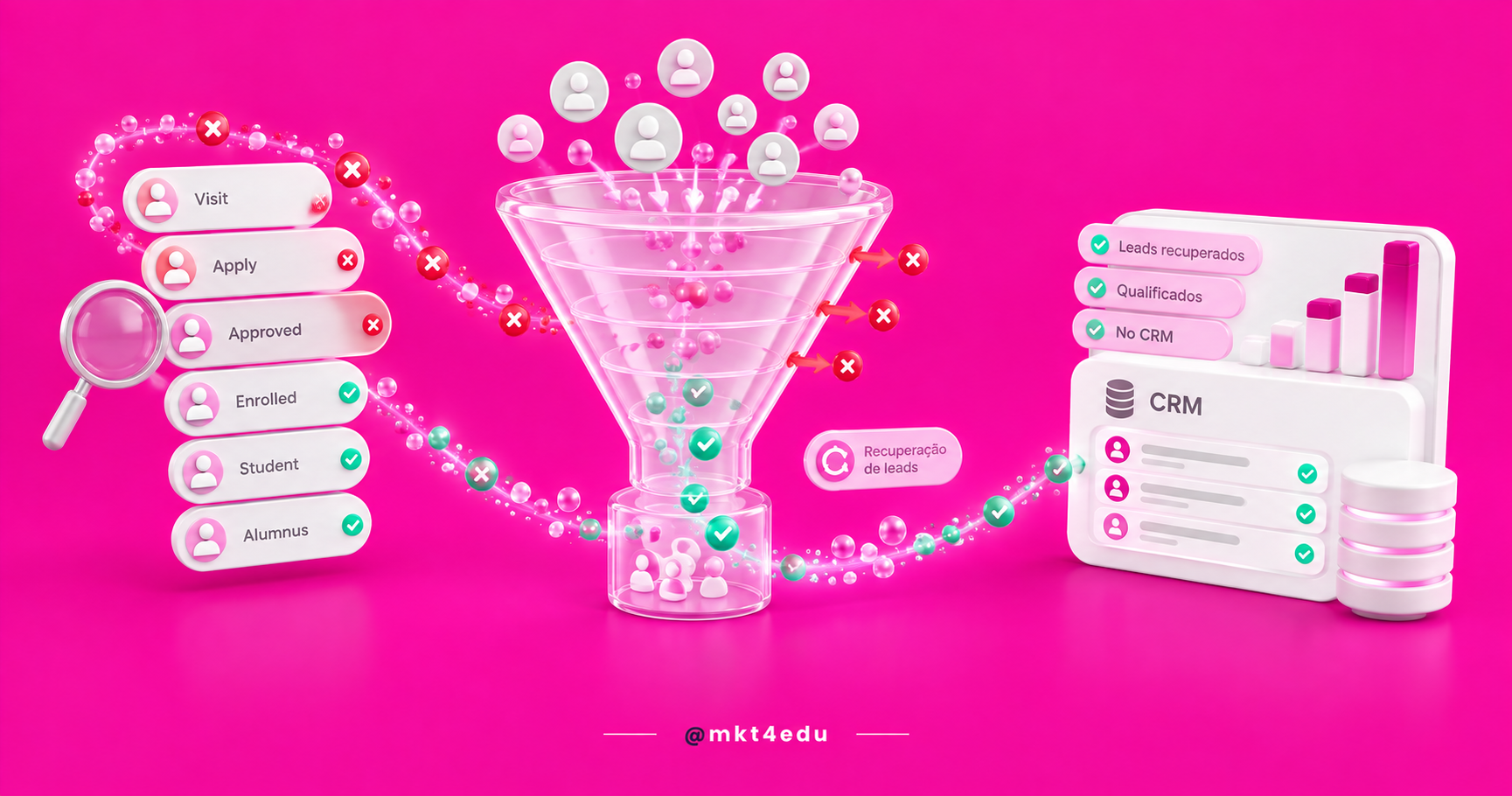
The first signal is stalled stock. A database with contacts who opened emails, visited the course page and never finished the application has already shown intent, and what is missing there is human contact.
The second signal is the calendar. In the two weeks before applications close, the candidate's decision window shrinks, and a direct approach starts to feel like help rather than intrusion.
The third signal is geographic concentration. A college that draws half of its applicants from five high schools spends less going to those schools than bidding for the same audience in a media auction.
There are also signals that rule the action out. Purchased lists, contacts with no recorded consent and databases with no interaction history deliver dialing volume and almost no enrollments.
The question of how to run student recruitment campaigns almost always starts with the channel instead of the criterion. The reverse order works better: signal first, channel second, creative piece last.
Teams that already know how to do inbound marketing have the raw material for that reading. Every content interaction leaves a trace, and traces turn a list of names into a shortlist worth calling.
Each signal has a channel that responds better and a metric that proves the call was right. Here is how the pairings line up:
|
Signal in the database |
Indicated channel |
What to measure |
|
Application started and not finished |
Phone call and text message |
Applications resumed within 72 hours |
|
Interest concentrated in a few schools |
Targeted flyer and campus visit |
Applications carrying the printed code |
|
Large database with no recent interaction |
Ad segmented by lookalike audience |
Cost per completed application |
|
Applications closing in two weeks |
Text message reminder |
Enrollments per send |
Table: Relationship between the signal observed in the database, the indicated direct channel and the metric that confirms the call.
The table works as a decision filter, not as a menu. If no signal appears in the database, the correct answer is to go back to content and let demand mature.
What data supports the decision to use outbound marketing?
The decision to trigger outbound marketing rests on four pieces of data: contact source, interaction history, declared stage of the buyer's journey and the deadline on the academic calendar. Without them, the direct approach becomes guesswork, and cost per enrollment rises with no one able to explain why.
Data collection was never a privilege of inbound marketing. Any direct action can return information, as long as the piece carries an identifier and the response lands in a structured field.
The CRM (Customer Relationship Management) system is where that information gets organized. It stores source, history and stage for every candidate, and it is what tells the team who gets a call and who stays in nurturing.
The outbound marketing data in student recruitment gives the external benchmark. The internal one comes from the school's own database, and it tends to be more useful, because it reflects who actually applies.
Teams that already know how to build inbound strategies have half of that organization in place. The same form that feeds an email nurturing track feeds the call queue, without asking the candidate for a second round of information.
Which outbound marketing strategies work in education?
Four outbound marketing strategies still deliver in education: flyer distribution, segmented social media ads, text messages backed by phone calls, and face to face work at student fairs. What separates the version that works from the one that annoys is the data behind each of them.
How do you distribute flyers without wasting the print run?
Flyer distribution pays off when the print run is targeted. Choosing the schools that already produced enrollments in the last three cycles concentrates the material on an audience with history, instead of scattering paper across a whole neighborhood.
Timing matters as much as the address. A flyer handed out during the week applications open has a practical job, and the same piece outside that window goes straight to the bin.
The piece can also collect information. A short printed code tied to its own application page turns paper into a traceable source, which is what outbound in practice at a school looks like when it is measured rather than assumed.
How do you run social media ads without sounding intrusive?
Social media ads escape the intrusive label when the targeting uses first party data. A lookalike audience built from the list of enrolled students tends to deliver more applications than targeting by generic interest.
Paid media for educational institutions is usually where the two channels meet, because the same tracking feeds content remarketing and the direct offer ad.
Do SMS and phone calls still work in student recruitment?
SMS (Short Message Service) still works as a short reminder, not as a sales piece. Deadline alerts, application confirmations and a link to resume an unfinished form get high read rates and fast replies.
A call takes more preparation than a message blast. A script that opens by naming the course the person looked at changes how the call lands, because it stops sounding like a cold list bought from a third party.
How do you use student fairs as a data channel?
A student fair has the best ratio between conversation and data collected. Every exchange at the stand yields a name, a course of interest and a school of origin, which feeds both the call queue and the email track.
The common mistake is treating the fair as an isolated action. Without moving the collected data into the database on the same day, the contact cools down before the admissions team calls back.
How do you measure the return of outbound marketing?
Measuring outbound marketing requires one identifier per action and a single point of arrival. A printed code, a reserved phone number, an exclusive landing page and a filled source field turn flyers, calls and fair stands into comparable lines in one recruitment report.
The indicator that decides is CAC (Customer Acquisition Cost), read in education as cost per enrollment. Adding up the cost of an action and dividing it by the enrollments it generated gives an honest comparison between channels.
An expensive direct action can be the cheapest one in the mix. If a flyer cost more per contact but converted four times better, its cost per enrollment lands below a channel with cheap contacts and weak conversion.
Three numbers carry most of the reading in direct channels: text message open rate, click rate on the link sent and response rate on the calls placed. All three come from the same platform that runs the email track.
Teams that know how to build inbound strategies already live with source and conversion dashboards. The work is extending that dashboard to field actions, which historically stayed outside the report.

How to run educational marketing campaigns with both channels?
Campaigns deliver more when outbound marketing and inbound marketing share the same database and the same calendar. Content warms and qualifies, the direct channel closes the decision window, and automation decides when each contact moves from one side to the other.
A single database is the starting requirement. Two separate lists produce the worst possible scenario, with the same person getting a sales call and a top of funnel email on the same afternoon.
Knowing how to do marketing automation is what makes that handover workable day to day. Simple rules do the job, without a long implementation project.
It is worth designing both flows at the same table. Deciding how to create inbound strategies alongside the direct contact rules avoids improvising the active approach a full term later.
Integrating inbound and outbound marketing strategies also organizes student recruitment and retention. The same history that supports an enrollment supports the conversation with students who are already on campus.
Among the educational marketing strategies for colleges that gain the most from this stitching is remarketing. It uses behavior recorded by content to decide who deserves a direct offer ad.
Frequently asked questions about outbound marketing
What to prioritize first in outbound marketing at your school?
The priority in outbound marketing is not picking a channel, it is organizing the data that authorizes contact. A database with recorded source, interaction history and journey stage lets you trigger a flyer, a call or an ad with criteria, and stop what is not converting mid campaign.
The second step is the identifier. No field action should leave without a code, a reserved number or its own page, because an action with no traceable source never enters the comparison with other channels.
The third step is the calendar. Mapping the decision windows for the whole year turns a last minute decision into planning, and it is what really answers how to run Educational marketing campaigns without improvising at the deadline.
None of this replaces content. Marketing strategies for colleges still depend on inbound marketing to build demand, and the direct channel remains the one that harvests that demand at the right moment.
If you want to leave a diagnostic session with the trigger criteria designed, the identifiers missing from each piece and the order of next cycle's decision windows, you can talk to the student recruitment specialists at mkt4edu.



























 Portugal