




Now that you probably already know what UX Writing is, it's time to learn another UX add-on, UX Design.
Although the concept of UX (user experience) is not new, it is now understood as the set of perceptions and reactions a person has when interacting with a product, system, or service, online or offline.
In other words, according to the ISO 9241-210 standard, UX brings together practices that aim to deliver the best possible experience at every touchpoint between users and your brand.
UX Design in practice to improve user experience
UX Design is the process of planning what a person’s experience will be like when interacting with a product, system, or service, whether digital or physical. It starts from the idea of user experience as the set of perceptions, emotions, and reactions before, during, and after use, and aims to make this journey more fluid, enjoyable, and valuable. In online interfaces, UX Design works together with areas such as UX Writing, research, strategy, and UI to ensure usability, information clarity, empathy, and consistency across all touchpoints with the brand.
-
-
Understand UX as the set of perceptions and reactions in every interaction with products and services.
-
See how UX Design increases satisfaction and loyalty through easy and pleasant interfaces.
-
Differentiate UX Writing, UX Design, and other areas involved in user experience.
-
Grasp the importance of empathy, usability, and anticipating pain points along the journey.
-
Recognize the impact of UX Design on conversion, satisfaction, and reduced maintenance costs.
-
What you will see in today’s content
-
What user experience is and how it shows up in each interaction.
-
What UX Design is and how it complements UX Writing.
-
The practical differences between a designer and a UX designer.
-
The foundations and principles of UX Design applied to digital interfaces.
-
Examples of empathy and anticipating user pain points, such as in e-commerce flows.
-
The main advantages of adopting UX strategies for products and services.
-
The relationship between UX, mobile-first, responsiveness, and cart abandonment.
-
How good UX Design influences organic performance, SEO, and business results.
What is user experience?
Put simply, user experience is the set of perceptions, emotions, and reactions a person has before, during, and after using a product, system, or service. It covers usefulness, ease of use, trust in the brand, and the overall sense of value created in each interaction.
In practice, user experience goes far beyond visual design. It combines content quality, technical performance, accessibility, and consistency across digital channels, so that the journey feels natural and seamless for the user.
This means that when we talk about any type of online interface (mobile, blog, website, applications, etc.), UX techniques must be present, whether they are design-oriented or text-oriented.
Today, more than 60% of global web traffic already comes from mobile devices, which makes the experience on small screens a decisive factor for conversion and retention. Investing in truly mobile-first UX design reduces friction in checkout flows, improves time on page, and strengthens users’ trust in your brand.
To give you an idea, here are some of the areas related to user experience:
- UX Writing: area responsible for writing with a focus on the consumer/user experience;
- UX Strategy: UX related to the company's strategies as a whole;
- UX Developer: UX related to the use and development of tools and solutions;
- UX Research: this person focuses on developing user research in order to identify pain;
- UI Design: area that works with the visual part of digital interfaces.
In addition, strong UX design has a direct impact on your site’s organic performance. Elements such as loading speed, visual stability, and mobile usability are part of the signals considered in the page experience guidance provided by Google Search documentation, which highlights how UX, SEO, and business results are closely connected.
There are other areas involved in UX, such as Information Architecture, professionals involved with usability and computer-human interaction, etc. But these are the best known. Today, we are going to talk a little more about UX Design.
First of all: UX design: what is it?
If, on the one hand, UX Writing aims to put more fluid and targeted text in an interface, UX design aims to increase user satisfaction and loyalty through an easy-to-use interface that provide a pleasant interaction in the user's contact with the product.
An interesting thing about professionals called UX designers is that they do not only work on online products and services, this work also extends to physical products.
This work has the challenge of creating products that are easy to use and interact with, whether they are digital or not. Here, we are talking, once again, about offering an experience so that people can see a delivery of value with your product.
The union of the UX writer with the UX designer (and, if possible, all other areas of UX) has everything to deliver an unforgettable experience and be remembered for a long time.
A well-known UX professional, Laura Klein, says the following:
“If UX is the experience that a user has while interacting with your product, then UX Design is, by definition, the process by which we determine what that experience will be.
UX Design always happens. Whether it's intentional or not, somebody makes the decisions about how the human and the product will interact. Good UX Design happens when we make these decisions in a way that understands and fulfills the needs of both our users and our business.”
It makes perfect sense, doesn't it? When we talk about a brand and the sale of a product, it is important to focus on the consumer, but also on our vision as a company. If your goal is to create an e-commerce, you need to sign the step by step to create an account, choose products, cart, payment, etc.
One important thing: UX is very much about empathy and caring about anticipating user needs. Example: to check out a purchase on your e-commerce site, how can you improve the product choice, login and payment flow? Think about all the steps in this process and try to anticipate possible pains, such as page load time (responsiveness), ease between the login screen and the payment screen, etc.
Read too:
- UX writing: the importance of customer experience
- Marketing 5.0: get closer to your potential customers
- The 10 Whys of Having a Blog in Your Marketing Strategy
What is the difference between a Designer and a UX Designer?
Every UX Designer is a designer, but not every designer is a UX expert. Like this?
Well, a designer is a professional capable of working with design (really? Nobody knew – laughs). The focus of this professional is to develop, through an innovative design, graphic arts for the most diverse purposes: branding, advertising pieces, website layouts, social networks, etc. The designer is one of the key pieces in marketing, after all, it is by his hands that the entire visual part of your product/service/company is developed.
The UX Designer is the design person who specializes in the process of creating interfaces focused on the user experience. This professional focuses on usability, that is, in addition to creating a beautiful and eye-catching layout, this professional uses some techniques to optimize the user experience.
In UX Design, heat maps will be used, for example, to understand the best path for the user within the site and how to use colors and texts that speak more directly to the target audience, etc.
Basics of UX Design
Regardless of whether you design as a UX professional or not, here are some universal design foundations that you should consider when producing a digital interface (text, images, etc):
- Equity: Design with focus in UX is useful and marketable to people with diverse skills. A fair product is useful for serving a diverse audience, with their respective peculiarities (race, color, ability, gender, etc.);
- Flexibility in usability: UX-focused design takes into account that different people have different skills and preferences, so it can encompass different personalities;
- Simplified and intuitive use of interfaces: A UX-focused interface is easy to understand and is intuitive, regardless of user knowledge or qualifications;
- Easy-to-understand information: UX design communicates only what it needs to communicate. Although it uses storytelling as a technique to engage the audience, the text is concise and effective;
- Empathy and tolerance: the design aims to lead the user to a certain action, minimizing the chance of errors or "confusions" in the information received;
- Low Interpretation Effort: An interface that uses UX Design (and UX Writing) is designed efficiently and comfortably, so that there is little effort on the user's side to understand and search for information.
Always remember that the goal is for your user to understand your message, regardless of their size, age, social class, skills, life perspectives, etc. An interface must be read, experienced and understood by anyone.
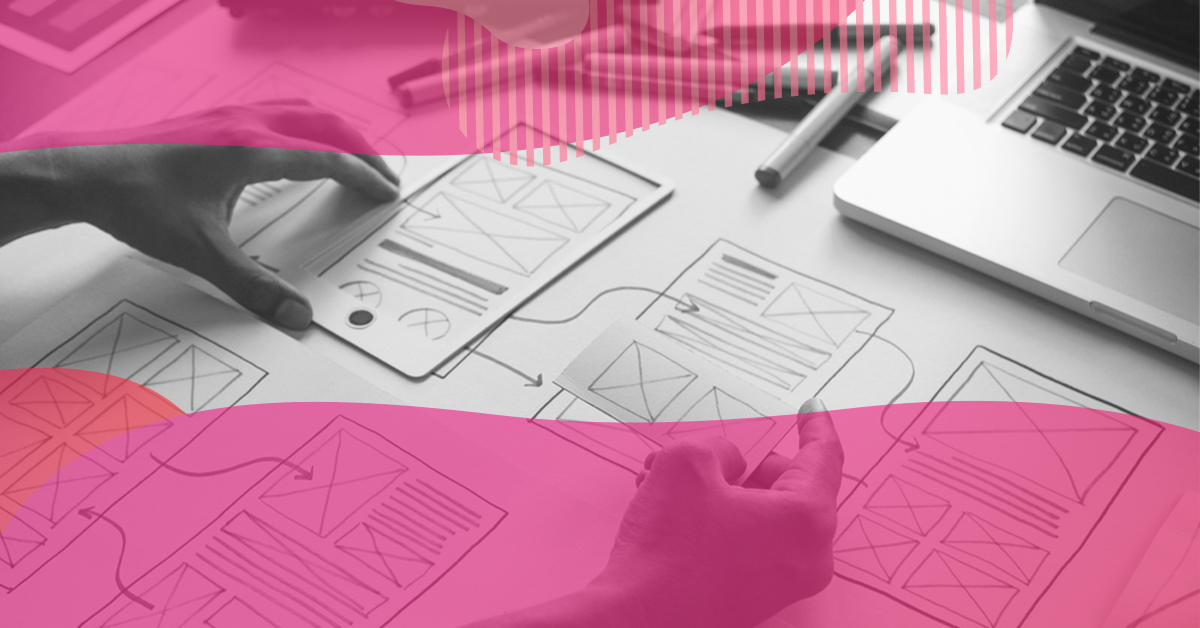
Image: Working with wireframes and user flows is a key step in UX Design to create more intuitive digital interfaces.
What is the advantage of using UX strategies?
Well, the father of marketing already said about customer satisfaction:
"The best advertising is made by satisfied customers" - Philip Kotler.
Who are we to disagree, right? Think of all the times you entered a website, but ended up giving up on buying a product because of the difficulty of the website; with the increase in the use of cell phones, this is quite frequent, given that responsiveness does not always work well.
Here are some more advantages of UX Design:
- Increases the conversion rate;
- Increases the number of new users;
- Generates greater customer satisfaction;
- Reduces the cost of maintenance in development.
We hope that this content has helped you to notice that having this professional in your marketing strategy is essential! By the way, don't forget to continue browsing our blog here and learn more about the world of marketing!
If you haven't checked out our post on UX Writing, take the opportunity to check out: UX writing: the importance of customer experience.

Frequently asked questions about UX Design and user experience
What is user experience (UX)?
User experience is the set of perceptions, emotions, and reactions a person has before, during, and after using a product, system, or service. It includes how useful the solution is, how easy it is to use, the trust placed in the brand, and the sense of value delivered in each interaction. It is not just about a pretty layout: it involves content quality, technical performance, accessibility, and consistency across digital channels. When these elements work together, the journey becomes more natural and fluid for the user, increasing satisfaction and the likelihood that they will interact with the brand again.
What is UX Design in practice?
UX Design is the process of defining what the user’s experience will be like when interacting with a product, system, or service. The goal is to increase satisfaction and loyalty through interfaces that are easy to use and make interactions enjoyable. This work is not limited to the online environment: UX designers can also work on physical products, always focusing on usability and perceived value. In line with Laura Klein’s idea, UX Design is the set of decisions about how humans and products will interact. When those decisions consider both user needs and business needs, the result tends to be a more consistent and effective experience.
What is the difference between a designer and a UX designer?
Every UX designer is a designer, but not every designer is a UX specialist. Designers are professionals trained to work with design in general, creating graphic pieces, branding, website layouts, social media materials, and other visual solutions. A UX designer, on the other hand, focuses specifically on creating interfaces centered on user experience. Beyond appearance, they care about usability, navigation flows, and clarity of information. In UX Design, they can use tools such as heat maps and other analysis methods to understand the user’s path through a site and adjust colors, texts, and visual elements to better speak to the target audience and support a more intuitive journey.
How do UX Writing and UX Design work together?
UX Writing and UX Design are complementary areas within UX. While UX Writing aims to create clearer, more fluid, and more helpful texts inside interfaces, UX Design focuses on structuring the visual and interaction experience. When these two roles work together, layout, flows, and messages move in the same direction. This makes understanding easier, reduces confusion, and creates a more pleasant journey. The combination of UX writers, UX designers, and other UX areas increases the chances of offering a memorable experience in which every touchpoint helps users perceive the value of the product or service.
What are the main UX Design foundations for digital interfaces?
Some important UX Design foundations for digital interfaces are linked to universal design principles. Equity ensures the product is useful and marketable for people with diverse abilities and contexts. Flexibility in use recognizes that different users have different preferences and capabilities, offering multiple ways to achieve the same goal. Simple and intuitive use makes the system easy to understand, regardless of the user’s technical background. Information should be easy to perceive, with concise and effective texts even when storytelling is used. Empathy and tolerance aim to minimize errors and misunderstandings, while low interpretation effort ensures users don’t have to “fight” to find or grasp what they need.
Why is empathy so important in UX?
Empathy is central in UX because the goal is to anticipate user needs and pain points before they become obstacles. When designing a flow such as an e-commerce checkout, it is essential to think through every step: product choice, account creation, login, cart, and payment. With an empathetic view, the team identifies possible difficulties, such as slow loading, lack of responsiveness, confusing screen transitions, or too many steps. By reducing these frictions, the experience becomes more comfortable and trustworthy. Instead of demanding extra effort, the interface guides users clearly and predictably, increasing the chances they complete their tasks and feel satisfied with the brand.
What are the advantages of investing in UX Design strategies?
Investing in UX Design strategies brings direct benefits to customer experience and business results. A good experience reduces drop-offs, such as when someone abandons a purchase because navigation is difficult or a site is not responsive. This connects with the idea that “the best advertising is done by satisfied customers,” linking UX to building a positive perception. Specific advantages mentioned include higher conversion rates, growth in the number of new users, greater customer satisfaction, and lower development maintenance costs. By planning clearer and more efficient interfaces aligned with user needs, companies reduce technical rework and increase their chances of fostering loyalty.
How is UX Design related to mobile devices and mobile-first?
UX Design is closely related to the experience on mobile devices, especially in a context where more than 60% of global web traffic already comes from phones. When a site is not responsive, users often give up on a purchase or leave the navigation because it is hard to use on smaller screens. Investing in truly mobile-first UX Design means planning flows, elements, and texts based on how people actually use mobile devices, reducing friction in steps such as login and payment. This helps improve time on site, reduce cart abandonment, and increase trust in the brand, since the interface adapts to user needs on any device.
How does UX Design impact SEO and organic results?
Good UX Design directly affects a site’s organic performance. Elements such as loading speed, visual stability, and mobile usability are part of the signals evaluated in page experience, according to Google’s documentation. When an interface loads faster, avoids abrupt layout shifts, and is easy to use on smaller screens, navigation becomes more pleasant and efficient. This tends to reduce bounce rates and increase engagement, strengthening organic results. In this way, UX, SEO, and business outcomes are connected: improving user experience is also a way of strengthening digital presence and the brand’s competitiveness.
Is UX Design applied only to digital products?
UX Design is not limited to digital products. Although the text emphasizes online interfaces such as websites, blogs, apps, and e-commerces, it also points out that UX professionals can work on physical products. The focus remains the same: creating experiences with easy usability and interaction, in which users perceive value in every contact with the product or service. In digital contexts, this means working on screens, flows, and texts to make navigation easier. For physical products, the focus is on how people handle, understand, and use them. In both cases, the goal is to offer a clear, accessible, and pleasant experience that strengthens the relationship between user and brand.
To the next!
























 Portugal