





"Ok Google, set an alarm for 6 a.m." The command still works, but whoever answers on the other side is no longer the same. In September 2026, Google began removing Assistant from most Android devices, and Gemini took its place.
Google voice search has stopped being a shortcut for typing less. It became a conversation with a system that generates the answer instead of simply reading a link out loud.
That difference has a direct consequence for writers. Content no longer competes for a position on the results page, it competes to be the passage chosen to build the spoken answer.
How does Google voice search work today?
Google voice search works in three steps: the device captures speech, converts the audio into text and sends the query to the search engines. The difference sits at the end of that path, because Google's virtual assistants now return generated text rather than a link read out loud.
On a phone, anyone asking how to search by voice on Google has two paths. The microphone in the search bar still works for dictating an ordinary query, which returns the usual results page.
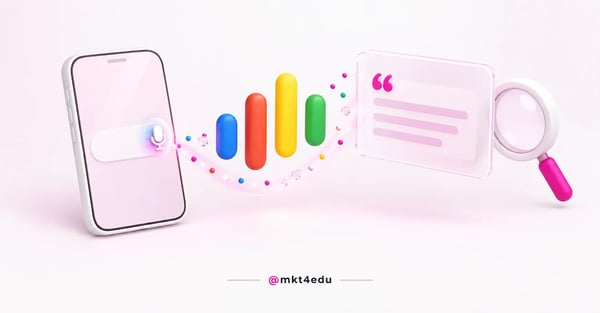 Caption: In Google voice search the system composes the answer from snippets instead of returning the whole page.
The second path is the Live icon, right below the search bar. There the question is spoken and the answer comes back as audio, inside a conversation that accepts follow-up questions.
For content producers, the relevant change is one of unit. The system does not pick one page to read in full, it retrieves passages and assembles an answer, which brings spoken search closer to the logic described in search intent optimization.
What changes with the Google Assistant shutdown and the arrival of Gemini?
Google started removing Assistant on September 4, 2026, according to the reporting on the Google Assistant shutdown. The removal reaches Android phones and tablets, Wear OS watches, headphones and phone-projected Android Auto. Cars with Google built-in keep working after that date.
The switch is not reversible for people who have already received it. Anyone who loses access to Assistant cannot go back on that device, and Gemini answers as the default assistant.
In practice, everyday commands still exist. Setting an alarm, asking for the forecast and playing music keep working, now inside an assistant that holds a conversation instead of running a closed list of actions.
What really changes is user expectation. Virtual assistants that hold a conversation receive longer and more specific questions, because people no longer have to simplify the command to be understood.
That is the first editorial consequence of the change. Text that answers a short, generic question loses ground to text that answers a whole question, spoken the way one person would say it to another.
What is Search Live in Google voice search?
Search Live is Google's spoken search mode, where a person asks out loud and receives the answer as audio, in conversation format. It became available globally on March 26, 2026, across more than 200 countries and territories, in every language where AI Mode already operated.
Access is direct. In the Google app for Android or iOS, the Live icon sits right below the search bar and opens the spoken conversation.
There is also combined use with the camera. Through Google Lens you can point the device at something and ask about it out loud, mixing image and speech in the same query, according to the announcement of the global Search Live rollout.
The consequence for content is the same one described for Google AI Mode. The answer arrives synthesized, and what survives that synthesis is the passage that made sense on its own, outside the context of its source page.
How to optimize content for voice search?
To optimize content for voice search, turn each real question from your audience into a heading phrased as that question, and answer right below it in a paragraph of 40 to 60 words that reads well on its own. Add conversational language, long-tail keywords and fast pages.
The self-contained passage is the unit of work. Because spoken search returns a piece of the text rather than the page, every paragraph has to restate its subject instead of leaning on the one before it.
Three adjustments solve most of the problem in content creation. The first is writing the section heading with the question a person would actually ask out loud, not with an institutional paraphrase.
The second is putting the answer in the first sentence of the paragraph, not at the end. Systems that assemble answers cut the passage from the top, so building toward a climax costs the citation.
The third is keeping one idea per paragraph. Blocks with three subjects stitched together arrive fragmented for both the reader and the retrieval system, which weakens any content for voice search.
Vocabulary deserves a pass too. People speak in simpler sentences than they type, so content for voice search gains when catalog terms are traded for words someone would use in a conversation.
None of this requires a parallel SEO strategy. Nothing here rewrites how to do SEO from scratch either, because spoken search reuses the same structure that already organizes the site, with a higher demand for clarity inside each passage.
The broader conceptual work of optimization sits in the material on voice search and how to stand out in results, which works as the foundation. Here the focus is Google's ecosystem, where that foundation meets Gemini, Search Live and AI Mode.
How to do keyword research for spoken queries?
Keyword research for spoken queries starts from whole questions, not from isolated terms. Instead of starting with "education degree tuition", the starting point is "how much does an online education degree cost per month", which is how the doubt comes out when it is spoken.
That is why long-tail keywords dominate this scenario. Spoken queries carry more words, more context and less ambiguity than typed ones.
There is a built-in gain in that shift. Long-tail keywords tend to face less competition and carry clearer intent, which raises the chance that your answer gets used.
Informal language is the second axis of keyword research in this format. Nobody says "simplified admission process entry", they say "how to get into college without taking an entrance exam", and it is that second phrasing that needs to be in the text.
A practical route is gathering the questions that already arrive through the service desk, through messaging apps and through the site forms. They are the most honest raw material available for content creation aimed at voice.
Does AMP still speed up pages for Google voice search?
No. The Google Search Central documentation on AMP, updated on July 1, 2026, states that Google Search indexes AMP pages just like other web pages and applies the same standard to all pages, regardless of the technology used to build them. There is no preferential treatment.
That is an important correction to what was recommended a few years ago. Adopting AMP is not wrong, but it does not buy any crawling or ranking advantage either.
The bar today is page experience measured by Core Web Vitals. These are three metrics with public thresholds, and they apply to any technology used to build the site.
Here is how the thresholds are organized:
|
Metric |
Good threshold |
What it measures |
|
LCP |
up to 2.5 seconds |
Time until the largest element on screen appears |
|
INP |
up to 200 milliseconds |
How the page responds to each user interaction |
|
CLS |
up to 0.1 |
Visual stability, or how much the layout jumps while loading |
Table: Good thresholds for the three Core Web Vitals, according to the web.dev documentation.
INP became a stable metric in 2024, replacing the old FID. It is the one most tied to the feeling of a sluggish site, because it measures the delay between a tap and the page's visible reaction.
The question of how to optimize your website for that bar usually starts with image weight and script bloat, two subjects covered in the material on website optimization and its SEO and GEO pillars. It is user experience (UX) work before it is SEO work.
The link to voice is direct. A slow page gets in the way of people who arrive through audio, because they give up before finding the information. Anyone asking how to optimize your website for spoken search should look at these three numbers first.
How does Google voice search widen inclusion and accessibility?
Google voice search widens inclusion because it removes the need to write. People with low literacy, people with limited formal schooling and people with visual or motor disabilities can look for information by speaking, without depending on typing correctly on a small keyboard.
That is a reach gain that rarely makes it into the calculation. A large share of the audience looking for technical courses, adult education, distance learning degrees or a first diploma is more comfortable speaking than writing.
Voice also solves temporary barriers. Someone driving, cooking, carrying something or with their hands full uses the same feature for a different reason, and the institution serves both cases with the same content.
There is an important execution caveat here. Real accessibility does not stop at spoken search, it continues on the page that receives the person, with adequate contrast, alternative text on images and a coherent heading structure.
User experience improves for everyone when a site is built that way. Video captions, audio transcripts and a clear heading hierarchy help screen reader users and ordinary search visitors alike, and they belong to the same UX budget.
Inclusion is not an SEO tactic, and it is not worth selling as one. The positive side effect on reputation and reach is real, but the reason to do it is letting more people reach information about studying.
What does Google voice search have to do with AI SEO?
The link is the shape of the passage. The same self-contained paragraph that answers a spoken question well is the one most likely to be cited in a generated answer, which makes AI SEO and spoken search two uses of the same editorial work.
The reason is mechanical. AI search systems break the page into pieces and retrieve pieces, not whole pages, exactly as described in the content on SEO in the AI era.
That retrieval mechanism reorders the priorities of anyone thinking about how to do SEO today. The competition for position still exists, but it now shares the stage with a competition to be the source the system picks to build the answer.
The side effect is well known and documented in the material on zero-click search. Some queries end without a click, and the brand wins by appearing as a cited source, not by receiving the visit.
The discipline that organizes this work appears in the content on answer engine optimization. It swaps the question "how do I rank this page" for "how do I become the answer to this question".
Three practices concentrate the result here. Citing named sources, using verifiable statistics with a year attached and bringing in the voice of someone with real experience are what usually separate content that gets used from content that gets ignored.
That is also why AI SEO and spoken search travel together in the digital marketing strategies of teams working in education. An SEO strategy that already organizes content by question serves both channels with the same structural adjustment.
What does an education institution gain from Google voice search?
An education institution gains presence at the moment the doubt appears. Questions like "which nursing school is near me" or "when does enrollment open" get asked out loud, on a phone, outside business hours, and whoever answers first enters the consideration set.
There is a natural alignment with the rest of the funnel. The same questions that feed content creation for voice work as a script for the service desk, for campaign material and for course pages.
For higher education institutions (HEIs) with physical campuses, local information carries weight. An up to date address, opening hours and phone number on the institution's profile support a good share of spoken answers with proximity intent.
The work can be run in house or with outside support, as in the SEO for LLMs and generative search service. What does not work is treating voice as a project separate from the rest of your digital marketing strategies.
Frequently asked questions about Google voice search
Where to start optimizing for Google voice search?
Start with the questions you already receive. List the twenty most frequent doubts from your audience, check which ones already have an answer on the site and rewrite each one as a section heading followed by a paragraph that answers on its own.
After that, look at speed. Measuring Core Web Vitals on your most visited pages costs little and quickly shows whether the problem sits in image weight, in scripts or in the template.
The third step is consistency. Google voice search does not reward a one-off overhaul, it rewards a site where every section answers a real question clearly.
If you want an outside read on what is already live before deciding where to start, the mkt4edu team can review your site's content and technical structure and point out the priorities for your SEO strategy in the next cycle.



.jpg)
























 Portugal