


In times of justified popularity for content marketing strategies, there are those who forget the power of paid advertising or simply do not know its place.
Is this your case?
Advertising for educational institutions has a logic of its own and asks for planning before budget. Our objective is to present a short guide so that you understand the importance of advertisements as part of your institution's marketing.
As you read, you will understand that educational advertising can be efficient, especially if developed in a strategic and properly based manner.
Continue reading to find out more!
What is paid advertising and how does it work in education?
While advertising itself is a very broad area of knowledge, paid advertising is a marketing strategy that assumes payment in exchange for space for advertising.
So there is both offline advertising, broadcast on radio or outdoors, for example, and online advertising, which stands out a lot nowadays.
The advertisement in advertising for colleges and schools is, therefore, the purchase of space in one or more media of interest to publicize the institution's brand, its courses, conditions, differentials, etc.
In other words, everything that promotes the sale of your services and leads to an increase in enrollments.
Is paid advertising a villain in student recruitment?
There are some factors that contribute to the idea that educational advertising can be frowned upon and generate bad results.
One of them points out that the internet has changed the way the public and brands interact, which has impacted the way people receive and feel about advertisements. That is true.
You may have already been bothered by a pop-up of an advertisement that simply appeared on the computer screen, interfering with reading. Or counted the seconds to skip an ad on YouTube videos.
These intrusions can indeed be negative, but when you think about it, there are certainly advertisements that you enjoyed seeing. Whether because they were informative and timely or simply because they aroused positive emotions.
And what does that mean? If developed based on well-defined strategies, paid advertising does not need to be seen as a villain. Otherwise, it could become an interesting strategy for your educational institution.
One approach that has proven effective is native advertising, which seamlessly integrates ads into editorial content, providing a less intrusive user experience.
This strategy is particularly useful in the education sector, where informative and relevant content can be promoted in a way that adds value to the reader, increasing the chances of conversion.
What is the power of online advertising for schools and colleges?
Being present, in an active and aggregating way, in the same environment as your audience is what sustains the online advertising of an educational institution. The ad does not create the applicant's attention, it uses the attention that already exists in the channel where that applicant spends the day.
Just think that many of your potential students often have a smartphone in their hands. And that means that online advertising, which does not need to focus only on networks, allows the advertisement to have a good chance of being received by the target audience.
Internet advertising has a great reach and can be done effectively and at low costs, leading to equally great results.
The secret is to have good marketing planning and know how to use the platforms chosen for advertising.
Among educational marketing strategies, online advertising is the one that offers the most measurable return in the short term.
It is very likely that you have already come across ads on Google or on social media. In which situation did you ignore or feel upset by this type of advertising?
Advertising for educational institutions is well received on the internet when it appears to the right audience. Therefore, it is important to use segmentation resources so that you have a better chance of reaching potential students (or even their guardians).
This is done both from a study of the platform and from knowledge about this audience and the objectives that your institution desires with each advertisement served.
How does offline educational advertising work today?
Offline marketing is the process that includes educational advertising that is done outside the internet or digital media. It still delivers local reach and brand effect in markets where the digital auction is already expensive.
Even though the power of online advertising is easily perceived nowadays, it does not nullify the effectiveness of developing offline campaigns.
Not without reason, offline marketing strategies keep attracting more students to schools and colleges.
Just remember the times you saw an advertisement for an educational institution in a printed newspaper or busdoor (located at the back of public transport buses).
These are examples of traditional paid advertising that can help your institution reach an audience that is not on the internet.
In addition to increasing your chances of attracting the attention of those responsible for students, they give your brand more visibility.
Your targeted online ad will reach an important part of your audience.
Complementing this action with an offline advertisement can make your institution known to the community at large, which in itself contributes to making it stronger.
Educational marketing has incorporated new trends that enhance the effectiveness of advertising campaigns.
The use of artificial intelligence (AI) for data analysis and content personalization allows educational institutions to create more targeted and effective campaigns.
Influencer marketing has also gained ground, with schools and colleges establishing partnerships with digital influencers to expand their reach and engagement with their target audience.
Younger applicants concentrate that attention in short video, which is why Generation Z and video deserve room in the media plan next to the offline effort.
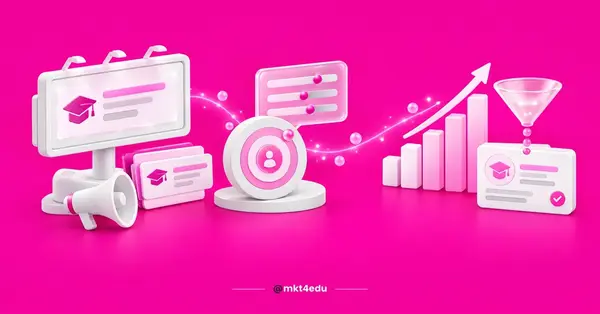 Caption: Paid advertising pays off when the ad, the targeting and the enrollment measurement belong to one flow, not three separate decisions.
Which campaign types to prioritize in paid traffic management?
Paid traffic management at an educational institution starts with the choice of campaign type, not with the choice of platform. Each format serves a different moment of the applicant's journey, and that decision defines where paid media turns into enrollment and where it only generates clicks.
In Google Ads, Performance Max campaigns bring search, YouTube, Display, Discover, Gmail and Maps together under the same conversion goal, with the distribution decided by the system itself.
Display campaigns have a new home in Demand Gen, with voluntary migration through the account's own tool starting in June 2026 and automatic migration afterwards. Institutions that already produce video and image creative arrive better prepared for that transition.
The choice follows the intent of the audience: search campaigns for those already looking for the course, Demand Gen for those who have not looked yet and need to be sparked, and remarketing for student recruitment for those who visited the site and did not convert.
A good share of the waste in paid media is not in the bid, it is at the bottom of the funnel. When paid traffic leads are not converting, the bottleneck is usually the form, the response time or the qualification, not the ad.
Producing video content for student recruitment feeds the creative of these formats and the organic channel at the same time, which spreads the production cost across campaigns.
Institutions without a dedicated in-house team usually support this routine with an agency specialized in educational marketing, which keeps auction, creative and measurement running through the whole admissions season.
How does SEO for AI change paid advertising in recruitment?
SEO for AI changed the beginning of the applicant's journey, because the answer started to appear inside the results page itself. In early 2026, 68% of Google searches ended without a click to the outside, according to a SparkToro study, which shrinks the space disputed by ads and organic results.
Google's AI features in search reorganize the results page and push the blue link further down. That does not eliminate organic, it only changes what organic needs to deliver in order to be cited.
Ads and organic are no longer separate compartments in student recruitment. SEO strategies feed what AI cites, and paid media guarantees presence while organic authority matures.
In an inbound marketing operation, SEO strategies and content marketing strategies produce the destination of the click: course page, comparison of study formats, tuition simulator.
The work of SEO in the AI era and paid advertising rest on the same asset, which is content able to answer the applicant's real doubt before enrollment.
The combination of paid traffic and organic tends to pay more than each channel on its own, because paid buys time and organic buys permanence.
Measuring that arrangement requires looking at the conversion rate by channel, not only at cost per click. Without that cut, inbound marketing and paid advertising dispute the credit for the same enrollment.
How to invest in paid advertising without losing money?
Whether you are doing internet advertising or offline advertising or, even better, combining the two strategies, it is important to ensure that the investment made generates results. The path is to define beforehand how much goes in, who the ad speaks to and which number will say whether it worked.
Therefore, it is worth checking out some tips for the success of advertising for educational institutions:
- Set your budget: evaluate how much your institution can and wants to spend on each advertisement or campaign. This way, you make sure to define actions that correspond to your possibilities.
- Know and segment your target audience: know who your ad message is for. This way, you will choose the right strategies (correct language, what attracts attention, in which medium to advertise, when to run the ad).
- Use advertising tools: there are platforms like Google Ads, the product's official name since 2018, that will help your institution follow important techniques to give due prominence to your online advertising. Add this tip to knowing the chosen platforms well to achieve the best results on each one and make the investment worth it.
- Explore new advertising platforms: in addition to traditional platforms like Google Ads and Facebook Ads, it is important to consider using emerging platforms like TikTok, which has emerged as an effective tool for reaching younger audiences. Creating creative and authentic content on these platforms can significantly increase engagement and visibility for your institution.
- Integrate your strategies: the alignment of marketing strategies, uniting online and offline, is something that favors not only the success of advertisements, but also the actions of your institution as a whole. In the case of advertising, this integration can better direct your choices to ensure that the investment is made more intelligently and effectively.
- Measure results: define metrics to monitor the success of your advertising actions. Information about the result of internet advertising can even be collected through data from the platforms themselves. In the case of offline educational advertising, other strategies must be present. For example, if your institution advertises a discount on tuition, it is worth asking the interested party by which means they received this message.
- Essential performance metrics: to assess the success of your advertising campaigns, it is essential to track metrics such as Cost Per Acquisition (CPA), Return on Investment (ROI), and Conversion Rate. These metrics provide valuable insights into campaign performance and help you make strategic decisions to optimize your advertising spend.
- Personalization and use of first-party data: with regulatory pressure on privacy and the limited reach of third-party data, it is essential that educational institutions invest in the collection and use of first-party data. This allows the creation of more personalized campaigns aligned with the needs and interests of potential students, increasing the effectiveness of advertising campaigns.
It is worth correcting a common assumption at this point. In April 2025, Google announced that it will keep the current approach to third-party cookie choice in Chrome, without rolling out a new standalone prompt on the subject.
First-party data remains the best bet for an institution, then, for a different reason: it is more accurate, it belongs to the institution itself and it answers privacy requirements better than any purchased base.
Want more tips for attracting students to your institution? Sign up for our newsletter!
Frequently asked questions about paid advertising
Where to start with paid advertising at your institution?
Paid advertising, when applied with strategy and targeting, is essential for attracting students and boosting institutional presence.
By integrating online and offline efforts, supported by data, AI, and metrics like ROI and CPA, educational institutions can reach the right audience, optimize campaigns, and achieve more effective results.
The first practical step is to choose one campaign, one audience and one metric, run it for a full admissions season and compare the result with the channel your institution already uses.
Among educational marketing strategies, this is the one that answers fastest about where it is worth expanding the budget in the next cycle.














 Portugal