




Responding to a lead within minutes or leaving them waiting until the next day can be the difference between closing a deal and missing an opportunity.
This is the daily dilemma for any sales team: the volume of contacts is growing, the channels are multiplying, and the team still has the same number of hours in the day.
This is where the SDR agent — also known as an AI SDR — comes in : an artificial intelligence application that handles the initial conversation with the lead, performs the initial qualification, and hands off to the human team only those contacts ready to move forward.
The technology has moved beyond the realm of mere promise. Today, AI agents can call a lead seconds after a form is filled out, converse naturally by voice, continue the conversation on WhatsApp, and log everything in the CRM—all without manual intervention.
Throughout this content, you’ll learn what an AI SDR is, how the system works behind the scenes, what technology powers it, and how it changes results for those who adopt it.
Table of Contents
What is an SDR agent, and what do they do?
An SDR agent, or AI SDR, is an artificial intelligence system trained to perform the role of an SDR (Sales Development Representative)— the pre-sales professional responsible for reaching out to leads, qualifying them, and scheduling meetings for salespeople.
The difference is that, with the agent, this entire cycle happens automatically, conversationally, and at scale.
In practice, this AI prospecting agent receives a trigger, such as a completed form, a new lead in the CRM, or a list of contacts for reactivation.
From there, it initiates the conversation, understands the person’s context, asks the qualification questions defined by the operation, and guides the lead to the next step—which could be scheduling a meeting, sending a proposal, or transferring the lead to a human agent.
The SDR agent should not be confused with a traditional customer service bot. A classic customer service chatbot follows fixed workflows: if the user clicks option A, they receive response A.
In contrast, AI agents work autonomously toward a specific goal. They interpret what the person says, adapt the conversation, decide on the next step, and perform actions in other systems, such as checking a calendar or updating a record in the CRM.
This difference completely transforms the experience for the person on the other end. Instead of navigating through rigid menus, the lead converses naturally, asks whatever they want in whatever order they want, and receives context-sensitive responses.
For the sales operation, the benefit is equally clear: each lead receives an immediate and consistent response, without depending on the availability of a team member at that moment.
How does an SDR agent work in practice?
To understand how AI-powered SDR works, it’s helpful to know the three layers that the SDR agent connects: the communication channels (voice and messaging), the AI model that drives the conversation, and the orchestration layer that links everything to the CRM and business rules.
When a lead comes in, the agent is triggered, engages in conversation, qualifies the lead, and automatically records the result.
To get a better picture, think of a typical customer journey. A person fills out an interest form on the website. Within moments, they receive a call or a message on WhatsApp. The agent introduces themselves, confirms the interest, asks three or four qualifying questions, and, if the profile matches expectations, immediately offers time slots for a conversation with the team.
All of this is documented in the CRM, including a transcript, summary, and lead classification.
Behind this simple experience lie specific components. Let’s take a look at them.
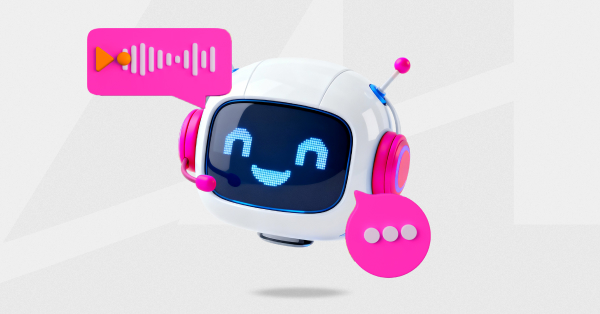 Caption: The AI-powered SDR agent operates across multiple channels, automating contact via voice and WhatsApp.
AI Voice Agent: The call that sounds human
The AI voice agent is the component that makes and receives phone calls using natural language.
It combines speech recognition, a language model that interprets and formulates responses, and text-to-speech technology that converts text into audio with natural intonation—all in real time.
The result is a seamless conversation in which the lead can interrupt, change the subject, and ask questions outside the script, yet the conversation remains coherent.
This type of agent is typically used to follow up with newly converted leads, confirm attendance at events and meetings, reactivate old contacts in the database, and conduct quick surveys of interest.
An important detail: the speed of the voice-based approach has a direct impact on the outcome. A classic study published by Harvard Business Review showed that companies that tried to contact a lead within an hour were nearly seven times more likely to qualify it than those that waited just one hour longer.
The voice agent reduces this response time to seconds, at any time of day.
AI Agent for WhatsApp: Conversations on the Preferred Channel
The AI agent for WhatsApp performs the same lead qualification role, but within the messaging app.
It answers questions, collects information, sends materials, offers scheduling options, and maintains the conversation history—all within the platform where many people already handle their personal and professional lives.
For the Brazilian market, this channel tends to be particularly strategic, since WhatsApp is the messaging app most deeply integrated into people’s daily lives.
A well-executed approach there has a natural advantage: the conversation doesn’t have to happen in real time. The lead responds when they can, and the agent picks up the conversation exactly where it left off, without losing any information.
Another strength is how it complements voice communication. In many operations, a phone call initiates the first contact, and WhatsApp maintains the relationship by sending a summary of the conversation, a link to the scheduled meeting, reminders, and supporting materials.
The lead moves between channels without having to repeat anything.
Orchestration and CRM: the brain behind the conversation
A good conversation is useless if it doesn’t translate into data, tasks, and next steps. The orchestration layer is what connects the SDR agent to the rest of the company’s marketing and sales tools: CRM, calendar, automation platforms, and communication channels.
It is this layer that defines, for example, that a lead from a specific campaign should first receive a phone call and then a message, that a qualified lead should be created as a deal in the CRM with the conversation summary attached, and that a lead that doesn’t fit the profile should be placed in a nurturing workflow.
In ecosystems like HubSpot’s, this workflow can be integrated even with the latest agent-driven automation features, such as the HubSpot Agent CLI, bringing marketing, sales, and operations even closer together.
What is the role of orchestration in an SDR agent?
Orchestration is what transforms good individual conversations into a complete pre-sales process.
It’s the layer that listens for triggers, decides which agent to activate, on which channel, and at what time, records the results, and keeps all systems speaking the same language. Without it, the company would have a call robot on one side, a WhatsApp bot on the other, and an outdated CRM in the middle.
This work is usually handled by workflow automation platforms, where each step in the process corresponds to a block in a visual workflow.
One block detects the trigger (the completed form, the new lead in the CRM), another activates the voice agent to make the call, another sends the WhatsApp message, another records the outcome of the conversation in the CRM, and another notifies the responsible sales representative.
Business rules are also defined within the orchestration. These include permitted calling times, maximum number of attempts, lead prioritization based on campaign source, and alternative paths when the person does not answer.
All of this is defined in the workflow, not within the conversation itself, which allows you to adjust the strategy without interfering with the agent—and vice versa.
Another significant benefit of this layer is governance. Since workflows are visual, documentable, and versionable, the operations team can audit agent actions, adjust specific rules without rewriting the entire workflow, and refine the process as they learn from the results.
For those who take data and compliance seriously, this makes a difference when scaling: every automated decision has a record of why it happened.
How does AI voice agent technology work?
The AI voice agent is built on platforms specialized in creating, testing, deploying, and monitoring agents that handle both inbound and outbound phone calls using natural conversations.
These platforms handle the most critical aspect of the experience: making the call sound like a real conversation, rather than a robotic recording.
However, this involves technical challenges that go unnoticed by those who only hear the result. The system needs to understand the lead’s speech in real time, determine the right response, synthesize the voice naturally, and manage the flow of the conversation—such as knowing when to speak, when to listen, and what to do when the person interrupts.
The most advanced platforms operate with very low latency precisely so that the agent’s response comes at the pace of a human dialogue, without those awkward pauses that give away a slow system.
In addition to the conversation itself, this type of technology offers important operational features for an SDR agent: voicemail detection, transfer to human agents when necessary, performing actions during the call (such as checking availability and scheduling appointments), and call monitoring to ensure quality at scale.
In the complete architecture, the division of roles is clear: the voice platform is the voice and ears of the SDR agent on the phone; the orchestration layer is the nervous system that connects that voice to data, rules, and other channels; and the language model is the brain that interprets and makes decisions within each conversation.
Why has having an SDR agent become so important?
Having an SDR agent has become important because lead behavior has changed faster than teams’ ability to keep up with it.
People research, compare, and request contact at any time; they expect an immediate response and easily abandon those who take too long. Meeting this expectation with just people is expensive and doesn’t scale.
Market figures help illustrate the scale of the problem. A global survey by Salesforce survey of more than 7,700 sales professionals showed that salespeople spend only 28% of their week actually selling, with the rest of their time consumed by tasks such as deal management and data entry.
In other words, a significant portion of the sales team’s payroll is spent on work that does not directly generate revenue.
Add to that the short window of interest for leads. As we’ve seen, the likelihood of a lead qualifying plummets as hours pass after conversion.
If leads come in at night, on the weekend, or during campaign peaks, and the team can only respond during the next business day, a significant portion of those opportunities will go cold before the first contact is made.
For Educational Marketing, this effect is even more pronounced. Student recruitment periods concentrate a huge volume of prospective students into just a few weeks, and every day of delay in reaching out can mean a prospective student enrolling with a competitor.
An inbound sales process, with an SDR agent on the front lines, ensures that no prospective student is left without a response during peak periods.
There’s also a competitive factor: as more companies adopt AI-powered SDRs in presales, the bar for speed and availability rises for everyone. Those who stick with an exclusively manual model find themselves at a structural disadvantage, responding in hours while competitors respond in seconds.
What are the benefits of an SDR agent?
The main benefits of an SDR agent are response times measured in seconds, continuous availability, the ability to handle many leads simultaneously, standardized qualification, automatic data entry into the CRM, and freeing up the human team to focus on higher-value conversations.
Before going into detail about each one, it’s worth understanding the general logic: the agent doesn’t compete with the human SDR; rather, it redistributes the work. High-volume, low-complexity tasks are handled by the machine, while conversations that require judgment, empathy, and negotiation are handled by people.
Here’s how this division works:
Comparison between Human SDRs and SDR Agents
|
Dimension |
Human SDR |
SDR Agent |
|---|---|---|
|
Response time |
Minutes to hours, depending on the queue |
Seconds after the trigger |
|
Availability |
Business hours |
24 hours a day, every day |
|
Concurrent volume |
One conversation at a time |
Dozens of conversations in parallel |
|
Consistency |
Varies with fatigue and experience |
Same approach for every contact |
|
CRM entry |
Manual, prone to oversight |
Automatic, with transcription and summary |
|
Strength |
Judgment, empathy, and negotiation |
Scale, speed, and standardization |
Table: Each column represents the best use of each resource; mature operations combine both rather than choosing just one.
With this distinction in mind, the benefits become clearer:
- Speed that keeps the lead engaged. Reaching out within seconds capitalizes on the moment when the person is still thinking about the topic, which tends to boost connection and qualification rates.
- Full coverage of the inbound funnel. No lead goes unaddressed due to a lack of staff, a spike in demand, or time constraints. This is worth its weight in gold for seasonal campaigns and product launches.
- Standardized qualification and reliable data. The same questions, asked in the same way, generate comparable data. The CRM system begins to reflect reality, with transcripts and summaries that the team can review before each meeting.
- Lower cost per contact at scale. Once implemented, an agent can handle ten or a thousand leads with a similar structure, which changes the economics of the pre-sales operation in growth scenarios.
- A team focused on closing deals. With automated screening, salespeople receive schedules filled with pre-qualified leads and complete context, allowing them to dedicate their energy to what truly requires human talent.
- Continuous learning. Each conversation generates data on objections, frequently asked questions, and optimal contact times, driving improvements in sales scripts, campaigns, and the agent’s performance.
Taken together, these gains are not isolated: speed improves engagement, engagement improves qualification, and well-documented qualification improves the salesperson’s conversation. It’s a self-reinforcing cycle.
Do SDR agents replace the sales team?
No, and that is perhaps the most important question of all. The SDR agent replaces tasks, not people.
It takes on the repetitive, high-volume work of pre-sales, while purchasing decisions continue to be shaped through human conversations — especially in consultative and longer-cycle sales.
The configuration that works best is a hybrid one. The agent handles the first layer: approaching, qualifying, scheduling, and keeping the lead warm. The human steps in when the conversation requires nuanced interpretation, handling complex objections, or negotiation.
And even in the automated layer, it’s advisable to maintain transfer routes: if the lead asks to speak with a person, the agent transfers the call seamlessly.
It’s also important to be transparent in your operations. Best industry practices include respecting appropriate contact times, offering an opt-out option in messages, and handling lead data in accordance with data protection laws.
A well-implemented SDR agent is not just a more sophisticated spam bot; it is a customer service channel that respects the time and preferences of the person on the other end.
Finally, the agent needs management just like any other team member. Someone must monitor conversations, review transcripts, adjust the script, and measure results. Operations that treat the agent as a living project — rather than a one-time setup — are the ones that achieve the best results over time.
How does mkt4edu use the SDR agent in its day-to-day operations?
At mkt4edu, the SDR agent isn’t just a concept on a slide — it’s an operational service that runs every day, making voice calls and conducting conversations on WhatsApp to support our client acquisition efforts.
Agents reach out to newly converted leads, assess their interest, answer frequently asked questions, and schedule meetings directly in the sales teams’ calendars.
The architecture follows the logic presented throughout this content: voice agents for calls, messaging agents for WhatsApp, and an orchestration layer that connects everything to the CRM, ensuring that every conversation is recorded, provides context, and defines the next step.
The design of each agent is part of the client’s sales process, with qualification scripts, tone of voice, and transfer rules defined collaboratively.
This service complements our artificial intelligence platform for student recruitment, which has been using conversational AI in interactions with leads and students for years.
The difference is that, now, the conversation also takes place over the phone, using a natural voice, and in a proactive manner: the agent doesn’t wait for the lead to call; the agent is the one who makes the call.
For managers, the practical benefits are evident in three areas: response time, which drops from hours to seconds; the sales team’s schedule, which now receives a continuous stream of qualified meetings; and the CRM, which gains a complete history of each interaction, ready for analysis.
Frequently asked questions about SDR agents
Is it worth having an SDR agent in your operation?
If your operation receives more leads than it can handle quickly, if opportunities go cold outside of business hours, or if the team spends more time screening contacts than selling, the answer is yes.
An SDR agent resolves exactly this bottleneck, as they ensure that every interested prospect receives an immediate, well-handled, and logged response, regardless of the day or time.
The best way to evaluate this is by looking at your actual situation: lead volume, current average response time, appointment rate, and team capacity. With these numbers in hand, you can clearly estimate how a voice and WhatsApp agent would impact your results.
Our team can conduct this analysis with you and demonstrate, in practice, how our SDR agents are already operating, using real calls and conversations. Schedule a meeting with us and discover what AI-powered pre-sales can do for your lead generation.
Understanding the concept helps, but the value shows up when AI agents are actually running inside your operation.


.jpg)























 Portugal