






Using marketing automation tools is already a reality for many organizations that know the benefits of technology that simplifies processes and streamlines the whole marketing routine, contributing to better results.
Does your university still not know which solutions to adopt? The list below covers the ones we use at mkt4edu, and that are also well known in the market.
The context explains the urgency. Digital advertising in Brazil reached R$ 42.7 billion in 2025, up 12.7% year over year, according to the Digital AdSpend report by IAB Brasil with Kantar Ibope Media. Running that volume of contact on spreadsheets and manual sending is no longer possible.
What does marketing automation solve in practice?
Automation solves the mismatch between the volume of contacts a university generates and the size of the team that has to answer them. It records every interaction, sends the right message at the right moment and keeps the history organized, without depending on someone remembering to do it.
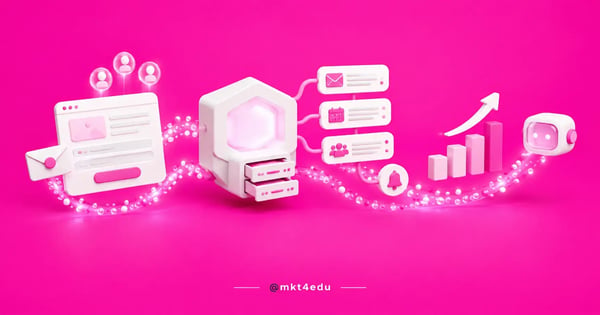 Caption: Marketing automation links contact capture to the central record and to scheduled communication, and that is what makes every campaign comparable with the others.
That mismatch grew alongside distance learning. Online programs now account for 50.7% of undergraduate enrollments in Brazil, according to the 2024 Higher Education Census, released by Inep. A student base spread across an entire country cannot be served at a front desk.
The gain shows up at both ends of the funnel. At the top, it supports enrollment campaigns with a fast reply to the prospect. Further along, it keeps communication alive with enrolled students, which ties automation directly to student recruitment and retention.
There is a less obvious effect, and perhaps the most valuable one. With a complete record, marketing strategies become comparable to each other, and the team finds out which educational marketing campaigns actually produced enrollments instead of arguing over impressions.
How does HubSpot organize contacts and workflows?
HubSpot offers a fairly complete marketing automation platform, with the free CRM as its highlight. The software automates contact management, providing information about each one, which helps build more promising relationships.
Your university can use this tool to access and analyze relevant data more easily and then develop sharper approach and communication strategies with students and prospective students, including individual characteristics of your audience.
What makes the CRM the center of the set is its position. It is the only place where the contact exists in full, with source, conversation history, program of interest and deal stage. The other tools either feed that record or read from it.
It is worth knowing the right order for a HubSpot implementation before buying, because installing modules out of sequence creates data rework. The intelligence applied to educational marketing depends on that base being well built.
Does MailChimp still handle email for enrollment campaigns?
Email marketing is a powerful strategy for student recruitment. To take advantage of it, though, sending emails one by one by hand is impractical. That is why it matters to have marketing automation technology that makes it easy to send email to a long contact list.
That is the case with MailChimp, one of the most popular platforms for sending email. Beyond its different automation options, it allows account integration and has a strong delivery rate, which favors conversions.
Two market changes weigh on this choice today. MailChimp became part of the Intuit portfolio, and deliverability got stricter once Google and Yahoo began requiring sender authentication for bulk senders, in February 2024.
In practice, that shifts the decision criterion. The question is no longer which tool sends faster, but which one keeps your domain reputation healthy across educational marketing campaigns.
What does RD Station offer on its platform today?
RD Station is another company with a marketing automation platform that carries several features. Through it, you can manage and monitor contacts, schedule social media posts, create automated communication workflows and even use features that support producing more engaging content.
The company behind the platform changed hands, and that has a practical consequence. RD Station was acquired by TOTVS in March 2021, for R$ 1.86 billion, and today it operates inside that group.
The consequence is practical, not ideological. Universities already running TOTVS systems for academic management find a shorter integration path, and that is usually the factor that decides between RD Station and an international platform.
Unbounce and Instapage: why do landing pages need their own tool?
We already mentioned email marketing as a powerful strategy for your university. To use it, though, you need a contact base of your own, meaning one that was not bought from other companies on the web.
For that, your university needs strategies that allow capturing those contacts, and one of them is using landing pages, which are nothing more than an invitation for the site visitor to hand over an email in exchange for content your institution offers.
Creating landing pages is a simple process at first. Creating different templates for different offers and improving their conversion power, however, takes work. For that, we rely on marketing automation tools such as Unbounce and Instapage.
The caveat applies to anyone who already has a CRM. Complete platforms now include a native landing page builder, and keeping a separate tool only pays off when the volume of tests is high enough to cover the extra license.
How does Leadmatch connect campaigns to data?
To improve the use of these and other marketing automation tools, we also have Leadmatch, our control system for student attraction, which can be integrated with several other pieces of software.
The system automatically updates, in real time, all data related to the campaigns your institution runs, including data pulled from other automation platforms.
That makes for a more concrete analysis toward more solid results. This consolidation is what allows comparing the performance of different channels in a single view, and it is also what supports marketing attribution end to end.
Without that layer, each tool reports its own slice. The email sender counts opens, the ads manager counts clicks, the CRM counts deals, and nobody can say what an enrollment cost. That gap undermines the most basic marketing tips on cost control.
Where do AI agents fit into marketing automation?
AI agents are the newest layer of automation, and they differ from traditional workflows in one respect: instead of running a sequence defined in advance, they interpret the incoming message and decide the reply and the next step within rules the institution sets.
The difference shows up in how prospects are handled. A classic workflow always sends the same email to whoever downloaded a resource. An agent has a conversation, qualifies the interest, identifies the program and the format, and hands the team only the contact worth calling.
The market tends to treat this layer as standard before long, and the platforms themselves have started building agents into the product, as the AI marketing predictions published by HubSpot show. Even so, results depend on clean CRM data rather than on the purchase itself.
For universities, the most direct use is speed of first response. Whoever replies in minutes joins the conversation; whoever replies in days competes with the school that already answered. It is worth seeing how that works in lead generation with AI.
How do you choose between automation tools?
The choice gets simpler once you stop comparing brands and start comparing functions. Each tool in the set solves a different problem, and the most common waste is paying two licenses that do the same thing. Here is how the functions break down:
|
Function |
Tool |
Priority |
|
Centralize contacts and history |
HubSpot (CRM) |
1st |
|
Send email at scale |
MailChimp or the CRM itself |
2nd |
|
Capture contacts on an offer page |
Unbounce or Instapage |
3rd |
|
Consolidate campaign data |
Leadmatch |
4th |
|
Integrate with academic management |
RD Station (TOTVS group) |
Depends on the ERP |
|
Answer and qualify prospects |
AI agent inside the CRM |
After the base is clean |
Table: How functions are distributed across the tools mentioned, and the suggested order of adoption.
The order in the priority column is not arbitrary. Without the CRM in place, the sender emails a list nobody can trace, and the landing page delivers contacts that get lost. Marketing strategies only become measurable once the central record exists.
Smaller institutions usually cover the first four functions inside a single platform. That cuts cost and integration work, in exchange for less flexibility in each isolated function. That trade-off is part of the educational marketing strategies of teams running lean.
Frequently asked questions about marketing automation
Where should you start with marketing automation?
Start with the record, not with the flashiest tool. As long as contacts live in a spreadsheet, any automation reproduces the same disorder at higher speed. A CRM with source, program of interest and conversation history filled in solves more than three new licenses.
After that, the sequence follows the table: email sending, capture on an offer page, data consolidation and, last, the agent layer. Each step only enters once the previous one is feeding reliable data.
The choice of tools shifts with size, academic ERP and team headcount, and that is where an outside read usually saves a contract. Our team runs that assessment with you in marketing automation, and you can talk to us to review the set you already have live.
























 Portugal