






Did you know marketing automation can bring meaningful benefits to education institutions? It supports process optimization, operational efficiency improvement, and stronger service channels for prospective students.
Through automation, it is possible to increase lead segmentation and nutrition, in addition to personalizing the experience of students. This tool also expands your ability to analyze and measure results.
In this post, we will explore some of the advantages why your educational institution should consider adopting automation tools as allies in your marketing strategy.
What you will see in today’s content
- How marketing automation optimizes processes and strengthens service channels for prospective students.
- Why a contact database is not enough without lead segmentation and nurturing.
- The importance of understanding the ideal student profile and using demographic and behavioral data.
- How to integrate marketing and sales with a CRM to centralize history, preferences, and interactions.
- How to segment leads and deliver relevant content, such as blog posts, e-books, and webinars.
- What lead scoring is and how to use scoring to identify more qualified leads.
- Why automation simplifies strategies, improves the experience, and expands analysis and measurement.
Good reading!
Marketing automation for educational institutions: key benefits
Marketing automation helps educational institutions optimize processes, improve operational efficiency, and strengthen service channels for prospective students. With well-structured tools, it is possible to increase lead segmentation and nurturing, as well as personalize the student experience throughout the journey.
Automation also expands the ability to analyze and measure results, supporting more objective decisions. For this, it is essential to understand the ideal student profile, integrate marketing and sales with a CRM, and apply strategies such as lead scoring to prioritize leads that are more likely to convert.
- Identify the ideal student profile with quality data on needs, interests, and pain points.
- Integrate marketing and sales with a CRM to organize history, preferences, and interactions.
- Segment and nurture leads with relevant content, sent at the most appropriate moments.
- Apply lead scoring to rank leads and focus efforts on the most qualified.
Marketing automation for educational institutions
When it comes to educational marketing, automation, as well as a set of well-structured tools they can create a machine capable of not only attracting students, but also converting them into effective and well-qualified enrollments.
However, having a contact base is not enough. It is necessary to have a concrete vision of Who is your ideal student? Considering segmenting your leads and knowing how to properly nurture them throughout the process.
Below, we will elaborate on the main advantages that automation offers for your institution:
Key Advantages of Using Marketing Automation
Now that we know what marketing automation is all about, we need to discuss how it can bring tangible benefits to your educational institution.
Next, we will explore what these benefits actually are that implementing a good automation strategy can offer:
Know the profile of your ideal student
Before we talk specifically about the advantages of using marketing automation, we first have to point out the importance of understanding who the students who study or want to study at your institution actually are.
Having this knowledge is essential to feed your processes with quality data about your leads, in addition to offering insights into their needs, interests and pains, providing a solid basis for creating rich content such as blog posts, videos and email marketing.
Therefore, having marketing automation tools will be key to establishing fluid and relevant communication between them and your institution.
Once you have an objective view of demographic data and other information, such as the age and gender of your leads, you will have opportunities to educate them and offer support throughout the buying journey.
When working with personal data, it’s important to keep collection and usage aligned with the Brazilian General Data Protection Law, clearly stating purpose and communication preferences. If your site uses tracking for segmentation, the Cookies and personal data protection guidance provides practical direction on notices and consent management.
MORE LIKE THIS:
- What is link building? Learn how to make it successful
- The 8 essential tips to improve your CRM. Check out now
- Automation: how to create a purchase flow in 5 standards
Integrate processes and tools
Another advantage that we can highlight when we talk about automation is the possibility of integrating your sales and marketing teams in a much more synergistic way, which has a positive impact on the purchasing journey of your potential students.
This works because a CRM centralizes history, preferences, and interactions, improving process clarity and making it easier for marketing to hand off better qualified leads to sales
After all, once your sales teams are better positioned to serve leads that were better qualified by your marketing team, they can offer a properly personalized and memorable approach to your customers.
With the right tools, such as a CRM, data analysis, email marketing and blogging platform, you can make your workflows more reliable and save resources and time, increasing the productivity of your marketing and sales teams.
More assertive lead segmentation and nutrition
Something very common to see nowadays during the lead capture phase is excessive capture of leads and failure to convert them in a cohesive way. This happens mainly because there is no in-depth understanding of that lead’s needs.
In view of this, two essential processes for your institution to stand out in its campaigns are segment and nurture your leads in the correct way.
Once you perform in-depth data analysis and obtain concrete information about your leads, you can categorize each one into distinct segments and optimize content targeting to convert them more reliably.
For example, when you know that a potential student is interested in pursuing a postgraduate degree at your institution, send content that is relevant to that interest. Offer relevant information like blog posts, ebooks, invite them to a webinar and make them feel engaged with your institution.
And, with marketing automation, sending this content at the most appropriate times becomes a much simpler and more objective process.
Invest in lead scoring
As we have seen so far, marketing automation will be your main ally when it comes to increasing the productivity and efficiency of your teams.
And once productivity is high, the number of leads that will enter your base will also increase considerably. And as we mentioned in the previous topic, you will need to segment and nurture them accordingly.
That's where we need to talk about lead scoring, which is a strategy to understand more precisely which leads are best qualified for conversion, based on a scoring system that goes according to your own institution's indicators.
For example, we can use data acquired from the enrollment base and map the average behavior of this lead base.
From this map, we can develop a scoring system to classify leads that fit the desired profile.
Therefore, if your campaign was designed to promote an in-person course, leads who live in regions closer to the college have a higher score.
By measuring these points, you have the knowledge you need to direct your marketing efforts to the leads that have a better fit and are more susceptible to conversion.
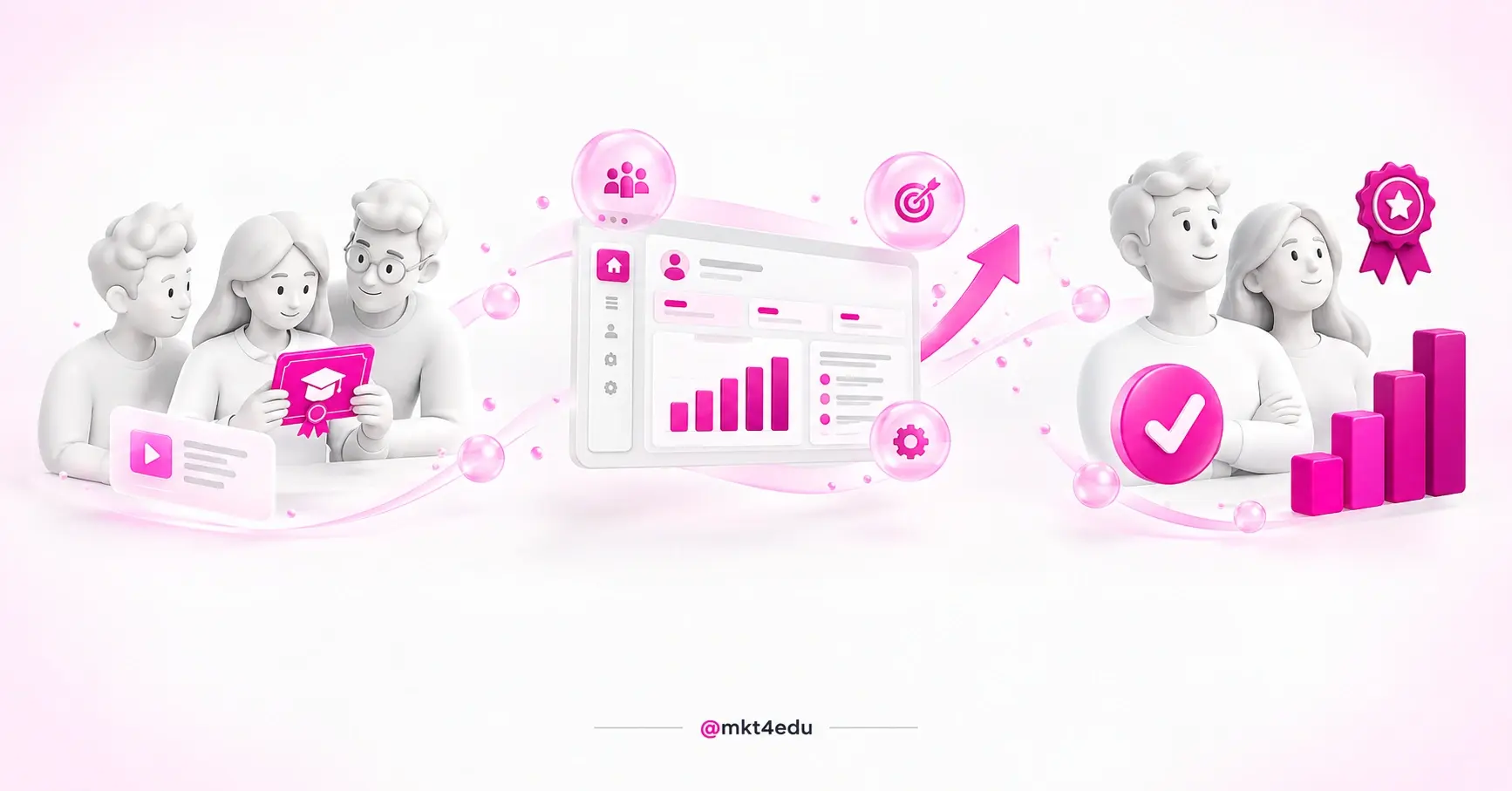
 Image: Automation helps centralize data and streamline lead nurturing and enrollment workflows in education.
After all, why use marketing automation in an educational institution?
In view of everything we have learned so far, we can say that the main motivation for implementing marketing automation in your educational institution is based on optimizing your processes and resources when capturing and converting your leads.
Relying on automated processes for your marketing efforts results in more objective and targeted actions for potential students who are actually more likely to study at your institution.
Overall, automation will simplify your strategies, improve your leads' experience, and offer concise insights into who is most interested and likely to convert.
Summary: Marketing automation promotes more efficient contact management, personalized communication, process optimization, data analysis and improvements in recruitment, alignment between teams and relationships with students and alumni. Implementing a CRM and other tools can be a valuable investment to boost your institution's success and improve the student experience.
Want to implement an Education CRM at your institution? With consistent processes, segmentation, and automation, you can build more predictable enrollment and relationship outcomes.
Visit our website and learn about the best strategies for using the platform and other tools in an intelligent and effective way.

Frequently asked questions about marketing automation for educational institutions
What benefits does marketing automation bring to educational institutions?
Marketing automation helps optimize processes, improve operational efficiency, and strengthen service channels for prospective students.
How does automation support lead segmentation and nurturing?
Automation makes segmentation and content delivery at the most appropriate moments simpler and more objective, based on concrete information about leads.
Why is it important to understand the ideal student profile?
Understanding the ideal student profile is essential to feed processes with quality data and gain insights into needs, interests, and pain points, creating a solid foundation for relevant communication.
How does a CRM support integration between marketing and sales?
A CRM centralizes history, preferences, and interactions, improves process organization, and facilitates the handoff of qualified leads between marketing and sales.
What is lead scoring and what is it for?
Lead scoring is a strategy that ranks leads through a scoring system aligned with the institution’s indicators to identify those who are more qualified and more likely to convert.
What is the main reason to implement marketing automation?
The main reason is to optimize processes and resources during lead acquisition and conversion, with more objective actions directed toward prospective students who are more likely to study at the institution.

.jpg)























 Portugal