






Search stopped returning only a list of blue links, and that changes what is expected of a page published today. Teams that write for education institutions felt the shift early.
The same article that used to bring a qualified visit now appears summarised inside the answer. Content optimization still pays off, with one extra target: being the source that the answer cites.
HubSpot delivers the operational side of that work in a single place, with keyword research, connected topics, per-page recommendations and performance reports in one view.
What the platform never did was measure keyword density. That difference matters, because many teams still review text by counting repetitions and believe they are following SEO best practices.
The route that works starts at search intent, passes through the structure of the answer and ends at the measurement of organic traffic, lead generation and conversion rates.
What is content optimization and what changed in search?
Content optimization is the set of decisions that makes a page answer a search intent well: choice of theme, structure of the answer, depth, data cited and periodic revision. The goal is no longer only to hold the first position, and it now includes being the source picked by an answer generated by AI.
 Caption: Content optimization now runs through three stages: the published text, the dashboard that measures it and the AI answer that cites the source.
The shift has a number attached to it. Between January and April 2026, 68.01% of Google searches in the United States ended without a click, against 60.45% in 2024, according to the SparkToro study built on the Similarweb panel.
That sample is from the United States and does not transfer automatically to other markets. The direction holds anyway: a growing share of the audience reads the answer and never visits the page it came from.
The practical consequence is uncomfortable for anyone who reports on sessions. A piece of content can do its job with flat traffic, as long as the brand shows up cited where the decision starts.
That is also why SEO strategies built only on ranking position look thinner now. Position still matters, but it is one surface among several serving the same answer.
How does content optimization support organic traffic and lead generation?
Organic traffic is made up of the people who reach your site without paid media, arriving from search results. It is the channel that accumulates value, because a well positioned page keeps working months after publication, with no extra cost per visit.
The link with lead generation comes from qualification, not from volume. A page that answers one specific doubt attracts someone who is already inside the problem, and that visitor converts at a higher rate than generic traffic does.
There is a known side effect of AI search on this channel, and it is worth following how Google AI is affecting organic traffic before cutting the production budget.
For education institutions, the arithmetic gets clearer inside each admissions cycle. Content answers the doubts that come before the application, and lead generation happens when the visitor finds there the information the institutional site does not give.
Which HubSpot SEO tools support content optimization?
The HubSpot SEO tools cover three distinct fronts: subject planning, through the topics tool; technical correction page by page, through the SEO recommendations; and result reading, through the traffic reports. All of them live inside HubSpot CRM, the customer relationship management base of the platform.
How do keyword research and topics work in HubSpot?
The topics tool organizes content around one central subject, with a pillar page and the subtopics that support it. Each asset connects to a single topic, and each topic accepts up to one hundred subtopics.
When you search a term, the HubSpot tool for topics, pillar pages and subtopics returns the monthly search volume and a difficulty score from 0 to 100. Those two signals help you decide where to invest production time.
 Caption: Content optimization starts by reading search volume and difficulty, before the editor is even open.
The balance between the two numbers is the useful criterion. High volume with high difficulty rarely pays off for a domain still building authority, while the long tail delivers fewer sessions per piece and converts better.
The one topic per asset restriction forces an editorial decision that many teams postpone: defining who owns each query. Without it, two pages fight over the same keyword and both lose position.
What do the HubSpot SEO recommendations actually check?
The SEO recommendations run over published pages and point out what to fix. They are organized in seven categories, according to the HubSpot documentation on SEO recommendations, and it helps to know the scope of each one before you prioritise the queue.
The seven categories assessed are these:
- Accessibility: elements that affect how screen readers and keyboard navigation handle the page.
- Crawling and indexing: what lets the search engine read and register the page.
- Mobile experience: how layout and reading behave on a small screen.
- On-page SEO: title, meta description, headings, image alternative text and internal links.
- Performance: loading time and the weight of page resources.
- Security: certificate and delivery over a protected connection.
- User experience: navigation and legibility signals that affect dwell time.
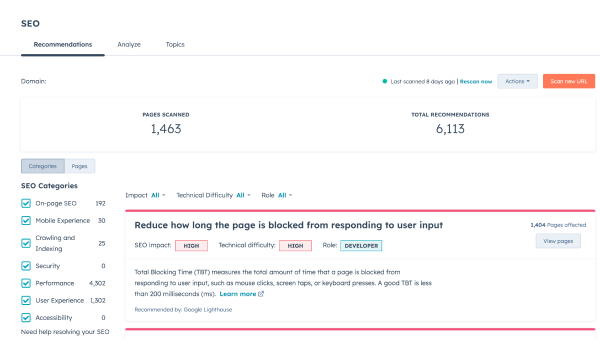 Caption: Content optimization page by page: HubSpot lists the fix, the category and the page affected.
None of those categories measures keyword density. Anyone who went looking for that indicator in the panel never found it, because it was never there to begin with.
The real advantage of the set is integration. Because everything sits inside HubSpot CRM, the same record that shows where a lead came from also shows which page that contact read before converting, with no export and no spreadsheet in between.
Plan choice changes what is available, and comparing the HubSpot CRM plans and what each one unlocks before signing avoids discovering the limit mid cycle.
How to optimize content for search engines without counting density?
To optimize content for search engines today, work on intent coverage instead of term frequency. That means answering the question in the first sentence, giving every derived doubt a section of its own, and using the natural vocabulary of the subject with no repetition target.
The old rule asked for a percentage of occurrences per text. The problem with it is twofold, and both sides need to be explicit for whoever is revising older material.
The first side is the guidance of the search engine itself. The Google spam policies describe keyword stuffing as filling a page with keywords or numbers to manipulate ranking, a practice the system treats as abuse.
The second side is opportunity cost. The on-page checklist used by mkt4edu records that counting secondary keywords and density consumes review time without moving position, which is why it can leave the list.
Anyone maintaining a large library gains more from revising the queue than from polishing a single text. It is worth checking the on-page optimization checklist and the SEO best practices that survive it to separate what still has effect from what became ritual.
In place of density, these are the checks that hold up under scrutiny:
- Answer in the opening: the first sentence of each section delivers the information rather than building to the end.
- Intent coverage: every derived doubt gets its own section, with a heading written as a real question.
- Verifiable data: numbers with a named source and a date, because that is what sustains a citation.
- Clean hierarchy: one H1, one H2 per block of subject and nested H3, with no level skipped.
- Internal link with context: an anchor that names the subject of the destination, inside a sentence that would stand without the link.
None of those items depends on counting words. All of them depend on someone reading the whole text and asking whether it answers what was typed into the search box.
Which content optimization strategies work today?
The content optimization strategies that last combine four fronts: genuine originality, user experience that is properly solved, connection between the pages and consistency of publication. None of those fronts is new, and that is precisely why they still separate who grows from who only produces in volume.
How to create content that is relevant and original?
Originality here means bringing something the competitor does not have: proprietary data, operational experience, an objection that only someone who serves the audience knows. Rewriting what already sits in the first result gives the search engine no reason to swap sources.
The decision about how to create content improves when the team starts from a real question, coming from support, from sales or from the site's internal search. The inventory of funnel doubts usually yields a better brief than the keyword spreadsheet.
Using AI in production does not change that criterion, it only speeds up the draft. It is worth seeing how to create content with AI without losing search performance before standardising the process.
How does user experience fit into SEO best practices?
User experience entered the SEO best practices because it directly affects the behavior of whoever arrives. A slow page, a layout that jumps and text in a single block push dwell time down, and short dwell time signals that the answer was not there.
Three fixes solve most cases: reduce the weight of the images, guarantee comfortable reading on mobile and break the text into short paragraphs, with subheadings that allow scanning.
How do internal links and backlinks support SEO strategies?
Internal links distribute authority and guide the reader to the next logical step. In mature SEO strategies, they follow the design of the topic: the pillar page points to the subtopics and each subtopic sends the reader back to the center.
Backlinks still count for the quality of the source rather than the quantity. One link from a recognized outlet in the sector weighs more than dozens of mentions in directories.
How does video content marketing fit into optimization?
Content marketing stopped being a synonym for the article. Video, gated material and newsletters cover different moments of the journey, and the article works better when it serves as the entry door into those formats.
The most expensive failure is not one of format, it is one of purpose, and recognizing the most common mistakes in content marketing strategies usually saves a quarter of production with no return.
Consistency closes the set. Publishing at a pace you can sustain and revisiting the published library shows the search engine that the site is still active, and it keeps older content aligned with what the reader looks for now.
Video: the content marketing mistakes that undermine content optimization, on the mkt4edu channel, in Portuguese
How to do SEO for AI and produce AI-optimized content?
SEO for AI is the work of appearing inside the answers of assistants such as ChatGPT, Gemini and Perplexity, and not only on result pages. The discipline is also called AEO (answer engine optimization), and it carries metrics of its own, separate from organic position.
HubSpot started to offer that measurement. The HubSpot AI visibility analysis tracks prompt coverage, frequency of mention, presence relative to competitors, sentiment of the citations and which assets were referenced.
The feature is available on Marketing Hub Professional and Enterprise, as well as through the HubSpot AEO product, with no external tool required.
SEO for AI does not replace the traditional checklist, it sits on top of it. A page that is slow, badly structured or thin loses in both arenas, because the assistants read the same web that the crawler reads.
AI-optimized content looks a lot like well written content, with three reinforcements. The answer comes before the explanation, every number carries a named source, and each section stands on its own when it is pulled out of context.
Producing AI-optimized content also means revising the existing library with a different eye, and it is worth consulting how to improve a site with the right SEO tools before opening a new production front.
How to measure content optimization and conversion rates?
Measuring content optimization requires separating three layers: reach, engagement and result. Reach is organic traffic and position, engagement is time on page and bounce rate, and result is the conversion rates plus the leads that became a real opportunity in the funnel.
The frequent mistake is looking only at the first layer. A page can climb positions, gain sessions and still produce no application at the end of the month.
In the reporting dashboard, cross pages with high traffic against pages with low conversion. The fix usually sits in the CTA (call to action), which offers something too distant from what the reader has just read.
Reading conversion rates page by page is what turns a dashboard into a decision, and mapping the path between the first visit and the conversion shows where the journey breaks.
For position and real queries, the complement comes from outside the platform. The Google Search Console performance report shows impressions, clicks and the queries that brought each visit, which no third-party tool reconstructs with the same precision.
Comparing equivalent periods avoids a hasty conclusion, because admissions seasonality, holidays and paid campaigns distort a week-by-week reading.
The step that closes the loop is connecting content and revenue. With HubSpot CRM recording source and history, you can tell which article appeared in the journey of the contacts who signed, not only which one had more visits.
Frequently asked questions about content optimization
Where to start content optimization in the next cycle?
Start with what already exists. A published library with residual organic traffic gives a faster return than any new brief, because the page already has history and only needs a sharper answer and refreshed data.
The second decision is about the checklist. Take density counting out of the review, put the check for answer in the opening and for sourced data in its place, and you free up team hours without losing anything that moves position.
The third decision is about measurement. Define now whether the indicator for this cycle is organic traffic, lead generation or conversion rates, because each one of them leads to different editorial choices in the month that follows.
Doing all of that in house is possible, and it demands calendar discipline plus someone willing to read the whole library critically. If that is the bottleneck, the SEO and content team at mkt4edu can audit what you have published and design the revision queue with you.




























 Portugal
