


Every private school opens the academic year with the same arithmetic on the table: how many new enrollments have to come in to replace the ones that left. That arithmetic got tighter recently, because the private network lost students two years running.
This is the point where digital marketing strategies stop being a showcase and become a replacement operation. The question is no longer whether to advertise, but which combination of channels holds enrollment volume at a cost the school can actually pay.
Brazil's 2025 School Census, published in February 2026 by Inep, the education research institute tied to the education ministry, gives the size of the problem: 46,018,380 enrollments in basic education, spread across 178,800 schools, down 2.29% from 2024.
Schools that treat recruitment as a two month campaign tend to pay more per student than schools running a student recruitment calendar spread across the whole year.
The digital marketing strategies that hold up such a calendar mix content, media, relationship and service, and none of them works alone.
Why have digital marketing strategies changed their job in schools?
Digital marketing strategies changed their job in private schools because the market stopped growing. In Brazil, the private basic education network fell from 9,517,832 to 9,245,384 enrollments between 2024 and 2025, a drop of 2.9%, according to the 2025 School Census results released by Inep. Recruiting stopped meaning growth and started meaning replacement.
The Brazilian private network now accounts for 20.1% of all basic education enrollments. In upper secondary, it holds 1.03 million enrollments inside a national total of 7.36 million.
Inep and the Brazilian education ministry attribute part of that retreat to demographics and to a more efficient system, with less grade repetition and a smaller age to year group gap.
Brazil is the sharpest published example, and the same squeeze shows up wherever the birth rate fell and the school network kept its size. The census numbers line up like this:
|
Indicator |
Figure |
Reading |
|
Basic education enrollments |
46,018,380 |
Down 2.29% on 2024 |
|
Private network enrollments |
9,245,384 |
Down 2.9%, from 9,517,832 in 2024 |
|
Private upper secondary |
1.03 million |
Inside a total of 7.36 million |
Table: Brazilian basic education in the 2025 School Census, with the private network highlighted.
The practical reading is blunt. A school that wants to grow has to attract students away from a rival, or win back families that left the private network.
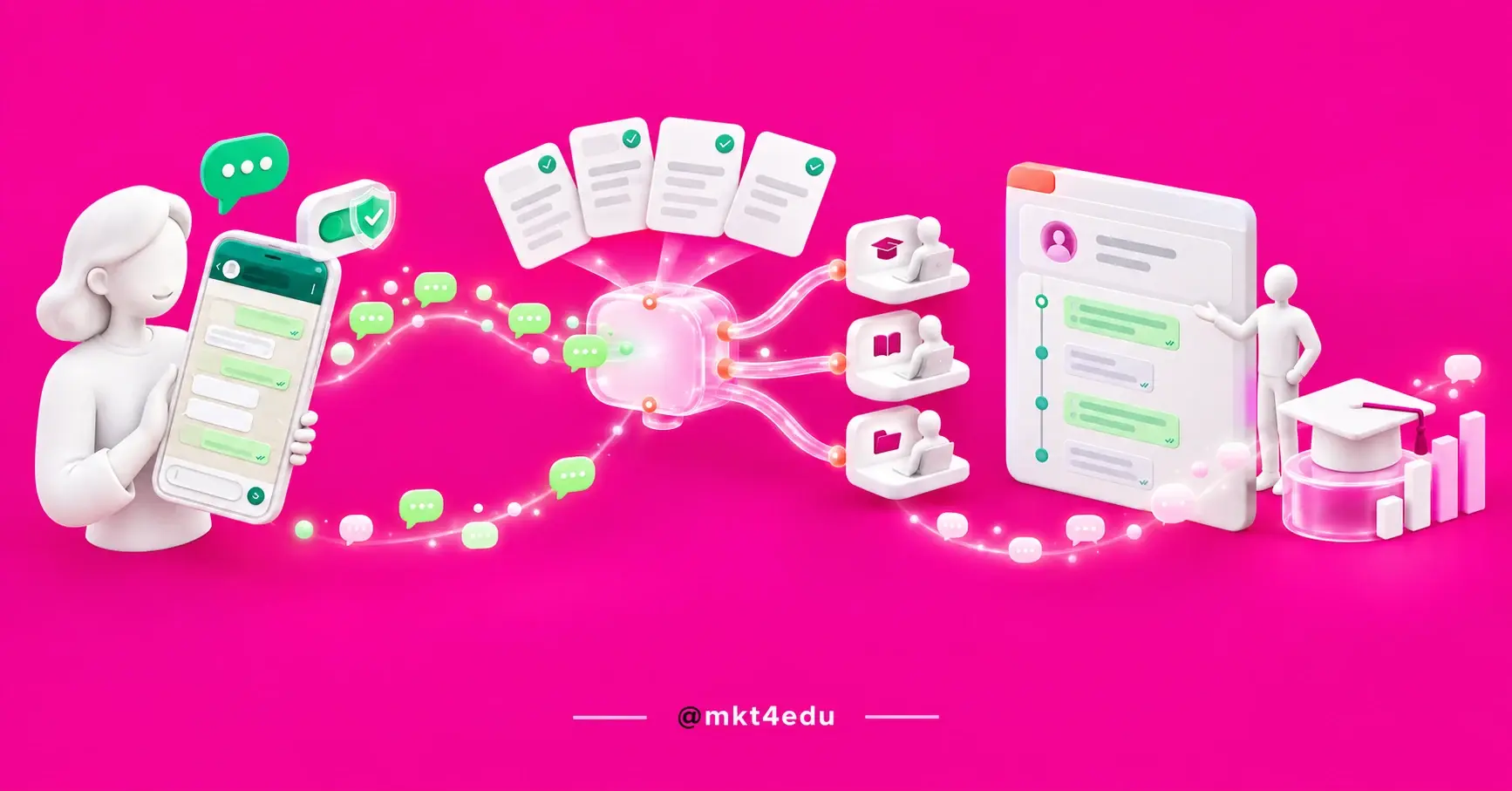
 Caption: The cover sums up the cycle: a school's digital marketing strategies start on the calendar and end with a filled seat.
What does a shrinking base change in student recruitment and retention?
A shrinking base moves the center of student recruitment and retention inside the school walls. When fewer students enter the system, every drop-out avoided is worth as much as an enrollment won, which makes last year's re-enrollment rate the first number to look at.
How much does it cost to attract students when the market shrinks?
The cost to attract students rises when the base shrinks, because more schools compete for the same families. The figure that matters is not cost per lead, but cost per completed enrollment, measured against the annual fee for that year group.
Understanding what it costs to attract students at each stage of schooling stops media decisions being made on the price of a click.
How do student and family experience decide enrollment?
Experience decides enrollment because families compare schools by what they feel at each contact, not by what they read in a brochure. Reply time on messaging apps, the clarity of the fee table and the tone of the admissions office weigh as much as the academic proposal.
User experience, or UX, is the result of every interaction a person has with the school, from first contact to the last day of the relationship. It stirs emotion, steers word of mouth and underpins loyalty.
Because the decision runs through two audiences, the school has to win the student and the parent at the same time, with different messages for each one.
What does omnichannel communication solve in student recruitment?
Omnichannel communication solves the broken context. When the website, the messaging app, the phone line and the admissions office share one history, the family stops retelling its own story at every contact, and the team knows where that parent stands.
A study published in the Jurnal Vokasi Indonesia on integrated student journeys found that joined-up channels let an institution offer a smoother, more personal experience, which strengthens its competitive position.
How does experience support retention after enrollment?
Experience supports retention because the enrolled student keeps assessing the school every day. A late report card, a help desk that never answers and a confusing notice erode the relationship long before a transfer request.
A parent satisfaction survey run twice a year tends to flag drop-out risk months in advance, while there is still time to act.
Which inbound marketing actions attract students to a private school?
Inbound marketing actions attract students by offering the school's most valuable asset before asking for anything in return: knowledge. Instead of interrupting a family with an advertisement mid-journey, the content answers the questions that family is already researching.
A guide to settling into the first year, a comparison of upper secondary pathways and a plain explanation of scholarship criteria pull in parents during the research phase.
Content tied to the school calendar avoids the most common pattern in private schools, which is publishing heavily for one month and then disappearing.
How does inbound sales turn a lead into an enrollment?
Inbound sales for education institutions turns a lead into an enrollment by using browsing and content history to prioritise whoever showed real interest. The team stops calling the whole list and talks only to families with a concrete chance of signing.
Inbound sales replaces the mechanical use of CRM, or customer relationship management software, with a reading of intent: who downloaded the scholarship guide, who visited the fees page twice, who opened the campus visit invitation.
That shift in focus cuts the team's effort, makes the enrollment process more accurate and lowers the cost per student recruited.
Where does educational marketing consulting fit into this design?
Educational marketing consulting fits in when the school has a small team and needs speed. An outside group specialised in recruitment arrives with process, a content rhythm and tested technology, which shortens the distance between deciding and enrolling.
Hiring educational marketing consulting does not replace the internal team, which stays in charge of the school's voice and of the relationship with families. A partner already working with CRM platforms built for education institutions also spares the school a long tooling experiment.
Video: how to turn leads into opportunities, the base of digital marketing for private schools, on the mkt4edu channel, in Portuguese
How do SEO strategies and SEO for AI change student recruitment?
SEO strategies change student recruitment because the school search starts in a search engine and, more and more, ends there. Search engine optimization used to be measured in visits, and is now measured by whether the school's answer is the one the engine shows.
Between January and April 2026, 68.01% of Google searches in the United States ended without a click, against 60.45% in 2024, according to SparkToro's analysis of Similarweb panel data.
That sample is American, yet the same direct answer mechanic appears in searches run elsewhere, with blocks generated by artificial intelligence sitting above the traditional results.
The loss of clicks hits top of funnel organic traffic first, because it is made of short answers the engine now delivers by itself.
The audience changed tools as well. The 2025 ICT Households survey, run in Brazil by Cetic.br, records 32% of internet users already working with generative artificial intelligence tools, rising to 59% among those with a higher education degree.
What is SEO for AI and how do you apply it to a school website?
SEO for AI is the work of structuring content so that language models can extract and cite answers from the school website. The concrete effort is answering real questions in short blocks, with the information in the first sentence and sources named.
Pages covering fees, scholarships, pathways and timetables have to be readable as text, not only as an image or a download, so an automated answer can quote them.
Which SEO strategies produce enrollments and not just visits?
The SEO strategies that produce enrollments go after decision searches, not curiosity searches. Terms such as a bilingual school in a named neighbourhood, fee levels and the enrollment calendar bring less volume, with intent far closer to signing.
Paid traffic or organic traffic: what sustains student recruitment?
Paid traffic sustains the peak, and organic traffic sustains the base. Media delivers volume fast inside the application windows and stops the day the budget runs out, while well-positioned content keeps bringing families in months after publication.
Combining paid traffic and organic traffic usually returns more than picking one side and defending it.
When does paid traffic pay off in a private school?
Paid traffic pays off when there is a window with a date attached, such as applications opening, a careers fair or an admissions campaign. In those periods the auction gets pricier, and cost per enrollment still tends to fall, because searcher intent peaks.
What does organic traffic deliver on its own?
Organic traffic delivers authority and memory. A family that found something useful from the school in March arrives at the October visit with an opinion already formed, which shortens the sales conversation and eases the pressure for a discount.
That effect does not show up in the monthly report. It shows up in next year's acquisition cost, when the school buys less media for the same number of enrollments.
Which social media strategies reach students and families?
Social media strategies reach students and families in different places. Parents tend to sit on Instagram, messaging apps and YouTube, while the upper secondary student splits attention between TikTok, Instagram and YouTube, with X, formerly Twitter, outside the daily routine of most teenagers.
The app repertoire has shifted a long way from the days when Facebook, Snapchat and Messenger appeared on every list of platforms used by young audiences. A plan written around those names points the budget at an audience that already moved.
Short vertical video is where the shift concentrated. A fifteen second clip from a classroom travels further among teenagers than a polished institutional film, and costs far less to produce.
The point of contact, though, is almost always the same device. The 2025 ICT Households survey from Cetic.br reports 86% of Brazilian households with internet access, against 83% in 2024, and around 65% of users going online exclusively through a mobile phone.
With 157 million internet users in Brazil, the competition for attention happens on a small screen, and the school website has to open fast and answer in a few taps.
How do you adapt the website and the admissions desk to mobile?
Adapting the website to mobile goes well beyond a responsive layout. A short form, a visible messaging button, a fee table legible without zooming and fast loading all move conversion for someone researching schools during a work break.
Which content works in an admissions campaign on social media?
An admissions campaign on social media works better with social proof than with institutional advertising. A testimonial from an admitted student, behind the scenes preparation and straight answers to application questions beat the same exam date artwork posted again and again.
Campaign experience with social media built around student enrollment shows that each platform's native format usually outperforms a piece adapted from another channel.
How do you build a student recruitment calendar for the school year?
A student recruitment calendar spreads effort and budget across the windows of the year, instead of piling everything into the enrollment period. A school that plans this way reaches the closing months with a warm list of families, rather than fighting for attention in a crowded auction.
A student recruitment campaign at a private school has three distinct moments: audience building, consideration and closing.
The school year offers natural windows for spreading out the educational marketing strategies, and they fit together like this:
- Audience building. Guidance content for families and students, early in the year, with no commercial ask attached.
- Consideration. Guided visits, open lessons and comparison material between schools, in the middle of the year.
- Conversion. An admissions campaign, media inside the application windows and remarketing, as applications approach.
- Re-enrollment. Retention work and follow-up with everyone who already visited, closing the cycle.
What ties the four windows together is what separates a calendar from a task list. Content made during audience building feeds the remarketing of the conversion window, and the list gathered in consideration becomes the invitation list at re-enrollment.
How do you measure whether the student recruitment campaign worked?
A student recruitment campaign is measured by completed enrollments, not by lead volume. The indicator that supports a decision is cost per enrollment in each year group, compared with the annual fee and with how long students stay at the school.
Three numbers settle the monthly meeting: leads by channel, lead to visit conversion rate, and visit to enrollment conversion rate.
Frequently asked questions about digital marketing strategies
Where to start with digital marketing strategies in a school?
Start with what is already inside the building. Before opening a new campaign, measure last year's re-enrollment rate, the reply time on messaging apps and how many booked visits became enrollments, because those three numbers show where money leaks today.
After that, pick one window of the calendar and treat it as a pilot, with attraction content, one paid campaign with a fixed date and measurement by year group. The digital marketing strategies that work in private schools are almost always the same, and what changes is the order of execution and the discipline of measuring.
Educational marketing consulting earns its keep at exactly this point, when someone has to own the number, review it week by week and correct course before the window closes.
A half hour conversation about your school's funnel finds the bottleneck faster than three months of testing, and the mkt4edu team runs that recruitment diagnosis with schools and education institutions.













 Portugal