






If you still think Google is just a static search box that returns ten blue links on the screen, it's time to update your technological definitions.
The search and technology ecosystem is changing at an impressive rate, and the great catalyst for these transformations has a first and last name: Google I/O.
Every year, the technology market stops and holds its breath to follow the news unveiled in Mountain View, California. More than just presenting operating system updates, this event dictates the rules of the game.
It dictates how brands, content creators and digital marketers will reach people on the internet. In 2026, the consolidation of agentic artificial intelligence changed the landscape forever.
Below, you'll learn what Google I/O is, how it has evolved to transform traditional search into an ecosystem of autonomous agents and what will change in content production and SEO for those who want to remain relevant in the age of GEO and AEO.
How does Google I/O impact search and SEO today?
Google I/O dictates the global direction of technology and, in recent editions, has transformed traditional search into a conversational and agentic experience.
For SEO professionals and content creators, this means that optimizing sites only for saturated keywords has lost its effectiveness.
Today, organic success requires adapting pages to Generative Engine Optimization (GEO) and Answer Engine Optimization (AEO) guidelines.
The aim is to structure portals so that they are easy to assimilate, accurate and highly reliable sources for the new intelligent robots and assistants such as Gemini.
In this new scenario, the market is adopting innovative methodologies such as Search Everywhere Optimization to ensure that brands are easily discovered on any artificial intelligence platform or existing search engine.
What is Google I/O and is it really useful?
Originally created in 2008, Google I/O is an annual conference for developers organized by the technology giant.
The acronym I/O has a very representative double meaning. It refers to Input/Output, the basis of all computing, and also to the motto Innovation in the Open, which highlights the company's commitment to building solutions collaboratively with the global technology community.
The event serves as Google's main showcase to present new software, heavy updates to the Android system, hardware innovations and, above all, the new APIs and artificial intelligence models.
For brands, the event acts as a thermometer that anticipates digital consumer behavior in the coming months and years.
This panorama indicates fundamental paths on how to do content marketing geared towards the real demands of the new generations and automatic recommendation engines.
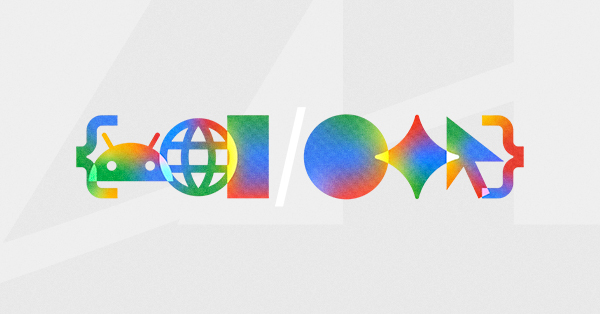 Image Caption: The visual and structural transformation promoted by Google I/O brings together code, traditional web and agentic artificial intelligence.
From 2016 to 2026: The historical evolution of Google I/O
The trajectory of Google I/O accurately reflects the very evolution of the modern internet.
While in the beginning the focus of the event was purely technical and geared towards the transition from desktops to smartphones, the last decade has redirected all the spotlight towards data science and machine learning.
Everything began to change dramatically at the historic 2016 event.
That year, CEO Sundar Pichai took to the stage to announce a radical change in positioning. Google was no longer a company focused on cell phones, but one focused on artificial intelligence.
It was at this conference that the world got to know Google Assistant, the first real step towards a search based on conversations and natural language, as recorded in the history of innovations on the Google Blog.
In the following years, evolution accelerated at an exponential rate. Between 2023 and 2024, the introduction of Search Generative Experience (SGE) and the launch of Gemini models transformed search results pages (SERPs).
In 2025, Google introduced Gemini 2.5 Pro with the innovative "Deep Think" mode, focused on in-depth logical reasoning, as well as Gemini Live, which enabled real-time voice and video conversations without any delay in response.
To clearly visualize this speed of evolution, we have created a comparative table highlighting the main revolutions presented by Google at the last three annual events.
This progression shows how we have moved from an artificial intelligence that is essentially informative to solutions that actually perform tasks on our behalf.
|
Event Year |
Main Announcements at Google I/O |
Main Technology Focus |
|
Google I/O 2024 |
Gemini 1.5 Pro, expansion of AI Overviews, Project Astra |
Response generation integrated directly into traditional search |
|
Google I/O 2025 |
Gemini 2.5 Pro (Deep Think), Gemini Live and ecosystem of media APIs |
Fluid interaction through multiple formats and advanced logical reasoning |
|
Google I/O 2026 |
Gemini Spark, Docs Live, Android Halo interface and Agentic Chrome |
Agentic era: autonomous execution of complex tasks by user channels |
Table: Evolutionary line of the technological milestones presented at recent editions of Google I/O.
As seen in the historical evolution, the year 2026 marks the definitive consolidation of so-called AI agents.
As a result, users' interaction with the web will no longer be based solely on passively reading pages, but will be mediated by highly integrated intelligent systems.
What changed at Google I/O 2026? The Agentic Age of Gemini Spark
While in previous editions artificial intelligence excelled at answering questions or generating text on command, Google I/O 2026 officially ushered in the era of autonomous action agents.
The most impactful announcement of the year was Gemini Spark, an intelligent personal agent capable of carrying out complex tasks in place of the user.
Unlike a traditional assistant, it doesn't just respond to everyday commands, but performs end-to-end tasks.
With strong integration with Gmail, Docs and third-party tools via the Model Context Protocol (MCP), it can navigate the web autonomously, fill in forms, organize schedules and cross-reference email data to create structured summaries such as the Daily Brief.
These announcements reflect directly on consumer behavior on the web, highlighting the following points:
- Docs Live and Advanced Voice: Launched to facilitate real-time collaboration, allowing people to create, edit and format complex documents using only natural voice commands.
- Android Halo: A new interface integrated into the mobile ecosystem that displays updates and the progress of tasks carried out by intelligent agents in real time in the background.
- Agentic Browsing in Chrome: The intelligent assistant now acts directly in the Chrome browser, acting as a mediator that directly searches, compares and executes purchase or research actions on websites.
The speed of adoption of these technologies is impressive.
Official data shared by Sundar Pichai in the official Google I/O 2026 press release show that the Gemini app has jumped from 400 million monthly active users to over 900 million in just one year, while the daily volume of commands has grown more than sevenfold in the same period.
What will change in content production and SEO with AI search?
The consolidation of generative search through AI Overviews transforms the way organic traffic reaches websites.
Whereas before the user had to click on several links to get an answer, Google's robot now summarizes the information at the top of the search page. This changes the rules of content production and forces the market to adopt new organic optimization fronts.
The Rise of GEO (Generative Engine Optimization)
GEO is the practice of structuring, enriching and writing content so that it is easily read, understood and, most importantly, cited by large language models (LLMs). Artificial intelligences don't perform searches like humans, they ingest data patterns.
Adopting a clear Generative Engine Optimization (GEO) strategy allows your site to be cited by the main search AIs on the market.
Sites optimized according to GEO specifications use clean semantic markup structures and, in many cases, already have standardized files available on the server such as the /llms.txt standard , making it easier for AI tools and crawlers to absorb information quickly and accurately.
To stand out consistently, digital marketing teams are now focusing on structuring SEO for LLM, creating more informative content free of repetitive or artificial terms and increasing Visibility on Google.
The Strategic Role of AEO (Answer Engine Optimization)
AEO focuses on the eligibility and accuracy of information. While traditional SEO is very concerned with numerical ranking on search pages, AEO works to ensure that the brand is the synthesized answer provided by the voice assistant or AI dialog box.
According to market analysis, appearing as a direct source in the answers generated by LLMs brings a strong gain in indirect visibility.
This positive impact is reflected in bottom-of-funnel channels, generating a new sales funnel focused on SEO and LLMs, with greater attraction of qualified leads.
How E-E-A-T shields the authority of your site / blog in search
Google maintains a strict fight against the abuse of mass-generated content with no real value for the user, a practice known as content abuse at scale.
Google's official search guideline on AI content makes it clear that automated creation is perfectly acceptable, as long as it is people-focused and demonstrates high levels of Experience, Expertise, Authority and Trust (E-E-A-T).
To ensure that your site continues to be discovered and cited by the new artificial intelligences in search, we've put together some indispensable practices based on current GEO and AEO guidelines:
- Focus on direct and precise answers: Structure short, objective paragraphs at the beginning of sections to make it easier for LLMs to capture snippets.
- Reinforce E-E-A-T: Insert real data, expert opinions, original case studies and avoid repeating generic web content.
- Make it easy for AI bots to read: Allow legitimate crawlers such as Googlebot, OAI-SearchBot and GPTBot to read and index your content without unnecessary blocks in robots.txt, unless you want to protect proprietary data.
- Adopt structured semantic markup: Use structured data like FAQPage to help Google render rich snippets in traditional and voice searches.
Following these guidelines ensures that your domain is not ignored by artificial intelligence technologies, positioning your brand as the primary source of information when the tools generate answers for users.
Frequently asked questions about Google I/O and the future of agency SEO
What does Google I/O stand for?
The acronym I/O stands for Input/Output and refers to the motto Innovation in the Open.
How does Gemini Spark work in everyday life?
Gemini Spark is an autonomous agent that performs complex flows of tasks without supervision. Integrated with emails, calendars and documents via the MCP protocol, it can cross-reference data from meetings, fill in forms and browse the internet to make autonomous decisions on the user's behalf.
What is GEO (Generative Engine Optimization) in digital marketing?
GEO is the set of content optimizations focused on engines generated by artificial intelligence. This methodology adapts the semantics, technical structure and information authority of pages so that large language models (LLMs) can crawl, digest and cite your site in their direct responses.
What is the impact of Artificial Intelligence on organic blog traffic?
AI reduces click-through traffic for purely informative searches by answering them directly on screen. To understand this change, see how Google's AI is affecting organic blog traffic in a profound way and adapt your organic attraction channels.
How can brands stand out in the new era of agentic search?
The accelerated evolution presented at Google I/O shows that the future belongs to companies that understand technology as an end-to-end revenue ally. Digital marketing no longer works in isolation in information silos.
Today, it needs to be connected to data intelligence, an impeccable technical SEO structure and a solid lead conversion strategy.
In this new agentic ecosystem, focusing on a high-quality user experience while optimizing the content portal for search AI is the only sure way to sustain organic growth for modern brands and educational institutions looking to expand their authority in the digital market.
To gain an in-depth understanding of how AI search engines break down user queries and discover how your site can respond to these multiple parallel searches, read our in-depth guide on Query Fan-Out: What it is and How to Optimize Your Site for AI.
The content presents practical insights into technical SEO for AI, showing how search agents fragment a single intent into several sub-queries and what to do to make your brand the top answer for all of them.


























 Portugal