






There comes a time when marketing starts to hurt. You look at the calendar, see the campaign going up, the budget rolling in, the team busy, and yet the enrollments or opportunities aren't progressing at the pace the goal demands.
You feel like you're doing a lot, but without a clear line between effort and results.
This is where a digital marketing plan stops being a "document" and becomes a decision-making tool.
It organizes what will be prioritized, what will be ignored for the time being, how the message will support the choice of lead and what indicators will honestly tell you if you're on the right track.
At the bottom of the funnel, this becomes more sensitive, as the lead no longer just wants to understand. They want to compare, reduce the risk and decide.
If your plan doesn't align media, pages, customer service and metrics in the same conversation, you end up paying a lot to push someone to a stage that the operation can't handle.
What you'll see in the post
So that you can understand clearly and apply it, I'm going to follow a sequence that usually works when the goal is conversion, not just visibility.
- What a digital marketing plan is and what changes at the bottom of the funnel
- How to translate business objectives into goals, KPIs and decision rules
- How to make a digital marketing plan in 9 steps, with clear deliverables
- Online marketing strategies that help convert leads that are already comparing
- How to fit paid media into the plan with funnel logic, budget and governance
- Digital marketing tools and routines to keep track without complicating things
- Common mistakes that make the plan look pretty but not very effective
- A practical next step for executing with paid media
With all this aligned, let's put together a plan that is actually usable.
An efficient digital marketing plan organizes objectives, audience, proposal, channels, budget, campaigns and metrics into a routine of execution and adjustment, with a focus on consistently generating conversion.
In practice, it creates a straight line between the business goal and everyday decisions: which campaigns go in, to whom, with which offer and indicator to keep, optimize or pause.
At the bottom of the funnel, the plan becomes stronger when the message answers real objections, the landing page reduces friction and the service maintains speed.
This combination doesn't guarantee results on its own, but it increases control over the process and makes paid media more predictable to operate.
What a digital marketing plan is and why it changes at the bottom of the funnel
A digital marketing plan is a combination of document and routine that defines goals, audience, proposal, marketing strategies, campaigns, channels, budget, schedule and metrics to guide online marketing execution.
At the top of the funnel, the plan tends to prioritize discovery and education. At the bottom, it needs to prioritize decision. In practice, this usually means three adjustments:
First: less generic communication and more messages that address specific questions from those who are close to buying.
Second: fewer isolated actions and more integration between ad, page and customer service.
Third: less focus on vanity metrics and more attention to indicators that show progress.
If you work in education, this difference shows up quickly. A lead can like the content and still get stuck when they need to understand price, conditions, grid, routine, support, differentials and the next step.
The BOFU plan exists precisely to unlock this with method.
What should you do before putting together a digital marketing plan?
The most common mistake when creating a digital marketing plan is to start by channel. Someone decides "let's do ads", another suggests "let's do content", and then there's the one who says "let's do social media", and the plan becomes a list of tasks, not a strategy.
Before choosing any campaign, make four alignments. They're not bureaucratic, they save money, energy and hours of meetings.
Alignment 1: business objective in plain language
A marketing objective is not to "generate leads". That's a means. The business objective is something like, for example, filling vacancies, increasing participation in a modality, reducing dependence on a channel, or improving the quality of the lead for the sales team.
Then translate these points into marketing objectives linked to the decision, such as:
- Increasing the volume of contacts with high intent (request for service, simulation, scheduling).
- Improving the conversion rate from visit to lead.
- Improve lead to opportunity.
This is not a promise. It's a way of structuring the goal in order to measure, adjust and improve consistently.
Alignment 2: proposal and proof the way the lead buys
At the bottom of the funnel, the lead doesn't want a catalog. They want security. Three questions help organize this:
- What pain does he want to solve in the next 90 days?
- What risk do they fear (time, money, frustration, reputation)?
- What proof can you show without exaggeration (method, structure, differentials, testimonials, auditable internal data)?
If these answers don't fit into a short sentence, campaigns tend to be "pretty" and unclear.
Alignment 3: who decides, who influences and who executes
It's not always those who research who pay. In B2B, often those who demand are not those who approve.
That's why mapping the decision-maker, influencer and user avoids campaigns that only generate volume but don't move forward.
Draw up a simple portrait of the decision-maker: role, objective, objections, language and criteria. Then describe the moment: urgency, deadline and real alternatives. This detail changes both the ad and the landing page.
Alignment 4: operational capacity to respond and convert
In BOFU, paid media can accelerate demand in a short time. The question is: can the service absorb it?
If the response time is high, if WhatsApp becomes a queue, if the landing page is confusing, the plan becomes a frustration generator. Adjusting capacity before accelerating usually avoids waste.
IT'S WORTH A READ:
- SWOT analysis: why apply it before any marketing campaign
- Native Advertising: what it is, how it works and how to measure it
- Branding strategy: a practical guide to building strong brands
- The importance of Hubspot in your marketing strategy
How to make a digital marketing plan in 9 steps
Below is a roadmap that a marketing professional can use even with a lean team. The order helps because it creates a logical dependency: you decide what to measure before deciding where to invest.
1) Define scope and boundaries
Every efficient plan has limits, so define the period, products or courses, markets and main goal.
Then determine what falls outside the focus of the current cycle. It can be uncomfortable, but avoid a plan that promises everything.
2) Break down the goal into working numbers
Take the final goal and break it down into steps. A generic model:
- Enrollment or sales target.
- Opportunities needed.
- Qualified leads needed.
- Visits, clicks or sessions required.
If you have history, use it. If you don't, start with hypotheses and treat it as version 1. The point is to create direction and a basis for learning.
3) Choose a central strategy
The core strategy is the main focus of the period. At the bottom of the funnel, it usually involves:
- High intent capture via search.
- Remarketing to recapture the undecided.
- Objective offer to move forward (appointment, simulation, conversation).
You can have supporting actions, but you need an axis so as not to waste money.
4) Design offer, proof and next step
For each campaign you intend to run, define:
- Offer: what the person gains by moving forward.
- Proof: what reduces risk and increases confidence.
- Next step: what happens after the click.
When this is written down, it's easier to align the ad, page and service.
5) Select channels by function
Instead of choosing a channel by preference, choose by function in the funnel. The table below compares common channels in online marketing from a decision point of view.
|
Channel |
Best for |
Point of attention |
When it tends to work best in BOFU |
|
Paid search |
Capturing active intent |
Competition can raise CPC |
When there are decision terms and an objective landing page |
|
Social Ads |
Target by profile and interest |
Initial intent may be lower |
When the creative brings proof and a forward CTA |
|
Remarketing |
Returning undecideds |
Excessive frequency wears you down |
When there is segmentation by stage and specific message |
|
E-mail and automation |
Unblock objections with sequence |
Base needs to be qualified |
When it reinforces proof and removes friction from the next step |
|
WhatsApp / SMS |
Quick conversation and confirmation |
Requires process and SLA |
When there is a routine and responsibility for each step |
|
BOFU content |
Support comparison and decision |
Needs to be direct |
When answering "almost yes" questions |
Table 01: Comparison of marketing channels by function in the funnel (BOFU)
The aim is not to use them all. It's to choose the ones that fulfill the function most consistently in your scenario.
6) Write the message by decision state
In BOFU, the lead is usually in three states:
- I want to, but I need details.
- I'm comparing options.
- I'm stuck on a specific objection.
For each one, define a central message, a proof and a CTA, as this avoids the generic ad and improves the quality of the contact that arrives.
7) Define budget and reallocation rules
Budget is not just a total amount, it's a decision rule. Separate:
- Acquisition (high intent).
- Remarketing.
- Controlled tests.
And set adjustment signals, for example, if the conversion rate of the page drops, you revise the page and the ad before increasing the budget.
If the cost per lead goes up and the quality goes down, you review the segmentation and offer.
8) Choose a few KPIs per stage
A simple dashboard usually works better than a crowded one. Examples:
- Acquisition: CTR, CPC, page conversion rate.
- Quality: percentage of qualified leads, effective contact rate.
- Conversion: lead rate, cost per opportunity, cost per enrollment.
In education, response time and appointment attendance rate can also be good operational signals.
9) Close governance and cadence
An executable plan defines responsibilities and rhythms:
- Who runs the campaign.
- Who approves the creative.
- Who adjusts the landing page.
- Who responds to leads and for how long.
- When the team reviews figures and decides on adjustments.
If your institution is already making progress in integrating marketing and sales, the RevOps logic helps to reduce friction and keep the plan alive.
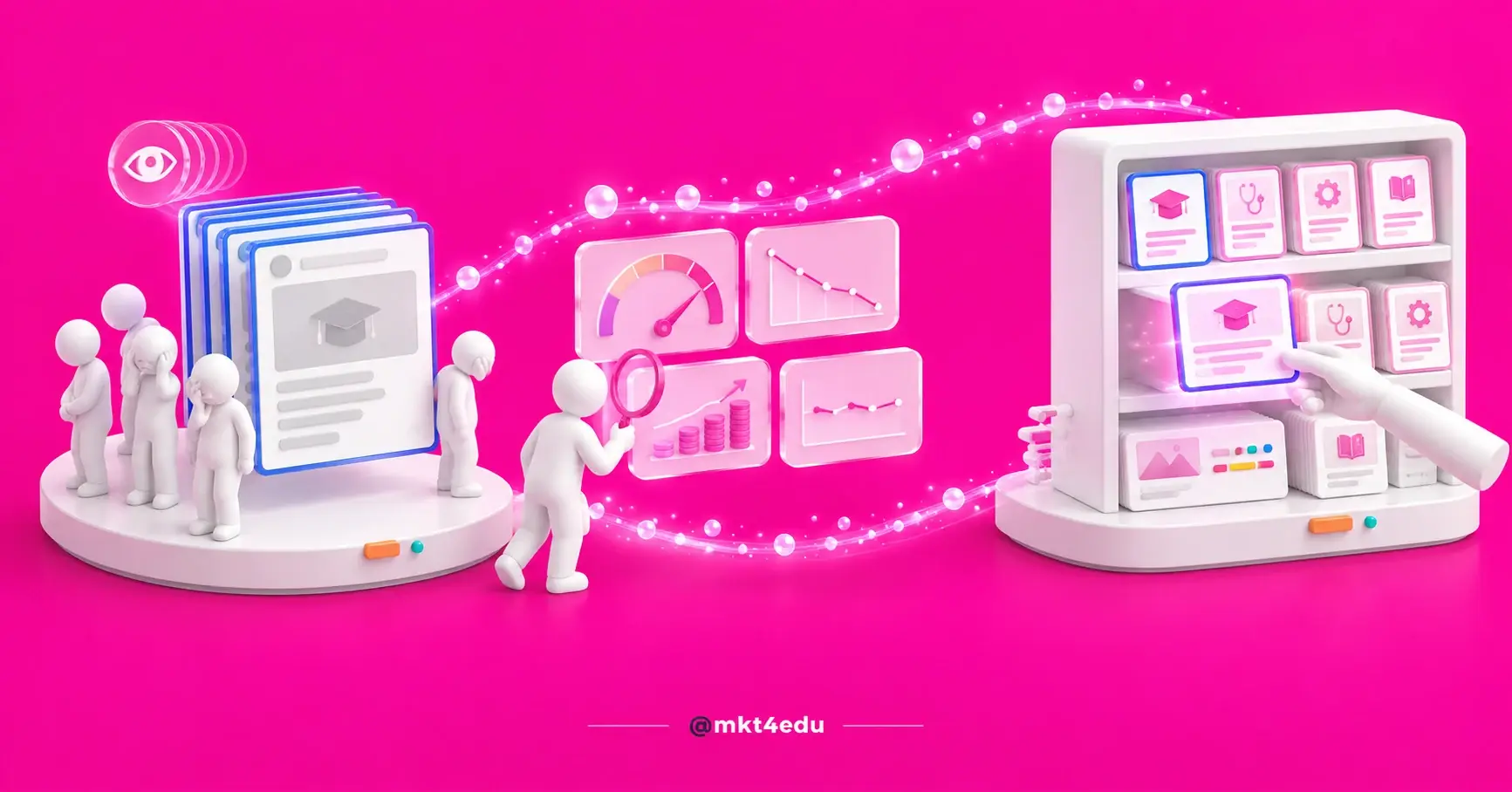
 Image: A digital marketing plan connects a checklist of actions, execution and goals to guide decisions and conversion.
Online marketing strategies that help convert
There are many tactics. At the bottom of the funnel, some tend to have a more direct impact because they deal with intent, timing and objection.
High intent search and decision pages
When someone searches for terms such as price, registration, enrolment, course in a city, entrance exam, postgraduate course in a specific area, the behavior is usually one of comparison and decision.
In many scenarios, search helps because it captures active demand. But the click is only worthwhile if the page makes sense.
A BOFU page usually needs:
- Objective promise consistent with the ad.
- Clear proof of what makes the difference.
- Visible and simple CTA.
- Minimal form friction.
Google reinforces general quality and experience practices as the basis for SEO, and this continues to apply even when the content appears on AI resources. A good guide is Google Search Essentials and the useful and trustworthy content guidelines.
Remarketing by stage, not by "everyone the same"
Remarketing works best when it respects intent. Examples:
- Visited the price page: message with conditions, simulation, deadlines and next steps.
- Visited the grid: message with method, support and academic differentials.
- Abandoned the form: message with proof and quick chat CTA.
With controlled frequency and a specific message, you tend to reduce useless repetition and increase relevance.
Creatives who answer objections
Promotion can help, but it doesn't always solve the problem. Common objections are: routine, time, fear of not following through, insecurity about support and doubt about value.
A good BOFU creative recognizes the doubt and offers a safe step. Instead of exaggerating, he clarifies, which can be an appointment, a simulation, a quick chat or a visit, depending on your model.
Consistency between ad, landing page and customer service
If the ad promises one thing and the landing page delivers another, you lose trust. If the page converts and the customer service takes too long, you lose timing. In BOFU, this link is just as important as the channel.
To organize the optimization of your site and conversions, practical support can be found in website optimization tools, because they help you define what to measure and where to move first.
How to fit paid media into your digital marketing plan
Paid media isn't just about "placing ads". At the bottom of the funnel, it's generally useful for capturing intent, reengaging the undecided and testing the message at speed. But it works best when each campaign has a defined function.
The matrix below helps you design campaigns with funnel logic and decision metrics.
|
Objective in BOFU |
Type of campaign |
Common offer |
KPI to decide (examples) |
|
Capturing intent |
Search with decision terms |
Schedule conversation, simulate monthly fee |
Cost per qualified lead, conversion rate |
|
Sustain comparison |
Social Ads with proof |
Testimonials, differentials, tour |
Lead rate, response rate |
|
Recover undecideds |
Remarketing |
Deadline reminder, proof, condition |
Frequency, CPA, return rate |
|
Reactivate base |
CRM campaign |
Assisted enrollment, live doubts |
Reactivation rate, cost per opportunity |
Table 02: BOFU campaign matrix: objective, campaign type, offer and KPI
Use this as a draft and adjust it to your buying cycle. The point is to know why each campaign exists and how you decide to optimize it.
Digital marketing tools to support the operation
Tools don't replace strategy, but they do facilitate discipline. See what usually helps at BOFU:
- CRM to record stage and origin.
- Email automation for follow-up.
- Consistent tagging and analytics.
- Single dashboard with KPIs per stage.
If WhatsApp is a strong part of your conversion, a communication ruler helps maintain cadence without seeming pushy.
How to get your digital marketing plan off the ground in 30 days?
The routine below works as a basis when you need to get out of "over-planning" and into controlled execution. Adapt it to your context.
Week 1: base and decisions
- Define goal, scope and audience.
- Review offer, evidence and objections.
- Adjust main landing pages.
- Define service SLAs and qualification criteria.
Week 2: first wave of campaigns
- Raise high intent search.
- Raise basic remarketing by audience.
- Create variations of creative by objection.
Week 3: data-driven optimization
- Review search terms and negatives.
- Adjust segmentations and creatives.
- Run simple page tests (title, CTA, proof).
Week 4: scale with governance
- Reallocate funds to campaigns that generate stage advancement.
- Expand ad groups or similar audiences.
- Refine scripts and follow-up rules.
The logic is to accelerate little by little, learn, correct and only then scale up. This usually saves budget and improves consistency.
Measurement without illusion: what you can decide with the data
At the bottom of the funnel, looking only at the last click can distort the reading, because the decision involves several aspects.
To operate, use what's available in your stack, but make it clear in the plan what you want to learn.
A useful reference for structuring this thinking is the Marketing Measurement Handbook, which helps to separate reporting from learning. The aim here is not to complicate things, but to avoid decisions based on a single lens.
BOFU Content, SEO and AI: where it comes in
Even at the bottom of the funnel, content marketing matters. Only the format changes.
Instead of "what is it", pages and materials that help you decide come in: comparisons, questions about price and conditions, a guide to choosing, FAQs, details of methodology, support and next steps.
For indexing and AI reading, the structure usually helps: clear headings, real questions as subheadings, direct answers at the beginning and concrete examples.
For search features with AI, Google indicates that best practices still apply, and a good guide is the page on AI features and your website.
If you're going to use FAQ markup, remember that the display of FAQ rich results has specific restrictions and scope; even so, a well-written FAQ section remains useful for the user and for clarity of content.
SEE ALSO THESE CONTENTS:
- AI Overview: what it is and how it works
- What Google's 'People Also Ask' is and how it works
- SEO for LLM: The Guide to Getting Featured in AI Responses
Common mistakes that make your plan look pretty but not very effective
Some mistakes appear in both novice and experienced teams when the pressure is on.
Mixing different objectives in the same campaign
Reach campaigns and conversion campaigns can coexist, but they usually require different creatives and metrics. Mixing everything together tends to create a confusing dashboard.
Buying volume and finding out later that it doesn't close
If you don't measure quality and stage progression, the plan becomes a registration factory. In BOFU, this tends to be expensive.
Ignoring the service SLA
Paid media can increase demand. If the response is delayed, you pay for missing the timing.
Changing everything at once
When you change audience, creative, offer and landing page on the same day, it's hard to learn. Test one variable at a time to keep a clear reading.
When it makes sense to call in a marketing professional or a paid media operation
Not every team needs to outsource. But some signs indicate that specialized support can reduce the learning curve.
- You have money, but no clear campaign governance.
- You generate leads, but the quality is unstable and nobody knows why.
- The team is overloaded and can't test methodically.
- The operation depends on just one person.
- You want to scale with control, without betting everything.
If two or more points are true, the risk of waste is high. And waste here is not just of money, but also of time and opportunity.
Next step: execute the plan with paid media
If you want to set up or revise a digital marketing plan with a focus on conversion and use paid media as a lever, the safest path begins with a diagnosis of the funnel, offer, pages and operational capacity.
From there, you can design campaigns with a clear function, governance and optimization routine.
A plan that survives contact with the calendar needs an editorial backbone, and that backbone is a content plan with owners and dates.

Common questions about digital marketing plans
What is a digital marketing plan?
It's a document and a routine that defines goals, audience, proposal, channels, campaigns, budget, schedule and metrics to guide decisions and execution in online marketing.
How do I create a digital marketing plan from scratch?
Start with a business and audience goal, break down the goal into funnel stages, choose a core strategy, select channels by function, define a budget with rules and establish a cadence for analysis and adjustment.
Which marketing strategies help most at the bottom of the funnel?
Search with high intent, remarketing by stage, creatives that answer objections, objective landing pages, quick follow-up and integration with CRM and customer service.
Is paid media mandatory in a digital marketing plan?
It's not mandatory, but it usually helps when you need to capture ready-made demand or recapture undecideds quickly, as long as the page and customer service are aligned.
Which digital marketing tools are essential?
Ad manager, tagging and analytics, CRM, email automation and a simple dashboard with KPIs by funnel stage.
How quickly can I tell if the plan is working?
It depends on the decision cycle and the volume of data, but many teams can learn something useful in the first few weeks if they have clear KPIs and a review cadence.
And now: how do you put your digital marketing plan into practice?
An effective digital marketing plan is not about doing more. It's about deciding better.
When you start from goal, offer and capacity, choose channels by function and create governance, execution tends to become lighter and more manageable.
At the bottom of the funnel, where the decision needs confidence and timing, the alignment between ad, page and service is the factor that most avoids waste and sustains conversion with consistency.

























 Portugal