






CRM and sales work best together when the team logs interactions, standardizes funnel stages, and uses data to prioritize deals with higher close potential. In practice, this reduces rework, improves forecasting, and makes outreach more consistent.
One example of a tool that supports this integration is the HubSpot free CRM, which centralizes contact and deal information to help track pipeline progress and sales activities.
In this article, you will see how CRM and sales connect across the process and where features like automation, pipeline management, and reporting help you scale with structure.
What you will see in today’s content
- How CRM and sales complement each other through interaction logging, funnel stages, and data based prioritization.
- What CRM is and why it gives context, history, and next actions to the sales team.
- How Inbound Sales connects to a consultative approach and timing tied to a lead’s pain points.
- How HubSpot’s CRM centralizes contacts and deals to follow the pipeline and activities.
- Integration between sales and marketing on a single platform, with real time data.
- Sales automation, including lead nurturing flows and follow up scheduling.
- Personalization with fields for interests, preferences, and purchase history.
- Reports and analytics to track conversion rate, average negotiation time, and average deal size.
- Three alignment points: funnel stages, automating repetitive work, and careful handling of personal data.
Good reading!
CRM and sales in a commercial team’s day to day
CRM and sales complement each other when the commercial team records interactions, standardizes funnel stages, and uses data to prioritize opportunities with a higher chance of closing. This reduces rework, improves predictability, and makes the approach more consistent.
In the digital market and in consultative sales, a well configured CRM helps sustain cadence, activity logging, and funnel visibility by centralizing information, history, and next actions. Tools like HubSpot’s free CRM support this integration by organizing contacts and deals and making it easier to follow the pipeline and team activities.
- Record interactions to keep context, history, and next actions.
- Standardize funnel stages to improve pipeline visibility.
- Use data to prioritize opportunities with a higher chance of closing.
- Apply automation to repetitive tasks, such as reminders and cadences.
- Use reports to track performance and improve predictability.
Hubspot for the digital market and inbound sales
CRM is the system that organizes lead and customer data and interactions so sales teams can run deals with context, history, and clear next steps. This becomes even more valuable when your sales process relies on cadence, activity tracking, and pipeline visibility.
In consultative selling, the inbound sales methodology helps match outreach and timing to the lead’s goals and pain points. A well configured CRM supports that routine by centralizing information and activities in one place.
O inbound sales is a methodology that aims to attract customers through relevant and educational content, instead of approaching them with intrusive advertisements. The idea is to create a relationship of trust with the customer, offering solutions to their needs and challenges. In this sense, HubSpot's CRM is a great ally, as it allows companies to manage all stages of the sales process more efficiently.
One of the main advantages of HubSpot's CRM is its integration with other platform tools, such as content marketing and social media management. This allows the company to have a more complete view of the customer, from the moment they are attracted by the content until they convert into a sale.
Additionally, HubSpot's CRM also offers sales automation features, such as creating lead nurturing flows and scheduling follow-ups.
Another relevant aspect of HubSpot's CRM is its customization capacity. The platform allows companies to create custom fields to store specific information about their customers, such as interests, preferences and purchase history. This allows for a more personalized approach when closing a sale, increasing the chances of success.
Additionally, HubSpot's CRM also offers analytics and reporting features, which allow companies to track their sales performance more accurately. It is possible, for example, to evaluate the conversion rate of leads into customers, the average negotiation time and the average ticket for sales made.
Finally, it is important to highlight that HubSpot is one of the leaders in the digital marketing and Inbound Sales market, and its CRM platform is recognized for its efficiency and ease of use.
With HubSpot CRM, companies can optimize their sales processes and strategies, improve customer relationships, and increase their effectiveness in the digital market.
More like this:
- How does CRM connects with the sales funnel steps
- What is a diagnostic evaluation in marketing strategy
- How does CRM connects with the sales funnel steps
The advantages of Hubspot CRM for online sales
A company's success depends, to a large extent, on the efficiency of its sales. And with the growth of e-commerce, investing in a customer relationship management (CRM) system has become essential for successful online sales. HubSpot is a market-leading CRM platform that can help optimize the entire sales process and increase your company's profits.
Here are some reasons why you should consider investing in a HubSpot CRM for online sales:
1. Sales and marketing integrationHubSpot's CRM allows sales and marketing teams to work together on a single platform, sharing data and information in real time. This helps increase efficiency, improve collaboration and optimize results.
2. Customization and ease of useHubspot's CRM allows for personalization of customer service, which can improve user experience and increase chances of conversion. Furthermore, the tool is very intuitive and easy to use, which makes the sales process faster and more efficient.
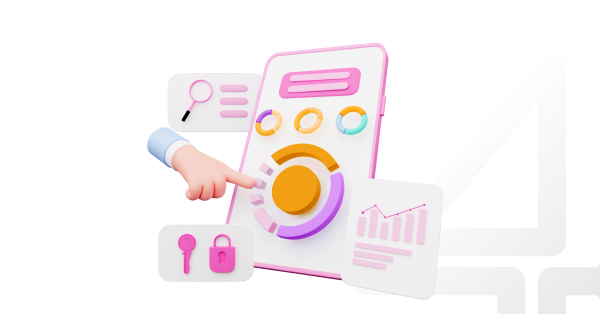
3. Marketing automation
HubSpot offers a number of sales automation tools, such as automatic email sending, workflow creation, and lead scoring. This helps streamline the sales process and allows teams to focus on more qualified leads.
4. Pipeline management
HubSpot's CRM gives you a clear view of the sales process and each lead's current stage in the pipeline. This helps teams identify bottlenecks and prioritize activities to maximize conversions.
5. Activity monitoring
HubSpot's platform allows sales teams to monitor lead activity in real time, including website visits, content downloads, and social media interactions. Based on this data collected, the information can help personalize communication with leads and increase the chances of conversion.
6. Reports and analytics
HubSpot offers a range of advanced reports and analytics to help sales teams better understand how their activities are performing and make more informed decisions. This includes sales activity reports, revenue forecast reports, and marketing campaign performance reviews.
For reporting to truly help, it’s worth aligning three process points.
First, define funnel stages that match how your team actually sells, because pipeline visibility depends on clear stage names and entry criteria. Sales pipeline management works best when everyone logs activities consistently.
Second, automate only repetitive work, like reminders and cadences, while keeping personalization where it changes outcomes. Sequences can structure follow ups without losing timing.
Third, handle personal data carefully from lead capture onward, with a clear legal basis and transparency, because CRMs often centralize sensitive relationship data. The Brazilian General Data Protection Law is a solid starting point to review consent, retention, and access.
These are just some of the advantages that HubSpot's CRM can offer to improve online sales. Ultimately, the platform helps sales teams better manage their customer relationships, increase efficiency and optimize customer acquisition and conversion.
Summary: Hubspot's CRM offers a wide variety of tools and other advantages for capturing and converting leads. Through the platform, your company has highly intuitive functionalities that can optimize the efficiency of your processes, as well as significantly and positively impact your customers' journey.
To learn even more advantages and benefits that Hubspot's CRM has to offer for your company, check out our other post and also discover the importance that the platform has on your marketing strategies.

Frequently asked questions about HubSpot CRM, sales, and Inbound Sales
What is CRM?
CRM is a system that organizes lead and customer data and interactions so the sales team can track deals with context, history, and next actions.
How do CRM and sales complement each other in practice?
CRM and sales complement each other when the team logs interactions, standardizes funnel stages, and uses data to prioritize opportunities with a higher chance of closing, reducing rework and improving predictability.
What is Inbound Sales?
Inbound Sales is a methodology aimed at attracting customers through relevant, educational content, building a relationship of trust by offering solutions to needs and challenges instead of using intrusive ads.
How does a well configured CRM help in consultative sales?
A well configured CRM supports the routine by centralizing information and activities in one place, which helps when the process depends on cadence, activity logging, and funnel visibility.
How does HubSpot’s free CRM support the integration between CRM and sales?
HubSpot’s free CRM centralizes contact and deal information to make it easier to track the pipeline and the team’s activities.
Which HubSpot CRM features help scale with organization?
Features such as automation, pipeline management, and reports help scale with organization by structuring repetitive tasks, improving funnel visibility, and supporting data driven decisions.
How does sales and marketing integration work in HubSpot CRM?
The integration allows sales and marketing to work together on a single platform, sharing data and information in real time, which improves collaboration, efficiency, and results.
What kinds of sales automation does HubSpot CRM offer?
HubSpot CRM offers automation such as creating lead nurturing flows and scheduling follow ups, as well as sequence features to structure follow ups with timing.
How can personalization in HubSpot CRM support conversions?
Personalization allows creating fields to store information such as interests, preferences, and purchase history, enabling a more personalized approach to increase chances of success.
Which metrics can be tracked in HubSpot CRM reports?
You can track metrics such as lead to customer conversion rate, average negotiation time, and average deal size, as well as activity reports and revenue forecast reports.
What should be aligned so that reports and pipeline management work better?
To work better, it is important to align 3 points:
- Define funnel stages with clear names and pass criteria.
- Automate only what is repetitive, keeping personalization where it changes outcomes.
- Handle personal data carefully from lead capture, with legal basis and transparency.
Why is careful handling of personal data relevant in a CRM?
It is relevant because a CRM usually concentrates sensitive relationship information, and capture and retention should consider consent, retention, and access with transparency.

.jpg)























 Portugal