






If you've already published content, boosted posts, set up a campaign and still feel that "people see it, but they don't go any further", this is usually less about a lack of effort and more about the order of the message.
In top-of-the-funnel content, the reader is usually like this: curious, suspicious, tired of big promises, short of time, and still trying to understand whether their problem is "real" or just a feeling.
When you try to push a decision before the person is ready, the result is rarely conversion. It's usually silence.
The AIDA funnel helps with just that. It organizes communication into four mental steps: Attention, Interest, Desire and Action.
It's not a trick or a rigid script. It's a simple way of aligning your message with the real state of the person on the other end.
AIDA funnel in practice for content that converts without forcing it
The AIDA funnel is a communication model that organizes your message into four mental steps: Attention, Interest, Desire and Action. It helps avoid the common mistake of asking for a decision before the person is ready, especially at the top of the funnel, when the reader is still curious, suspicious and trying to understand their problem. Instead of "pushing" the conversion too soon, AIDA guides you to deliver clarity, context and proof at the right time, and to propose a small, coherent action (such as saving, downloading a checklist or entering a trail). This way, metrics become a diagnosis of the step, not anxiety.
-
- Structure titles, openings, examples and CTAs by stage (without mixing objectives).
-
- Treat "Action" as the next light step at the top of the funnel, not "buy".
-
- Strengthen "Desire" with clarity and proof, not adjectives.
-
- Plan a trail with internal links to maintain continuity.
-
- Measure the right step with more honest metrics (CTR, time, returns, conversion).
What you'll see in today's content
Happy learning!
What is AIDA and what is AIDA in marketing?
If you've searched for "what is AIDA" and want a straight answer:
AIDA is a model that describes four stages of persuasion and decision-making: Attention, Interest, Desire and Action.
In practice, it is used to structure texts, pages, ads, videos and content sequences to lead someone from the first contact to the next step.
The most useful part of AIDA is not the acronym. It's the question behind it: what does the person need to feel and understand now, in order to go one step further without regret?
A curiosity about the origin: several popular sources attribute the model to St. Elmo Lewis (including academic references and dictionaries).
At the same time, there is historical research questioning whether this attribution is as solid as it is repeated in marketing, pointing to weak evidence and discussing other authors in the development of the AIDA model.
This detail matters for a simple reason: marketing thrives on repeating formulas. And when you repeat too many, you lose nuance. The AIDA funnel works best when you treat it as a communication structure, not as a "scientific truth".
How the AIDA funnel works in practice (Attention, Interest, Desire and Action)
Before getting into tactics, it's worth aligning what each stage actually asks for. In top-of-funnel content, "Action" should rarely be "buy".
Often, the best action is a small one: save, click on a guide, enter a trail, download a checklist. This respects real decision time and maintains trust.
The table below helps translate the AIDA model into content and result expectations. It's useful so that you don't measure everything with the wrong ruler.
Note that "metric" here is not vanity. It's diagnostic. You measure to understand if the step is working, not to punish yourself because the lead hasn't signed up yet.
|
Step |
What's on the person's mind |
Objective of the content |
Formats that usually work |
More honest metrics at the top |
|
Attention |
"Is this about me?" |
Being found and recognized |
SEO article, short video, social post with clear hook |
Impressions, CTR, organic entry |
|
Interest |
"Okay, I get it, but what about me?" |
Explain clearly and in context |
Guide, commented checklist, comparisons |
Time on page, internal clicks |
|
Desire |
"It sounds good, but do I trust it?" |
Reduce doubt and increase trust |
Examples, mini-cases, simulations, before/after |
Return to site, downloads, recurrence |
|
Action |
"What's the next step without pressure?" |
Guide and reduce friction |
Simple landing page, lightweight form, diagnosis |
Conversion, abandonment rate, lead quality |
Table 01: AIDA funnel applied to content and top-of-funnel metrics
When you structure it like this, it's easier to see common mistakes. For example, if you ask for a meeting in the Attention stage, you create an emotional leap. The person hasn't even decided whether they trust you, but you already want their time and commitment.
AIDA Methodology: how to write and plan content while respecting the right stage
The AIDA methodology becomes practical when you learn to "write in steps". It's not just about choosing a format, it's about choosing an intention.
Here's a simple step-by-step guide, but remember that you don't have to get it 100% right first time. What you do need to do is avoid the most expensive mistake, which is trying to speed up someone who is still confused.
How to apply AIDA to content (quick check)
Use the list below as a revision roadmap. You finish writing and ask yourself: did my text make each stage really exist or was it all jumbled up?
- Attention: do the title and the first paragraph make it clear what real pain you're going to solve, without exaggeration or impossible promises?
- Interest: have you explained the concept with examples and criteria, instead of just "defining" it in the abstract?
- Desire: have you included some proof that it works in the real world (data, reference, mini-case, demonstration)?
- Action: did you propose a next step consistent with the top of the funnel, with low friction, without "catching the person out"?
If you noticed that the "Desire" stage was weak, this is common. Many people try to compensate for desire with an adjective ("incredible", "unmissable", "the best"). This usually only makes it worse. Desire, in AIDA, is born more from clarity and proof than from excitement.
SEE ALSO:
- AARRR: Meet the pirate metrics in marketing strategies
- SWOT analysis: why apply it before any marketing campaign
- SMART goals: understand how to apply them to your business
Inbound marketing strategy with AIDA funnel (without forcing conversion too early)
Inbound marketing is a methodology centered on attracting, engaging and delighting through valuable content and relationships.
If you take a closer look, this ties in well with the AIDA funnel. Attraction connects with Attention. Engagement connects with Interest and Desire. And the next step, when it makes sense, becomes Action.
The common mistake is to try to "save face". It seems efficient in the short term, but it's costly in the long term, especially in education, where the person is afraid of making a wrong choice, has a limited budget, is influenced by family, deadlines and expectations.
Marketing that ignores these points may generate leads, but it generates leads with resistance.
The table below shows a practical way of transforming AIDA into inbound marketing strategy with pieces that connect, rather than loose content.
Think of it as a minimal trail. You don't need to publish everything at once, but you do need the pieces to "talk to each other" so that the reader feels continuity.
|
AIDA stage |
Type of content (top) |
Role in the journey |
Next recommended internal link |
|
Attention |
"What is the AIDA funnel and why does it still work?" |
Capturing doubt and generating clicks |
Practical "how to apply" guide |
|
Interest |
"How to apply the AIDA model to content and pages" |
Give criteria, examples and structure |
Post on sales funnel / journey |
|
Desire |
"Real examples and common mistakes in AIDA" |
Reduce insecurity, increase confidence |
Post on landing pages and conversion |
|
Action |
Checklist or simple template |
Convert with low friction |
Objective landing page |
Table 02: AIDA sequence for inbound at the top of the funnel
If you have a blog with a track record, the quickest difference usually comes from well thought-out internal linking.
Google itself recommends making content easily findable through internal links, as a general SEO practice (and this remains relevant in AI search features).
IT'S WORTH A READ:
- What are Leads and how to set up a proper sales funnel
- Ranking on Google: what is the ideal blog post length
- What is link building? Learn how to do it successfully
What are the best marketing strategies for each stage of the AIDA funnel?
The question "what are the best marketing strategies?" often has a catch.
The best strategy depends on the stage. A video can be perfect for Attention and terrible for Action, if there is no continuity. An article can be great for Interest and bad for Attention if the title doesn't address the real question.
I'll list strategies by stage. But here's the golden rule: don't mix objectives. If you want Attention, don't write as if the reader is already convinced. If you want Desire, don't treat it as if it were a school definition.
Marketing strategies by stage of the AIDA model
This list is for planning a mix of channels. You can use everything, but with different intentions.
- Attention (being found):
- SEO strategy with a focus on terms of real doubt, such as "what is AIDA", "AIDA model", "AIDA methodology".
- Short content on social with a unique and specific insight, without trying to explain the whole world.
- Interest (being understood):
- content marketing strategy with guides and applied examples, to get the person out of the abstract.
- Series (part 1, part 2) or clusters to keep the reader on topic.
- Desire (to trust and want):
- Demonstrations, mini-cases, comparisons, simulations.
- Data and references. Google values useful and reliable content, and this also applies to AI resources.
- Action (taking the next step):
- Simple landing pages, with a coherent promise and low friction.
- Clear and specific CTA, no "find out more" without saying what the person gets.
When you do it right, AIDA becomes an antidote to marketing that seems "too talky". You start communicating to someone who is real, who has doubts and is trying to decide carefully.
Educational marketing strategy with the AIDA funnel (examples that don't sound like a pamphlet)
In educational marketing strategy, the reader is almost always emotionally divided. They want to evolve, but are afraid of the cost, the time, not being able to cope, making the wrong choice.
If your content only talks about "infrastructure" and "discounts", you might attract attention, but you could lose interest quickly because you haven't touched on what's really weighing on them.
The table below gives examples by stage for education, keeping the top of the funnel as a priority.
We recommend reading the examples with intent in mind, not as ready-made text. Copying and pasting tends to sound artificial, and the public notices.
|
Stage |
Content theme (top) |
More human approach |
Light next step |
|
Attention |
"How to choose a course without falling for an empty promise" |
"If you're afraid of making a mistake, that makes sense. Let's organize criteria." |
Article + related links |
|
Interest |
"Objective criteria for comparing institutions" |
"What's 'best' isn't always best for your context." |
Comparative checklist |
|
Desire |
"What the student journey is like in practice" |
"You want predictability, not hype. Let's show you the day-to-day." |
Tour, video, mini-case |
|
Action |
"How to ask questions without pressure" |
"No strings attached. Just to see if it makes sense for you." |
Simple form |
Table 03: Examples of the AIDA funnel in educational marketing
Note how the Desire stage here doesn't depend on superlatives. It depends on reducing uncertainty and, in education, reducing uncertainty is a tangible benefit.
SEO strategy for the AIDA funnel: how to win clicks on Featured Snippets and prepare for AI Overviews
Attention, on Google, begins before the person reads your text. It starts with the click. And the click is influenced by position, snippet, title, intent and, increasingly, AI features and answer boxes.
Google Search Central itself has specific documentation explaining how AI features in Search work for website owners, and reinforces that good SEO practices are still valid.
They also make it clear that there is no extra "secret optimization" for AI Overviews and AI Mode, and that the focus should be on fundamental SEO and useful content.
In parallel, Google defines featured snippets as special boxes in which the snippet appears first and can also appear within "People Also Ask".
To get this out of the abstract, let's look at the numbers.
Graph with real data: organic CTR by position and why it changes your Attention
There are different studies with different results, because the SERP changes, the countries change and the type of query changes. This variation is normal.
To give you an objective reference, a report from 2025 compiles CTR by position and also by elements such as "People Also Ask" and snippets.
Graph (values from the 2025 report, CTR by position 1 to 5): First Page Sage
- Position 1: 39.8% ██████████████████████████████
- Position 2: 18.7% ████████████████
- Position 3: 10.2% ██████████
- Position 4: 7.2%███████
- Position 5: 5.1%█████
A study by Backlinko, based on millions of results, reports a different average CTR for position 1 (27.6%) and also discusses factors that alter CTR, such as titles and SERP format, which reinforces the idea that there is no "universal number", there is a scenario.
What doesn't change is the pattern: dropping positions reduces clicks significantly, and features such as snippet and question blocks can redistribute attention.
SEO techniques in the AIDA funnel (and how this also helps LLMs and AI searches)
You've asked for the application of SEO techniques and also techniques for indexing in AI searches.
I'll be very careful here not to promise what no one can promise: there is no guarantee of appearing in AI Overviews, nor in snippets. What there is is increased eligibility and clarity.
Google states that SEO best practices remain relevant for AI Overviews and AI Mode, and that there are no specific additional technical requirements.
Even so, there are clear recommendations, such as allowing crawling, having text content, using internal links and keeping the structured date coherent with the visible content.
Below is a practical list, but it's important to stress one important point: "writing for LLM" is not about filling the text with technical terms. It's about organizing the content so that it's easy to extract, quote and understand.
Optimization checklist for snippet, AI and human reading
This checklist works because it improves readability and reduces ambiguity, i.e. it's better for people and for the machine.
- Open sections with short, complete answers, especially in question headings ("what is it", "how does it work").
- Use headings with real search language, e.g. "how to apply", "why it works", "examples", "common mistakes".
- Break long explanations into blocks with micro-conclusions, so the reader doesn't get lost.
- Include entities and context, for example, "AIDA funnel", "AIDA model", "AIDA methodology", and connect with "inbound marketing", "content marketing" and "SEO".
- Use internal links to form a trail, something that Google itself cites as a useful practice that improves the discoverability of content.
- Back up claims with sources and data when it makes sense, because reliability isn't aesthetics, it's evidence.
If you only do one thing today, do this: write as if someone is in genuine doubt and needs clarity to decide the next step.
This type of content tends to perform better in SEO and be more "retrievable" in response systems, because it has structure and doesn't rely on fluff.
KEEP LEARNING:
- SEO for LLM: The Guide to Getting Featured in IA Responses
- How to increase visibility on Google: LLMs and AI to grow with SEO
- New sales funnel for SEO with LLMs
How to measure and optimize the AIDA funnel without anxiety about the wrong metrics
The top of the funnel often generates anxiety because it's where you do a lot of work and the return doesn't always come quickly. However, if you measure correctly, you can see micro-victories that indicate real progress.
An honest way of thinking: at the top, "Action" can be micro-conversion. You're gaining permission to talk again.
Metrics by stage of the AIDA funnel
These metrics make more sense when analyzed together, not in isolation.
- Attention: impressions, organic CTR, keywords entering the top 10, growth of ranked pages.
- Interest: time on page, clicks on internal links, scroll, pages per session.
- Desire: return to the site, downloads, recurring visits to related content, clicks on "cases" and "how it works".
- Action: landing page conversion, form abandonment rate, lead quality.
When Attention is good and Interest drops, the problem is probably a disconnected promise. The title promises one thing and the content delivers another.
Now, when Interest is good and Desire falls, there is usually a lack of proof or example, when Desire is good and Action falls, it is certainly friction.
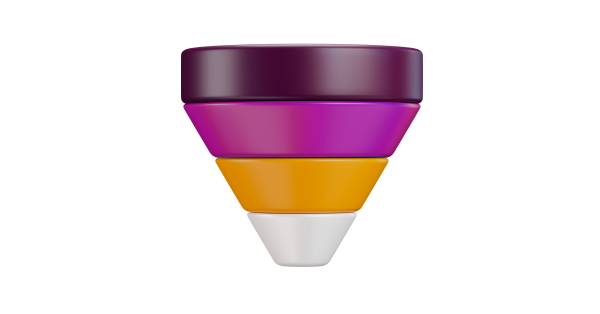 Image: Visual representation of the AIDA Funnel (Attention, Interest, Desire and Action).
Common mistakes when using the AIDA model (and why they happen)
I like to talk about mistakes because they are very human. We have goals, we have demands, we are in a hurry. But haste appears in the text.
- Attention becoming a "shout": drawing attention isn't about exaggerating, it's about being relevant to a specific pain.
- Superficial interest: defining a concept without explaining its application, leaving the reader with "ok, so what?".
- Adjective-based desire: trying to compensate for a lack of proof with strong words. This often leads to mistrust.
- Action with high friction: asking too much too soon, with a large form and a vague promise.
- Content without a trail: isolated posts don't build a journey or thematic authority.
If you've recognized any of these points, it doesn't mean that "your marketing is bad". It means you're in the same place as most teams at some point. The difference is having a method to adjust, and the AIDA funnel is one of those methods.
Simple plan to put the AIDA funnel into practice in 7 days (top of funnel)
This plan doesn't require perfection and it doesn't require a large team, it requires consistency and revision.
|
Day |
Focus |
Delivery |
|
1 |
Attention |
List of 15 real doubts from the public (questions and variations) |
|
2 |
Attention |
1 SEO article: "what is AIDA in marketing" with examples |
|
3 |
Interest |
1 guide: "how to apply the AIDA funnel" to content and pages |
|
4 |
Interest |
Revision of structure and internal links to form a trail |
|
5 |
Desire |
1 test content: example, simulation, mini-case, before/after |
|
6 |
Action |
1 light offer: checklist or template, with simple landing page |
|
7 |
Optimization |
Adjust titles, snippets, CTAs and linking based on CTR and engagement |
Table 04: 7-day schedule per stage of the AIDA funnel, with recommended deliverables for organizing content production.
Why the AIDA funnel is a good choice for the top of the funnel
The AIDA funnel remains useful because it doesn't depend on a platform. It depends on basic psychology: before acting, people need to perceive, understand and trust.
And here's a point that doesn't always come up in technical content: often, your reader isn't "difficult", they're just trying to protect themselves from regret. They want evidence, clarity, they want to feel that they won't be manipulated.
When you use the AIDA methodology with this care, the strategy becomes more human and, almost as a consequence, more efficient.
If the AIDA funnel has helped you organize the message, the next challenge is to turn this structure into consistent content that you can repeat without relying on inspiration, and that also works for SEO.
AIDA is the "map" of persuasion, but the result comes when you apply it to an editorial strategy, with guidelines, formats and optimizations that increase reach and retention.
To take that next step with the method, check out this complete guide: How to do content marketing.

Frequently asked questions about the AIDA funnel in content marketing
What is the AIDA funnel in practice?
The AIDA funnel is a model that describes four stages of persuasion and decision: Attention, Interest, Desire and Action. In practice, it is used to structure texts, pages, ads, videos and content sequences, leading someone from the first contact to the next step. Its main purpose is not to "memorize the acronym", but to align the message with the reader's actual state: what they need to perceive, understand and trust now in order to move up a step without regret. For this reason, it works better as a communication structure than as a rigid script.
Why does my content "catch the eye", but not move the reader forward?
This usually happens when the message tries to speed up a decision before the person is ready. At the top of the funnel, the reader is usually curious, suspicious, tired of big promises and short of time, still trying to understand if the problem is real. If you ask for a meeting, a purchase or a big commitment in the Attention stage, you create an emotional leap: the person hasn't yet decided if they trust you, but you already want time and commitment. The common result is not conversion; it's silence.
What changes when I think of "writing in steps"?
"Writing in steps" means choosing a clear intention for each piece of content, rather than mixing up objectives. In Attention, you seek to be found and recognized; in Interest, you explain with clarity and context; in Desire, you reduce doubt and increase confidence; and in Action, you guide a next step with low friction. This logic avoids the costly mistake of hurriedly trying to convince someone who is still confused. You don't need to get it 100% right first time; you mainly need to avoid speeding up those who still don't understand.
At the top of the funnel, what should the ideal "Action" be?
At the top of the funnel, the "Action" should rarely be "buy". Often, the best thing is a small action that is consistent with the actual decision time: saving, clicking on a guide, entering a trail, downloading a checklist. The aim is to guide the next step without pressure and to reduce friction while maintaining trust. When the action is light, you gain permission to talk again, and this is a micro-conversion that indicates real progress, even before a sale.
How do I know if my content has really covered Attention, Interest, Desire and Action?
A quick check is to review four points: (1) Attention: does the title and first paragraph make the real pain clear, without exaggeration? (2) Interest: did you explain it with examples and criteria, not just an abstract definition? (3) Desire: is there proof that it works in the real world (data, reference, mini-case, demonstration)? (4) Action: is the next step consistent with the top of the funnel, with low friction and without "catching on"? If "Desire" is weak, adjectives tend to get worse; clarity and proof tend to get better.
Which metrics make the most sense for each stage of AIDA?
Metrics serve as a diagnosis of the step, not as vanity. For Attention, impressions, organic CTR, growth of ranked pages and keywords entering the top 10. For Interest, time on page, clicks on internal links, scroll and pages per session. For Desire, return to the site, downloads, repeat visits and clicks on "how it works" content and trials. For Action, landing page conversion, form abandonment rate and lead quality. The sign of the problem changes depending on the combination of these metrics.
How does AIDA connect with inbound marketing without forcing early conversion?
The logic works well: attraction talks to Attention, engagement to Interest and Desire, and the next step, when it makes sense, becomes Action. The common mistake is to "save ground" by trying to skip stages: it may seem efficient in the short term, but it's costly in the long term, because it generates leads with resistance. A practical approach is to put together a minimal trail with pieces that connect: an Attention content that leads to an application guide (Interest), which leads to examples and evidence (Desire), and then to a light offer (Action).
What strategies are useful at each stage of the AIDA funnel?
The best strategy depends on the step and the objective. For Attention, focus on being found: terms of real doubt and clear hooks. For Interest, applied guides with criteria and examples, as well as series and clusters to keep the reader on the topic. For Desire, demonstrations, mini-cases, comparisons, simulations and support from data and references, reducing insecurity. For Action, simple landing pages, a coherent promise and low friction, with a specific CTA (not a generic one). The golden rule is not to write as if the reader is already convinced when they are still at the beginning.
How to apply AIDA in educational marketing without sounding like a pamphlet?
In education, the reader is often divided: they want to evolve, but are afraid of cost, time, not being able to cope and making the wrong choice. That's why the Desire stage tends to work better by reducing uncertainty than by using superlatives. Examples of more human approaches: in Attention, organizing criteria so as not to fall for empty promises; in Interest, comparing institutions with objective criteria; in Desire, showing the student's journey and day-to-day life with predictability; in Action, offering a way of answering questions without pressure, with a simple form. The focus is on evidence and clarity, not propaganda.
What can I do to increase clarity and eligibility for snippets and AI responses?
There is no guarantee of appearing in answer boxes, snippets or AI features; what there is is to increase eligibility and clarity. Good practices include: opening sections with short, complete answers; using headings with real search language (such as "what it is", "how to apply it", "why it works", "examples", "common mistakes"); breaking up long explanations with micro-conclusions; including context and entities of the topic (AIDA, inbound, content marketing, SEO); creating trail with internal links; and supporting assertions with evidence when it makes sense. In general, writing for those in genuine doubt improves human readability and extraction by response systems.
How to diagnose bottlenecks: when Attention goes well, but everything else falls down?
The diagnostic pattern changes by stage. When Attention is good and Interest drops, it's usually a disconnected promise: the headline promises one thing and the content delivers another. When Interest is good and Desire falls, there is usually a lack of proof, demonstration or example. When Desire is good and Action falls, the problem is usually friction: large form, generic CTA and confusing next step. There's also the bottleneck of "content without a trail": isolated posts don't build a journey or thematic authority.
How to put the AIDA funnel into practice in 7 days without relying on a large team?
A lean plan works best when it prioritizes consistency and revision. In 7 days, you can: (1) list 15 real questions from the public (Attention); (2) publish a definition article with examples; (3) create a "how to apply" guide on content and pages (Interest); (4) review structure and internal linking to form a trail; (5) publish proof content (mini-case, simulation, before/after) to reinforce Desire; (6) launch a light offer (checklist or template) with a simple landing page (Action); and (7) adjust titles, snippets, CTAs and links based on CTR and engagement.

























 Portugal