




Every business that starts to grow runs into the same bottleneck: the number of leads coming in exceeds the team’s ability to follow up with each one at the right time.
When this happens, sales leadership often faces a decision that seems simple but isn’t: AI SDRs vs. human SDRs — that is, who should prospect, who should qualify, and how much of this can be automated without compromising the quality of the conversation.
The answer is rarely “all or nothing,” and understanding each role helps lead to a better decision.
What Is an AI SDR?
An AI SDR is an artificial intelligence agent that performs the tasks of a pre-sales representative: it finds and enriches contacts, initiates the first contact, answers questions, qualifies leads, and schedules meetings for the sales team.
Unlike simple automation, it understands the context of the conversation and tailors its response accordingly.
In practice, the agent handles the most repetitive and operational part of the sales funnel. It researches the lead’s company, personalizes the approach based on signs of interest, follows up consistently without overlooking anyone, and logs everything in the system.
This frees up the inbound sales to focus on the conversations that truly require human judgment. In operations that already use artificial intelligence to generate qualified leads, the SDR agent is the natural evolution of this process.
An SDR agent is not a decision-tree chatbot
This is where the most common confusion on the topic lies, and it’s worth clearing it up right away. A decision-tree chatbot follows a fixed script, where the user selects options from a menu and the system responds with pre-programmed messages.
When a question strays from the script, it either freezes or repeats the same option. There is no language comprehension—only chained rules.
An AI SDR agent works differently. It interprets what the person has written in natural language, searches for information to provide a context-aware response, decides on the next step in the conversation, and adjusts its tone based on how the lead reacts.
Instead of pushing the person through a flowchart, it conducts a dialogue. This difference isn’t just cosmetic—it’s what separates automated screening from true qualification.
Therefore, comparing an SDR agent to an FAQ chatbot is like comparing apples and oranges.
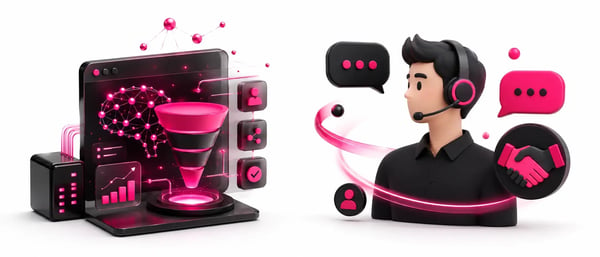 Caption: On the left, the automation workflow and data processed by an AI SDR; on the right, the focus on dialogue, empathy, and relationship-building generated by a human SDR.
What the human SDR does best
The human SDR remains unbeatable in everything that depends on subtle people skills. Complex negotiations, high-ticket consultative sales, interpreting hesitation, and building long-term trust remain the domain of humans.
In purchasing decisions involving multiple stakeholders, a professional’s sensitivity makes a real difference.
There’s also the trust factor. In high-value sales, the buyer wants to feel that they’re talking to someone who understands their problem and takes responsibility for the solution.
AI can lay the groundwork, gather context, and advance the qualification process, but when it comes to closing a difficult conversation or overcoming an emotional objection, having a person on the other end tends to yield better results.
AI SDR vs. Human SDR: A Side-by-Side Comparison
Each model excels in different aspects of pre-sales work, and viewing them side by side helps avoid the trap of treating one as a direct substitute for the other. Here’s how the two stack up on points that typically influence the decision:
|
Criterion |
AI SDR |
Human SDR |
|---|---|---|
|
Contact Volume |
High, with no operational cap |
Limited by work hours |
|
Availability |
24 hours a day, every day |
Business hours |
|
Cost per contact |
Tends to be lower at scale |
Higher, linked to salary |
|
Personalization at scale |
Researches each lead individually |
Depends on available time |
|
Empathy and reading between the lines |
Limited |
Strong |
|
Complex negotiation |
Limited |
Strong |
|
Consistency in follow-up |
Consistent, with no oversights |
Varies depending on the routine |
|
Ramp-up time |
Quick after setup |
Weeks of training |
Table: General comparison between AI SDR and human SDR in the areas that most influence model selection.
The table makes the pattern clear: AI wins in terms of volume, cost, and consistency, while humans win in terms of depth and relationship-building.
It’s worth quantifying the human aspect with data: market research on sales development indicate that it can take an SDR several months to reach full productivity and that they tend to stay in the role for only a short time, with high turnover—which makes a model reliant solely on people more expensive.
Operations that try to focus on just one side almost always fall short in one of these areas.
Will AI replace the SDR, or are we moving toward a hybrid model?
The question “Will AI replace SDRs?” comes up in almost every discussion on the topic, and the most widely accepted view in the market is that AI tends to transform the role, not eliminate it. What disappears is the mechanical part of the job, not the ability to sell.
To say that AI-powered SDRs completely replace humans ignores the conversations that still depend on judgment.
The fastest-growing approach is the hybrid SDR model with AI. In this model, the agent handles prospecting, the initial contact, and the initial qualification, separating those who fit the profile and have the intent from those who aren’t ready yet.
When a lead reaches the decision-making stage, the human team steps in with a more consultative conversation. The result is a faster-moving funnel at the top and a more qualified one at the bottom, with the human team focusing their efforts where they are most effective.
Clearly defining the criteria for qualifying leads with AI is what makes this division of labor work in practice.
How to Choose the Right Model for Your Operation
The choice depends less on trends and more on your type of sales. Three variables help you decide: average order value, lead volume, and deal complexity.
The higher the average transaction value and the more complex the sale, the greater the role of human involvement. The higher the volume and the more standardized the initial approach, the more value AI adds.
For sales with an average ticket size and a large number of prospects, putting AI on the front lines of prospecting typically frees up capacity without expanding the team. For enterprise sales, the agent can act as support, providing context and handling follow-ups while a human leads the sale.
Before making a decision, it’s worth estimating how much an AI SDR would cost in your specific situation and how that compares to the cost of hiring a human. If you decide to adopt the technology, the next step is to understand how to implement an AI SDR agent without disrupting your operations.
Frequently Asked Questions About AI SDRs and Human SDRs
After all, is it worth swapping the human SDR for the AI SDR?
Viewing the issue as a trade-off can lead to the wrong decision. What makes sense for most operations is to establish a clear division of labor: AI handles scale and consistency, while people handle depth and relationships. When this boundary is well defined, the team sells more without bloating the organization.
If you’re evaluating how to integrate an AI SDR agent into your sales machine without sacrificing the quality of the conversations that matter, it’s worth working this out with those who already manage inbound salesprocesses on a daily basis. Talk to the mkt4edu team to identify where automation helps and where humans remain crucial to your operation.
The robot versus person choice softens when AI-driven prospecting takes only the first screening.


.jpg)























 Portugal