






The way we search for information on the internet is undergoing the most profound transformation since the creation of Google.
Before, we typed in keywords and manually navigated through a list of blue links. Today, people prefer ready-made answers, generated directly by artificial intelligence.
For brands and institutions, understanding how Google's AI is affecting organic traffic is the first step to maintaining digital relevance.
However, there is a new step in this evolution that goes far beyond answering questions statically. We're talking about autonomous AI agents, which perform tasks and make decisions independently.
It is against this backdrop of technological transition that the concept of agentic SEOemerges . Understanding this new layer of optimization is a decisive factor for the survival of any company or educational institution on the web.
What you'll see in the post
- The structural transition between traditional SEO, GEO/AEO and agentic SEO.
- How robots and artificial intelligence agents crawl your site.
- Direct comparison table with the three phases of digital search evolution.
- Practical steps to optimize your pages for AI agents using the /llms.txtstandard .
- The impact of this technology on the customer and student acquisition journey of generation Z.
About agentic SEO
Agentic SEO is the practice of optimizing the technical architecture and content of a website so that it can be easily discovered, mapped and triggered by autonomous artificial intelligence agents.
While traditional SEO focuses on attracting clicks from humans, agentic SEO prepares your pages so that decision-making robots can interact with your systems, evaluate your services and even complete transactions on behalf of the end user.
What is agentic SEO?
To understand agentic SEO, we first need to follow the maturity of search channels.
In recent years, we've seen the growth of AEO (Answer Engine Optimization) focused on optimizing content for direct response mechanisms.
This was soon followed by discussions about Generative Engine Optimization (GEO). The aim here is to ensure that language models cite and highlight your brand in short answers.
Agentic SEO represents the next level in this evolution. An AI agent goes beyond a simple chat that summarizes texts from the internet, it is a system designed to meet complex objectives using planning, memory and integrated tools.
Imagine a young person from generation Z who wants to enter higher education. He can give the following instruction to his virtual assistant: "Find the three best face-to-face Software Engineering courses in my region, compare the tuition fees and send my interest form to the one that is most advantageous".
In this practical flow, the AI agent will browse the internet independently. It will carry out parallel searches, consume data from APIs and make the screening decision on its own, without the user having to open a single browser tab.
If your website isn't structured so that this artificial intelligence can read and interpret your data quickly, your brand will simply cease to exist for the buyer of the future.
How do AI agents interact with your website?
Artificial intelligence agents use specific crawling robots to read and decode the content available on the web.
Marketers and developers need to know these robots well in order to manage access to their pages strategically.
OpenAI, for example, uses specific crawlers for different technical purposes. As detailed in the OpenAI crawler documentation documentation, the GPTBot robot is used exclusively to collect public training data from the base models.
On the other hand, OAI-SearchBot is the robot responsible for indexing and displaying websites in real time in ChatGPT Search. The ChatGPT-User agent only comes into play when a user makes a direct request in real time or activates a customized automation.
On the Google side, the operation follows a similar logic. The standard crawler remains responsible for indexing the conventional SERP organically.
Even in the face of AI innovations, balancing new technologies with traditional indexing formats remains the key for those who want to find out how to increase visibility on Google consistently.
For the artificial intelligence environment, Google offers the Google-Extendedtoken . It allows website owners to decide whether or not they want their content to feed Gemini and other generative systems of the company, according to the official guidelines of the Google Developer Guidelines.
If your company completely blocks all these agents in the robots.txtfile , your training data will be protected, but your site will be invisible to the smart search engines that are generating high-converting traffic.
Differences between Traditional SEO, GEO and Agency SEO
To make your strategic marketing decision easier, we've organized the fundamental differences between these three search optimization approaches in the table below.
|
Comparison Criteria |
Traditional SEO |
GEO / AEO |
Agentic SEO |
|
Main Consumer |
Humans who perform searches and click on links |
Language Models that synthesize and summarize answers |
Autonomous AI agents that perform integrated tasks |
|
Content Format |
Long texts, detailed blogs and visual loading |
Direct paragraphs, structured lists and clean definitions |
Functional APIs, JSON-LD and summaries in /llms.txtfiles |
|
Expected action |
The user clicks on the page, navigates and fills in forms |
The model displays the textual response and cites the brand link |
The agent consumes the technical data, compares it and makes a decision |
|
Success metrics |
Organic clicks, SERP impressions and visitor traffic |
Share of Voice in AI, direct quotes and brand mentions |
Task completions, agency leads and API integrations |
Table comparing the evolution phases of search engine optimization strategies.
Focusing exclusively on generating manual visits to the site by humans is a tactic that tends to lose efficiency as consumer behavior becomes automated by personal assistants.
How do you optimize your site for agentic SEO?
Adapting your company's digital ecosystem for the age of AI agents requires an intelligent combination of technical excellence and valuable content.
Ultimately, producing highly relevant texts is still the basis of the whole process. Mastering the best practices of how to do content marketing is essential for nurturing both human readers and search robots.
Below, we highlight the main practical optimization fronts for your website.
Implement the /llms.txt file
One of the biggest innovations for direct communication with artificial intelligence models is the proposed standardization of the /llms.txtfile .
This Markdown file is inserted directly into the root directory of your site, just as we do with the traditional robots.txtfile . The project is formally detailed on the llmstxt.org.
The aim of /llms.txt is to provide a clear, clean and straightforward summary of all the relevant content on your domain. It serves as a context map optimized for the processing limitations of intelligent agents.
This approach is part of the indispensable gear of SEO for LLM. It points out structured paths without loading unnecessary design codes that slow down robot reading.
Clean APIs documented by agents
Autonomous AI agents often interact with corporate websites through system integrations. This process is known in technology as function calling ortool use.
If your educational institution offers a tuition simulation tool, for example, ensure that this functionality has a simplified public API.
Providing an API documented under market standards allows a search agent to consume your prices accurately, without misinterpretation or hallucinations.
Structured data and robust Schema Markup
Structured data markup helps search engines decode the real context of a page. In the age of intelligent agents, this practice has become vital.
Using Schema markup for courses, products, prices and reviews allows AI agents to find crucial information in milliseconds.
When organizing the data on your site, follow the best practices recommended by Google Search Central on structured FAQ and product data, as this guarantees total technical consistency.
Focus on reputation and E-E-A-T
Autonomous AI agents use refined trust and safety criteria to make recommendations or close purchases.
For this reason, Google's E-E-A-T guidelines (Experience, Expertise, Authority and Trust) are fundamental to feeding intelligent algorithms.
Having positive reviews on independent consumer protection channels, citations on reliable news portals and clear brand mentions helps to build this authority.
Knowing how to do SEO and be cited by AIs has become a major competitive differentiator for companies and institutions seeking to lead this new search market.
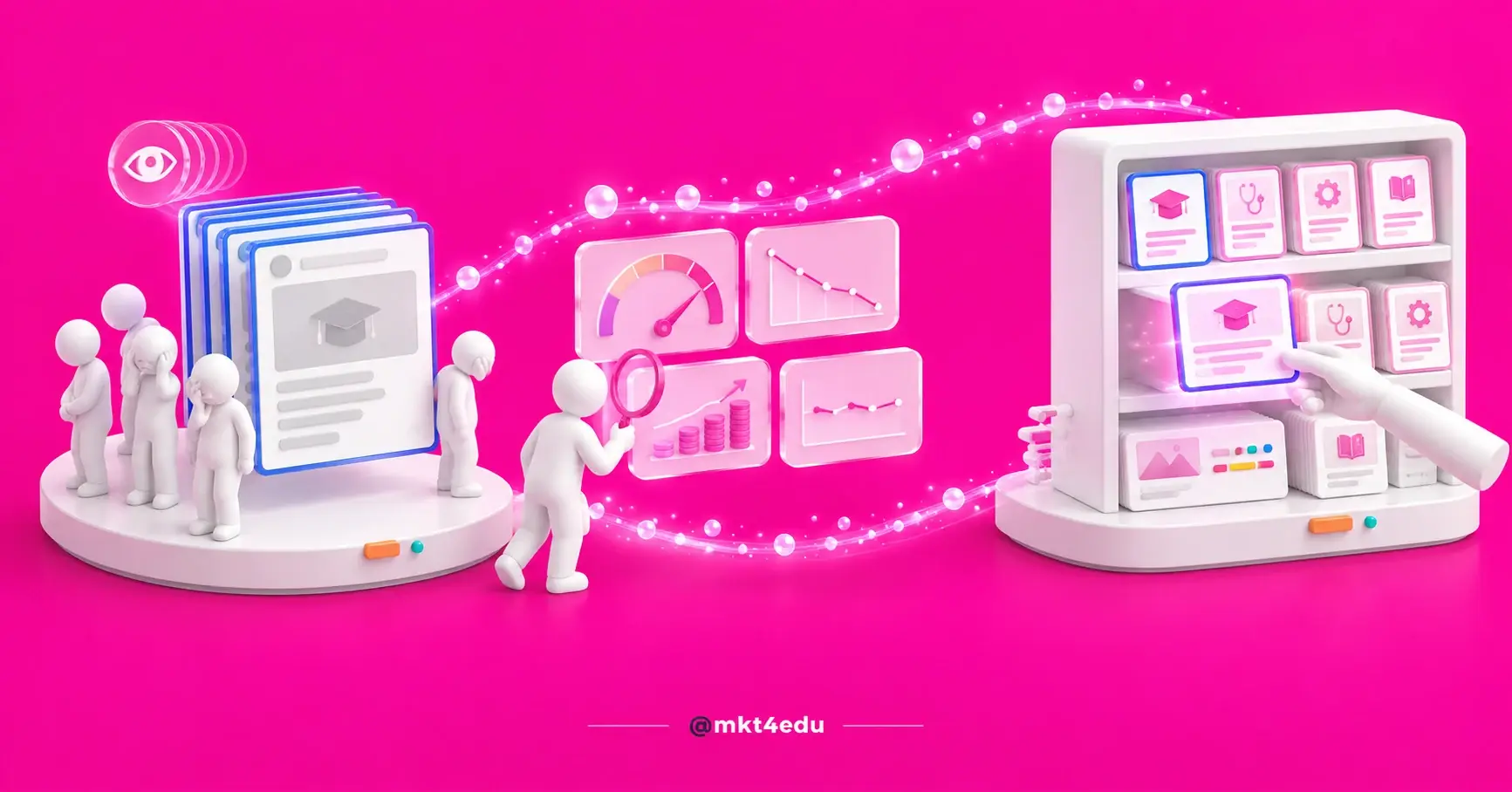
 Caption: The new autonomous AI agents are transforming clicks into direct searches and automated transactions.
The impact of Agentic SEO on educational marketing
For marketing focused on attracting students, agentic SEO completely redesigns the journey of attracting new candidates, especially when talking to generation Z.
In this dynamic scenario, reviewing the basics of marketing and whether your educational institution really knows how to sell its brand is a fundamental step towards standing out even before the student makes a manual search decision.
This audience values instant answers, rejects traditional bureaucratic processes and prefers dynamic self-service interactions.
By preparing your course portal for intelligent search agents, you ensure that the advantages of your infrastructure, prices and curricula are visible to virtual career choice assistants.
In addition to attracting these new agentic leads, your commercial operation needs to be aligned with the best sales process automation practices.
Having integrated channels to manage opportunities and qualify future candidates with the support of modern platforms is part of our specialty in structuring processes of excellence and alignment in the marketing ecosystem.
Frequently asked questions about agency SEO
What is the real difference between GEO and agency SEO?
GEO optimizes textual content so that AIs generate structured summaries on the user's screen. Agentic SEO focuses on the technical architecture of the site, such as public APIs and /llms.txt files, so that robots perform practical actions and make conversion decisions directly.
Does the use of AI to create content harm agent indexing?
No, as long as the content is useful and focused on the end user's experience. Google's guidelines prioritize relevant content created for people. The use of automation to organize or optimize information is welcome, as long as the material offers real value to the reader.
How can I check if my site is friendly to AI agents?
You can test your site by temporarily disabling the rendering of style sheets (CSS) and complex Javascript scripts. If the textual structure remains logical and readable, the site is well positioned. Providing the main pages in clean Markdown format also makes it much easier for LLMs to read.
How can you prepare your company for agentic SEO?
Starting to transition your organic content strategies to the agency SEO model requires commercial vision and advanced technical skills.
The first step is to conduct a technical diagnosis of your institutional website's infrastructure. This will help you assess how readable it is for the intelligent robots leading the new consumer era.
If you want to get ahead of the competition and build a recommended digital presence powered by AI assistants, talk to those who master innovation applied to business growth.
On the mkt4edu blog, you'll find the main analyses, trends and technology solutions that turn clicks into real conversion opportunities for your brand.


























 Portugal