Almost every educational institution already publishes something. Few can say which topic brought an enrollment, which format carried the family's decision and which material shows up when the answer arrives ready made, before any click.
That gap sits between producing content and running a content strategy. Production fills the calendar, while the strategy connects topic, buying journey stage, channel and indicator. This guide walks the whole path, from the definition to the results dashboard.
What is content marketing and what is it not?
Content marketing is the system that turns an audience question into material that is published, distributed and measured. It exists so the right person finds the institution on their own, moves forward with honest information and stays close after enrollment.
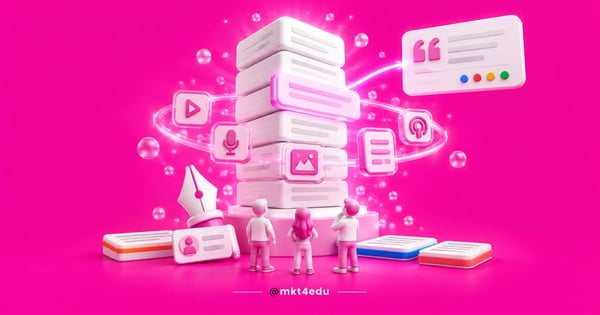 Caption: Content marketing no longer ends at the ranking: the same material has to carry the buying journey and be quoted by the AI generated answer.
The short definition is deceptively simple. What separates a content strategy from an occasional blog is the existence of four written decisions: who you speak to, which question each piece solves, which channel carries it and which number proves it worked.
A blog fed without criteria is not content marketing, even when it publishes every week. Institutional pages that only describe the school do not count either, because they answer the brand's question, never the question the family typed into search.
The inverted starting point is the practical detail. A topic is born from the audience's doubt, passes through the institution's real ability to answer with authority and only then finds its format, which may be an article, a video, a spreadsheet, a webinar or a carousel.
It is worth separating the discipline from two neighbours often mistaken for it. An inbound marketing strategy organizes the entire capture operation, including automation, forms and nurturing. A digital marketing strategy also covers media, social networks, email and the institutional website.
Content marketing is the fuel for both. Without relevant material, an inbound marketing strategy nurtures leads with empty emails, and a digital marketing strategy becomes pure space buying, which drives up the cost of every student captured.
Anyone who needs the execution checklist aimed at Google and at LLM (Large Language Model) systems will find the walkthrough in the sibling article on how to do content marketing for Google and LLMs. This guide handles the strategy that comes before that execution.
Which goals does content marketing deliver for an institution?
There are six goals that build on one another: visibility, organic ranking, lead nurturing and conversion, student retention, lower cost per result and market education. None of them shows up in isolation, and none shows up in the first month of publishing.
How does content increase the institution's visibility?
Visibility grows when the institution answers concrete questions on the platforms where the audience already searches. Job market, salary ranges, admission routes and study routine are topics a college answers better than any generic portal.
This type of material generates natural engagement because it arrives at the moment of doubt. For the family, the institution stops being one option among many and becomes the reference consulted every time the decision moves one step forward.
Why does content improve organic ranking?
Organic ranking improves because the algorithm rewards proven usefulness, not volume. Pages that answer well hold the session longer, lower the bounce rate and accumulate quality signals that sustain the ranking over the following months.
An SEO (Search Engine Optimization) strategy without valuable content delivers the worst possible scenario. Traffic does arrive, but the session ends quickly, the lead never signs up and the page loses position in the next quarter, when the algorithm consolidates its reading of behaviour.
How does content nurture and convert leads?
Content nurtures when it answers an immediate need and opens the next question in sequence. The person downloads an ebook, subscribes to the newsletter and authorizes contact, which turns an anonymous visit into a relationship recorded inside the sales funnel.
From there, every piece delivered pushes the lead one stage further along the sales funnel and returns profile information. Conversion stops depending on commercial insistence and starts depending on the quality of the sequence, which changes the conversation between marketing and sales.
Does content help retain enrolled students?
It does, and this is the most neglected part of the operation. After enrollment, content sustains perceived value with career guidance, a commented academic calendar, employability material and alumni stories that confirm the choice the family made.
A satisfied student shares material, answers surveys and recommends the institution to their network. That cycle reduces dropout and feeds the next semester's capture with no media cost, which no acquisition campaign manages to deliver on its own.
Why does cost per result fall over time?
Cost falls because published content keeps working. A well positioned article serves searches for years, while an ad stops delivering the minute the budget runs out, which completely changes the arithmetic of accumulated investment.
Among B2B marketers, 58% reported increased sales and revenue from content marketing in 2023, a Content Marketing Institute figure compiled by Semrush in April 2024. In the same roundup, 68% of businesses see content ROI (Return on Investment) grow through the use of AI.
How does content educate the market about a new model?
A school with an innovative pedagogical proposal faces a problem that precedes the sale: families do not search for what they cannot yet name. Content solves that problem by explaining the model, why it exists and the result it produces in practice.
This effort serves three audiences at once. Families already looking for an alternative, families unhappy with traditional schooling who still see no options, and parents who heard about the model and want to understand it before visiting the campus.
How to create an effective content marketing strategy?
An effective content marketing strategy is built in six linked steps: define the persona, research keywords, spread topics across the buying journey stages, build the calendar, plan distribution and fix the indicators before the first publication.
The order matters more than it seems. Teams that start with the calendar end up filling dates with whatever was easiest to write, and discover the following quarter that they published thirty pieces for the same sales funnel stage.
How to create a persona that holds the editorial plan together?
To create a persona is to turn real data about students and families into an operational portrait that guides editorial decisions. It is not a friendly character with an invented name, but a summary of goal, objection and choice criteria that fits on one page.
Anyone asking how to create a persona needs questions, not a ready made template. Start with six: which result the person wants, which fear blocks them, who else weighs in, where they research, which language they use and how long the choice takes.
Answers come from three combined sources: interviews with students enrolled in the last year, commercial team records of recurring objections and site behaviour data. Perception research with families who walked away completes the picture with what nobody enjoys hearing.
How does keyword research fit into the SEO strategy?
Keyword research translates the persona into search language. It reveals the exact way a question is typed, the approximate search volume and the difficulty of competing for the term, which defines the order of the editorial queue.
A mature SEO strategy separates terms by intent. An informational query asks for an explanatory article, a comparative query asks for evaluation material, and a transactional query asks for a course page with proof, price and admission conditions clearly visible.
The common mistake is chasing volume. Twenty thousand monthly searches for a generic term are worth less than two hundred searches from someone typing the course name plus the city, because the second query carries a clear intent to enroll.
How to spread topics across the buying journey?
The buying journey has four moments: learning, problem recognition, solution consideration and decision. Each moment asks for a different type of piece, and the imbalance between them is the most frequent flaw in editorial calendars at educational institutions.
A proportion that works well in education reserves roughly half the pieces for the top, a third for the middle and the rest for the bottom. That split keeps new visitors flowing without leaving decision stage prospects without supporting material.
How to build the calendar and the distribution plan?
The calendar has to match the enrollment cycle, not the civil month. Educational institutions work with predictable capture windows, and bottom of funnel material should be published and indexed weeks before applications open.
Distribution is the step that suffers the most budget cuts and returns the most results. Every published piece yields a newsletter, a social cut, a community answer, a video excerpt and an approach argument for the commercial team.
How to create a marketing campaign on top of that base?
Knowing how to create a marketing campaign after that groundwork is almost mechanical. Choose a single objective, one audience, one content offer and one time window, and only then decide which channels will carry the delivery.
A well built marketing campaign has content on three levels: the piece that attracts, the material that captures the contact and the sequence that warms the lead up to a commercial conversation. Without the third level, the campaign produces sign ups and nothing else.
What is content planning and how do you build yours?
Content planning is the decision, made before production starts, about what gets published, in which order, for which stage of the buying journey and against which success indicator. It turns strategy into an operable document, with topic, owner, channel and date.
The difference between strategy and content planning is one of altitude. Strategy answers why the institution produces and for whom, while content planning answers what ships next week, who writes it and where that piece gets distributed.
A minimum content planning sheet fits in five columns: topic, keyword, journey stage, format and publication date. Add a sixth column with the indicator that piece has to move, and the calendar stops being a task list.
The most common mistake is planning by volume. Twelve top-of-funnel topics in the same month fill the blog and move no enrollment, because nobody at the bottom of the funnel finds supporting material at the moment they need to decide.
Reviewing content planning every admissions cycle is worth more than getting the first version right. A topic that underperformed drops out, a topic that worked gets spun off, and whatever was left behind returns to the queue with its priority recalculated.
Video: How to turn an admissions goal into a clear, measurable target before opening the semester content planning sheet.
Which content format fits each stage of the buying journey?
Each stage of the buying journey asks for a different format and a different indicator. Educational material attracts at the top, comparison supports the middle, social proof closes the bottom and relationship content keeps the student engaged after enrollment.
Confusing the stages is expensive. A price table at first contact pushes away someone still discovering the course, and a case study shown to someone who does not yet know what they want becomes ignored content, however good the production is.
|
Buying journey stage |
Funnel stage |
Content format |
What to measure |
|
Learning |
Top |
Explanatory article, short video, carousel and course glossary |
Organic sessions and engagement rate |
|
Problem recognition |
Top to middle |
Practical guide, support spreadsheet, aptitude test and open webinar |
Visitor to lead conversion rate |
|
Solution consideration |
Middle |
Format comparison, commented curriculum and email sequence |
Lead to opportunity rate |
|
Decision |
Bottom |
Alumni testimonial, course page with pricing and campus tour |
Opportunity to enrollment rate |
|
Post enrollment |
Retention |
Employability content, student community and welcome track |
Retention rate and active referral |
Table: Each row carries a single indicator. When the number in one row improves and enrollment does not move, the bottleneck sits in the next row, and that is where the following piece has to be produced.
Read the table from the bottom up when capture drops without warning. A bottom of funnel problem shows first in the lead to opportunity passage, and only later contaminates the enrollment number the board follows at the close of the cycle.
The conceptual base of stage, qualification and handover is detailed in the guide on what are leads and how to set up a suitable sales funnel, worth reading before any calendar redesign.
What are the main strategies to structure content for AI?
The main strategies to structure content for AI are three: answer the question at the start of the block, back the claim with a verifiable figure and name the source inside the text. Together they raise the odds of being quoted in the generated answer.
The reason is easy to understand. An AI generated answer assembles a new text from excerpts of pages, so whatever can be extracted safely has an advantage over material that only makes sense after a full read.
One academic study measured that effect. The paper GEO: Generative Engine Optimization, by Pranjal Aggarwal and colleagues, tested nine optimization methods across ten thousand queries and recorded visibility gains of up to 40% in generative engine responses.
The three best performing optimizations in the study were adding expert quotations, adding statistics and citing sources. All three share one trait: they hand the model a short, attributable and verifiable excerpt that can be reused without risk.
On the search side, there is no additional technical requirement to appear in Google's AI features. A page needs to be indexed and eligible to appear with a snippet, and no special file, exclusive markup or dedicated schema is required.
There is a documented side effect worth noting in that same material. Clicks coming from results pages with AI Overviews, the AI generated summary at the top of search, tend to be of higher quality, in the sense that people usually spend more time on the site once they arrive.
Which content formats for AI search work best?
The content formats for AI search that earn the most citations are the ones that isolate the answer in a closed block. Frequently asked questions, short definitions, comparison tables, numbered step lists and figures with a named source lead that list comfortably.
Narrative formats remain important for the person reading, and should not disappear from the plan. The answer is a mix: open the section with an extractable block of 40 to 60 words and develop the argument right below, for whoever wants the full reasoning.
How to structure content for AI search in practice?
Structuring content for AI search in practice starts with the section title. Turn every subheading into a real question, answer it in the first paragraph and avoid opening the block with a pronoun that depends on the previous paragraph to make sense.
Then comes the trust layer. Sign the content with real authorship, state the update date, name the sources used and keep what is visible on the page consistent with what is declared in structured data.
That trust layer has its own name in the search vocabulary, and the detail sits in the article on E-E-A-T in SEO. It matters even more when the subject involves a long term educational decision.
A word of caution about the size of this movement. Among the organizations surveyed for Adobe's AI and Digital Trends 2026 report, 54% are preparing to optimize content for AI discovery tools, which signals growing competition for the same space.
Video: What most influences the chance of a piece being quoted by an AI generated answer, in a video recorded in Portuguese.
The full technical walkthrough for this adaptation, with crawl checks and page structure, sits in the material on SEO for AI. For using AI inside production itself, see the guide with content marketing tips with AI.
How does content marketing drive B2B sales?
Content marketing drives B2B sales by shortening the client's internal persuasion work. In a long cycle with a buying committee, mid funnel material is what circulates among the people who will sign the contract.
The dynamic changes in three ways. The cycle stretches across months, the decision passes through more than one person in charge, and whoever fills in the form rarely approves the budget, which forces different pieces for the same account.
In education, B2B sales show up in corporate agreements, corporate training, graduate programmes for teams and partnerships with schools. In all those cases, content has to speak to the technical area and to the finance area at the same time.
The material that unlocks the deal is usually the hardest to produce. A case study with numbers, an honest comparison of formats, a cost per employee calculator and a document of hard questions answered plainly move the conversation more than any top of funnel piece.
The study B2B Content and Marketing Trends: Insights for 2026, by the Content Marketing Institute with MarketingProfs, surveyed more than a thousand marketers and found that 96% of organizations produce thought leadership content.
The same research points to the bottleneck. In many companies, fewer than 5% of employees contribute to that content, which concentrates authority in a few voices and limits the volume an operation can publish without losing depth.
The bridge between content and commercial approach is inbound sales, which uses the lead's reading and download history to open the conversation at the right point. The playbook applied to the sector sits in inbound sales for educational institutions.
Without inbound sales, content hands a qualified lead to a team that calls with the same script as always. The result is wasted information: the institution knows what the person read, yet runs the conversation as if it knew nothing.
Do organic content and paid traffic compete with each other?
Organic content and paid traffic do not compete, because they solve different problems inside the same plan. Paid traffic buys immediate reach and tests a message in days, while organic content builds an asset that keeps delivering after the spend ends.
The most productive combination uses media as a research instrument. An ad reveals in one week which promise converts best, and that answer becomes an article headline, a video topic and a course page argument the following month.
In the other direction, content makes media cheaper. Someone arriving through an article already understands the problem, which improves the quality of the audience used in remarketing and lowers the cost per qualified lead in capture campaigns.
Inside a digital marketing strategy, the right question is not which front to choose, but which proportion fits the moment in the cycle. An application window asks for more media, while the period between capture waves asks for more organic building.
Video: Paid media and organic content side by side, with the logic for splitting budget between the two fronts, in a video recorded in Portuguese.
How is content marketing done on social media?
Content marketing is done on social media through adaptation, not replication. The topic is born in the main piece, gains a cut that works in each network's format and points back to the full content when the person wants to go deeper.
Content production for social media has its own logic of rhythm and language. The article solves the whole question, the carousel solves a slice, the short video solves one objection and the answered comment solves one family's particular case.
In practice, each pillar piece should yield five to eight social spin offs. That calculation changes the economics of digital content production, because it spreads the cost of research and writing across a larger number of published deliveries.
Channel choice follows the audience, not the trend of the quarter. A K-12 institution finds families on Instagram and WhatsApp, while undergraduate and graduate programmes reach decision makers on LinkedIn and YouTube with more technical material.
Running content production for social media at scale demands an approval routine, a piece bank and a performance record by format. Without that, digital content production turns into weekly improvisation and the learning gets lost between one campaign and the next.
Integration between social publishing and the contact base is what closes the loop. The operational path with a single tool is detailed in the article on HubSpot and social media marketing.
When is it worth hiring a content marketing agency?
Hiring a content marketing agency makes sense when the institution already knows what it needs to publish but cannot sustain the pace with the internal team. Before that clarity, hiring only outsources the confusion and multiplies the cost.
Three signals mark the moment. The calendar slips more than two weeks per month, the editorial plan depends on a single person who also handles other fronts, and the volume needed to compete for the main terms sits above current capacity.
There is a practical difference between the two kinds of partner available. A content production agency delivers volume, deadlines and editorial standards, while a content marketing agency also takes on strategy, measurement and the connection to the commercial funnel.
The wrong choice shows up quickly on the dashboard. Hiring a content production agency when strategy is missing produces many pieces with no destination, and buying strategy without production capacity produces a handsome plan that never leaves the document.
Before signing, ask for three concrete things: two examples of content produced for the education sector, the research and review process the team uses, and the monthly report template with the indicators the institution will follow.
Sector exclusivity is another point that deserves a direct question. A partnership serving three competing institutions in the same city tends to produce similar material, which cancels out exactly the differentiation content was supposed to build.
How to measure content marketing without fooling yourself?
Honest measurement combines four numbers: lead generation per piece, engagement rate, bounce rate in the GA4 (Google Analytics 4) sense and conversion by funnel stage. Page views on their own prove nothing and mislead entire meetings.
In GA4, engagement rate is the percentage of engaged sessions and bounce rate is exactly the inverse: the percentage of sessions that were not engaged. A session counts as engaged if it lasts over ten seconds, has a key event or records at least two views.
That definition changes how the report reads. A quick answer page may show a high bounce rate under the old metric and look perfectly healthy in GA4, because a ten second read with scrolling already qualifies as an engaged session.
For lead generation, the useful number is per piece and per stage, not the monthly total. Knowing that two articles account for 60% of sign ups changes the next quarter's plan far more than knowing how many leads came in overall.
People asking how to generate leads with content usually need one simple course correction. The offer has to match the size of the question: long material for someone studying the subject and a direct conversation for someone already checking admission terms.
Conversion by stage closes the ruler. Track visitor to lead, lead to opportunity and opportunity to enrollment, along with the average time of each passage, because that pair reveals where content is missing.
Fix the reading window before publishing. Organic content matures in quarters, and changing the assessment every thirty days produces nervous decisions that dismantle precisely the topics that were starting to pay off.
Frequently asked questions about content marketing
How to put content marketing to work in your institution?
Start with a diagnosis, not with a topic list. Map which pieces already exist, which sales funnel stage each one fits and which stage of the buying journey is uncovered today, because that is where the first cycle should strike.
Then write the persona on one page, pick ten search terms with clear intent and spread those terms across top, middle and bottom. That pair of documents settles half the calendar arguments that stall marketing meetings.
In the third step, fix the indicators before publishing. Lead generation per piece, engagement rate and conversion by stage have to sit on the dashboard from the first month, so the quarterly reading does not depend on memory.
Finally, treat the strategy as a routine with quarterly review. One new topic per cycle, one format tested at a time, and the operation starts accumulating memory of what worked instead of restarting with every change of owner.
If the next step is structuring that operation with people who already do it in education capture, talk to the Mkt4edu team and turn the editorial calendar into an enrollment plan.















 Portugal