




The digital marketing world has just gone through one of its most intense moments of the year. If you've noticed the organic traffic graphs fluctuating over the last few weeks, it's not just you.
Google has officially confirmed the completion of the Google Core Update for May 2026, one of the most impactful and rapid updates to the recent search algorithm, which has brought profound changes to how content is classified, tracked and displayed, especially in an ecosystem that is increasingly integrated with Artificial Intelligence (AI).
For digital marketers, content generators and SEO strategists, this analysis is the starting point for understanding the new rules of the game.
Organic search is transforming into a more interactive, conversational and task-oriented experience.
Instead of fearing volatility, understanding the dynamics of this update is the key to standing out in traditional searches and on new AI platforms.
What you'll see in the post
- The detailed timeline and volatility of the Google Core Update (May/2026)
- The main winners and losers of the update from an E-E-A-T perspective
- The evolution of traditional search for the GEO and AEO ecosystem after Google I/O 2026
- How to structure your content to be cited by LLMs and AI assistants
- A practical action plan to audit, protect and expand your organic traffic
What is important to know about the Google Core Update (May/2026)?
The Google Core Update was Google's second major update in 2026. It began on May 21, 2026 and had its official conclusion recorded in the Google Search Status Dashboard on June 2, 2026.
During these 12 days of propagation, the market faced severe fluctuations in positioning on the SERP (search engine results page).
Google's central objective was clear: to raise the quality bar, prioritizing content that provides in-depth analysis, first-person experience and real utility, while reducing the reach of pages that are purely focused on monetization or that merely repeat information that already exists on the internet without adding value.
How did the rollout and the 12-day volatility work?
Many updates usually take two to three weeks to consolidate, but the May 2026 update stood out for its speed and intensity.
The first tremors in the rankings were felt on the very first weekend, around May 23rd.
SEO experts from all over the world reported massive fluctuations in multiple niches and languages, characterizing this update as much stronger than the one in March 2026.
This rapid movement came just after Google I/O 2026, an annual conference in which the technology giant reinforced its positioning towards artificial intelligence-assisted searches, virtual agents and integrated search experiences.
This proximity of dates demonstrates that traditional classification algorithms are being calibrated to feed and coexist harmoniously with new intelligent search formats.
During the 12-day period, the same site may have seen its impressions plummet and then recover some of the volume.
This fluctuation happens because Google's ranking systems test different combinations of results to understand which pages really satisfy the user's search intent more accurately and quickly.
The role of E-E-A-T post-Update: What has changed?
O E-E-A-T stands for Experience, Expertise, Authoritativeness, Trustworthiness. It represents the set of quality guidelines that Google uses to assess the credibility of a piece of content.
The algorithm has refined its ability to differentiate between a human expert reporting on a real case and a generative AI tool that merely condenses existing topics in an automated way
Which sites gained and which lost relevance in the SERP?
To understand the real impact of the algorithm, you need to analyze the behavioral patterns of the pages that have risen and those that have lost ground.
Google's focus on combating so-called commodity content (shallow, generic and repetitive) has become even more evident in this update.
To illustrate these market movements, we have prepared a comparative table with the main types of pages affected by the Google Core Update (May/2026).
Performance comparison after the May 2026 update
|
Content Type / Site |
Organic Search Trend |
Main Evaluation Factor |
|
Pages with expert analysis (POV) |
High Relevance (Gain) |
Unique perspective, proprietary data and verifiable authorship. |
|
Generic content and shallow listings |
Significant Drop (Loss) |
Repeated information, lack of depth and excessive focus on keywords. |
|
Institutional sites and strong brands |
Stability / High (Gain) |
Robust signs of trust, real engagement and topic authority. |
|
Affiliate blogs without product testing |
Steep Drop (Loss) |
Pages focused only on quick monetization with no added value for the user. |
|
Quick response pages and detailed tutorials |
High Relevance (Gain) |
High practical utility and ideal structure for extracting snippets. |
Table: Analysis of variations in organic visibility based on Google's quality standards after the May 2026 update.
This reorganization of positions makes it clear that the era of volume for volume's sake is over. Sites that automated the creation of thousands of shallow pages without specialized human review quickly lost ground, while publications focused on user experience gained prominence.
How does organic search integrate with Artificial Intelligence?
If traditional SEO previously focused solely on ensuring clicks to the site, the post-update scenario requires a much broader look. We are experiencing the consolidation of GEO (Generative Engine Optimization) and AEO (Answer Engine Optimization).
These two methodologies aim to ensure that a brand is not only found by the search engine, but also cited and recommended by artificial intelligences.
When Google activates its AI-generated overview at the top of searches, it synthesizes a direct answer for the user.
This change means that brands need to position themselves as absolute references on their topics so that Google's AI or search engines like ChatGPT select their link as an official bibliographic source.
AI search optimization focuses on preparing your site's architecture for data ingestion by large language models (LLMs).
A practical and innovative example is the use of the _llms.txtfile , an initiative that helps AI crawlers map the most relevant documentation and content on your site in a clean and structured way.
According to the guidelines in the HubSpot's complete guide to AEO he brand that constructs clear and direct answers to complex questions inherits authority in the conversational environment.
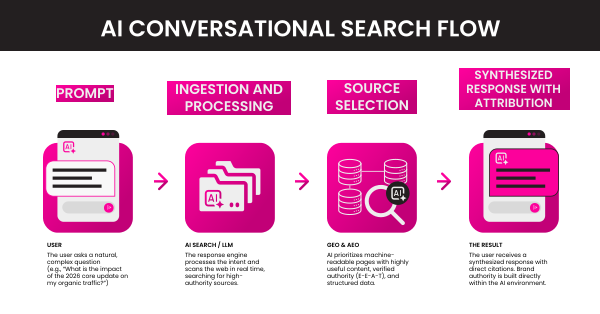 Caption: Infographic demonstrating the flow of AI-based conversational search and the importance of optimizing for GEO and AEO.
What do marketers have to gain from this change?
Despite the initial scare caused by the temporary drops in traffic that many companies experienced during the 12 days of the update, the Google Core Update (May/2026) is excellent news for strategic marketers.
By clearing the SERP of low-quality content and mass-generated spam, Google is opening up valuable space for brands that invest in real relationships and thematic authority. Some of the biggest competitive advantages to be gained include:
- Increased quality of leads: Users who arrive at your site through in-depth, highly useful content have a greater intention to engage and convert.
- Building brand authority: Instead of competing for thousands of irrelevant secondary terms, your company becomes recognized by artificial intelligences as a top reference in the topics it masters.
- Efficient content investment: Fewer high-quality pages generate more results than hundreds of shallow texts. The focus shifts to data intelligence and surgical SEO updates.
- Alignment with Generation Z: Younger audiences prioritize authenticity, speed and dynamic response formats. Aligning your SEO with Search Everywhere Optimization you position your brand where searches actually occur, whether on Google, TikTok or social networks.
For this to work perfectly, it is essential that professionals use modern monitoring tools and a good on-page SEO checklist to ensure that the entire technical structure of the site is impeccable for traditional and AI search crawlers.
How to audit and recover your site's traffic after the update?
If you've noticed negative fluctuations in your traffic after June 2, 2026, the first step is not to panic. Changing the entire structure of your site in the heat of the moment can make it difficult to diagnose correctly.
The best approach is to focus on an analytical and structured audit, following fundamental steps for the recovery and consolidation of your organic channel:
- Wait for the dust to settle: Wait a few days after the official conclusion to analyze the consolidated Google Search Console data. Daily comparisons during the rollout tend to be inaccurate.
- Map the affected pages: Identify exactly which URLs lost positions and which queries suffered a drop in impressions.
- Evaluate the depth of the content: Compare your text with competitors who have gained positions. Is your content really the best and most useful for solving the searcher's query?
- Reinforce experience and authorship: Add real biographies of experts to your publications, cite reliable external sources and add data or research exclusive to your company.
- Eliminate or consolidate superficial content: Old, short or no longer useful pages should be consolidated into more robust guides or redirected strategically to avoid diluting your domain's authority.
By following this method of refinement, you turn what seemed like a temporary loss into a precise diagnosis to guide the sustainable growth of your content strategy.
Frequently asked questions about Google Core Update (May/2026)
Does the Google Core Update (May/2026) penalize sites that use artificial intelligence?
No. Google assesses the quality of content independently of the technology used to create it.
According to Google's guidelines for AI-generated content automation is allowed. However, the final material must be useful, original and user-focused. The algorithm only punishes automated mass production designed to manipulate rankings.
What is the difference between traditional SEO, GEO and AEO?
Each methodology caters for a different type of web discovery:
- Traditional SEO: Focuses on ranking pages in the blue link list through keywords, domain and backlinks.
- AEO (Answer Engine Optimization): Aims to structure direct answers and data for voice assistants and quick response boxes.
- GEO (Generative Engine Optimization): Adapts the site so that the brand is recommended and cited by generative intelligences such as ChatGPT and Gemini.
How long does it take for a website to recover from a negative Core Update swing?
Generally, the corrections applied can take a few months until the next major algorithm update to take effect.
However, the pace of Google's updates in 2026 is more dynamic. If the quality improvements in content are profound, recovery could happen in less time.
How do I prepare my site for artificial intelligence indexers?
The technical focus should be on machine readability. Ensure that LLM crawlers can consume your data optimally:
- Structured Data: Implement full Schema markup (such as FAQPage and Article).
- Content Structure: Write headings based on real questions and direct answers right at the beginning of the section.
- Crawler accessibility: Organize your main content in Markdown format and make the _llms.txt file available at the root of the site.
 Caption: Google Core Update of May 2026 accelerated the integration between traditional organic results and artificial intelligence (AI).
How to move forward with digital marketing from now on?
The closure of the Google Core Update (May/2026) reinforces that the future of search belongs to brands that combine technical excellence with genuine human connections.
The focus of every SEO and content marketing professional should be to become the best possible answer to the customer's pain, integrating the facilities of automation with the detailed curation and strategic eye of industry experts.
If your company wants to successfully navigate this transition to the era of AI-based marketing, Revenue Operations (RevOps) and generative search, having the right support makes all the difference.
At mkt4edu, we have developed complete customer acquisition methodologies that combine the best of traditional marketing with cutting-edge artificial intelligence tools. Contact us today and find out how we can design a tailor-made strategy to accelerate the growth of your business.
The next step: turning quality into visibility
Understanding the impacts of the Google Core Update (May/2026) is only part of the process.
After reviewing content, strengthening E-E-A-T signals, structuring information for search engines and optimizing the user experience, a fundamental question arises: how do we ensure that all this effort generates more reach and organic results?
The very scenario presented by Google shows that creating relevant content is not enough. You need to develop a consistent strategy to expand your digital presence and gain a foothold in traditional searches and AI-driven environments.
So the next step is to understand which factors really influence your brand's positioning and exposure in search results.
In the content "How to increase visibility on Google", you'll find practical strategies to strengthen your authority, expand your organic reach and maximize your opportunities to generate organic traffic in an increasingly competitive and artificial intelligence-driven environment




























 Portugal