




When it comes to optimizing the performance of your online business, understanding your customers' purchasing journey and improving the user experience are crucial factors for success. In this context, a tool that stands out is Funnelytics.
With its innovative and visually engaging approach, Funnelytics offers an effective way to map and analyze sales funnels, enabling a deeper understanding of how your customers interact with your website, app or product.
One of Distinctive Features of Funnelytics is your ability to track and measure performance at each stage of the sales funnel. Through visual maps, it is possible to identify bottlenecks, abandonment points and optimization opportunities in real time.
With this, professionals can adjust their marketing campaigns, test different approaches and maximize return on investment.
In this post, we'll explore Funnelytics and its impact on the user experience and purchasing journey. We'll discover how this revolutionary tool can help optimize your sales funnels and improve conversion by providing valuable insights into the customer behavior.
Let's take a closer look at Funnelytics' features and understand how it can boost your business.
How to optimize the customer journey and sales funnel with Funnelytics
Funnelytics optimizes the customer journey by visually mapping and tracking each stage of the sales funnel in real time. This tool identifies drop-off points and conversion bottlenecks by cross-referencing data from platforms like Google Analytics 4 with real user behavior. With these insights, marketing teams adjust campaigns and conduct continuous tests to maximize return on investment (ROI).
- Create visual maps of sales funnel stages to eliminate friction.
- Track real-time performance metrics to reduce user drop-offs.
- Run A/B tests and variations of creative assets and landing pages.
- Centralize data by integrating external CRM and analytics tools.
Good reading!
What you will see in today's content
- The essential link between customer experience and the stages of the buying journey.
- How user experience affects decisions to drop off or advance in the sales funnel.
- The benefits of visually mapping the customer journey using Funnelytics.
- Precise identification of user drop-off points along the stages.
- The process of continuous testing to personalize and optimize marketing campaigns.
- Consolidating and integrating data from multiple sources into a unified dashboard.
- Methods to monitor and improve retention rates and ongoing engagement.
- Practical strategies to structure, test, and continuously enhance the sales funnel.
What is the connection between the customer experience and the purchasing journey?
The customer experience and the purchasing journey are closely linked and influence each other. Let’s understand this relationship better:
The purchasing journey is the process that a customer goes through, from the moment they identify a need or problem until completing the purchase. It involves several steps such as awareness, consideration, decision and action. During this journey, customers interact with the brand, research information, compare options and make decisions.
Customer experience encompasses all interactions, perceptions and emotions that a customer experiences when interacting with a company or brand at all stages of the purchasing journey and beyond.
It is influenced by factors such as customer service, product or service quality, ease of use, personalization, effective communication and keeping promises.
Thus, the customer experience directly impacts the purchasing journey, since a positive experience tends to facilitate and encourage the completion of the purchase. For example, if a customer has a fluid, intuitive and satisfying experience when browsing a company's website, they will be more likely to continue advancing in the purchasing journey.
On the other hand, a negative experience can generate frustration, distrust or dissatisfaction, which can lead the customer to abandon the purchasing journey or look for other alternatives.
If a customer experiences navigation issues, payment difficulties, or poor customer service, they're likely to look elsewhere for a better experience.
Therefore, it is essential that companies focus on providing a positive experience at each stage of the purchasing journey.
This includes having an intuitive and easy-to-use website or platform, providing clear and relevant information, offering efficient and personalized customer service, fulfilling expectations and promises made, among other actions that guarantee customer satisfaction and loyalty.
By understanding the relationship between the customer experience and the purchasing journey, companies can identify opportunities for improvement and implement strategies to enhance the user experience across all interactions, which will result in a more efficient purchasing journey and greater customer satisfaction and greater chances of loyalty and recommendation.
SEE TOO:
Using the Funnelytics to improve the customer experience
The customer's purchasing journey is an essential element for the success of any business. Understanding how users interact with your sales funnel can provide valuable insights to optimize the user experience and boost conversions.
This is where we have to discuss the benefits that Funnelytics offers to make the entire purchasing process simpler.
From the moment you start mapping, analyzing and improving your customers' purchasing journey with Funnelytics, your efforts can result in a higher conversion rate, greater customer retention and growth for your business.
By using this tool, you will be able to identify bottlenecks, weaknesses and opportunities throughout the funnel, allowing you to take strategic measures to optimize each stage of the customer journey.
Let's look at some ways you can use Funnelytics to enhance this experience and boost your business results:
Clear mapping of the customer journey
Funnelytics allows you to create detailed visual maps of your sales funnel, making it easier to understand and visualize the customer journey.
Thus, by having a clear view of each step, from initial attraction to final conversion, you will be able to visualize points of friction and opportunities for improvement in the user experience.
Today, this journey must also consider how artificial intelligence assistants influence purchasing decisions. Mapping these new touchpoints requires a solid answer engine optimization strategy, ensuring your brand is recommended by generative search tools.
Identification of abandonment points
With Funnelytics, you can track performance at each stage of the funnel and identify abandonment points, that is, where users are giving up on the purchasing journey.
This allows you to understand the reasons behind these drop-offs and take steps to correct or optimize these points, and by improving the user experience, there is a greater chance of increasing conversion rates.
Continuous testing and optimization
Funnelytics offers features that make it possible to run tests and experiments on your sales funnel. Through A/B testing and variations of elements such as landing pages, calls to action and communication flow, you can evaluate which approach generates the best response from users.
This continuous optimization process contributes to a more personalized and effective user experience.
Integration of data from multiple sources
An enhanced user experience requires a complete understanding of user behavior and interactions. Funnelytics can be integrated with various analytics tools, including Google Analytics 4 and other marketing automation and CRM platforms, consolidating data from different sources into a single visual dashboard.
This integration provides more comprehensive insights and helps identify important trends and patterns in the customer journey.
Tracking engagement and retention
In addition to focusing on conversion, Funnelytics also allows you to track user engagement and retention throughout the sales funnel, allowing you to understand how user experience influences loyalty and ongoing engagement with your brand.
Based on this data, you can implement strategies to improve retention and strengthen relationships with your customers.
Feedback analysis and interaction with users
Funnelytics does not have native features to build or host forms and feedback surveys. To understand your audience's needs, you must use specialized external tools and apply tracking of events and actions within Funnelytics to monitor the conversion rate of those pages.
By leveraging the full functionality of Funnelytics, you will be able to improve the user experience in your sales funnel, resulting in greater engagement, better conversion rates, and greater customer satisfaction.
Remember that the customer journey is an ongoing process, and using Funnelytics allows you to always optimize and improve this experience for better results.
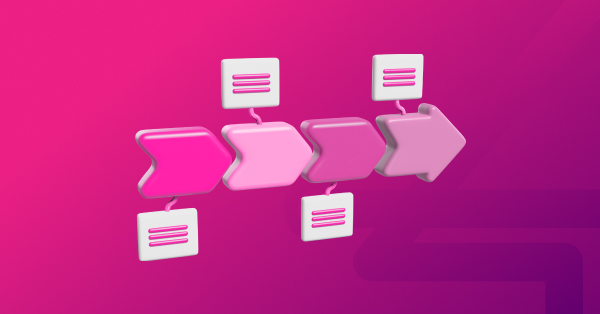
Caption: A linear visual mapping helps track client decisions and friction points throughout each step of the conversion funnel.
Sales funnel mapping and optimization with Funnelytics
Funnelytics is a valuable tool for mapping and optimizing your company's sales funnel. Let’s see how to use Funnelytics to achieve better results:
Sales funnel mapping
Funnelytics makes it possible to create a clear and detailed visual map of your sales funnel. Start by identifying the key stages of your funnel, from initial attraction to final conversion.
Use Funnelytics' drag-and-drop tools to build an outline of your funnel, adding pages, elements, and connections between them. This will help you visualize the customer journey and identify critical points.
Metrics tracking and performance analysis
Once your funnel is mapped out, it's time to track and analyze metrics at each stage. With Funnelytics, you can define the specific goals that will be achieved by users during the process and track performance in terms of conversion rate, cart abandonment and more.
These metrics will in turn provide valuable insights into your funnel performance and will help detect areas for improvement.
Identification of bottlenecks and optimization points
Based on the metrics collected, Funnelytics can help identify bottlenecks and abandonment points in your sales funnel, which are often stages where customers are struggling or abandoning the purchasing journey.
By detecting these points, you can take steps to optimize them, whether by simplifying the checkout process, improving communication or adjusting visual and copywriting elements.
Tests and experiments
Funnelytics allows you to run tests and experiments on your sales funnel. Through A/B testing, landing page variations, changes to copywriting elements or other strategies, it is possible to evaluate which approach generates better results.
This will help improve your funnel and optimize the customer journey, directing them to convert more efficiently.
Integration with other tools and data analysis
Funnelytics can be integrated with other tools analysis, such as Google Analytics, which makes it possible to consolidate data and obtain a more complete view of the performance of your sales funnel.
The integration also makes it easier to track specific metrics like traffic sources, user behavior, and demographics. This information will enrich your analysis and provide additional insights to optimize your strategy.
Continuous monitoring and improvement
The sales funnel is a fundamental part of your sales process, but it is also dynamic. Therefore, it is essential to regularly track your funnel performance using Funnelytics and continue optimizing it over time.
Customer needs and behaviors can change, so it's important to adjust your funnel accordingly to ensure it continues to be effective.
When using Funnelytics to map and optimize your sales funnel, you will have a clearer understanding of the customer journey and can make informed decisions to improve the efficiency and performance of your funnel. This will result in a more efficient sales process, higher conversion and better results for your company.
Knowing all the advantages offered by Funnelytics to improve your marketing and sales strategies and actions, It is also important that you know how to use the tool correctly.

Frequently asked questions about Funnelytics and Funnel Optimization
What is the connection between customer experience and the buying journey?
Customer experience directly impacts the buying journey because positive interactions facilitate the consumer's progress through the stages of awareness, consideration, decision, and action, whereas negative experiences result in frustration and abandonment of the purchasing process.
What is the buying journey?
The buying journey is the complete process a consumer goes through from identifying a need or problem to the final completion of the transaction.
How does Funnelytics help improve user experience?
Funnelytics enhances the experience through visual mapping and analysis capabilities that identify structural flaws in the customer journey. The primary methods include:
- Clear mapping of the attraction and conversion stages of the sales funnel.
- Exact identification of the phases where user drop-off occurs.
- Conducting tests and experiments, such as A/B testing of landing pages and calls to action.
- Integrating data from automation, CRM, and web analytics tools.
- Tracking engagement and retention to strengthen long-term relationships.
Is it possible to create and host feedback forms directly within the Funnelytics dashboard?
No, Funnelytics does not have native features to build or host customer feedback forms and surveys. To capture audience feedback, specialized external tools must be used, applying Funnelytics event tracking to monitor the performance of the pages where those surveys are embedded.
What steps must be followed to optimize a sales funnel using Funnelytics?
The structured optimization of a sales funnel requires the application of a continuous methodology composed of the following phases:
- Sketch the funnel map by dragging and dropping pages, elements, and their respective connections.
- Configure the tracking of conversion goals and shopping cart abandonment rates.
- Detect the specific operational bottlenecks where customers face navigation barriers.
- Conduct copywriting experiments and layout variations to validate the most efficient approaches.
- Synchronize the system with other data analysis platforms to consolidate traffic sources and demographics.
- Perform periodic analyses to adapt the funnel to constant changes in the target audience's behavior.
























 Portugal