





Every educational institution already posts on social media. The question that goes unanswered is a different one: how much of that became an application.
Social media marketing delivers reach and conversation easily, and that is exactly where operations tend to stall. The candidate comments, sends a message, asks about cut-off scores and never reaches the form.
This article handles both halves of the problem. The first is content and media, the second is process: who responds, how fast and where that conversation is recorded.
What is social media marketing for educational institutions?
Social media marketing is the use of social platforms to build audience, generate conversation and move a candidate to a measurable next step. In education, that next step has a name and a deadline: applying to the admissions process, inside a calendar window that does not repeat.
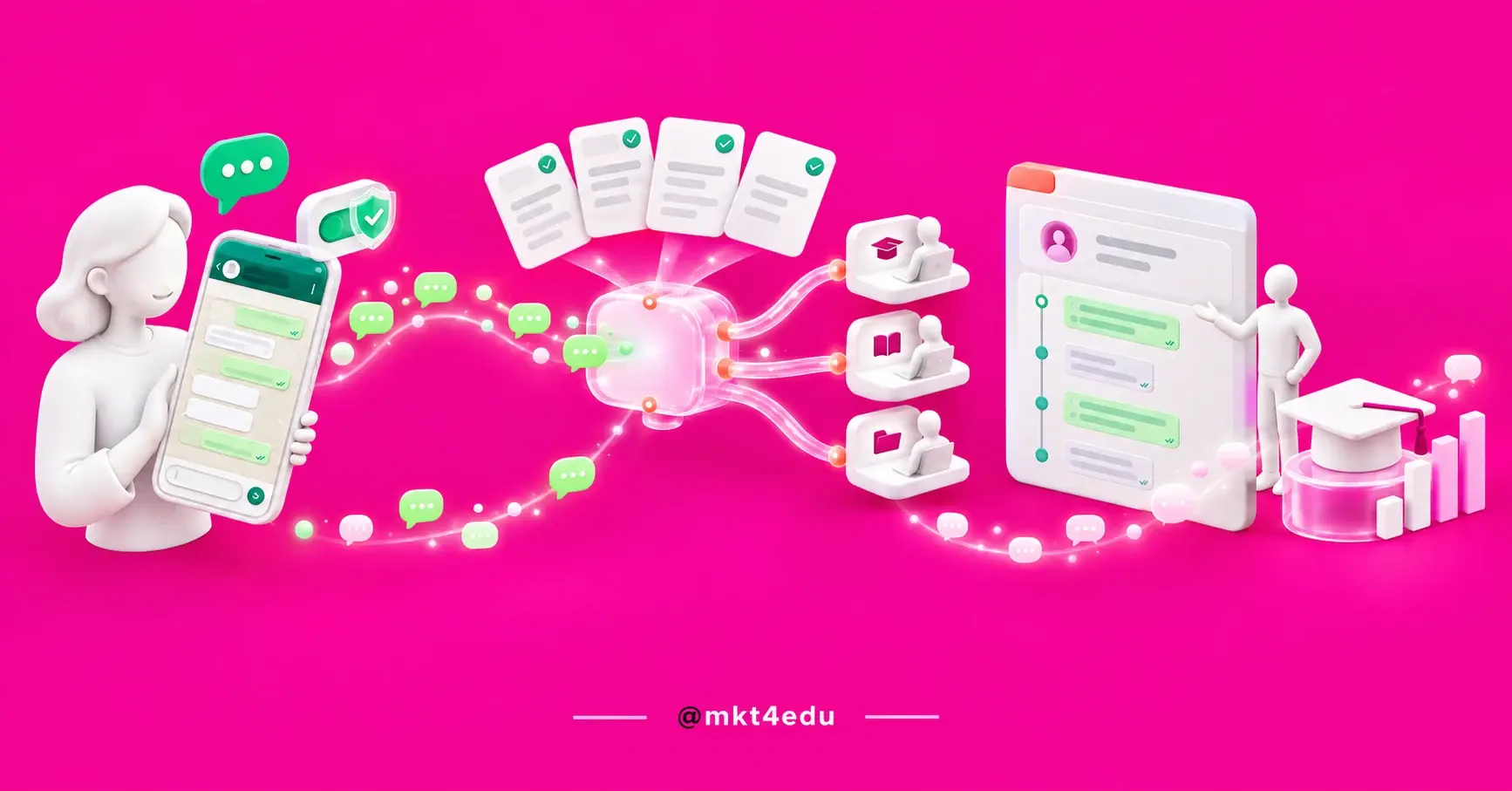
 Caption: The post creates attention, support carries the conversation and the CRM shows how much the student who came from each social network actually cost.
That calendar constraint changes everything. A retail brand can recover a lost sale the following week, an institution loses the candidate for a whole cycle.
The product is different too. A degree is a multi-year decision, involving family and price comparison, so social media rarely closes the enrollment on its own.
Its role is to shorten the distance between interest and conversation. Institutions that treat social media as a showcase collect followers, and those that treat it as a front door collect applications.
The market justifies the care. Brazil has 10.2 million undergraduate enrollments, according to the 16th Higher Education Map from Instituto Semesp, and the competition for each of those seats plays out in the same feeds.
Where are the students your university wants to reach?
Brazil has 150 million active social media user identities, equal to 70.4% of the population, and 185 million internet users. The figures come from the Digital 2026: Brazil report by DataReportal, based on October 2025 data.
Platform distribution helps decide where to put budget and where to put people:
|
Platform |
Reach in Brazil |
Role in acquisition |
|
YouTube |
150 million |
Long-form program and career content |
|
|
147 million |
Social proof and direct message conversation |
|
TikTok |
131 million adults |
Discovery and low-cost reach |
|
|
109 million |
Adult audience and bill payers |
Table: Advertising reach per platform in Brazil in October 2025, according to DataReportal.
Facebook deserves a note that admissions campaigns usually ignore. It lost the young candidate, but it remains strong among parents and bill payers, who take part in the enrollment decision.
X, formerly Twitter, has moved out of the center of educational acquisition in Brazil. Keeping a profile there is an institutional positioning choice, not a lead volume play.
The practical conclusion is that channel choice is not settled by team preference. It is settled by looking at who decides the enrollment for that program and which platform that person uses.
A recent Instagram change extends that social proof with no extra work. Since September 2026, users can add a post they are tagged in straight to their profile grid, without reposting it. That works well for graduation photos, event shots or student ambassador content showing up on the university’s official feed, credited to whoever took the picture.
Do memes and short video still work in social media marketing?
Yes, and they remain the lowest cost per reach format in social media marketing. Memes work because they communicate attitude and situation in a second, and the admissions season produces fresh material every week, which gives institutions free raw content.
What changed is the speed requirement. A meme used three days after the moment dies in the feed, so the approval process has to fit into hours.
Short video expanded the reach of that repertoire. Reels and TikTok videos deliver institutional content to people who do not follow the institution, which is the only cheap way to grow audience today.
There is a line worth respecting. Humor about low scores, financial hardship or missing a cut-off score builds reach and destroys trust, because it mocks the very pain of the person you want to enroll.
Formats that hold the brand better share a pattern: real student talking about the program, faculty answering candidate questions and behind-the-scenes footage of labs or internships. Engagement is lower than a meme, but the intent of who arrives is far higher.
The rule that resolves the tension is simple: memes for reach, student and faculty content for conversion. Social media and inbound marketing strategies deliver more when both live on the same calendar.
How does targeted advertising improve student acquisition strategies?
Targeted advertising is the ad delivered to an audience defined by criteria such as age, region, education level and behavior, instead of an open audience. In student acquisition strategies, it cuts wasted budget and raises conversion, because it speaks to people at the right age and the right decision moment.
The gain shows up first in cost. An admissions ad served to someone who already holds a degree burns budget with no chance of return.
Regional targeting is the most underrated for on-campus institutions. Commuting distance defines enrollment far more than a declared interest in the program.
Platforms shifted the axis of control in recent years. Instead of refining audiences manually, the advertiser feeds conversion signals and lets the algorithm search, which is the logic behind broad automated campaign types.
That shift makes signal quality more important than clever segmentation. If the conversion event you send is “form submitted” rather than “enrollment completed”, the algorithm will optimize for a pile of poor leads.
Cost per acquisition control depends on the same discipline. Setting an investment ceiling per program and tracking the real cost per enrollment prevents the scenario where the campaign quietly blows past the institution's target during the peak.
Can you boost an Instagram Live for an admissions campaign?
Yes, once the option is live on the account. Instagram now lets you turn a live broadcast into an ad directly from the Live composer, before or during the stream, to reach people beyond the institution's existing followers.
For a university, the clearest use case is a live Q&A with a program coordinator, an admissions help-desk session during the enrollment window, or a guided campus tour — formats already part of the recruiting routine that gain extra reach once boosted.
Keep this separate from the "Live Video Ads" product Meta announced in June 2026, which depends on a closed group of live-commerce platforms and hasn't reached most markets. Boosting a Live is a simple in-app button, with no outside partner involved.
Brazil is now confirmed among the countries where the option is live: Instagram's own Help Center documents the feature, and Brazilian trade press (Mobile Time, E-Commerce Brasil and other industry outlets) reported tests with Brazilian businesses in beauty, home and retail showing a median 3.3x return. Eligibility is a public, business or creator account with 1,000+ followers and a payment method on file. The minimum budget has now been confirmed: US$100, per a Meta study cited by Brazilian trade outlets (Central do Varejo, Janela Publicitária and Academia Brasileira de Marketing, reported between September 29 and October 1, 2026).
Once the option appears, Instagram recommends scheduling the boost at least two hours ahead of going live, to cut down on delivery delay once the stream starts.
Are micro-influencers worth it in an admissions campaign?
Micro-influencers usually deliver more result per unit of spend than large profiles in admissions campaigns. The reason is proximity: smaller, local audiences trust recommendations more, and the enrollment decision is heavily influenced by someone who has lived that program.
The best cast is rarely outside the institution. Alumni employed in the field, senior students and faculty with a digital presence carry authority no media contract can buy.
This format also solves a cost problem. A campaign with ten local profiles costs less than one insertion with a national influencer and covers exactly the cities the enrollments come from.
It is worth defining what each profile will say. A generic testimonial about a “great university” moves nobody, while a concrete account of an internship, a lab or a first job answers the candidate's real question.
One compliance note closes the topic. Advertising has to be identified as such, and a paid testimonial presented as spontaneous opinion exposes the institution for no good reason.
One feature makes this strategy easier to run without extra work: Instagram’s Collab tool publishes the post as a joint post with the alumnus’s, faculty member’s or ambassador’s own profile, and it shows up on both feeds at once, combining likes and comments instead of splitting reach across two separate posts.
A study by Emplifi covering more than 520,000 brand posts in the first half of 2026 found that posts published by the creator, as a Collab, reach noticeably more audience than posts without collaboration. The data comes from retail and e-commerce, not education, so it works as a direction rather than a promise of the same number in an admissions campaign, but the mechanic, using Collab instead of just tagging or asking for a repost, applies across sectors.
How do you move a follower from social media to the enrollment system?
The path from a post to the enrollment system needs the smallest possible number of steps. Every intermediate screen, every extra form field and every login requirement drops a share of candidates who had already decided to apply.
The first fix is the destination. A link that drops the candidate on the site's homepage transfers to them the work of finding the program, and many give up there.
The second is the form. Name, phone, email and program of interest are enough to start the conversation, and the rest of the data can be collected later, during support.
The third is the question channel. Many people do not apply because they have a pending question about price, cut-off score or documents, and that is where a fast messaging channel resolves more than any FAQ page.
There is a common trap in this design. Optimizing everything for form volume fills the funnel with low-intent contacts, and the problem moves rather than disappears. It is worth calibrating the qualification bar so that generating leads with AI does not simply inflate volume.
What does an AI SDR agent solve during the admissions peak?
An AI SDR agent answers a candidate's first contact in seconds, qualifies interest and either books or routes the case to a person. During the admissions peak, it solves the bottleneck no campaign can solve: the volume of conversation arriving outside business hours and on weekends.
The problem it attacks is familiar to anyone running admissions. A lead answered within minutes is far more likely to advance than the same lead answered the next day, and the campaign peak is exactly when the team cannot keep up.
Its job is triage, not selling. It confirms program of interest, delivery mode, shift and the candidate's situation, then hands that context to a human advisor.
The agent also standardizes information. Questions about price, documents and deadlines start receiving the same correct answer, regardless of who was on shift.
Integration is what decides the outcome. An agent that converses well and records nothing in the CRM only moves the problem, so choosing among AI-powered SDR tools should start from how they write back to your CRM.
There is also a limit worth stating plainly. Sensitive conversations, scholarship negotiations and undecided families need a person, so the design has to plan the handoff instead of insisting on automation.
Why does a CRM for student acquisition close the campaign's books?
A CRM for student acquisition is where the result of social media marketing stops being an estimate. It records the origin of every contact, tracks progress to enrollment and lets you state how much the student who came from Instagram, TikTok or paid traffic actually cost.
Without that record, the budget discussion becomes a contest of opinions. Each department presents the figure that favors it, and nobody can prove what generated enrollment.
The same repository serves the next stage. Using a CRM for educational management after enrollment allows tracking of attendance, payment status and satisfaction, which are the retention signals.
That continuity is what separates a campaign from an operation. Acquiring well and losing the student in the second term hands the problem back to marketing in the following campaign, at a higher cost.
Two cautions close the subject. The first is the legal basis for processing candidate data, and the second is recording discipline, because a half-filled CRM produces reports nobody trusts.
Teams designing this for the first time usually save time by structuring the funnel before choosing the tool, which sits at the center of educational marketing strategies for colleges.
Frequently asked questions about social media marketing
What changes when social media marketing becomes a process?
When social media marketing stops being a posting calendar and becomes a process, three things move. The campaign gains an enrollment target, support stops being the bottleneck during the peak, and budget starts being decided by real cost per student.
Content still matters, and memes still deliver cheap reach. The difference is that they stop being the end of the line and become the entry to a path that ends at the enrollment system.
None of this requires rebuilding the operation at once. Picking one program, measuring its cost per enrollment by channel for one cycle and correcting from there already changes the internal conversation about budget.
If you want to design that path around your admissions calendar and your campaign figures, talk to our team.



.jpg)






















 Portugal