






Every institution celebrates when the recruitment funnel fills up, but few notice that the open drain on the other side sends much of that effort straight back out the door.
Student retention is precisely the tap that closes that drain and, in education marketing, it almost always gets less attention, less budget and fewer people than recruitment.
The reason is psychological before it is financial. A new enrollment is visible, something to celebrate in a meeting. A student who stayed shows up in no victory report, even though keeping them cost far less than replacing them would.
That asymmetry of perception hides where the institution's cheapest money actually is.
Throughout this text, you will see the numbers comparing recruiting and retaining, how to calculate the ROI of retention and a practical path to turning persistence into policy rather than hope.
What is student retention and why does it sustain cash flow?
Student retention is the set of practices that keeps a student enrolled and engaged through to completing their course, semester after semester. It measures how many students stay relative to those who might drop out.
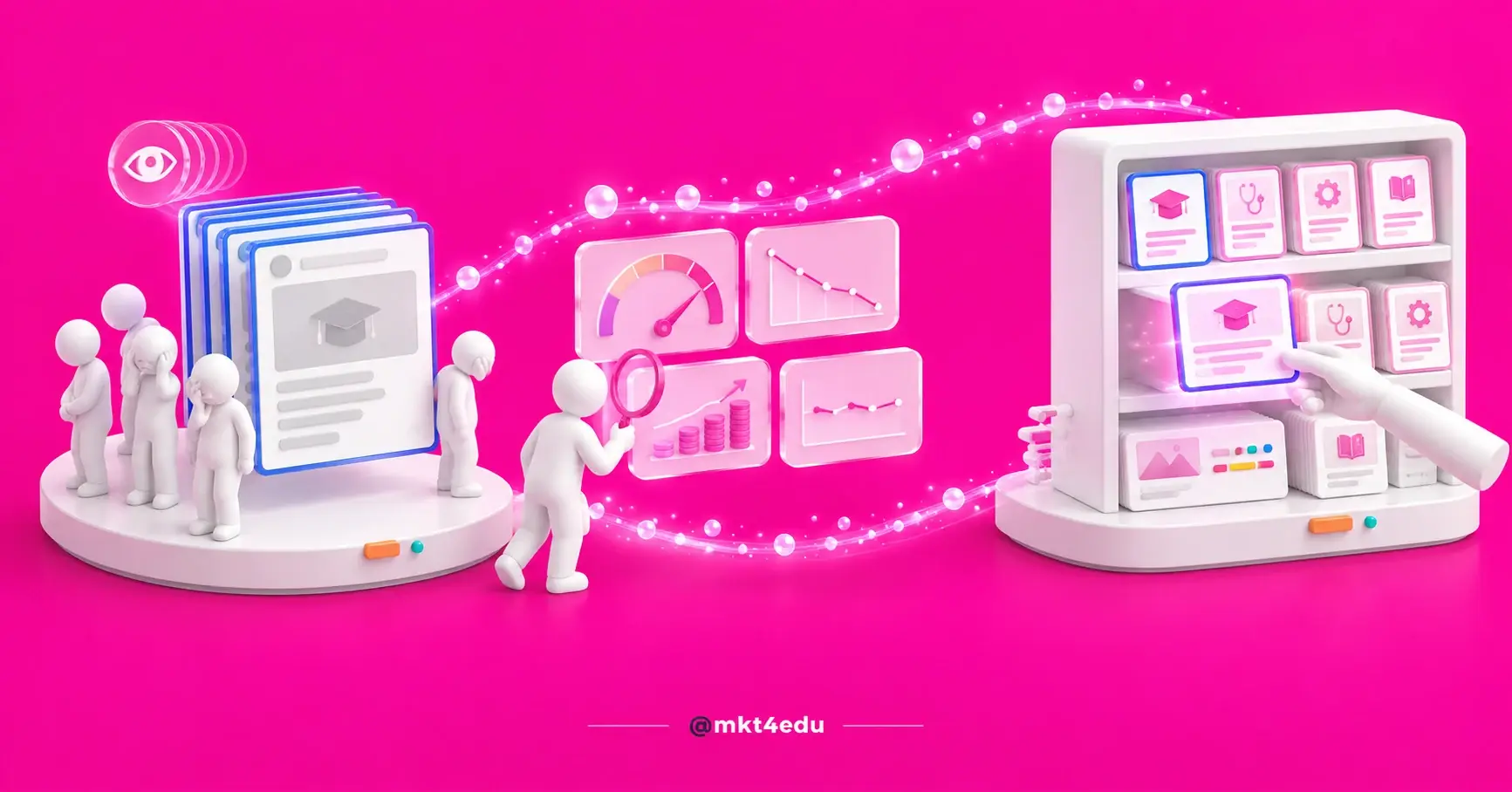
 Caption: student retention seals the hole in the funnel and costs less than replacing each lost enrollment.
It is the foundation of any institution's financial health, because it protects revenue that has already been won.
It is worth separating three terms often treated as synonyms. Persistence is the student staying enrolled in the next cycle. Retention is the aggregate result of that persistence over time.
Loyalty goes further: it is the bond that brings the graduate back for a postgraduate program, refers friends or defends the brand. Persistence secures the present of the cash flow; loyalty widens the future.
Retention matters because every student who stays represents predictable tuition, with no new acquisition cost. It is recurring revenue that funds operations and gives the budget predictability.
When dropout rises, the institution has to recruit more just to stand still. It is like rowing against the current: a lot of effort, little net progress. Retaining is what allows recruitment to mean real growth rather than replacement.
Does retaining cost less than recruiting? What the numbers show
Yes, retaining costs far less than recruiting. As Harvard Business Review points out, winning a new customer tends to be much more expensive than keeping a current one.
In education, recruitment cost involves media, a sales team, scholarships and entry discounts that retention simply does not repeat.
Think about the anatomy of a new enrollment. There is investment in ads, content production, tools, commissions and, often, an aggressive first-semester discount to beat the competition. All of that before the first full tuition payment comes in.
Retaining an already enrolled student skips nearly that whole chain. The relationship exists, the record is in the CRM and the academic bond is already built. The cost becomes one of follow-up and care, not of conquest.
There is a second data point that reinforces the argument. According to HubSpot, the probability of selling to an existing customer sits between 60% and 70%, against 5% to 20% for a new one.
Applied to education, that means offering a graduate program to a soon-to-be graduate is far more efficient than chasing a stranger at the top of the funnel.
To see where the money concentrates, here is how the two sides compare:
|
Factor |
Recruiting a new student |
Retaining a current student |
|
Relative cost |
High (media, commission, discount) |
Low (follow-up and care) |
|
Relationship |
Has to be built from scratch |
Already exists |
|
Conversion probability |
Lower, cold funnel |
Higher, active bond |
|
Revenue predictability |
Uncertain until enrollment |
Recurring each semester |
|
Referral effect |
None yet |
Generates word of mouth and reputation |
Table: Comparison between the effort of winning a new enrollment and that of preserving an existing one.
The point is not to abandon recruitment, it is to see that every lost student forces you to pay the most expensive price of the cycle all over again.
The best education marketing strategies balance both sides: they fill the funnel and, at the same time, hold on to those who already came in. Closing the dropout drain is what makes investment in data-driven student recruitment truly pay off.
How do you calculate the ROI of student retention?
The ROI of retention compares what you invest in keeping students against the revenue that persistence preserves and generates. The base formula is the financial gain from retention minus the cost of the program, divided by that cost.
The return is significant because the protected revenue is recurring and the investment is lean.
Start with revenue at risk, multiplying the number of students likely to drop out by average tuition and by the months remaining in the course. That is the amount the institution loses if nothing is done.
Then estimate how many of those students a retention program manages to preserve. If a follow-up effort saves part of them, add up the tuition of the students who kept paying. That is the gross gain of the action.
Finally, subtract the program's cost: people, technology, communication. What is left, divided by the cost, is your ROI. Since retaining is cheap and the saved revenue is recurring, the return tends to comfortably beat that of equivalent recruitment.
There is also the compounding effect, hard to ignore. The classic figure attributed to Frederick Reichheld, of Bain & Company, and reported by Harvard Business Review, suggests that increasing retention by 5% can lift profit between 25% and 95%.
It is a wide range, varying by sector, but the direction is unambiguous, since small gains in persistence move results a great deal.
That calculation gets more reliable when the data sits in one place. A Revenue Operations setup integrates marketing, sales and academics so that retained revenue is measured with the same rigor as recruited revenue.
What is student lifetime value and how does it change the math?
Student lifetime value, or LTV, is all the revenue a student generates while they have a relationship with the institution, from the first semester to the last repurchase.
It changes the math because it shifts the view from the isolated enrollment to the total value of the relationship, which retention directly extends.
Without thinking in LTV, the institution sees the student as a one-off sale. With LTV, it sees a journey: the degree, a possible second qualification, a graduate program, short courses and referrals. Every additional year of persistence raises that number.
The simple calculation is average tuition multiplied by time enrolled, plus future repurchases. A student who stays four years is worth far more than two students who drop out in the second semester, even if recruiting both cost the same.
This is where retention and loyalty meet finance. When LTV grows, the institution can invest more in recruitment without losing margin, because every student won pays for themselves many times over. Retention is what stretches that horizon.
Raising LTV depends on a good experience at every touchpoint. Artificial intelligence tools applied to relationships help personalize the journey at scale, which sustains persistence and opens room for new offers to the same student.
How do you build a student retention program?
A student retention program is a continuous structure that identifies dropout risk, acts on it and measures results.
It combines data, people and communication to turn persistence into a process rather than luck, and it is one of the education marketing fronts that most protects revenue. Ideally it runs all year, not only at re-enrollment time.
The first step is defining the metric and the target. Choose a retention rate by period and by course, establish the current baseline and a realistic improvement target. Without a number, there is no management.
Then map the moments of risk. The start of the first semester, exam weeks, tight financial periods and the re-enrollment window concentrate most of the exits. Each one calls for a specific action.
Next, define the triggers and the responses. Falling attendance, declining grades or late payment should set off a human or automated contact. Here is how a program is organized in practice:
- Diagnosis: measure the current retention rate by course, class and semester.
- Risk segmentation: classify students as low, medium or high dropout risk.
- Actions by segment: tutoring, financial negotiation, academic mentoring or reinforcing belonging.
- Contact channels: combine human service and automation across WhatsApp, email and phone.
- Measurement: track retention saved, cost per retained student and program ROI.
Scale comes from automation. A chatbot dedicated to retention keeps constant contact with the student, answers financial and academic questions instantly and flags for the human team the cases needing personal attention.
Automation and human care do not compete. Automated service covers volume and speed; a person steps in where there is emotion, negotiation or a delicate situation.
A service agent on WhatsApp can be the first line of that contact, filtering what requires a human touch.
What signals predict dropout before the student leaves?
Dropout signals appear weeks or months before the formal exit. Falling attendance, declining grades, late payments, going quiet on communication channels and recurring complaints are the main ones.
Reading them in time is what separates reactive retention from preventive retention, which is far cheaper and more effective.
The common mistake is acting only when the student asks to withdraw. By then the decision has matured and reversing it costs much more. Efficient retention lives in the earlier stage, when the discomfort is still reversible.
Attendance is the most sensitive indicator. A student who starts missing classes rarely drops out overnight; they drift away gradually. Monitoring attendance by subject anticipates a good share of the exits.
The financial signal calls for tact. A late payment usually indicates a momentary difficulty, not disinterest. A negotiation approach at the right time, with real options, resolves cases that became dropouts purely for lack of contact.
Reading all those signals manually is unfeasible at scale. Data models that cross attendance, performance and financial history can predict individual risk and prioritize who needs attention.
Connecting that intelligence to the CRM, as in integrations such as AI with HubSpot, turns the alert into organized action before the student decides to leave.
Still have questions about student retention?
Is it worth prioritizing student retention now?
It is, and it is probably the highest-return decision available at your institution today. Student retention costs less than recruitment, protects recurring revenue and multiplies the lifetime value of every enrollment.
While recruitment competes for attention across the entire market, retention works with people who have already chosen you.
What most institutions lack is not willingness, it is structure: organized data, monitored signals and a routine that acts before the student decides to leave. Building that is faster and cheaper than most managers imagine.
At mkt4edu, that is exactly the work we set up. As education marketing specialists, we combine strategy, data and automation to reduce dropout and turn persistence into measurable results, with recruitment and retention pulling in the same direction.
If you want to stop paying the expensive price of an enrollment twice, this is the moment to act. Talk to our team and we will design a retention program tailored to your institution's reality.

























 Portugal