






For the first time on record, distance learning overtook on-campus education in Brazil and reached 50.7% of enrollments, according to the 16th Higher Education Map from Instituto Semesp. The figure changes the size of the game, but it does not solve the problem of anyone who has to fill a class.
Online student recruitment got more competitive precisely because the market grew. With no geographic barrier, the same person receives ads from dozens of institutions in the same week.
The result is that winning that contest is no longer a matter of spending more on ads. It now depends on search presence, response speed and a process that follows the applicant through to the first tuition payment.
What changes in online student recruitment compared to on-campus?
Online student recruitment changes in three structural ways: the competitive radius stops being the city and becomes the country, the average ticket tends to be lower in mkt4edu's experience, and the decision happens in days, not months. That demands volume, fast responses and automation to keep cost per enrollment viable.
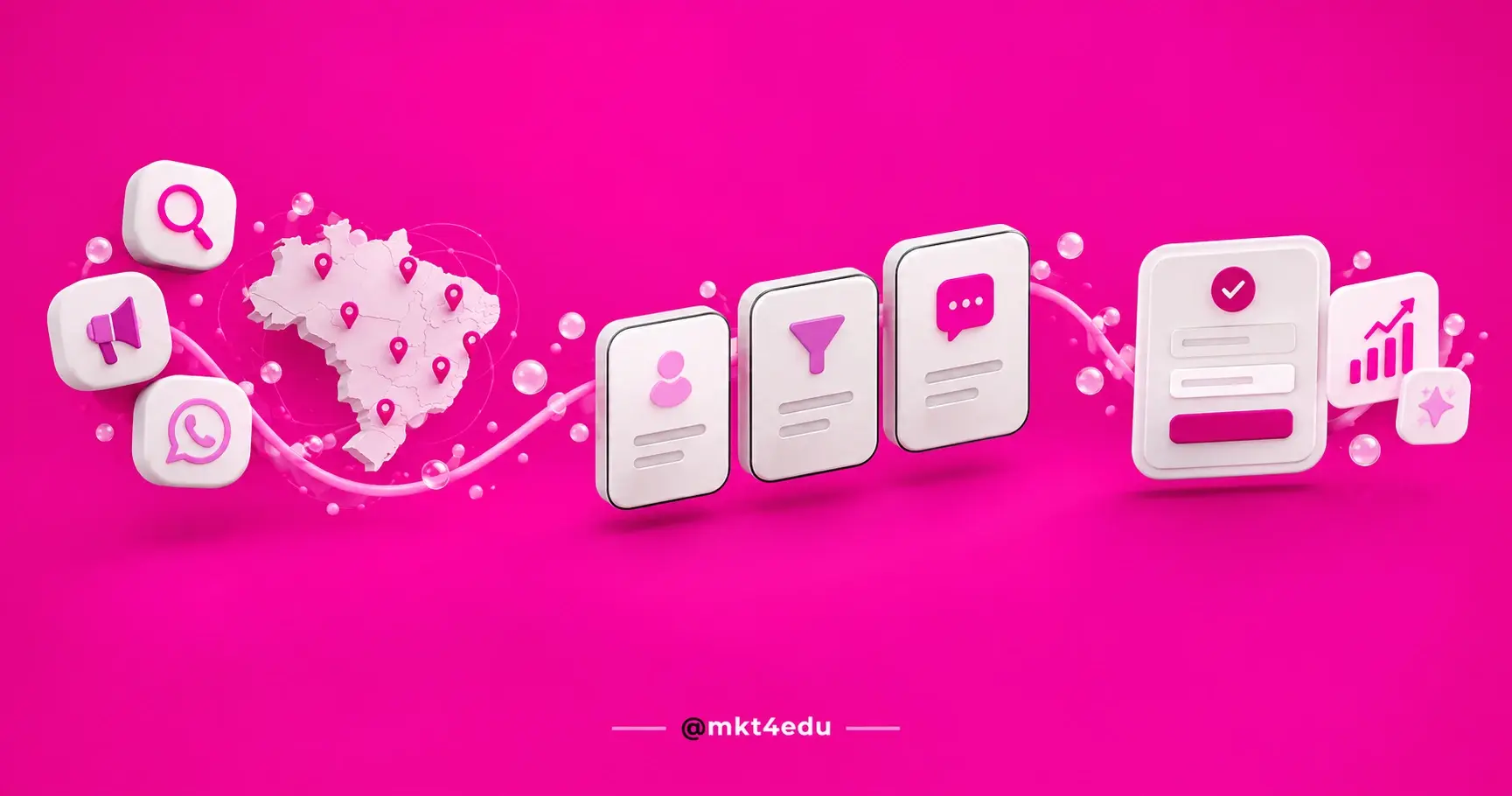
 Caption: online student recruitment competes for applicants nationwide and depends on search, paid media and fast responses through to enrollment
On campus, the distance to the building filters competition naturally. In distance learning that filter does not exist, and the applicant compares price, institutional reputation and ease of entry across a few browser tabs open at the same time.
The lower ticket has a direct consequence for the budget. When tuition for a distance program is a fraction of the on-campus one, the acceptable cost per enrollment falls in the same proportion.
That is why successful distance operations rarely depend on a single expensive channel. They combine organic traffic, paid media and their own database to dilute the average cost and sustain volume across the year.
Speed also matters. An applicant who fills out a form at 9pm and gets contacted two days later has already applied to another institution, because distance learning admissions are usually immediate.
There is also a profile difference that changes the message. The Higher Education Census published by Inep details the profile of distance learners, concentrated among working adults who decide by weighing routine, cost and time to completion.
The adult profile shifts the central argument of the communication. Campus facilities and student life weigh little in that decision, while schedule flexibility, entry route and diploma recognition weigh a lot.
Which channels sustain recruitment for online programs?
Digital marketing for online student recruitment rests on four fronts: organic search, paid media, content and conversational channels. Search and content build owned volume over time, while paid media and WhatsApp deliver immediate responses inside the application cycle and sustain the enrollment peak.
Organic search is usually the most underrated channel in distance learning. Someone searching for “online degree” or a specific program name is already in the comparison stage, and the program page is what should receive that visit, which is the job of the SEO practice.
For institutions with hubs, local SEO applied to colleges resolves an important part of that contest, because it places each unit on its own city's map.
Within digital marketing for online recruitment, paid media has another job: filling the calendar. In a recruitment campaign, it responds within the same cycle and allows course correction when a program is below its application target.
Conversational channels, in turn, decide the enrollment. WhatsApp applied to student recruitment shortens the time between interest and application, provided someone or some flow is on the other side answering quickly.
Here is how the roles break down across channels:
|
Channel |
Role in the funnel |
Response time |
|
Organic search |
Owned volume and comparison |
3 to 6 months |
|
Paid media |
Filling the calendar |
Same cycle |
|
Content and email |
Nurturing the undecided |
Weeks |
|
WhatsApp and service |
Closing the enrollment |
Minutes |
Table: How roles are distributed across channels in a recruitment operation for distance programs.
None of these fronts works in isolation. Paid media gets expensive when there is no organic base, and content takes too long when there is no budget sustaining the application peak.
How do you promote online programs by hub and by region?
Promoting online programs by hub requires treating each unit as its own market. That means a specific page per hub, campaigns segmented by the real service radius and budget distributed according to local demand, rather than split evenly across all units.
The most common mistake is running a single national campaign for an operation that, in practice, serves specific neighborhoods and cities. The result shows up as a cheap lead in the report and an enrollment that never happens.
Public data helps prioritize before spending. The Higher Education Census published by Inep allows comparing supply and demand by region before opening or reinforcing a hub.
In practice, budget distribution changes when the institution looks at enrollments per hub instead of leads per hub. Units with less volume but high conversion usually deserve more investment than they appear to.
The message also changes from one region to another. A program that sells on employability in a city with installed industry needs a different argument in a city where that same sector does not hire.
Hubs with local staff call for extra care in routing. When the lead lands in a single central queue and only later goes back to the unit, the applicant waits twice and the chance of a fast response is lost along the way.
Among the educational marketing strategies applied to hubs, the cheapest one is usually the most forgotten: keeping address, phone and opening hours correct for each unit, so local search finds the right institution.
How do you improve lead generation for educational institutions?
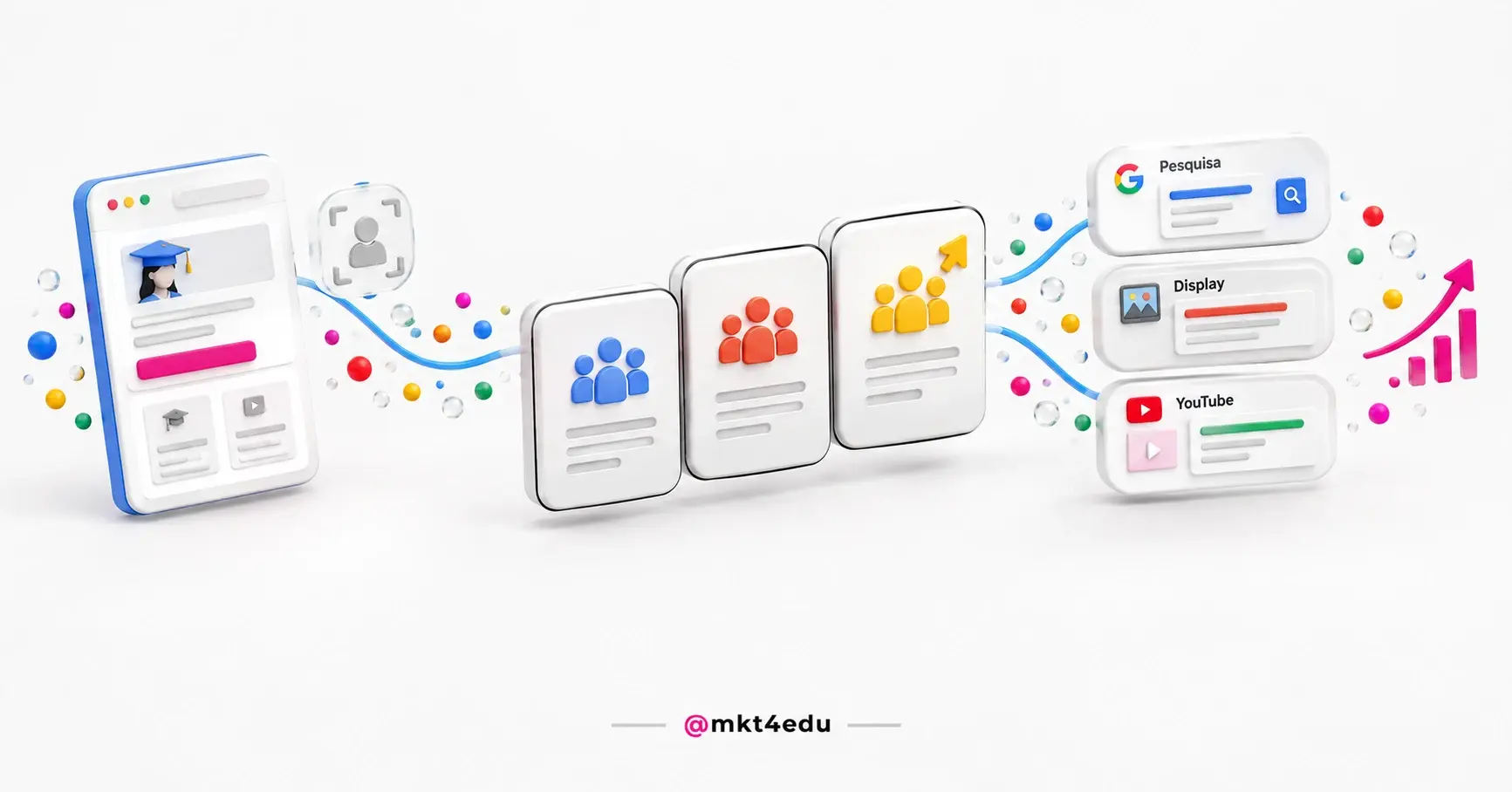
Lead generation for educational institutions improves when the form asks for the bare minimum and the rest of the information is gathered in conversation. Too many fields in the first interaction sink the page's conversion, especially on mobile, where most distance learning applicants come from.
Name, phone and program of interest are enough to start the conversation. Income, schedule preference and entry route can be asked later, by whoever is already in contact with the applicant.
The second lever is the lead's origin. A form filled from a complete program page generates a more qualified contact than the same form fed by a generic “go to college” ad.
The quality of the origin is where student recruitment and retention start to connect, because an applicant who understood the program before applying is less likely to drop out in the first weeks of class.
Lead generation strategies applied to recruitment and retention, on mkt4edu's channel.
The third lever is response time. Operations that reply in minutes convert more than operations that reply in hours, and that difference usually outweighs any gain from ad optimization.
How do you increase online enrollment conversion after the application?
Online enrollment conversion increases when there is a communication sequence covering the gap between application and payment. That stretch loses the most applicants in distance learning, because applying is free, immediate and done at several institutions at once.
Applying is not enrolling. Until the invoice is paid and the paperwork is uploaded, the applicant is still comparing other options.
The sequence has to anticipate the real objections at this stage: questions about payment methods, paperwork, diploma recognition and how classes run. A well-built communication sequence resolves most of them without depending on a phone call.
The channel matters as much as the message. WhatsApp applied to distance learning campaigns tends to have far higher read rates than email at this final stage, especially among working adults.
None of this works without logging. If the conversation happens on an agent's phone and never enters the CRM that sustains recruitment, the institution loses the history and repeats the approach with someone who already answered.
The cadence of that sequence matters as much as the content. Contact on the same day as the application, a paperwork reminder in two days and a follow-up before the deadline cover most drop-offs caused by forgetfulness.
It is worth separating whoever stopped over a question from whoever stopped over money. The first situation is resolved with information, while the second depends on a scholarship, financing or payment terms, and requires a different route.
What does the new distance learning framework change in educational marketing strategies?
Brazil's new distance learning framework reorganized the in-person, blended and distance modalities. Decree 12,456/2025 determines, in article 8, that undergraduate Law, Medicine, Nursing, Dentistry and Psychology be offered exclusively in person. That forces a review of program pages, ads and sales talk.
The change affects educational marketing strategies in two concrete, immediate ways. The first is the modality name in each piece of communication, which has to reflect the program's real design after the reorganization.
The second is the promise. A program that now requires a minimum of in-person hours cannot be advertised as fully online, even if the old curriculum allowed that reading.
The rules and deadlines are consolidated in the guidance material on the new distance learning framework published by ABMES, which gathers the decree and the corresponding ordinances.
Reviewing this early avoids expensive rework. An approved campaign, printed material and an indexed page all cost more to fix later than to adjust before the cycle starts.
How do you measure recruitment cost and student retention in distance learning?
Measuring recruitment and retention in distance learning has to go beyond cost per lead. The indicator that supports decisions is cost per enrollment, cross-referenced with how long the student stays, because a cheap enrollment that drops out in the first term costs more than an expensive one that graduates.
Dropout in distance learning is the figure that most undoes an optimistic recruitment analysis. The 16th Higher Education Map from Instituto Semesp records 41.6% total dropout in the modality in 2024, against 24.8% on campus.
With that gap, looking only at enrollment volume gives a wrong reading of the result. Student retention has to enter the same dashboard as recruitment, not a separate report from the academic team.
Three indicators are usually enough to start: cost per enrollment by program, conversion rate from applicant to enrolled student, and first-year retention. They show whether the problem is attracting, closing or keeping.
Institutions that have already structured a measurement plan tied to revenue operations can answer those questions without building a manual spreadsheet for every meeting.
When the dropout number shows up early, the institution can act while the student is still enrolled, which is what dropout control and retention work is about.
Which mistakes sink online student recruitment?
Five mistakes explain most weak results in online student recruitment: depending only on paid media, treating every hub the same, asking for too much information in the form, taking too long to respond, and measuring leads instead of enrollments. All of them are fixable within a single application cycle.
Dependence on paid media shows up when the budget runs out and lead volume drops to zero the following week. With no organic base, the institution pays full price for every contact, every term.
Treating hubs uniformly wastes budget in regions with no demand and leaves money on the table in regions that would convert more. The fix depends on looking at enrollments per unit, not the overall average.
Slow responses are the cheapest mistake to fix and the most expensive to keep. In a market with no geographic barriers, whoever answers first is usually who enrolls the student.
Finally, measuring leads instead of enrollments creates the illusion of an efficient campaign. A serious educational consultancy will ask for enrollment data before commenting on any channel, because that is where the math works out or does not.
There is a sixth mistake, less visible, that appears after the cycle. The institution celebrates the volume enrolled in February and discovers in June that much of that class no longer attends classes.
When that repeats, the problem is rarely marketing alone. It usually sits in the promise made during recruitment, which did not match the program found after enrollment.
Aligning expectations at the source is the cheapest adjustment available. A program page that is honest about course load, class format and requirements reduces early dropout without costing a cent more in media.
Frequently asked questions about online student recruitment
Where do you start with online student recruitment?
Start with the stretch that already has interested people and still loses applicants: the gap between application and enrollment. Adjusting the communication sequence and the response time in that period usually delivers faster results than launching a new campaign.
Then organize the measurement. As long as the report shows leads rather than enrollments by program and by hub, any budget decision is a well-intentioned guess.
Only then is it worth investing in volume. With the funnel logged in the CRM and the conversion known, paid media stops being a bet and becomes a calculation.
If your institution is at that point, the mkt4edu team can help structure the student recruitment and retention operation with HubSpot's CRM and turn educational marketing strategies into a predictable process. Talk to our team to assess your scenario.
























 Portugal