


Marketing celebrates the month's lead volume, and sales complains that nobody in that list wants to buy. The conversation repeats itself at companies of every size, almost always for the same reason: the teams never agreed on what MQL and SQL mean, and each one qualifies by its own standard.
The way out is not generating more volume, it is agreeing on criteria. Naming each stage, creating a formal acceptance point and recording deadlines turns lead management into a process with an owner and a measurement.
The logic applies to any operation betting on inbound marketing, and it gets urgent in the enrolment funnel, where a lead tends to go cold within days. The examples come from mkt4edu's routine in student recruitment operations.
What is an MQL and what is an SQL?
An MQL is the lead marketing has qualified: the profile fits the solution and interest has been shown through behaviour or a direct request. An SQL is the lead sales has assessed and accepted to work. Both are formal contact lifecycle stages, and between them sits an acceptance decision that organises the relationship between the teams.
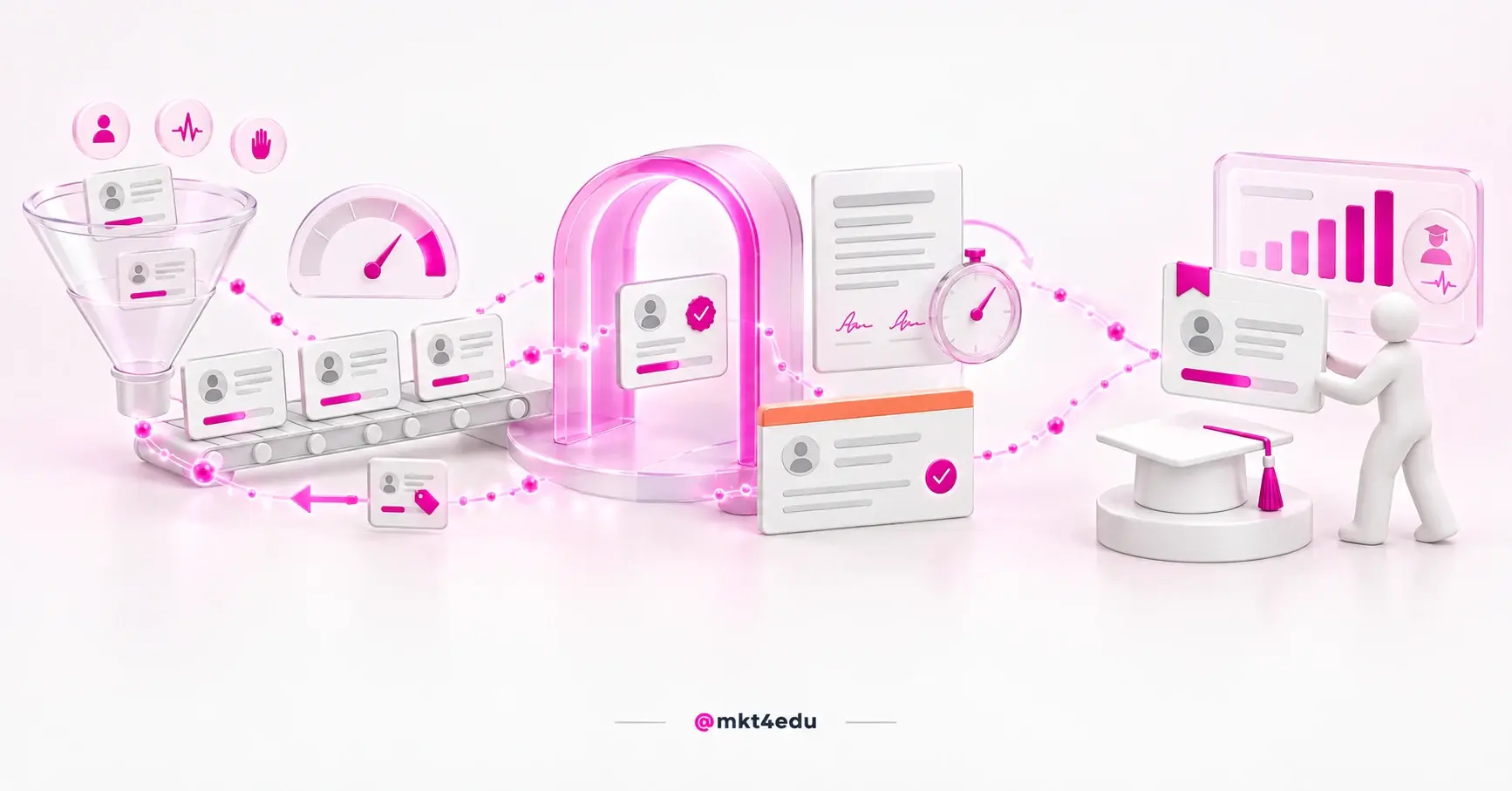
 Caption: MQL and SQL separate the contact marketing qualified from the one sales accepted to work
In practice, the MQL is born of inbound marketing: content, forms, nurturing and engagement scoring. Once the set of signals crosses the agreed threshold, marketing marks the lead as qualified.
Video: audiobook from the mkt4edu channel on the funnel where MQL and SQL sit
The SQL belongs to Inbound Sales territory. The rep receives the lead, checks profile and context and decides whether to accept the approach. Acceptance turns the contact into a real opportunity, with an owner, a deadline and a defined next action.
The distinction avoids two expensive mistakes: treating every marketing-qualified lead as ready for a proposal, which burns contacts and wears the team down, and leaving a mature lead waiting in the database until a faster competitor takes the sale.
Without a shared vocabulary, lead management becomes a battle of narratives: marketing points at volume, sales points at quality, and nobody sees where the funnel is actually stuck.
When is a lead ready to go to sales?
A lead is ready for sales when it combines three filters: a profile inside the audience the company serves, recurring engagement with the brand's content and channels, and an explicit signal of intent, such as a proposal request or an application started. Those three filters form the minimum qualification threshold before any approach.
The most stable way to run that threshold is lead scoring: points for profile, such as role, sector and region, added to points for behaviour, such as pages visited and email replies. The model for lead scoring in education marketing shows how to calibrate weights and the cut-off.
Not every response to a marketing campaign is buying intent. An ebook download signals interest in the topic; a quote request signals a decision in progress. Separating those signals keeps browsers out of the sales queue.
Two explicit signals justify an immediate handover, even with a low score: a direct request for contact and an interrupted purchase, such as an application form abandoned halfway. Waiting for nurturing to finish its cycle, in those cases, means losing the moment.
Video: audioblog from the mkt4edu channel on the scoring that draws the line between MQL and SQL
When the score reaches the threshold but does not cross it, the lead goes back into nurturing with bottom-of-funnel content. Lead conversion improves when that middle queue gets its own treatment instead of waiting for the next campaign.
How do you build an SLA between marketing and sales?
The SLA between marketing and sales is a short agreement recording what each team delivers, within what deadline and under which acceptance criteria. It turns lead handover into an auditable process: it defines what an MQL is, what an SQL is, the maximum time to first contact and the rule for returning a lead.
The document does not need ten pages, it needs two signatures: an SLA sales did not help write becomes wallpaper at the first tight target. So it is built in a joint meeting, with real examples of good and bad leads on the table.
Volume belongs in the agreement too. When campaigns generate peaks, the SLA defines where the overflow goes: a qualified-lead queue prioritised by score, temporary reinforcement in the service team, or nurturing until capacity opens up. Without that clause, the peak becomes leads going cold in the database.
A lean model covers most operations. Here is how the criteria sort out:
|
Criterion |
Definition |
Owner |
Deadline |
|
MQL definition |
Profile in the target audience and a score above the agreed threshold |
Marketing |
Reviewed each cycle |
|
SQL acceptance |
Profile and context checked, with acceptance or rejection logged in the CRM |
Sales |
Within 1 business day |
|
First approach |
First contact with the accepted lead, in the channel set in the agreement |
Sales |
Within 24 business hours |
|
Attempt cadence |
Minimum contact attempts, varying channel and time of day |
Sales |
5 business days |
|
Return with a reason |
A rejected or lost lead goes back to marketing with the reason logged |
Sales |
At the moment of rejection |
|
Criteria review |
Joint read of acceptance, return and conversion rates |
Marketing and sales |
Monthly meeting |
Table: model SLA for lead handover between MQL and SQL, to adapt to each operation's volumes and deadlines
The deadlines in the model are a starting point, not a market rule. What cannot vary is that they exist: a deadline with no owner is just a promise, and the SLA exists to take digital marketing strategies out of the promise business.
How do you configure lead handover in the CRM?
Lead handover in the CRM (Customer Relationship Management) works when the system mirrors the SLA: a clear stage for the MQL, an acceptance field for the SQL, automatic owner assignment and an alert when the deadline is missed. Without that configuration, the agreement lives on paper, and lead management goes back to depending on the rep's memory and a parallel spreadsheet.
The first design is the lifecycle: lead, MQL, SQL and opportunity, with entry criteria written into the property itself. In projects run by mkt4edu, the deal is only created after qualification, and before that the work happens on the lead record. The funnel stays clean, with no browser's card occupying the pipeline.
Owner assignment needs an explicit rule, not common sense. The standard adopted in those operations is direct: an open deal keeps its original owner, and a new contact enters through team rotation. The rule ends the fight over a hot lead and protects the negotiation history.
The acceptance stage deserves a required decision field, with a date and a reason. That record is what feeds pipeline management with HubSpot and makes it possible to measure how long each lead waits between qualification and first contact.
Inbound sales depends on that recorded context: the rep who opens the CRM and finds the source, the content consumed and the reason for qualification approaches better than the one handed a name and a phone number.
This design involves pipeline, automation, permissions and reporting. A structured HubSpot CRM implementation solves the configuration alongside the internal team, from the lifecycle to the tracking dashboard.
What do you do with a lead returned by sales?
A lead returned by sales always goes back to marketing with the reason logged. The return is not a failure of the process, it is the data showing where the criteria missed: profile outside the audience, wrong moment to buy or insufficient information. Without the reason, the same cold lead will be sent again next month.
In the operations mkt4edu runs, rejected or lost leads always carry the reason on the record. That discipline makes it possible to break the losses down: how many fell on profile, how many on timing, how many on budget. Each slice calls for a different correction at the top of the funnel.
A timing reason sends the lead back to nurturing, not to the bin. Lead segmentation in HubSpot splits those contacts into lists by return reason, and each list gets its own flow, tuned to whatever blocked the purchase.
Requalification has gained a recent reinforcement. AI (Artificial Intelligence) rereads the returned lead's history and points to the best moment for another attempt, and AI-powered lead qualification hands back to sales only the contacts that genuinely warmed up again.
The circuit closes in a short recurring meeting between the teams, reading the acceptance and return rates. That is where the SLA stops being a document and becomes an instrument of the company's marketing strategy.
MQL and SQL in the enrolment funnel: what changes in education?
In the enrolment funnel, MQL and SQL take on their own shape: the MQL is usually the lead with a defined programme of interest and profile, and the SQL is the candidate with an application started or a direct request for support. The academic calendar shortens deadlines, and seasonality concentrates volume into short windows.
Within an education marketing strategy, that difference changes the weight of the signals. A partial entrance exam application is worth more than a dozen downloads, and the chosen programme defines who approaches, because each area calls for its own argument.
Education marketing campaigns also change the rhythm of the SLA. At the peak of the admissions season, a one-day approach deadline becomes a one-hour deadline, because candidates usually apply to more than one institution and tend to enrol with whoever answers first.
The mechanics of the SLA during admissions are the same as the digital marketing strategies of any sector, what changes is the clock.
One trigger deserves dedicated automation: the self-service candidate who gets stuck halfway through the application. In mkt4edu's operations, that stall generates an automatic task for sales to reach out, with the exact drop-off point noted. The contact arrives while the doubt is still alive.
The post-application stage is a whole funnel of its own, with its own priorities and cadences. The route from applicant to enrolled student details that stage, from exam scheduling to completing enrolment.
Outside the peaks, education marketing campaigns feed the base of the next cycle: whoever did not enrol now can return as an MQL next term, as long as the relationship sequence stays active. That continuity is what separates a mature education marketing strategy from isolated actions.
Roles, tools and owners by stage are laid out in how to manage leads in education, from the first form to the handover to the adviser.
Frequently asked questions about MQL and SQL
Where do you start rolling out MQL and SQL in your operation?
Start with the agreement, not the tool: a meeting between the two teams, definitions of MQL and SQL with real examples and a lean SLA with deadlines and owners. The following week, take the agreement into the CRM and switch on the deadline alerts.
Measurement comes before sophistication. Two rates are enough in the first month: how many MQLs sales accepts and how long an accepted lead waits for its first approach. Those two numbers show whether the problem is the criteria or the operation.
MQL and SQL are not funnel bureaucracy, they are the contracts that get marketing strategy and the sales routine working to the same rhythm. Teams that sign that contract early trade arguments for fine-tuning.
The next step is seeing where the contacts neither team follows are draining away. The map of lead loss in the enrolment funnel shows the exact leak points between recruitment and enrolment and how to close each one.













 Portugal