






Dropout stopped being a seasonal scare and became a fixed line in institutional financial planning. Knowing how to retain students now weighs as much as knowing how to recruit them, because the empty seat in the middle of the term never shows up in the enrollment funnel, yet it shows up in full in the quarterly result.
The reason is arithmetic. Every student who leaves in the third semester takes away the acquisition cost already paid, the revenue that was still coming and the infrastructure investment sized for a class that no longer exists.
No new campaign gives that value back. The replacement student carries a fresh acquisition cost, and the institution ends up paying twice for the same seat.
The scenario has also changed in nature. Quitting is no longer a reaction to an extraordinary event: it became structural, pushed by the fast growth of distance learning and by the pressure on household income.
Treating the subject as a one-off emergency misses the point. Treating it as a continuous process, with data, routine and conversation, recovers margin semester after semester, without depending on a budget increase that rarely arrives in the volume needed.
How big is dropout in Brazilian higher education?
Annual dropout in Brazilian higher education stood at 24.8% on campus and 41.6% in distance learning, considering all networks, in base year 2024. In the private network, those percentages rise to 26.6% and 41.9%. The figures come from the 16th Higher Education Map by Instituto Semesp.
The cut matters more than it seems. Quoting 24.8% as if it were the private network rate understates the problem, disorganizes any retention target and produces an action plan calibrated for a reality that is not the institution's own.
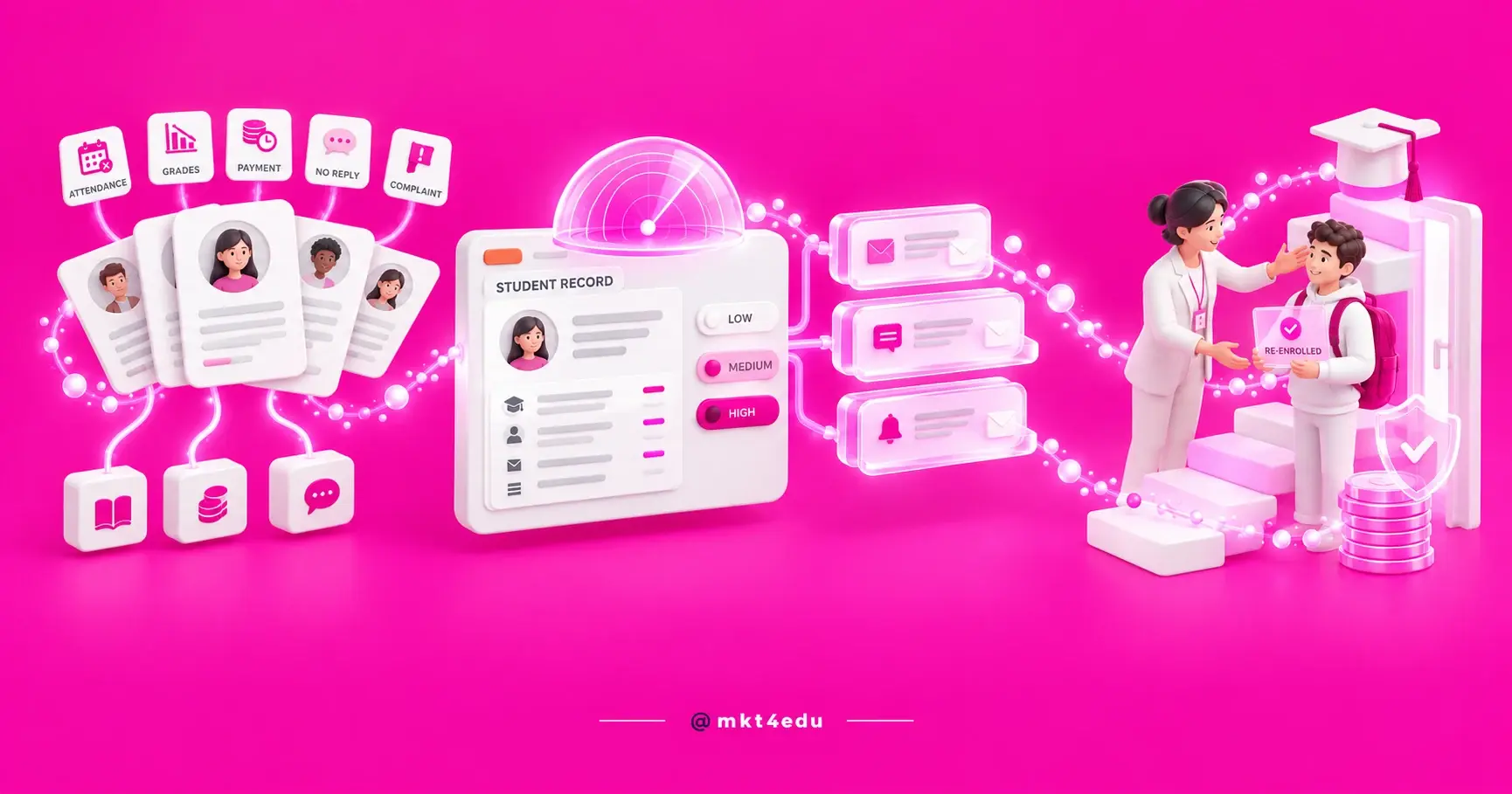
 Caption: Knowing how to retain students starts with reading the risk signal on the dashboard before the student has already decided to leave.
There is a second and harsher reading: cumulative dropout along the student journey. It shows how many students from the same entering cohort left before finishing, and it is the indicator that best describes the real damage to the enrolled base.
|
Cut |
Rate |
|
Annual dropout, on campus, all networks |
24.8% |
|
Annual dropout, distance learning, all networks |
41.6% |
|
Annual dropout, on campus, private network |
26.6% |
|
Annual dropout, distance learning, private network |
41.9% |
|
Cumulative dropout, 2020 to 2024 cohort, private network |
64.7% |
|
Cumulative dropout, 2020 to 2024 cohort, private distance learning |
68.1% |
Table: Annual and cumulative dropout rates in Brazilian higher education, base year 2024, Instituto Semesp.
Almost two thirds of an entire cohort leave before graduating in the Brazilian private network. That is the number that should preside over any conversation about retention targets, rather than the isolated annual rate, which is far more comfortable to look at.
Reading the trajectory by stage is what turns the figure into a plan, as the analysis of what drives dropout and how to predict it shows in detail.
The backdrop has changed decisively. Brazil's 2024 Higher Education Census recorded 10,226,873 undergraduate enrollments, with distance learning reaching 50.7% of the total and surpassing on campus courses for the first time.
Among entering students, the imbalance is even wider: 66.8% start in distance learning courses, according to the Higher Education Census notes published by Inep. The private network accounts for 79.8% of enrollments.
The conclusion is uncomfortable. The format growing fastest is precisely the one losing the most students along the way, which means that enrollment growth in the private network coexists with an increasingly unstable base.
Why does retaining students cost less than recruiting new ones?
Retention costs less because the enrolled student has already consumed the full acquisition investment. When dropout rises, the balance between lead cost and students in class breaks, and the institution starts buying new contacts only to replace seats it failed to hold.
The student who stays reverses that logic. Over the semesters, they cover their own recruitment cost, start generating results and relieve pressure on the entering class target for the next cycle. Retention, in that sense, is the cheapest form of recruitment.
One percentage point less of dropout is worth more than the same budget poured into ads. The difference is that the gain from retention shows up in recurring cash, not only in the funnel.
It is worth noting that the student who decides to stay is also saying something. There is a bond there, and a bond is the cheapest indicator that the institution got something right. The full financial reasoning appears in the breakdown of the economic return of keeping enrolled students.
Late payments offer another clue. In Brazilian private higher education, the rate stood at 8.73% in the first half of 2025, with a drop of 1.9% against the same period of the previous year, according to Semesp and Principia.
The movement, however, is not uniform. On campus courses fell 3.1%, while distance learning rose 8.4%, confirming that financial pressure concentrates in the format growing fastest in enrollments. The general average hides that asymmetry.
In other words, payment difficulty concentrates exactly where dropout is highest. Treating late payments and abandonment as separate problems, each with its own team and its own report, costs money and delays the intervention.
What makes a student quit before finishing the course?
A student quits by accumulation, not for a single reason. Tuition price sits at the top of the list, followed by the perception that the course does not deliver the promised return, the distance from the institution and the feeling that nobody would notice their absence.
Tuition value ranks among the three main reasons students suspend or abandon a course. It is the most cited trigger, but it rarely acts alone.
Perceived quality comes right behind. Even before enrolling, the future student checks the course score published by Brazil's Ministry of Education and compares it with the alternatives available in the region.
Then comes career expectation. Nobody sustains four years of effort in a degree that shows no clear value in the job market, and that perception forms early, in conversations with alumni and with internship colleagues.
And there is the least measurable factor of all: belonging. The student wants to feel that the institution cares about their education, and the absence of that signal erodes the bond in silence.
Mapping those factors one by one is what separates a generic retention program from a targeted one, as the review of the variables that impact school dropout makes clear.
Caption: The webinar breaks down how dropout builds up across the student journey instead of landing as a single event. Video in Brazilian Portuguese.
Which student retention strategies work in practice?
The student retention strategies that work attack three fronts at once: the perceived quality of the course, the proximity between institution and student, and the ability to spot risk early. A retention program that only reacts to a withdrawal request arrives far too late.
The starting point is internal. Knowing how to retain more students requires looking at the academic product before looking at communication, because no message cadence compensates for a course that fails to deliver what recruitment promised.
How does course quality sustain retention?
A well rated course holds students because it confirms the decision they already made. When the classroom experience matches what was promised during recruitment, the doubt about continuing loses force.
Four elements concentrate that perception:
- A curriculum updated to the current reality of the profession.
- Faculty with authority and a recognized track record in the market.
- Labs with infrastructure and technology compatible with the practice of the course.
- Scientific output strong enough to sustain the institution's reputation.
Faculty deserve double attention. Professors with real market cases motivate more than any institutional campaign, because students mirror whoever teaches them and measure their own future by the trajectory of the person leading the class.
What does proximity to the community change in dropout?
Proximity reduces dropout because it turns enrollment into belonging. The student who recognizes themselves inside the institution and its surroundings finds more reasons to stay than to leave, even under financial strain.
Three moves help build that bond:
- Communication personalized by student situation, since every case has its own cause.
- Institutional participation in topics that matter to the surrounding community.
- Consistent work on social inclusion and on welcoming underrepresented groups.
None of this works without routine. An isolated mid semester action does not move an indicator, and the practices already tested in live operations are gathered in the rundown of the best student retention strategies.
Alignment between teams matters just as much. When recruitment and retention report to different leaders with different targets, the student falls into the gap between them, and the handover after enrollment never really happens.
Caption: Retaining students and generating leads are two halves of the same cycle, which is why retention starts before enrollment. Video in Brazilian Portuguese.
How to use AI for student retention without falling back into menu chatbots?
Using AI for student retention means replacing the options menu with an agent that reasons about the actual case. The old chatbot offers predefined paths and freezes when the question leaves the script. The agent queries systems, understands the student's situation and acts.
The difference shows up in the first contact. The menu asks what the student wants; the AI agent already knows they have three absences and one open installment.
This kind of operation relies on data the institution already holds. Attendance, grades, payment history and Customer Relationship Management (CRM) records form the risk dashboard.
From there, the conversation happens where the student already is. Messaging apps and voice support cover most cases, without requiring anyone to log into an academic portal.
The correct design respects a clear boundary. The agent solves operational matters on the spot, such as a duplicate invoice, a simple renegotiation, a class change or guidance on re-enrollment, without sending the student to a waiting queue. That volume is what consumes the support team the most.
When the subject is sensitive, the rule changes: the case goes up to a person, with the full context already gathered. Grief, illness in the family and severe financial crisis are not solved by automation.
The real gain is not a smaller team. It is reach: no human operation can talk to ten thousand students in the week the risk signal appears, and that week is exactly what decides whether the student re-enrolls or disappears.
The architecture of that operation, from the risk dashboard to human escalation, is described in the walkthrough of the AI agent applied to student retention. For institutions that prefer to implement with outside support, mkt4edu designs and runs this kind of AI agent for the academic journey.
The same logic extends beyond support. Predictive models, automated reporting and workload planning already shape daily academic decisions, and retention is usually the first area where that shift becomes visible.
How to build student retention campaigns without relying on discounts?
Sustainable student retention campaigns work on perceived value before touching price. A discount solves the month and creates a bigger problem next semester, because it recalibrates payment expectations downward across the whole base and opens a distortion that is hard to reverse.
Price does need monitoring, and that is non negotiable. Tracking the local market and keeping tuition coherent with the structure offered prevents losses by simple comparison, especially in regions with a heavy supply of low ticket distance learning courses.
The care lies in how to concede. In many cases, postponing a payment without giving up the full amount protects cash better than granting a permanent reduction.
There is also a coexistence limit. Large tuition differences between students in the same class turn into noise, undermine trust in the commercial policy and generate review requests that swamp the registrar's office at the start of every term.
That is why good student retention campaigns combine a financial condition with an academic counterpart, such as tutoring, remedial support or a reorganized course load. The student receives a way out, not a pardon.
This is one of the reasons Educational marketing strategies do not fit inside an offer calendar. They need to follow the entire journey, from first contact to graduation, as the panorama of educational marketing strategies for institutions shows.
When the internal team cannot absorb the volume, hiring an educational marketing agency is usually faster than building the structure from scratch. The selection criteria change, though: what matters is experience with enrollment and retention, not a generic portfolio.
Does a distance class have to feel distant?
A distance class does not have to feel distant. What separates the two is the deliberate presence of the institution in the student's routine, with active tutoring, fast feedback and contact that does not depend on their initiative. The screen is a medium, not a barrier.
Instructional design carries weight. Live sessions with real participation, commented feedback and small groups create a bond that recorded material alone never produces, even when the audiovisual production is flawless.
Monitoring also has to be proportional to risk. With almost 42% annual dropout in the Brazilian private distance learning network, treating the remote student with the same level of contact as the on campus student is simply not enough.
The specific reading of this format, with the causes particular to remote abandonment and the journey points where it tends to happen, is detailed in the analysis of dropout in online learning.
Frequently asked questions about how to retain students
How to retain students by the next enrollment cycle?
Knowing how to retain students stopped being a long term project and became an operating routine. The institution that organizes the risk dashboard, defines the contact cadence and handles price with criteria already collects results in the following semester.
The first step is modest and revealing: measure dropout with the right cut, separating on campus from distance learning and comparing your own network with the national average, not with the memory of last semester.
The second is to pick one front and execute it well. It can be active tutoring, it can be an AI agent on first contact, it can be a review of the discount policy. One front done properly beats five announced and abandoned.
The third is to treat retention as part of your educational marketing strategies, with a target, an owner and monthly follow up. Whoever understands how to retain more students stops seeing recruitment and retention as separate teams.


























 Portugal