






Content in partnership with GITEX AI LATAM.
In March 2027, São Paulo hosts the first Latin American edition of GITEX, one of the largest technology event networks in the world. GITEX AI LATAM 2027 arrives at a specific moment: Brazil has just announced billions in supercomputing for artificial intelligence.
The country discovered that building those systems is easier than feeding them enough energy to run. This is not just another technology conference on the calendar.
GITEX AI LATAM 2027 brings together, in the same space, those buying AI capacity (government, companies, universities) and those who have to deliver the physical infrastructure for that capacity to exist: power generators, data center operators, connectivity providers and investors.
Why is Brazil investing heavily in AI right now?
Brazil is investing heavily in AI because, on August 20, 2026, the federal government announced R$ 2.3 billion (around US$ 444.2 million) across two supercomputing projects. The announcement was attended by President Luiz Inácio Lula da Silva and Science, Technology and Innovation Minister Luciana Santos.
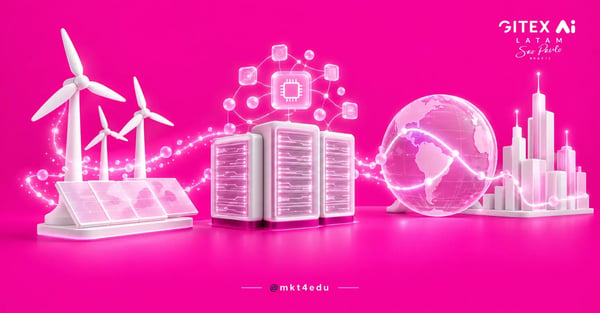 Caption: GITEX AI LATAM 2027 puts energy, data centers and connectivity in the same room, the three fronts that sustain AI in Brazil
The R$ 2.3 billion invested across both projects is funded by the National Fund for Scientific and Technological Development (FNDCT).
The investment splits into two fronts. The first, of R$ 1.3 billion (around US$ 251 million), enables a supercomputing project in Rio de Janeiro with China's Huawei and iFlytek, slated to start in July 2027 and focused on general-purpose and sector-specific language models.
The second, of R$ 1 billion (around US$ 193.1 million), goes to a supercomputer in Rio Grande do Norte, with technology expected from America's Nvidia. The goal is to rank among the ten most powerful AI processing systems in the world by the end of 2027.
Choosing two suppliers from different countries is not accidental. According to the government's own statement, the strategy is to avoid depending on a single company, technology or country, at a moment when the United States and China are contesting leadership in AI infrastructure.
Money and hardware solve, however, only part of the problem. A cutting-edge supercomputer needs electricity in constant, predictable volume to operate, and that is where public discourse about AI in Brazil already collides with the reality of the country's power grid.
What is the real bottleneck for AI expansion in Brazil?
The real bottleneck for AI expansion in Brazil is electricity, not hardware investment. While supercomputer announcements take the headlines, the energy market is already moving to solve the next problem: where and how to connect AI data centers to the power grid at scale.
Why does the Pecém Complex concentrate those energy investments?
The Pecém Complex concentrates those investments because it brings together, in the same region on the coast of Ceará, port infrastructure, available land and enough wind generation potential to sustain operations that consume electricity 24 hours a day.
On June 8, 2026, Voltalia, a French renewable energy company, secured a 322 MW grid connection from Brazil's National Electric System Operator at Pecém, specifically to enable high-consumption data centers. The company already has 3.6 GW of installed and under-construction capacity in Brazil.
Pecém already had a heavyweight precedent. Omnia Data Centers and Casa dos Ventos closed a self-generated renewable energy deal valued at US$ 2 billion, lasting 20 years, for the data center expected to host operations for ByteDance, TikTok's parent company.
Energy stopped being a support line item in a data center's budget. It became the criterion that decides, first, where the next wave of AI projects in Brazil will be built.
Placing those moves side by side, it becomes easier to see that they happened in sequence, almost as if one announcement pushed the next:
|
Date |
Move |
Value involved |
|
Jan. 2026 |
V.tal announces the Synapse submarine cable, linking São Paulo to the United States |
Not disclosed |
|
May 2026 |
Omnia and Casa dos Ventos close renewable energy for ByteDance's data center at Pecém |
US$ 2 billion (20 years) |
|
Jun. 2026 |
Voltalia secures a 322 MW grid connection at Pecém |
Connection capacity |
|
Aug. 2026 |
Federal government announces supercomputing in Rio de Janeiro and Rio Grande do Norte |
R$ 2.3 bn (~US$ 444.2 m) |
|
Mar. 2027 |
GITEX AI LATAM brings these players together in São Paulo |
Event |
Table: Dates and values as disclosed by the companies themselves and by the federal government in the announcements cited throughout this article.
The Synapse cable and the Pecém deal with Casa dos Ventos were announced before the federal supercomputers. That suggests the energy and connectivity markets were already moving in anticipation of demand the government only made public months later.
Why did connectivity enter the contest for AI infrastructure?
Connectivity entered the contest because AI at scale also depends on international data traffic between Brazil and the main technology markets, and the country's existing cable infrastructure does not keep up with that volume.
In January 2026, V.tal announced the Synapse submarine cable project, roughly 9,700 km long, linking São Paulo to New Jersey, with a branch in Fortaleza and projected capacity of up to 320 Tbps. The company presents the project as a direct response to growing AI demand.
Gaining traction in the same movement is the discussion around the REDATA program, which could offer incentives tying data center investment to clean energy generation and research and development. The program's final design is still under debate, and that part of the scenario should consolidate in the coming months.
The picture that emerges is of a country trying to tie together three fronts that normally evolve at different speeds: processing capacity, energy and connectivity. It is exactly that intersection that GITEX AI LATAM 2027 proposes to put in the same room.
What does the race for energy mean for marketing and technology companies?
The race for energy means, for marketing and technology companies, that AI infrastructure in Brazil will generate a large volume of content and public statements about energy, data centers and digital sovereignty, a topic that now interests AI search engines directly.
That volume of content about energy and infrastructure connects to a movement already discussed in Answer Engine Optimization: as tools such as ChatGPT, Gemini and AI Overviews on Google answer questions about Brazilian technology infrastructure, brands publishing well-researched, well-structured content on the topic have a better chance of appearing as a cited source.
The same reasoning applies to Query Fan-Out, the process by which those tools break a broad question into several smaller searches, about energy, public investment, suppliers and industry events, and then assemble a single answer.
Companies that depend on AI infrastructure gain a concrete reason to lock in energy and connectivity contracts early, since delays on that front turn into launch delays. Investors get a clear signal that the relevant money is not only in companies consuming AI, but also in the physical chain that sustains that consumption.
How does GITEX AI LATAM 2027 work?
GITEX AI LATAM 2027 works as a regional platform connecting technology companies, governments, startups and investors with Latin America's digital economy. According to the GITEX AI LATAM organizers, the event expects participants from more than 100 countries.
GITEX AI LATAM comes from the same network that runs GITEX Global in Dubai, today one of the largest technology events in the world. The 45th edition, held in October 2025, gathered 6,800 technology companies, 2,000 startups and 1,200 investors, with representatives from 180 countries, according to GITEX Global's official statement.
The São Paulo edition is structured around five tracks: AI Innovations Showcase, focused on artificial intelligence innovations; Startups North Star LATAM, focused on the startup and investor ecosystem; GISEC LATAM, dedicated to cybersecurity; AI Everything LATAM, focused on practical AI application; and DCII, on data center infrastructure.
Behind the expansion into Latin America is a regional digital market estimated at almost US$ 950 billion by 2026, according to consultancy PCMI, cited in GITEX AI LATAM's official statement. Brazil accounts for a relevant share of that figure.
The country projects an information and communication technology market of US$ 259 billion, according to IMARC Group, and an artificial intelligence market of US$ 99.8 billion by 2033, according to Grand View Research, both cited in the same statement. Trixie LohMirmand, CEO of GITEX, describes Brazil as the base of the Latin American economy and a regional benchmark in technological development.
The event is organized by Dubai World Trade Centre, through Informa, with institutional support from the São Paulo City Hall, in partnership with the São Paulo Development Agency (Adesampa) and the Innovation Diplomacy Program (PDI).
According to Rodrigo Goulart, municipal secretary for Economic Development and Labor, hosting GITEX is a milestone for consolidating São Paulo as Latin America's innovation hub.
Francisco Forbes, president of Prodam, highlights the intention of turning the São Paulo edition into one of the GITEX brand's global references. The city already takes local startups, such as those in the Vai Tec and Green Sampa programs, to international technology events, and GITEX arriving on its own turf extends that strategy.
São Paulo enters this contest with concrete credentials: it leads the national and regional ranking of StartupBlink's 2025 Global Startup Ecosystem Index, after attracting US$ 33.5 billion in venture capital over the last decade. According to the Elcano Royal Institute, the São Paulo ecosystem is worth US$ 113 billion today and has already produced 11 unicorns.
As happened with Slush, the Finnish event that established itself as a meeting point between startups and investors, the real test for GITEX AI LATAM will not be the size of the event. It will be whether it translates those meetings into concrete contracts, in the mold of what is already visible at Pecém.
Frequently asked questions about GITEX AI LATAM 2027
Does GITEX AI LATAM 2027 arrive in time to solve the energy bottleneck?
The figures from recent months show a Brazil willing to buy supercomputers, close billion-dollar renewable energy contracts and launch a new submarine cable, all in under a year. What remains open is whether those three fronts will keep advancing at the same pace.
GITEX AI LATAM 2027 arrives precisely in that gap, as the first major Latin American stage where government, energy, data centers and technology will sit at the same table to discuss it in public. For companies that depend on AI infrastructure, it is worth following closely what comes out of it.
Anyone who wants to follow that discussion up close, including the DCII track dedicated to data center infrastructure and energy, can pre-register for GITEX AI LATAM 2027 to secure a place on March 16 and 17, 2027, at the Anhembi Convention Center, in São Paulo.

























 Portugal