





Planning marketing for the next generations is not an exercise in futurology. Generation Alpha already uses AI at school and already influences what the family buys; Generation Beta is being born in a country with a fertility rate below 1.6 children per woman; and the shrinking of Brazil’s young population is already in the 2022 Census data.
What most plans are missing is the link between those facts and the decisions about channel, content and relationships that are being made right now.
This article makes that link with sources: IBGE for demographics, Pew Research and McCrindle for definitions and behavior, NielsenIQ and Bank of America for spending power, McKinsey and Deloitte for consumption. Generation Z appears as a reference for what has already happened, not as the subject. The higher education example is here because it is the sector that feels demographics first.
Who are the next generations and how are they defined?
The next generations are three cohorts with cutoff dates set by the consultancy McCrindle: Generation Alpha (2010 to 2024), Generation Beta (2025 to 2039) and Generation Gamma (2040 to 2054), followed by Delta from 2055. The dates vary between sources and matter less than the shared trait: the technology available in childhood.
The reference is Generation Z, which has already arrived. The Pew Research Center places the start of Generation Z in 1997, as the first cohort with no memory of a world without the internet. It is adult, it consumes and it works as a preview: what Z did with the smartphone, Alpha is doing with AI.
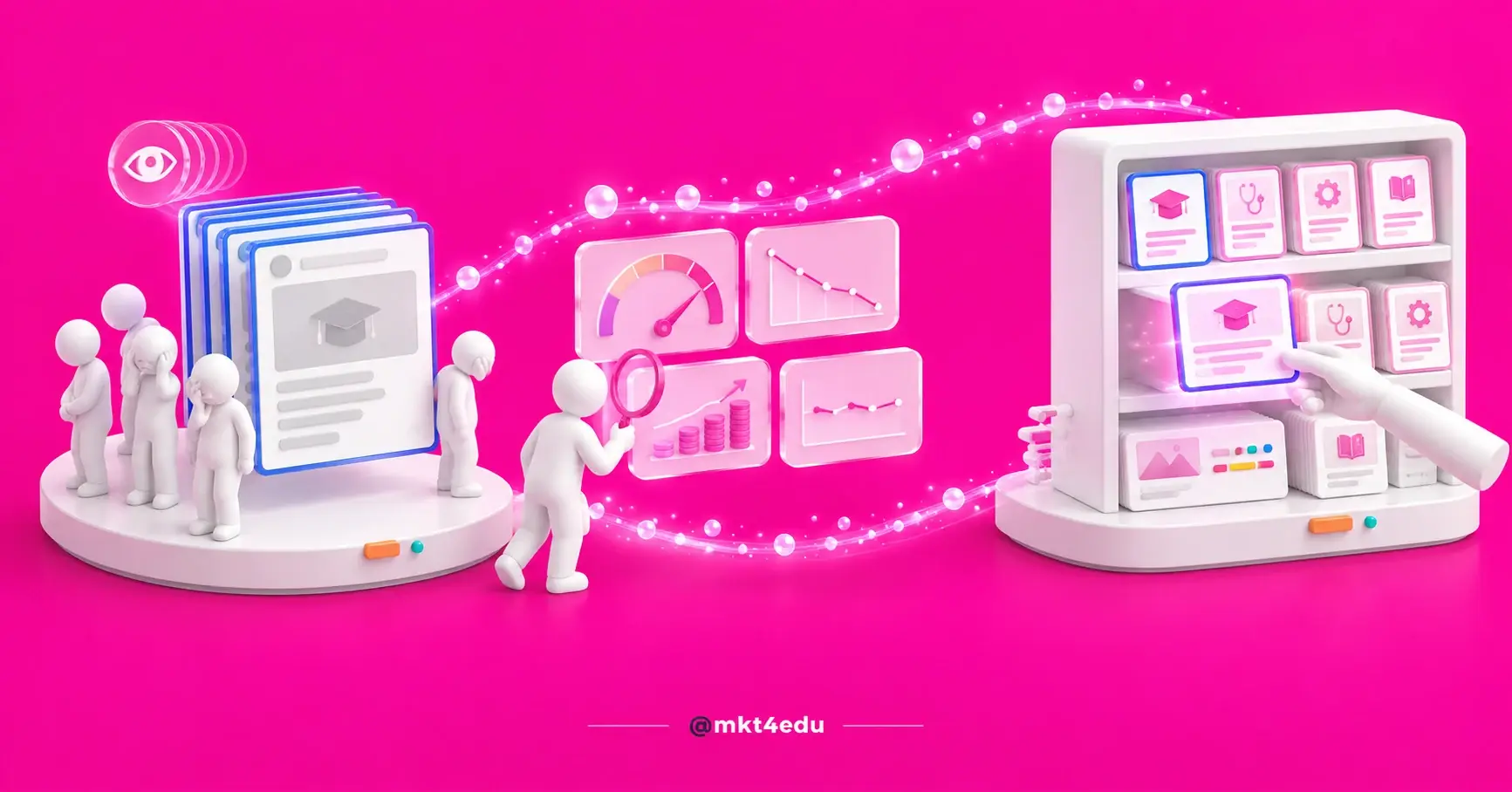
 Caption: Generation Alpha, Beta and Gamma arrive in waves, and each wave changes the assumptions about audience, search and trust
Generation Alpha is defined by McCrindle as born between 2010 and 2024, the first cohort entirely born in the 21st century and, according to the consultancy, the largest in history in absolute numbers, with around 2 billion people once it is complete. It grew up with tablets, voice assistants and, in its second half, with generative AI at school.
Generation Beta began in 2025. McCrindle projects that it will represent 16% of the global population by 2035 and describes it as the first cohort for which AI and automation will be fully embedded in everyday life from birth. Many of its members will live into the 22nd century.
Generation Gamma comes next, from 2040 to 2054, and Delta from 2055 to 2069, in the same naming scheme. There is no data on them, only the direction: they will be born to Generation Z and Alpha parents, in older and less populous countries, with AI as the default interface. For marketing, they are a horizon, not an audience.
What the cohorts share is the starting point. Z learned to search on Google and moved to AI; Alpha learned to search by asking; Beta and Gamma will learn with AI as the default interface. Each one requires a marketing strategy built on a different assumption about how a person finds the brand.
What do Brazilian demographics change in marketing strategy?
Brazilian demographics change marketing strategy because the young audience is shrinking in absolute numbers while the country ages. The 2022 Census counted 203 million inhabitants, with 40.1 million people aged 0 to 14, 12.6% fewer than in 2010, and 22.2 million aged 65 or over, 57.4% more.
The 0-to-14 bracket in 2022 is exactly Generation Alpha. It is the cohort that will reach ages 18 to 24 between 2026 and 2040, and it is smaller than the generation before it. Every brand that depends on new young customers, from universities to digital banks, will be competing over a smaller base.
The aging is fast. The median age rose from 29 in 2010 to 35 in 2022, and IBGE projections indicate that the population stops growing in 2041, peaking at 220 million, with median age reaching 48 by 2070. The fertility rate falls from 1.57 in 2023 to 1.44 in 2041.
For marketing strategy, the consequence is trading volume for value. Growing by acquiring more young people will get more expensive every year, because there are fewer young people. The alternative is to retain more, sell more to each customer and serve more age brackets, and the 2030 plan has to choose which of those levers to pull.
There is a second, less obvious effect. A smaller and more connected cohort has more bargaining power, because brands compete for it more intensely. Generation Alpha will be courted like no Brazilian generation before it, and its tolerance for generic marketing is likely to be the lowest yet.
Generation Beta is being born inside that curve. With fertility projected at 1.44 children per woman in 2041, each cohort of Brazilian newborns is smaller than the last, and Gamma, from 2040 on, will be born in a country that has stopped growing. The demographic assumption behind every long-term plan is the same: fewer young people, more older ones.
How much will the next generations spend?
The next generations will concentrate global spending power from 2035 on, and Generation Z shows the pace. NielsenIQ estimates that Z, with 25% of the world population, will reach $12 trillion in spending power by 2030. Bank of America projects it as the largest and wealthiest generation by around 2035.
The bank’s numbers show the speed. According to the Bank of America Institute, Generation Z’s global income goes from $9 trillion in 2023 to $36 trillion by around 2030 and $74 trillion in 2040. Alpha will follow the same curve ten to fifteen years behind, and Beta after that.
Generation Alpha already moves money before it earns any. McCrindle estimates an economic footprint of $5.46 trillion by 2029, combining what children spend directly and their influence over family consumption. Anyone selling to families is already selling to Alpha, even without speaking to it.
The figure that changes planning is the pace. Many brands treat Alpha as the “audience of the future” and keep the budget on the audience that pays today. By the projections, the first Alphas enter the workforce around 2030, and the relationship built with their families in 2026 is what decides who they will buy from.
In Brazil, young spending power coexists with the smaller base that demographics dictate. Fewer people, with more income and more information, is a market in which marketing strategy has to be more precise and less mass-oriented.
How does Generation Alpha search and decide?
Generation Alpha searches with AI before it reaches the brand and decides based on people it trusts, and today’s data on children and teenagers already shows it. Much of the research on 9-to-17-year-olds in 2025 and 2026 describes Alpha, not Z.
In Brazil, 65% of children and teenagers aged 9 to 17 already use generative AI, according to TIC Kids Online Brasil 2025, most of them to study. That bracket was born between 2008 and 2016: it is almost entirely Generation Alpha.
Among Z’s young adults, the figure is 90% AI use in daily life, according to Google with Ipsos.
In the United States, Pew Research measured the same movement among teenagers. 64% of 13-to-17-year-olds have used an AI chatbot, and about 30% use one daily. Among the uses, 57% look for information and 54% do homework. For people under 18, AI is already the first stop.
Generation Z’s buying behavior points to Alpha’s direction. McKinsey found that 28% of Generation Z already uses generative AI to shop and 60% regularly use the AI summary at the top of search, against 16% and 29% of boomers. And 34% say social platforms play a decisive role in purchases.
The journey starts in an AI answer and passes through a social platform before it reaches the website.
The detail McKinsey adds is uncomfortable for brands: Generation Z reports lower trust in the channels it uses to research, even though it uses them more. It consults AI and doubts it; it follows creators and knows they are paid. Search got easier, and trust got more expensive.
For marketing strategy, that means showing up in the answer and being verifiable outside it. Content that AI can cite, which is what Google AI Mode demands, puts the brand in the first stop; real people provide the confirmation AI does not. What Z has already taught is in marketing to Generation Z.
What changes in the next generations’ relationship with brands?
The next generations’ relationship with brands is moving toward trust in people, intolerance of noise and the expectation that a brand solves something beyond selling. Generation Z already shows digital fatigue and Alpha already uses AI as company; both treat brands as a disposable option when the experience does not match the promise.
The fatigue is measured. Deloitte’s 2026 global survey of more than 22,000 young people found that 58% of Generation Z reports digital fatigue and 74% uses AI at work. An audience tired of screens is an audience that filters more, and frequency-based marketing tends to be filtered first.
AI has become an interlocutor for Alpha. Common Sense Media found that 72% of American teenagers aged 13 to 17 have used AI companions, and about a third find conversations with AI as satisfying as conversations with friends.
For marketing, the effect is that the next generation will expect a conversation from the brand, not an ad, and it will compare that conversation with the one it has with the machine.
The relationship with creators changes in kind. Generation Z trusts creators more than any media other than friends and family, but it knows they are paid, which makes coherence between creator and brand a condition of the partnership. Generation Alpha, raised with AI, tends to take that further: trust in those who demonstrate, doubt toward those who assert.
Purpose stops being a slogan. These generations grow up with access to information about what companies actually do, and the gap between talk and practice is exposed in minutes. It is not that purpose matters more; it is that incoherence costs more.
What can marketing expect from Generation Beta and Gamma?
From Generation Beta and Gamma, marketing can expect four trends, all derived from what is already known about them and none of them measured yet: AI as the default interface for consumption, sustainability as a minimum expectation, brand relationships measured in decades and a young audience that keeps shrinking in countries like Brazil. These are outlooks, not data.
The first trend comes from the definition of the cohort itself. McCrindle describes Generation Beta as the one for which AI and automation will be fully embedded in everyday life, from education to entertainment. The likely consequence is that search stops being an act and becomes a continuous conversation with an agent, and the brand has to exist inside it.
The second trend is sustainability as a floor. The same consultancy states that, for Beta, sustainability “will not be just a preference, but an expectation,” given climate change, urbanization and population displacement. Brands that treat the topic as a differentiator today are likely to meet a generation that treats it as a requirement for entry.
The third trend is the length of the relationship. If many members of Beta will live into the 22nd century, a brand that wins over the family of a baby born in 2026 could have a customer for eighty years.
Customer lifetime value, measured in years today, starts being measured in generations, and the brand’s own data is the only asset that survives that span.
The fourth trend is demographic and is already in IBGE’s numbers. Gamma, from 2040 on, will be born in a Brazil that has stopped growing, with a median age near 45. Marketing to young people, in that scenario, is marketing to a heavily contested minority, and most consumption comes from people who have been customers for decades.
What cannot be known is the behavior. Nobody has measured how a child born in 2030 will search, trust or buy, and any claim to the contrary is a hypothesis. What can be done is to build today the structure that holds in any scenario: findability through AI, trust through people and first-party data.
How do you prepare marketing strategy for 2030 and 2040?
Preparing marketing strategy for 2030 and 2040 requires four decisions taken now: shifting part of the acquisition target to retention and value per customer, making content citable by AI, building relationships through people and community, and organizing first-party data so you do not depend on platforms. None of them requires new technology; all of them require a change in priority.
The first decision answers demographics. If the young base is shrinking, growing through acquisition alone gets more expensive every cycle, and retention becomes the main lever. That changes metrics, budget and team: less money in acquisition media, more in experience, community and relationships with existing customers.
The second decision answers search. If Alpha already starts research in AI and Beta will be born inside it, the brand has to be in the answer, and that depends on content with named sources, direct answers, verifiable data and structure a machine can read. It is the SEO for AI playbook applied as strategy, not as a tactic.
The third decision answers trust. Creators, customers and employees speaking on video and in community provide the confirmation AI does not. That requires partnership budget with editorial freedom, a testimonial program and presence on community platforms, of which Bilibili is the most recent example to reach Brazil.
The fourth decision answers data. Each of the previous ones only works if the brand knows who the customer is, where they came from and what they did next, and that means owning the CRM, the tracking and the automation, as in generating leads with AI. Platforms change; the brand’s data stays. The four decisions come down to this:
|
Fact about the next generations |
Source |
Marketing decision |
|
The 0-to-14 cohort fell 12.6% between 2010 and 2022 |
IBGE, 2022 Census |
Retention and value per customer above acquisition |
|
65% of Brazilians aged 9 to 17 (Generation Alpha) already use generative AI |
TIC Kids Online Brasil, 2025 |
Content citable by AI as the basis of search |
|
Generation Z uses channels more and trusts them less |
McKinsey, 2026 |
Confirmation through people: creators, customers and community |
|
Generation Beta will have AI embedded in daily life and many will live into the 22nd century |
McCrindle, 2025 |
First-party data and CRM for a relationship measured in decades |
Table: Facts about the next generations and the marketing decision each one implies.
None of the four decisions depends on knowing how Beta or Gamma will behave. All of them create the structure that will serve those cohorts when they arrive: a brand findable by AI, trusted through people and in control of its own data.
Why does educational marketing feel the next generations first?
Educational marketing feels the next generations first because the product is sold to a fixed age bracket: people entering higher education are generally between 17 and 24, and that is exactly the bracket demographics are shrinking. It is a sector-level example of what awaits any brand whose customer is young.
The sector’s numbers show the squeeze. According to Semesp’s Higher Education Map, the net enrollment rate for 18-to-24-year-olds is stagnant at 20.8%, and enrollment growth came from distance learning, which is already 50.7% of the total and 73.5% of new entrants, with an audience mostly over 25.
An institution that only recruits young students for on-campus programs is competing over the cohort that is shrinking.
In student recruitment, the decisions in this article apply. Being in the AI answer to the candidate’s question about careers, having students and alumni as voices on video, and treating the CRM as an asset that follows the candidate from first contact to enrollment. What changes is the urgency, because the sector is already living the demographics that awaits everyone else.
In student retention, the effect is direct. With fewer new entrants available, every dropout costs more, and retention starts to be worth more than recruitment on the bottom line. Community, follow-up and continuous content stop being academic support and become marketing strategy.
Frequently asked questions about the next generations and marketing
What do you lose by postponing marketing for the next generations?
Postponing marketing for the next generations costs you the position in the AI answer, the relationship with creators and customers who confirm the brand, and the database that follows the customer to their income peak. Those three assets take years to build, and Generation Z reaches the top of spending power by around 2035.
The cost is silent because it never shows up in a campaign. It shows up when the brand is not cited in the question a candidate or consumer asks AI, when the creator partnership starts from zero while the competitor already has a community, and when the customer base is smaller because demographics shrank and nobody worked on retention in time.
Of the four decisions in this article, the one that pays off fastest is shifting acquisition to retention, because it holds today, with today’s demographics. The math behind that decision, with cost and result figures, is in why retention costs less than recruitment, the next step in this reading.

























 Portugal