





The Brazilian educational market went through a structural shift that most marketing plans have yet to absorb. Distance learning stopped being a complement and became the majority format, while dropout settled in as the sector's most expensive bottleneck.
That combination changes the question driving investment. It is no longer only how many students come in, but how many stay and at what cost, because a healthy intake funnel alongside high dropout merely replaces the loss.
What follows reorganizes educational marketing strategies around the most recent official figures, instead of starting from generic trends.
What does the Brazilian educational market look like today?
The Brazilian higher education market reached 10 million undergraduate enrollments in 2024, and for the first time distance learning surpassed on-campus education. The figures come from the 2024 Higher Education Census, released by Inep in September 2025, and put distance learning at 50.7% of the total.
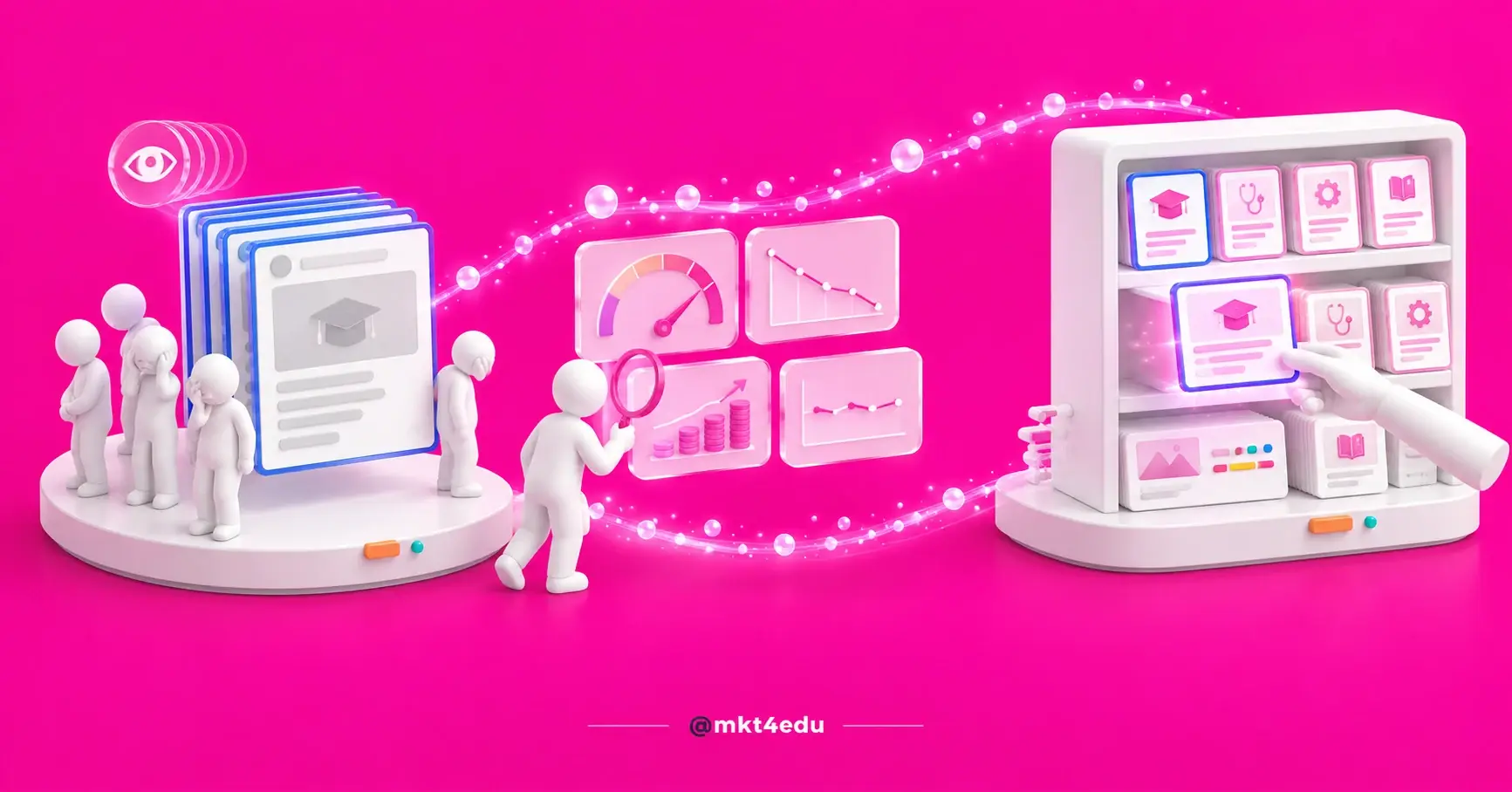
 Caption: With distance learning already in the majority and dropout above 40% in that format, student enrollment and retention stopped being separate fronts.
Distance learning grew 5.6% between 2023 and 2024, according to the same survey. The figure matters less for the percentage and more for what it signals: the candidate who decides on enrollment without ever setting foot on campus became the norm, not the exception.
The 16th Higher Education Map, from Instituto Semesp, adds the other side of the ledger. Total enrollments reached 10.2 million, up 2.5%, while the net enrollment rate stayed at 20.8%, essentially flat.
That stagnation is the most uncomfortable figure for anyone planning enrollment. The market grows in absolute volume, but the share of the college-age population actually attending higher education does not move, which means competing for an audience that is not expanding.
|
Indicator |
2024 value |
Source |
|
Undergraduate enrollments |
10 million |
Higher Education Census, Inep |
|
Distance learning share |
50.7% |
Higher Education Census, Inep |
|
Distance learning growth over 2023 |
5.6% |
Higher Education Census, Inep |
|
Annual dropout, on campus |
24.8% |
16th Higher Education Map, Semesp |
|
Annual dropout, distance learning |
41.6% |
16th Higher Education Map, Semesp |
|
Net enrollment rate |
20.8% |
16th Higher Education Map, Semesp |
Table: Official indicators that redefine the priority between enrollment and retention in Brazilian higher education.
How does data analysis support educational marketing?
Data analysis is the foundation of any educational marketing strategy because it connects investment to enrolled results. It lets you understand how leads and students behave, measure each channel's real performance, and correct campaigns while they are still running, instead of discovering the mistake when the term closes.
Many institutions invest in digital marketing without extracting what the data from that operation could deliver. The report becomes an accounting exercise rather than a decision instrument.
The practical difference sits in the level of the question. Knowing how many leads a channel generated is record-keeping, while knowing how many of those leads enrolled and were still there in the second term is management.
Defining the set of most relevant metrics for the institution before building any dashboard avoids the most common problem, which is tracking many numbers without a single one changing a decision.
Using that data has to respect data protection law, with clear consent, a declared purpose and secure storage. Beyond the legal requirement, careful privacy practice sustains the trust of someone deciding where to study.
How do you build student enrollment strategies?
Student enrollment strategies work when they start from the candidate's real intent rather than the institution's internal calendar. The starting point is mapping how the decision happens, which doubts stall the application and in which channel each stage resolves, and only then distributing budget by return per stage.
Organic search sustains the top of the funnel because it captures the question at the moment it appears. Content answering questions about programs, formats, financing and job prospects reaches the candidate before the price comparison.
Paid media plays a different role, which is accelerating the bottom of the funnel during enrollment windows. The known risk is dependence: when media is the only channel, cost per student rises every cycle and the institution loses leverage over its own operation.
It is worth tracking acquisition cost per program rather than only the consolidated figure. Programs with different tickets and demand hide averages that look healthy, and understanding how to reduce the institution's CAC starts with that breakdown.
Speed of response to a lead remains the most underestimated factor. A contact that arrives on the weekend and gets a reply on Tuesday has already compared three other institutions, and much of the media investment is lost in that gap.
Anyone structuring this front will find a stage-by-stage path to improve student enrollment in an organized way.
How do you build student retention strategies?
Student retention strategies have to identify the risk of dropping out before it turns into absence. According to Instituto Semesp, annual dropout reached 24.8% in on-campus programs and 41.6% in distance learning in 2024, which means the fastest-growing format is also the one losing the most students along the way.
That number repositions the budget priority. Retaining an enrolled student costs a fraction of winning a new one, and the effect shows up in the same term, without depending on a new campaign.
Risk signals are usually observable well in advance. Falling attendance, late assignments, silence on support channels and recent missed payments show up weeks before formal abandonment.
The effective answer combines data with human contact. An automated alert that triggers a real conversation solves more than a message sequence treating every at-risk student the same way.
Map the causes the institution can actually address as well. Financial difficulty, mismatched expectations about the program and lack of connection with the class account for a meaningful share of dropout, and each one calls for a different action.
The practical detail sits in the material on dropout rate causes and prediction across the term.
How do you use CRM in educational marketing strategies?
CRM in educational marketing works as the single record of the relationship with each person, from the first click to re-enrollment. It removes the fragmentation between marketing, admissions and the registrar's office, and lets the same base support both student enrollment and retention without duplicating effort.
The immediate gain is context. Whoever answers now knows which content the candidate read, which program they researched and how many times they already tried to make contact, which completely changes the quality of the conversation.
The structural gain is memory. A student who drops out and comes back two years later arrives with a history, not as just another new lead.
The common trap is treating the tool as a technology project. A CRM without predefined funnel stages, qualification criteria and owners for each transition becomes an expensive database nobody opens.
Before configuring any automation, it is worth understanding how CRM boosts student enrollment and designing the process the tool will merely record.
Why does mobile marketing still define enrollment?
Mobile defines enrollment because that is where the candidate's journey happens from beginning to end. Researching programs, comparing institutions, talking to admissions and sending documents all go through the phone, and any friction along that path shows up directly in funnel conversion.
Google indexes the mobile version of pages, so the phone experience also defines what enters the search index. A site that works well on desktop and stalls on mobile loses on both ends.
Long forms are the most frequent point of loss. Every extra field on a small screen drops conversion, and much of the data requested at application could be collected after the first contact.
Messaging follows the same logic. The candidate replies to a short, objective message on the channel they already use, and ignores a long institutional email with a PDF attached.
How do you integrate online and offline actions in the student journey?
Integrating online and offline means treating a campus visit, a career fair, an open class and a digital campaign as points on the same journey, recorded in the same base. When those worlds do not talk, the institution pays twice for the same candidate and loses the read on which action actually produced the enrollment.
The integration starts by capturing data from in-person events in the same system that receives digital leads. A paper list nobody types up is a discarded opportunity.
The enrolled student is also a content source, and that is the most underused integration. A real testimonial, a lab routine and a class project carry credibility no advertising piece reaches.
Alumni deserve attention of their own. Someone who already studied at the institution tends to consider a graduate program with less resistance, and that base is usually outside any communication sequence.
Which educational marketing trends should you follow?
The educational marketing trends with the most practical effect today are well-built decision dashboards and artificial intelligence applied to prediction and support. Both act on the same bottleneck, which is the gap between how much data is available and how much of it the team can act on.
Dashboards that drive decisions
Control panels are worth what they provoke, not what they display. A good dashboard answers a handful of management questions, shows the gap against target and points to which action is pending.
The typical mistake is the beautiful, inert panel with dozens of indicators nobody uses to change anything. Cut everything that does not alter a weekly decision.
Applied artificial intelligence
AI in educational marketing already operates on three fronts with observable results: predicting propensity to enroll and to drop out, automatic segmentation of the base, and conversational support at scale. All three free up team time for the contact that requires human judgment.
Prediction is the application with the most direct effect on budget, because it lets you concentrate effort where conversion probability is highest. How predictive AI in student recruitment works shows how this kind of model connects to budget decisions.
One methodological caveat applies. A predictive model learns from the institution's history, so a small base, dirty data or incomplete records produce poor predictions wearing the appearance of precision.
Frequently asked questions about the educational market
What should you prioritize first in the educational market?
Start with retention. With dropout at 24.8% on campus and 41.6% in distance learning, the typical institution loses more students along the way than it can add through any realistic increase in enrollment budget, and that calculation is rarely made.
Next, organize the data before buying a tool. A funnel with defined stages, written qualification criteria and named owners returns more than any automation installed on top of an undefined process.
Only after that is it worth scaling enrollment investment, because then every additional dollar enters an operation that knows how to measure what happened to it.
If you want that prioritization done with your institution's own numbers, talk to our team to review the current situation.

























 Portugal